#Chapter 2 — The World on One Sheet
Contents
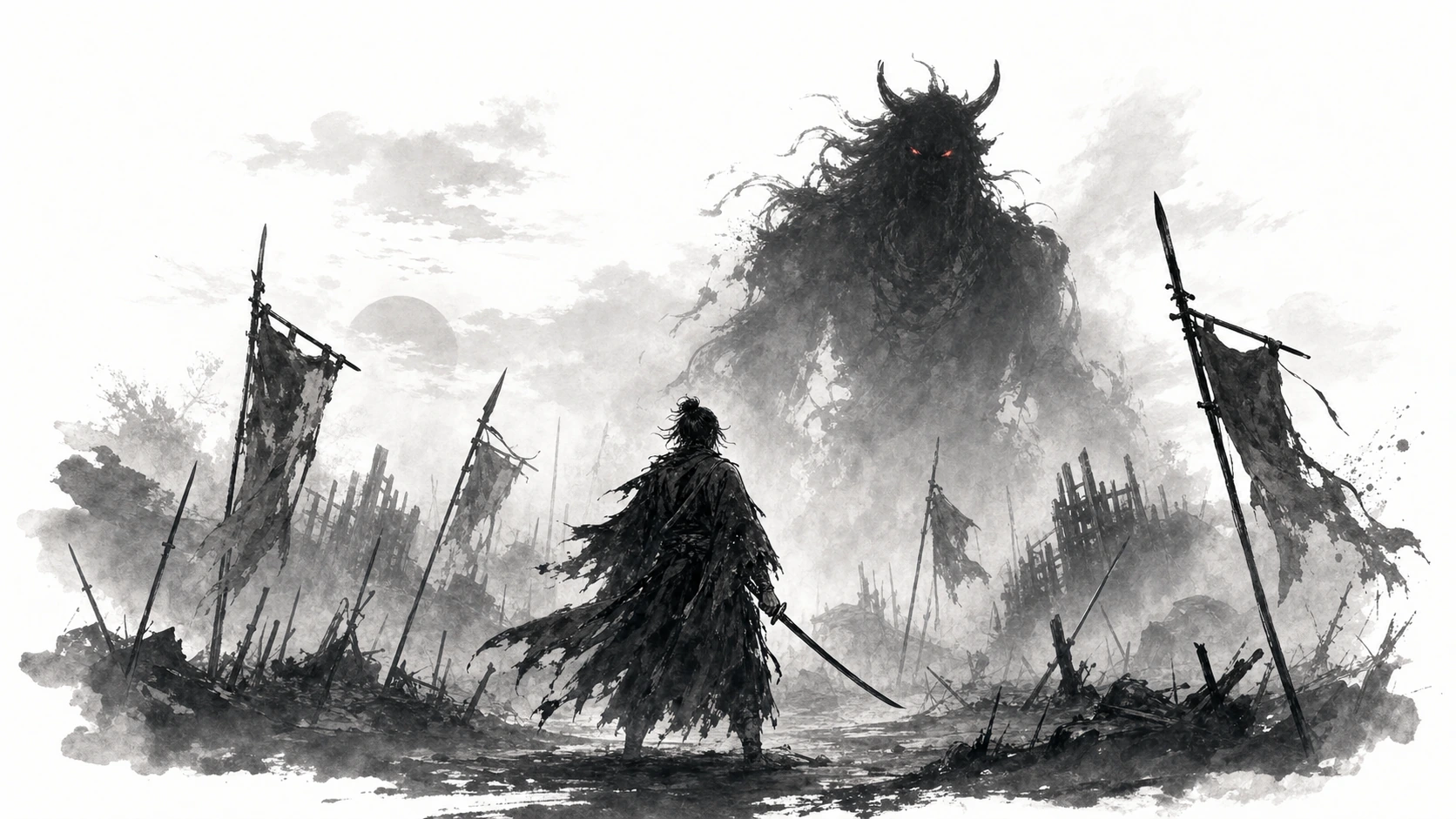
On a mist-wrapped battlefield, a warrior with drawn blade stands face to face with a red-eyed shadow. This is the world you will walk into. This chapter sums up that world on one sheet — in which age, alongside what, and staking what do you fight. The rules begin next chapter. Here, first, decide where your blade will turn.
#1. The Age — A Sengoku of Blades and Yoma
#The Warring Age
The age is Sengoku (戰國). The emperor's authority collapsed long ago, and the daimyo of every province spill blood over the realm. Ashigaru die in the front ranks, samurai charge the enemy general, and shinobi hunt heads in the shadows of night. The historical setting runs from the late Sengoku into Azuchi-Momoyama — the era of Oda Nobunaga, Toyotomi Hideyoshi, and Tokugawa Ieyasu. The level of technology is katana, yari, bow, and teppo; armor is tosei gusoku (當世具足); castles are of stone. There is a class order of warrior, farmer, artisan, and merchant; monks are a separate class, and shinobi are an unofficial force.
Only one thing differs from history — yoma are real.
#The Gate of the Spirit Realm Opens
When the blood of war soaks into the earth, the gate of the Spirit Realm (靈界) opens. The Spirit Realm is a spiritual world overlaid on the human one. In ordinary times it is unseen, but where war, death, and rage concentrate, the gate opens. Through that gap oni (鬼) come down from the mountains, tengu (天狗) watch from the sky, and the grudge of the fallen becomes onryo (怨靈) wandering the field. Hungry gaki (餓鬼) gnaw at corpses, and yoko (妖狐) take human shape to weave between the camps.
The yoma of this world are not "what humans cannot understand" but "what humans know all too well." Jealousy, grudge, greed, wrath — the dark emotions of humankind given form are yoma. And so cutting down a yoma is only a stopgap. If the root of the emotion remains, it rises again. True resolution is to release the grudge, or seal it, or purify it — and the warrior of the Sengoku knows nothing but the blade. So the daimyo hires an onmyoji (陰陽師), commissions Exorcism from an esoteric monk (密教僧), and soothes the soldiers' fear with the prayers of a Pure Land Monk (淨土僧). Combat does not end with the blade alone. Strike down with the blade, seal with a sutra passage, purify with onmyo arts — warrior, monk, and onmyoji must join their strength.
The Spirit Realm does not loose yoma alone. The Spirit Realm is a place where the flow of time differs — a dimension where the human world's past, present, and future exist at once. The moment its gate opened, weapons carried back across the ages began to flow out. Realm Wandering Relics (靈界鬼物) — a blade a future master swordsmith will forge is placed, before it is even made, into the hand of a samurai of this age. The details of this existence are in the weapon materials of the core rulebook.
#The Nanban and Gunpowder
The outlanders who crossed over from the Nanban (南蠻) brought a new power called gunpowder. The teppo (鐵砲) pierces even an oni's hide, and the cannon topples castle walls. Some daimyo take up this foreign technology eagerly; some hold to tradition and reject it. What the outlanders brought was not the teppo alone — the word of Deus (天主), that is, the Kirishitan (切支丹) faith, came with it. The notion of a "single god" was revolutionary in this land where eight million kami and countless buddhas coexisted, and some felt kinship with it while some raged.
#The Scale of This Game
The scale of this game is not the grand pitched battle but the tactical engagement of a small unit. Lord-grade PCs, 2–4 of them, with a few squads face a swarm of yoma or an enemy unit. (Lord-grade is the top of the unit-grade ladder — your PCs stand right there. You learn the grades in Chapter 3.) The typical scenarios are yoma subjugation, castle siege, wagon escort, assassination interception, Barrier defense, and Spirit-Realm incursion. Combat is not one hero dominating the field alone — the samurai holds the front rank, the ashigaru keeps formation with the spear, and the archers pour down rain from behind. The hero is strong, but without soldiers the field cannot be held.
#Where You Stand
The player stands at the heart of this chaos. A commander under a daimyo's order, a ronin who lost his lord, an exorcist monk of a mountain temple, a teppo user come from a foreign land, a shinobi ranging the field — you can be anything. Lead a handful of elites to subjugate yoma, topple an enemy daimyo, or wield the power of yoma to seize the realm. The enemy of humankind is yoma and, at the same time, human. In that space between, you must make a choice. Follow the lord's order, or follow your own conviction. Cut the yoma down, or understand it. Protect your comrades, or complete the mission. Those choices, gathered together, become the story of your character.
Source: co-02-01 setting · co-02-06 timeline · co-01-02 what Konsei Reiyotan is
#2. The Three Ways and Six Hearts — Where Your Blade Turns
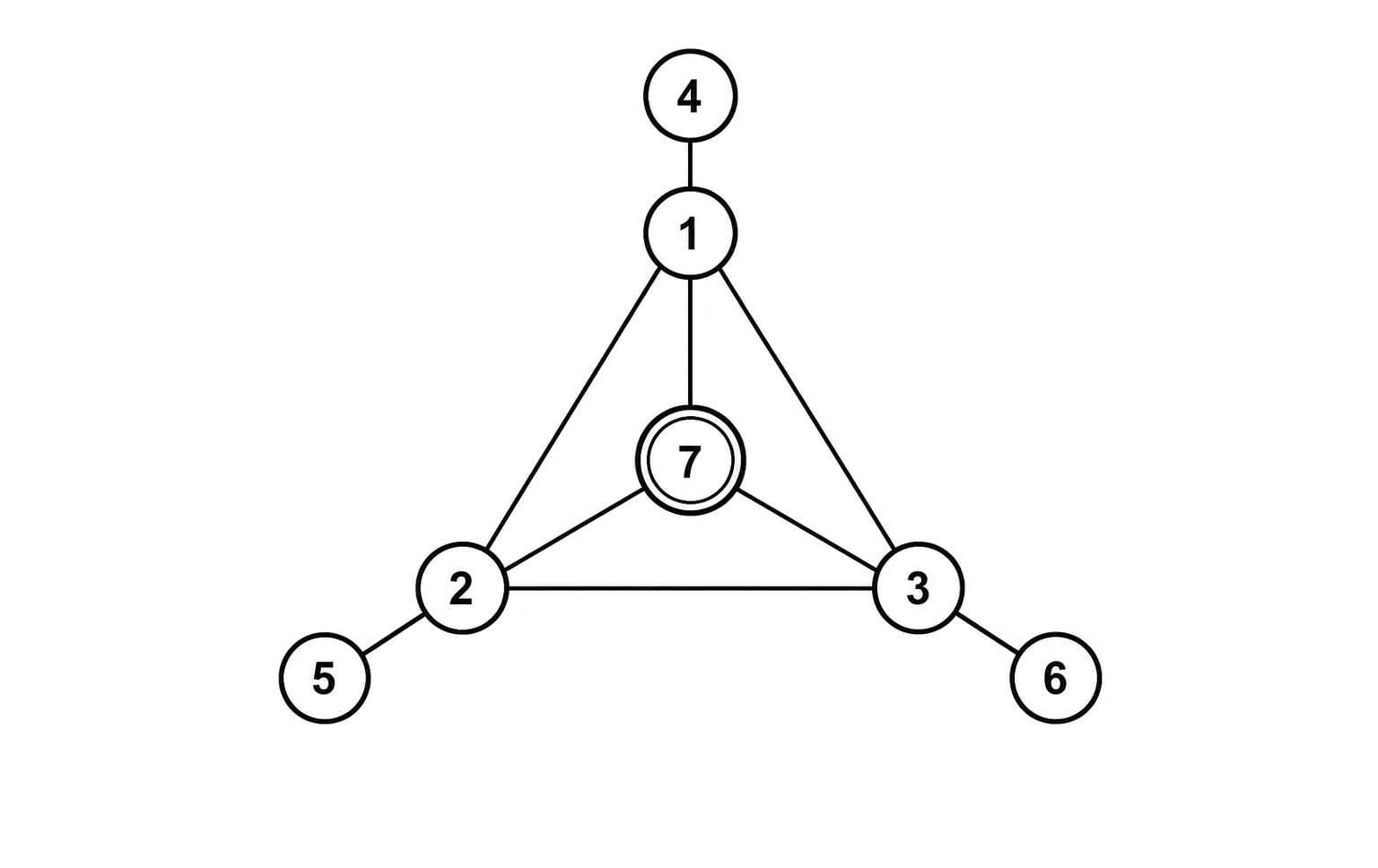
| Number | Meaning |
|---|---|
| 1 | Truth |
| 2 | Compassion |
| 3 | Loyalty |
| 4 | Demon |
| 5 | Void |
| 6 | Hegemony |
| 7 | No Heart |
The 9 alignments of D&D are not used. A being of this world stands on the path of one of the Three Ways (三道) — Confucian (儒), Buddhist (佛), Immortalist (仙) — and the bright face (明) and dark face (暗) of that path decide the direction of the heart. The Three Ways and Six Hearts is not a value that "diminishes" but a direction that "turns." To turn from Loyalty (忠) to Hegemony (覇) is not to become a bad person but to walk a different path. Which is right cannot be known until the story ends.
When you make a character, you choose one Way (道) and one Heart (心) of that Way. A 1st-dan character usually begins with a Bright Heart (明心), and a Dark Heart (暗心) is chosen with the GM's permission. The Heart is not a mechanical constraint but a narrative tool — it does not limit your actions but answers why you take up the blade.
#The Three Ways (三道)
| Way (道) | Root | Core Value | The Question It Asks |
|---|---|---|---|
| Way of Rites (禮道) | Confucian (儒) — Confucianism/Bushido | Order, loyalty and duty, human ethics, propriety | "What is the way of a human being?" |
| Way of Emptiness (空道) | Buddhist (佛) — Buddhism | Compassion, karma, emptiness (空), liberation | "Why does suffering exist, and how does it end?" |
| Way of Mystery (玄道) | Immortalist (仙) — Taoism/Shinto | Nature, harmony, the divine spirits, non-action | "Is the world complete as it is?" |
Each Way has a bright face (Bright Heart) and a dark face (Dark Heart). When Loyalty (忠) reaches its extreme it becomes Hegemony (覇); when Compassion (慈) reaches its extreme it becomes Void (虛); when Truth (眞) reaches its extreme it becomes Demon (魔). Bright heart and dark heart are a hair's breadth apart.
#The Six Hearts (六心)
Bright Heart of the Way of Rites — Loyalty (忠, Loyalty) The heart that takes up the blade for the lord, for the house, for the realm. It believes that to serve something greater than oneself is the way of a human being. The heart of Loyalty guards order — it keeps its promises, repays obligation, honors rank, and on the field stands first and withdraws last. Fitting classes are samurai, Pure Land Monk, scholar. A moment of conflict: "Must one obey even when the lord's order is wrong?"
Dark Heart of the Way of Rites — Hegemony (覇, Hegemony) The heart in which the conviction "my order is right" has changed into "all things must be under my order." The great cause of uniting the realm into one, the purification of burning away heresy, the resolve to burn a village "for the greater good." The heart of Hegemony forces order — those who do not submit are enemies, and on the road of hegemony there is no compassion. The turn from Loyalty to Hegemony happens when one harms the innocent "for the great cause," when one forces one's own order upon others.
Bright Heart of the Way of Emptiness — Compassion (慈, Compassion) All beings suffer — the enemy, the yoma, even lesser yoma. The heart of Compassion takes up the blade yet does not hate; it strikes the enemy down yet chants the sutra. It fights to prevent more suffering, not because it hates the enemy. Whether one can extend compassion even to a yoma is the trial of this heart. Fitting classes are Pure Land Monk, entertainer, esoteric monk (the compassion side). A moment of conflict: "If I do not kill this yoma the village dies. Yet this yoma too is suffering."
Dark Heart of the Way of Emptiness — Void (虛, Void) The heart in which the awakening "all is suffering" has fallen into "then nothing has meaning." When the one you love dies, the village you meant to protect burns, and the yoma you meant to save kills a human in the end, compassion collapses into the Void. The heart of Void is emptiness — it seeks to protect nothing, and at times, "to end all suffering," it seeks to end the world itself. The turn from Compassion to Void happens in the despair of when all one meant to protect has crumbled, when compassion goes unrewarded.
Bright Heart of the Way of Mystery — Truth (眞, Truth) The world is complete as it is. Human and yoma alike are part of nature, and the order of the kami (神) is older and broader than the order humans made. The heart of Truth seeks harmony — it does not deem the coexistence of human and yoma impossible, and it sees that even the opening of the Spirit Realm's gate may be the world seeking a new balance. Fitting classes are wildlander, feng shui master, arahitogami, onmyoji (the coexistence side). A moment of conflict: "If I seal this yoma the mountain's kamuy rages. Yet if I do not seal it the village is in danger."
Dark Heart of the Way of Mystery — Demon (魔, Demon) The heart in which "as it is" has become "the strong prey on the weak." The strong devour and the weak are devoured, that is the law of nature — human morality and compassion are not in nature. The heart of Demon is instinct. Power is law, and it does not restrain desire. When a hanyo casts off its humanity and becomes a great yoma, when a wildlander denies civilization itself, that is this heart. The turn from Truth to Demon happens when the view shifts from "nature is beautiful" to "nature is cruel," when one is intoxicated by the power of yoma.
#No Heart (無心, No Heart)
A state inclined toward no Way. It has neither side nor conviction. A wanderer, a merchant, or one who has lost direction. Not an object of blame but simply one who has not yet found the path. Losing conviction, one may fall from any Way into No Heart, and finding a new Way out of No Heart becomes a great turning point of a character's growth. Ronin, shinobi, gaijin, merchant, and the like often begin naturally from No Heart.
#The Heart Turns
The heart of a person is not fixed. Choices on the field, what is lost, what is protected, betrayal and obligation — all of these push the heart toward the bright side or the dark side. A turn within the same Way (Bright ⇌ Dark) is natural, but to change the Way itself (Rites ⇌ Emptiness ⇌ Mystery) requires a life-changing event, such as a lord's betrayal or the loss of everything. The turn is judged by the GM and happens when there is narrative conviction. Kirishitan are treated as the Way of the Lord (天主道), a system of their own outside the Three Ways — the Bright Heart is Faith (信), the Dark Heart is Madness (狂). The details are in the faith materials of the core rulebook.
Source: co-02-02 Three Ways and Six Hearts · co-02-08 faith of the Sengoku §Kirishitan
#3. An Overview of the Factions — Who Contends for the Sengoku
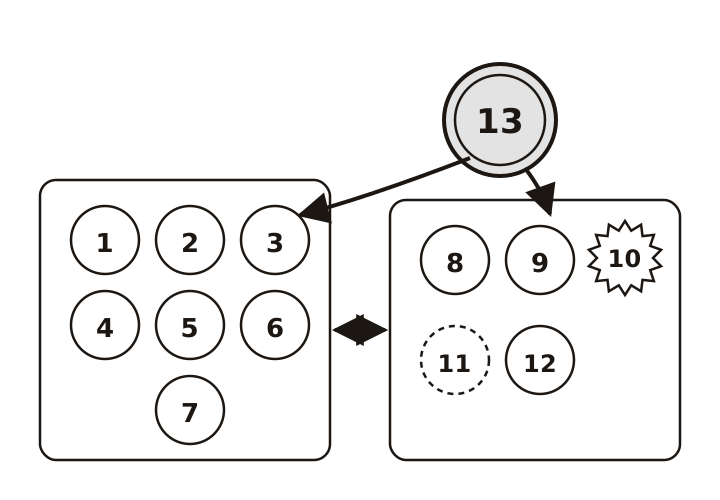
| Number | Meaning |
|---|---|
| 1-7 | 7 human factions (in table order) |
| 8-12 | Yoma factions (in table order) |
| 13 | Throne of the Spirit Realm — the sixth on the yoma side and the common enemy (double circle) |
| 10 | Hannya Altar — hostile to all (sawtooth border) |
| 11 | Muhyeon Band — neutral to all (dashed border) |
In the Sengoku, seven human and six yoma, thirteen factions in all, are entangled. Today's enemy becomes tomorrow's ally, and the true enemy seeks to swallow the world itself. Each faction has its own leader, philosophy, and unit types, and every unit belonging to a faction shares a faction trait (an [aptitude] passive property) by which that faction's philosophy manifests on the field. Below are the names and a one-line note — when you grow curious about the leaders, faction traits, unique unit types, and relations, open the faction map of the core rulebook.
#Human Factions
| Faction | Heart (心)/Way (道) | One Line |
|---|---|---|
| Kagura Domain (神樂藩) | Hegemony / Way of Rites | The strongest military force of the Sengoku. It expands its territory under the banner of yoma subjugation. Loyalty on the surface, Hegemony beneath. |
| Hiei League (比叡連) | Loyalty → Hegemony / Way of Emptiness | The temple league of Mount Hiei. Aiming at the complete sealing of yoma, a purism that refuses any compromise. |
| Sakai Guild (堺座) | No Heart / — | The merchant league of the port city of Sakai. It sells arms to both camps and deals in secret even with yoko. |
| Fuma Band (風魔衆) | No Heart or Demon / Way of Mystery | The shinobi group of Kanto. It serves no lord and takes only the "interesting" highest-bidding commission. |
| Ikko-ikki (一向一揆) | Compassion / Way of Emptiness | The uprising force of farmers and common folk. A wave that chants "Namu Amida Butsu" and does not fear death. |
| Kunitomo Guild (國友座) | Truth / Way of Mystery | The teppo and karakuri artisan group of Omi. "The blade cannot beat yoma. Technology alone is the answer." |
| Enryokan (遠慮館) | Truth / Way of Mystery | The forbidden academy that studies the coexistence of yoma and human. Its force of arms is feeble, but its knowledge of yoma is the finest of the Sengoku. |
#Yoma Factions
| Faction | Heart (心)/Way (道) | One Line |
|---|---|---|
| Shuten Mountain (酒天山) | Demon / Way of Mystery | The mountain fortress ruled by the oni king Shuten-doji. A civilized savagery that makes humans the "relish" of its feasts. |
| Biu Mountain (尾羽山) | Demon/No Heart / Way of Mystery | The secret court of the yoko. It does not kill humans but uses them — its weapon is not violence but deceit. |
| Hannya Altar (般若祭壇) | Void / Way of Emptiness | A collective consciousness where the grudge of the fallen has congealed. The longer war continues, the stronger it grows. |
| Muhyeon Band (霧幻衆) | Loyalty / Way of Rites | The council of the tengu. Not hostile to humans, but it judges the arrogant. Neutral by default. |
| Ibuki Garden (伊吹園) | Demon / Way of Mystery | The domain of the kumo (giant spiders) deep within Mount Ibuki. It does not kill humans but "collects" them with spider silk. |
| Throne of the Spirit Realm (靈界の王座) | Outside the Three Ways / — | The will of the Spirit Realm itself. It seeks to break down the boundary of the two worlds. The common enemy of all factions. |
Human factions feud with one another, and yoma factions with one another too. The Muhyeon Band is neutral to all, the Hannya Altar is hostile to all, and the Throne of the Spirit Realm is the common enemy of human and yoma alike. Relations, encounter packages, and unit-type stats are in the faction map of the core rulebook.
Source: co-02-03 faction map
#4. The Scent (香) — One Way to Read It
Each entry in this book and in the core rulebook mostly begins with a Scent (香). The Scent is a short introduction that paints the mood, scene, and smell of that entry — not a rule, but the air of the place where the rule sits. After the Scent comes the Law (法). The Law is the numbers, checks, costs, and conditions — the rules you actually roll. In the yoma bestiary, the Scent paints the sound and smell heard first as that yoma approaches and the form that dawns on the eye, and the Law records Wounds, Defense, and techniques. In each Heart (心) of alignment too, the Scent paints the reason that heart takes up the blade, and the Law records the fitting classes and the turn triggers. You can skip the Scent and the rules still roll, but if you read the Scent you come to see why the rule was made the way it was. When you read this book, read the Scent for mood and the Law precisely — divide your reading that way.
Source: co-02-02·co-02-03 and the like — the Scent/Law composition convention of every CO entry
#Summary
- The Age: a Sengoku where yoma are real. The gate of the Spirit Realm opens, and oni, tengu, onryo, gaki, and yoko are born from the dark emotions of humankind. Yoma do not end with cutting; sealing and purification are needed. The scale is the tactical engagement of a small unit (Lord-grade PCs 2–4 + a few squads).
- The Three Ways and Six Hearts: Way of Rites (Loyalty/Hegemony), Way of Emptiness (Compassion/Void), Way of Mystery (Truth/Demon), and No Heart. The replacement for D&D's 9 alignments. Not a diminishing value but a turning direction. At character creation choose 1 Way + 1 Heart, and 1st dan usually begins with a Bright Heart.
- The Factions: 7 human (Kagura Domain · Hiei League · Sakai Guild · Fuma Band · Ikko-ikki · Kunitomo Guild · Enryokan) + 6 yoma (Shuten Mountain · Biu Mountain · Hannya Altar · Muhyeon Band · Ibuki Garden · Throne of the Spirit Realm) = 13. For details, the CO faction map.
- Scent/Law: each entry opens with the Scent (a mood introduction) and continues with the Law (the rules). Read the Scent for mood and the Law precisely.