#Rite and Reason — Why the Blade Is Drawn
Contents
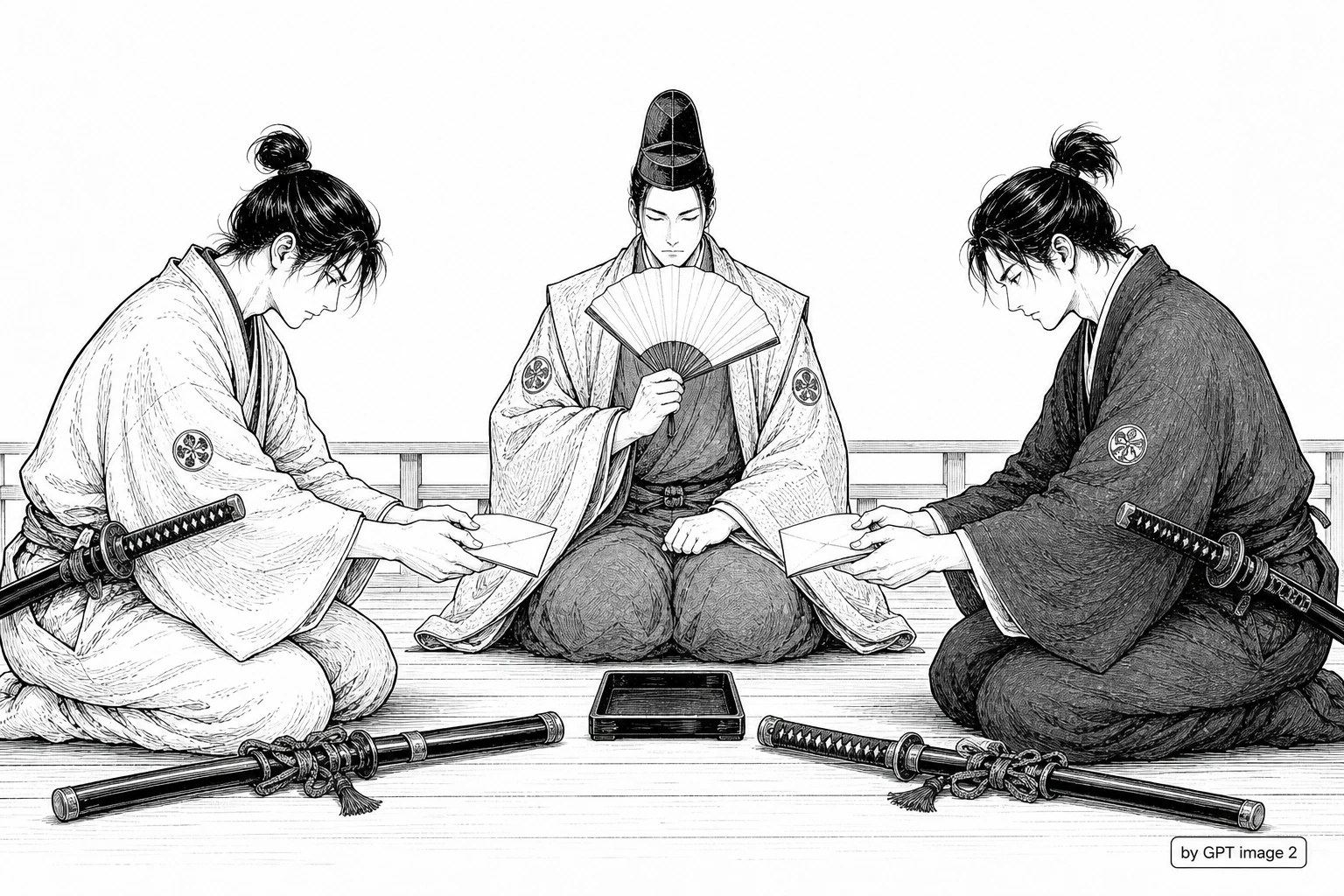
This document belongs to the front. The duel's rules are in
02; here we cover why that blade is drawn and how it is settled. Read it once before rolling the rules, and a duel becomes not a mere clash of numbers but a single story.
#Commentary — Why the Blade Is Drawn
A duel always has a reason. That reason sets both the weight and rules of the duel (sparring match or live blade) and the aftermath.
| Reason | Kanji | Character | Usual Form |
|---|---|---|---|
| honor / insult | 名譽 | recovers lost face by the blade | shinken shobu (life-or-death duel) or gozen jiai |
| vengeance | 仇討ち | strikes down the enemy of a slain family or lord (domain permission required) | shinken shobu |
| dojo yaburi | 道場破り | enters another's dojo and wagers the signboard | sparring match or shinken shobu (by agreement) |
| gozen jiai | 御前試合 | tests skill before a lord and an audience | sparring match (sundome) as a rule, sometimes lethal |
| gekokujo trial | 下剋上 | proof of skill with one's station at stake | shinken shobu |
| private grudge | 私怨 | money, a woman, an old debt | from an unagreed Surprise Attack to a formal duel |
The most dangerous misunderstanding. One side believes it is a sundome (寸止め, stopping just short of contact) sparring match, but the opponent draws a live blade — and that ground becomes a tragedy. Prior agreement on whether it is a sparring match or a shinken shobu is the first step of duel ritual (
02Two Modes,03).
#Commentary — The Ritual Before the Blade Is Drawn
A formal duel is already half underway before the blade is drawn.
- hatashijo (果たし状) — the letter of challenge that asks for a duel. The date, place, time, weapon, and whether it is to the death are written and sent. It is settled once received and answered. Ignoring or fleeing is in itself a defeat and a disgrace.
- second (立会人) — the witness-cum-referee each side raises. They judge fouls, declare the bout, and testify afterward. A duel without a second can be read as "private murder."
- place and time — riversides, islands, shrine grounds, and dojos are common. Arriving late to shake the opponent's composure (
03Ganryujima) is already part of the contest. - greeting and nanori (名乗り) — the formal self-introduction declaring name, school, and lineage. Before the lord, this one point of etiquette can sway regard.
#Scent — Witnessed: A Two-Line Hatashijo
Editor's note: a single duel letter kept by an old second.
The paper held only two lines. "Tomorrow at the Rabbit hour (卯時), I request to meet you on the riverside sandbar. Live blade (眞劍)." Below it, a name of three characters.
"It is these two characters, 'live blade,' that are terrifying." The old man folded the duel letter again. "Without these two characters, one of the two would still be alive today. They would have crossed wooden swords once, shared a single cup of wine, and parted ways." He was silent for a while. "Half of a duel is decided not by the blade but on this paper. What is to be wagered — one's face, or one's life. The moment that is written down, the blade is already half drawn."
#Commentary — After the Blade Is Sheathed: The Aftermath
A duel does not end just because one side has fallen.
- inquest and disposal — the second's inquest, the recovery of the body. The legality of the shinken shobu (whether a hatashijo and a second existed) is determined here.
- the domain's (藩) judgment — in a domain that has banned private duels, even the victor may be punished. Only a gozen jiai is safe. (The closer to Edo, the stricter the ban on private fights — ex3.)
- the katakiuchi chain — if the dead person has a family, that grudge is inherited. Today's victor becomes tomorrow's target. A single duel becomes a scenario across two generations.
- dojo and reputation — winning a dojo yaburi gains the signboard; losing it loses the disciples. The victor is followed by a Renown Title; the one who wins by cowardice, by disgrace.
- the name that remains — sometimes the loser is remembered longer. So it is with Kojiro (
03, fc03) — "the name that losing left behind."
These aftermaths are the very seed of the next scenario. A single duel is not a campaign's full stop but its comma.
#Scent — One Sentence
"The blade is drawn in a single breath, but the bond that blade has cut runs two generations."