#IF-C: When the Sun Rises Again — Imperial Divine Might (神威) and the Theocracy of the Three Houses (三家)
Contents
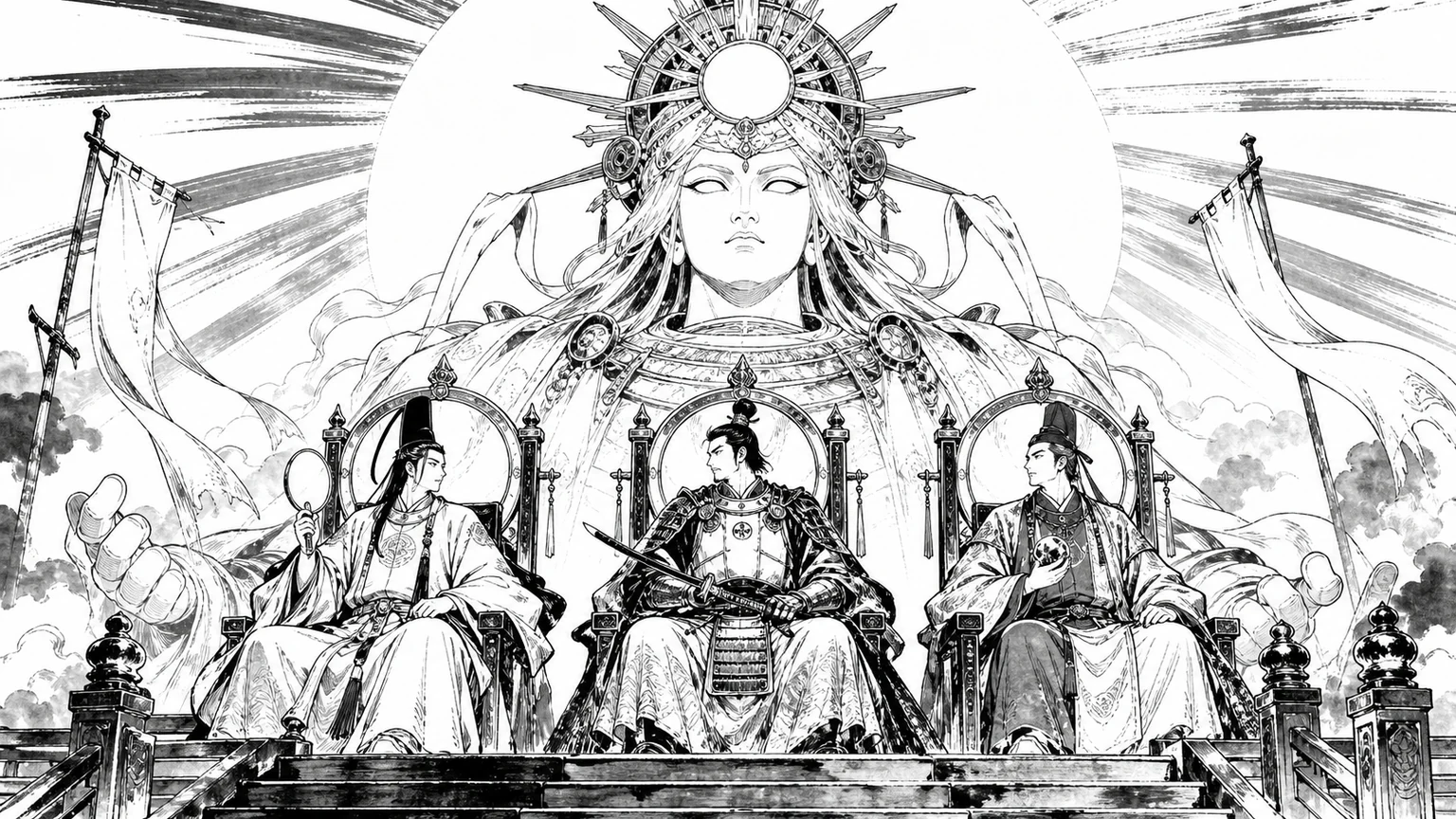
This document belongs to the front. There are no new rules and no new numbers — what is treated here is only the narrative of the IF-C worldline. For the canonical facts of the factions, figures, and events that appear — the Three Sacred Treasures, arahitogami, Amaterasu, Kagura Domain, Konryu, Enma-doji, and the rest —
co-02-03,co-02-06,co-02-08, andex3take precedence, and this document lays only fiction on top of them. The stats and rules of the Legendary Godframe "Amaterasu-no-Kaishin (天照之改神)" are not reprinted here; they are referenced only by link tozn13-08. Adoption follows the opt-in Variant principle ofco-99-01, and wherever facts conflict, canonicalcoalways takes precedence.
#Brief — The Return of the God (回神) and the Kaishin (改神): the Event and Its Embodiment as Arms
The two words split off from the same name, yet they are not the same thing.
The Return of the God (回神, new) is the event in which Amaterasu's (天照) divine might returns to the politics of the present world. It joins that old promise of the myth of the Heavenly Rock Cave (天岩戸) — that even when the sun hides behind the rock door it must surely come back, that the light once concealed will shine upon the world again. The Return of the God is neither relic nor weapon. It is a single moment in which scattered divine might comes back into the heart of politics, and from that moment the legitimacy of the realm shifts from the buke's sword to the light of imperial power.
The Kaishin (改神, canon) is that return given a body. It is a giant embodied with the Three Sacred Treasures for its heart — that is, zn13's Legendary Godframe "Amaterasu-no-Kaishin." Sword and jewel and mirror settle within a single vast form, so that the returned divine might becomes an arms that walks the battlefield. What that frame can do, how it moves, and by what asymmetry the three treasures are bound together are not treated here — the stats and rules are in zn13-08, and this document speaks only of the politics and tragedy surrounding that giant.
One is an event, the other is the steel that event wears. The Return of the God must occur for the Kaishin to stand, and the Kaishin must stand for the world to believe the Return.
#Brief — Divergence and Development: Legitimacy Shifts to Imperial Power
In true history, what suppresses Konryu (混流) is the buke's wards and exorcism. The seal of the Hiei League, the sword of Kagura Domain, the cooperation of the three factions press the Gate to the Spirit Realm shut, crack and all. IF-C changes the subject of that sentence.
The court recovers the scattered Three Sacred Treasures. The sword at Atsuta, the jewel in its own place, the true mirror at Ise — it draws the three sacred objects, which slept apart in their several sanctuaries, into one place and calls down the Return of the God. Then what presses Konryu down is not the art of sealing but the majesty of the god itself. The power that closes the Gate changes from the buke's craft to the sanctity of imperial power, and the party that holds the legitimacy of unification passes from the buke to the imperial house. This is the exact mirror of IF-A — there the sword monopolizes the seal and covets the realm; here divine might absorbs the seal and reclaims it.
But the returned god cannot stand alone. Rule is the covenant of the Three Houses (三家, new).
- The Imperial House (new) holds the mirror — Yata-no-Kagami (八咫鏡) — and controls the giant, monopolizing "the right to call the Return of the God," that is, the Summoning Right. Alone among the Three Sacred Treasures, the mirror is not a divine treasure but ranks as a masterwork, and to achieve whole divine might one must draw out the true relic at Ise — which bears the weight of pawning the imperial line's legitimacy entire (→ see Table).
- The buke = Kagura Domain (神樂藩, canon) holds the sword and pilots the giant. The greatest martial force against the great yoma becomes, now, a single blade offered up beneath divine might.
- The kuge (new) hold the jewel — Yasakani-no-Magatama — and attune to the heart of the giant.
The Imperial House summons, the buke cuts, the kuge uphold. Only when the three hands are laid on together does the giant open its eyes. And that very structure is the curse of this worldline — if one estate lets go, the nation stops.
#Brief — The Fourfold Tragedy and the Seam
First, the concert of the three houses is itself the running of the state. The three must hold their treasures together for the giant to stand and divine might to be sustained. The withdrawal of one estate is not one hand slipping away but the halt of the entire nation. Rule rests upon the most fragile of conditions: the simultaneous cooperation of three houses.
Second, divine might is a function of belief. Majesty hangs on how many believe it to be a god. And so the theocracy inevitably tries to govern doubt — it slides into a terror that stops the doubting mouth and punishes the doubting heart. To guard divine might becomes to trample doubt.
Third, the cause of light rolls down into the darkness of theocracy. The pretext of driving out the darkness decides, in the name of divine might, just how far the darkness reaches. Hanyo and Kirishitan, wildlanders who withdrew to the mountains, commoners who doubt the god — human heresy is burned alongside Konryu. In the very world where the sun has risen again, those who stand where the light does not reach are burned as heretics.
Fourth, the moment a god is borrowed, it ceases to be a human dynasty. With the god's power comes the god's will. When politics borrows divine might, the price is subjection to the god's will. If IF-B is the world where "humans become the puppets of the yoma," IF-C is the world where "humans become the puppets of the god." The court, having borrowed its legitimacy from the god, can no longer run the nation by human will.
The seam. This worldline has seated the seed of its own collapse in the cockpit — the buke who holds the sword. If an ambitious Tokugawa lets go of the sword, the giant stops, and the three houses, one hand short, collapse. When the buke's sole shogunate fills that vacuum, the covenant of divine might recedes into symbol and the realm returns to a world administered by Tokugawa's martial force — that is, back to true history and EX3. The failure of IF-C therefore answers a single question: why did the emperor of Edo settle back into being a symbol rather than a living god once more. Because divine might was once borrowed for politics, and the price was too high.
#Commentary — One-Line Thesis
"The god who returned, three hands held together — only until one hand lets go."
The Return of the God is large enough to save the world, and because of that size it must be shared among three houses. Power held in shares is power only while together; the moment any one hand lets go, that very thing becomes a weapon that stops the nation. The glory and the catastrophe of IF-C come from the same three hands.
#Scent — Short Narrative: Sidelong Glances at the First Descent
There were three seats where the giant opened its eyes.
The Imperial House's proxy, seated at the mirror's seat, chanted the incantation of summoning, and before the words were done glanced sidelong at the sword's seat. Kagura Domain's pilot, seated at the sword's seat, gripped the hilt, and before that hand could tremble glanced sidelong at the jewel's seat. The kuge official, seated at the jewel's seat, laid his mind upon the heart, and before that beat could steady glanced sidelong at the mirror's seat.
The three did not trust one another. Untrusting, they made the giant walk together. The sun rose again — with the three of them never taking their eyes off one another.
#Table — Divergence · Development · Outcome
| Axis | IF-C narrative |
|---|---|
| Divergence point | Instead of the buke's seal, the court recovers the scattered Three Sacred Treasures and calls down the Return of the God (回神) — the party of legitimacy shifts from the buke to imperial power (the mirror of IF-A). |
| Development | The returned divine might suppresses Konryu. Rule becomes the covenant of the three houses (三家) — Imperial, warrior, courtier — and the three must hold their treasures together for the giant to stand and the nation to run. |
| The giant's body | "Amaterasu-no-Kaishin," the Three Sacred Treasures embodied for its heart (zn13-08, see the stat link). |
| Fourfold tragedy | ①Three-house concert = state running, the withdrawal of one hand = state paralysis ②divine might = a function of belief → a terror that punishes doubt ③the cause of light → the darkness of theocracy that burns human heresy (hanyo·Kirishitan·wildlanders·doubting commoners) ④the moment a god is borrowed, it ceases to be a human dynasty (the god's puppet). |
| Outcome (the seam) | When the buke Tokugawa lets go of the sword and the giant stops, the three houses collapse, and the buke's sole shogunate fills the vacuum, returning to true history·EX3. The answer to "why did the emperor of Edo become a symbol again." |
The three seats of the Three Sacred Treasures (no numbers, no rules):
| Seat | Sacred object | Estate (new allotment) | Role | Weight |
|---|---|---|---|---|
| Summon · control | Yata-no-Kagami (八咫鏡) — ranks as a masterwork, not a divine treasure | Imperial House (new) | Controls the giant and holds the Summoning Right to call the Return of the God | To draw out the true relic (Ise) and achieve whole divine might is a sacrilegious weight that wagers the imperial line's legitimacy entire. A replica alone leaves the giant's heart imperfect. |
| Pilot | Ame-no-Murakumo (天叢雲劍, the true relic at Atsuta) | The buke = Kagura Domain (神樂藩) | Pilots the giant and wields the sword | The greatest martial force against the great yoma is subordinated into a single blade offered up beneath divine might. Withdraw this sword and the giant stops (the wedge of the seam). |
| Heart attunement | Yasakani-no-Magatama (八尺瓊勾玉) | The kuge (new) | Attunes to the giant's heart and upholds divine might | It takes charge of divine might, ritual, and the treasures — yet with that same hand it must also write the roll of heretics. |
The mirror (Yata-no-Kagami) is grouped under the common name of the Three Sacred Treasures, yet it is not a divine treasure but ranks as a masterwork, and the true relic resides at Ise Grand Shrine. To achieve whole divine might one must draw that true relic out of its sanctuary, and that is not the moving of one sacred object but a sacrilegious gamble that throws the whole legitimacy of the imperial line onto the battlefield — this is narration that honors the zn13 canon by which "Amaterasu-no-Kaishin" was designed as an intended asymmetric trinity of "two divine treasures + one masterwork," and here that weight is borne only in story (no numbers, no rules).
#Note — The Three PC Lenses (Narrative Version)
To lead into it / to prevent it / after it has come to pass — all three are narrative, with no numbers. Scale is gauged only in the words of novice, adept, master, and campaign.
#To Lead Into This History
- (novice) Guard the shrines and palaces where the Three Sacred Treasures sleep — against grave-robbers, spies of the yoko (妖狐), and the arson of heretics. It is the work of keeping the court from losing its right to recover the treasures, and a night that saves one small shrine becomes the first brick of the Three-House compact.
- (seasoned) Bind Kagura Domain to the buke's seat — the sword. Hold Kagura Nobutsuna to loyalty, persuade him to offer the sword of the greatest martial force against the great yoma into the giant's cockpit, and escort that road. If IF-A sets Kagura up as the monopolist of the seal, here it subordinates it into a single blade beneath divine might.
- (master) Gather the true relics of the scattered Three Sacred Treasures into one place — the sword of Atsuta, the jewel of Yasakani, and the mirror of Ise. Drawing out the mirror of Ise in particular onto the battlefield makes the giant's heart whole, but it is a sacrilegious gamble that wagers the imperial line's legitimacy entire.
- (master) Have priests, shrine maidens, and the arahitogami (現人神) preside over the rite that calls down the Return of the God (回神). Press down the Gate to the Spirit Realm with the majesty of the god, and absorb into the court's single divine might the seal that once leaned, divided, on three factions.
- (campaign) Mediate the covenant of the three houses (三家) and set up the emperor as a living god. Bind the Imperial House (mirror · Summoning Right), the buke = Kagura (sword), and the kuge (jewel) into one covenant to fill the giant's three seats, and turn history toward a theocratic Edo.
#To Prevent This History
- (master · → block IF-C) Prevent the Three Sacred Treasures from gathering in one place. Bar the removal of the most fragile of them, the mirror of Ise, with your own body, or see that only a replica is recovered in place of the true relic, so the giant never attains whole divine might.
- (master · → also serves IF-B) Sever the Imperial House's Summoning Right (new). Turn back the infiltration of the yoko who covet the right to call the Return of the God, or win over or eliminate the qualified holder, and expose the spy network of Tamamo-no-Mae (玉藻前) planted deep in the court to taint the legitimacy of the summoning.
- (seasoned · → true history) Expose the darkness of the theocracy. Bring before public opinion the truth that the majesty of the god burns hanyo, Kirishitan, wildlanders, and doubting commoners as heretics — through the testimony of the Hundred-Tale Society and the entertainers who carry ghost stories.
- (campaign · → true history·EX3) Split the three houses so Tokugawa lets go of the sword. If the ambitious buke withdraws the blade from the cockpit, the giant stops. Seam the covenant of divine might into the buke's sole shogunate and return it to true history.
#After This History Has Come to Pass (Under the Three-House Theocracy)
- (campaign) One seated in one of the giant's three seats — Imperial (mirror) · warrior (sword) · courtier (jewel). Three who bear loyalty and doubt toward different houses must run one body for the nation to move, and my seat cannot trust the other two. Under the pressure that if one person lets go the nation stops, you weigh concert against withdrawal at every turn.
- (seasoned) A heretic hunted by divine might — hanyo · Kirishitan · wildlander · doubting commoner. Hiding and fleeing through a world that hunts in the god's name, you link the underground network of fellow heretics.
- (campaign) A buke choosing whether to keep holding the sword or let go. He stands between loyalty (offering the sword to divine might) and dominion (taking the sword back, breaking the three houses, and seizing the realm himself). The moment he lets go of the sword is both the collapse point of IF-C and the divergence into the shogunate's true history.
- (seasoned) The doubt of a divine-might bureaucrat. A kuge civil official who manages the treasures and the rites, yet must write with his own hand the names on the massacre roll. Case by case, he chooses whether to quietly alter the record and save one heretic, or keep to the discipline.