#Three Cities and the Five Highways
Contents
Fiction-Only + Scene Tool. Regional commentary and location operation guide.
#Scent — Rumors on the Road
Rumors in Edo do not ride horses. They spread slowly through a porter's shoulders, a roadside inn's meal, the river mist at the ferry dock, and the unfamiliar letters of Dejima. Cities and roads are the blood vessels that carry incidents, and yoma cling to the dark corners of those vessels.
#Law — Choosing the Stage
- When opening a scene, establish first the authority the location grants, who its witnesses are, and what its escape routes are.
- For city incidents, use rumors and status as the core pressure; for highway incidents, use checkpoints and movement restrictions.
- In zone combat, prioritize "who is blocking the road" and "what must pass through" over the physical size of the terrain.
#Scene Commentary — Place Sets the Genre
The same incident looks entirely different in Edo, Kyoto, Osaka, and Nagasaki. In Edo it is a matter of public order and censorship; in Kyoto it is a matter of old names and authority; in Osaka it is a matter of ledgers and logistics. In Nagasaki, outside eyes record the incident in an entirely different way.
Roads are the devices that connect these places. A highway is not merely a transit zone but a stage on which status verification, travel passes, checkpoints, inn rumors, and ferry transactions accumulate. In a long campaign, send the PCs down the same road repeatedly. A place that was an unremarkable teahouse on the first visit may be the Hundred-Tale Society's relay point by the third.
What to decide when choosing a location:
- Is it acceptable to openly bear arms here?
- Does rumor spread quickly, or do records get erased quickly?
- When an enemy flees, do they disappear into the road, the waterway, or the crowd?
#Session Application — Creating First Impressions by Location
- Opening scene: Edo starts with a checkpoint; Kyoto with an ancient name plaque; Osaka with a warehouse ledger; Nagasaki with an unfamiliar record.
- Complication: the same clue acquires a different meaning each time it moves to a new city. A ledger is money in Osaka, evidence in Edo, and an external report in Nagasaki.
- Final question: is this incident a secret of one place, or a secret that travels along the road?
#Locations Covered
- Edo: shogunate, public order, licensed quarter, theater, nagaya, bathhouse, waterways.
- Kyoto: imperial court, echoes of onmyodo, shrines and temples, ancient gates.
- Osaka: commerce, warehouses, transport, black market.
- Nagasaki / Dejima: outside witnesses, Dutch learning, foreign goods.
- Five Highways: processions, escort, checkpoints, bandits, yoma incidents.
#Geographic Grounding for First-Time Readers
Edo-period Japan was not a country connected by railroads and telegraphs as it is today. Travel was slow, checkpoints were many, and status and travel passes determined the road. So "where does the incident happen" is not mere background — it changes the nature of the incident.
The four axes to fix in mind first:
| Axis | What It Is | Scene Sensibility |
|---|---|---|
| Edo | The shogun's and shogunate's city | Public order, censorship, records, the eye of power |
| Kyoto | The emperor's and ancient authority's city | Ritual, onryo, shrines and temples, the lingering echo of the Heian era |
| Osaka | The city of rice, money, and warehouses | Merchant companies, logistics, black market, ledgers |
| Nagasaki | The restricted port that touches foreign lands | Dutch learning, interpreters, outside witnesses, forbidden goods |
What connects these four is the highway. Highways are not travel routes but instruments of governance. Post towns are lodgings and also surveillance points; checkpoints are public-order facilities and also the thresholds of stories. Ferry docks and bridges collect logistics, so rumors and smuggling flow together.
#Why the Three Cities Differ
Edo, Kyoto, and Osaka are all large cities but they do not serve the same role. Edo is the present of new power; Kyoto is the past of old authority; Osaka is the reality of making a living. Add Nagasaki and the outside world's gaze enters.
When selecting a city the GM asks the following first:
- Is this incident a matter of power? Then Edo.
- Is this incident a matter of an old name? Then Kyoto.
- Is this incident a matter of money and logistics? Then Osaka.
- Is this incident a matter of outside witnesses and forbidden knowledge? Then Nagasaki.
The same yoma artifact changes its meaning with the city. In Edo it is evidence that must be confiscated; in Kyoto it is a relic of an ancient rite; in Osaka it is a commodity with a price; in Nagasaki it is a monster specimen mistakenly catalogued by a foreigner.
#Edo
Edo is the shogunate's city. The shogun's castle, the residences of hatamoto and gokenin, the nagaya of the townspeople, licensed pleasure districts, rivers and canals, and countless bathhouses and theaters all overlap within a single city.
The strength of Edo scenarios is the sense of closeness. The center of power and the daily lives of the lower classes are near each other. A possession incident in an inner room of a mansion can become a bathhouse Kaidan the next day, and the storyteller who heard that story can spread the Hundred-Tale Society's words to the world.
When first drawing Edo, do not imagine just one vast castle — picture the concentric rings of daily life surrounding the castle. Warrior estates, merchant streets, nagaya, bridges, moats, canals, theaters, the licensed quarter, temples and shrines, and bathhouses are not far apart. High power and low rumor can reach each other within a single day.
Signature scene material for Edo:
| Location | What It Shows | Incident Seed |
|---|---|---|
| Around Edo Castle | Shogunate authority and inspection | A missing document; a possessed official |
| Nagaya | Townspeople's daily life and rumors | Residents who all dream the same dream |
| Nihonbashi | The start of the road and the checkpoint | A box that breathes; a travel pass that vanished |
| Yoshiwara | Licensed entertainment and surveillance | A yoma that steals a guest's name |
| Kabuki theater | Performance and censorship | Lines on stage that wake an onryo |
| Bathhouse | A public forum where status briefly loosens | A Nurarihyon who seems always to have been sitting there |
#Kyoto
Kyoto is the city of old names. It is not the political center of the Edo shogunate, but the imperial court, ancient shrines and temples, and the residue of onmyodo remain. The dim gate of the Heian era has not entirely disappeared even in Edo times, and Kyoto is the city that holds the most of those traces.
Kyoto incidents suit a structure where the past grips the present. Old onryo, abandoned rites, shrines that have changed names, and unspoken dealings between the court and the shogunate become the starting point of incidents.
Kyoto is not "a city grown old and weak." On the contrary, its age makes even the shogunate hesitant to handle it carelessly. The rituals of the court, the great temples, the old noble families, and the names of ancient onryo cannot be erased by Edo-style administrative documents alone. Here, yoma incidents tend to return in the form of "a name thought to be finished that is not finished yet."
Signature scene material for Kyoto:
- A seal extending from the Heian era is broken by Edo-style renovation work.
- An object used in court ritual whispers a different name each night.
- In temple records the person is dead; in shogunate records they are still alive.
- An old onmyo family cooperates with shogunate inspectors while telling them nothing complete.
#Osaka
Osaka is the city of money and warehouses. Rice, logistics, merchant companies, wholesalers, and transporters all move here, and among them flow yoma artifacts, forbidden famous blades, and sealed objects.
Osaka incidents suit the Edo-period successor organizations of the Sakai Guild, the Black-Tag Gang, merchant-company escort work, and the black market. Not only sword-bearers but merchants, craftsmen, scholars, and entertainers can stand at the center of an incident.
For readers new to the Edo-period economy, one point to remember: "rice is the language of money." A samurai's stipend is reckoned in rice; a domain's finances are shaken by rice production and market prices. Osaka is where that rice and logistics converge. So a single line of an Osaka ledger can shake an entire domain's honor.
Signature scene material for Osaka:
- A sealed object moves through a rice warehouse under a different cargo tag.
- A merchant company learns of a yoma incident but does not stop the transaction.
- The Black-Tag Gang takes a forbidden talisman as collateral in place of a gambling debt.
- The whereabouts of a missing famous blade are recorded in the ledger as "ten wet dishes."
#Nagasaki and Dejima
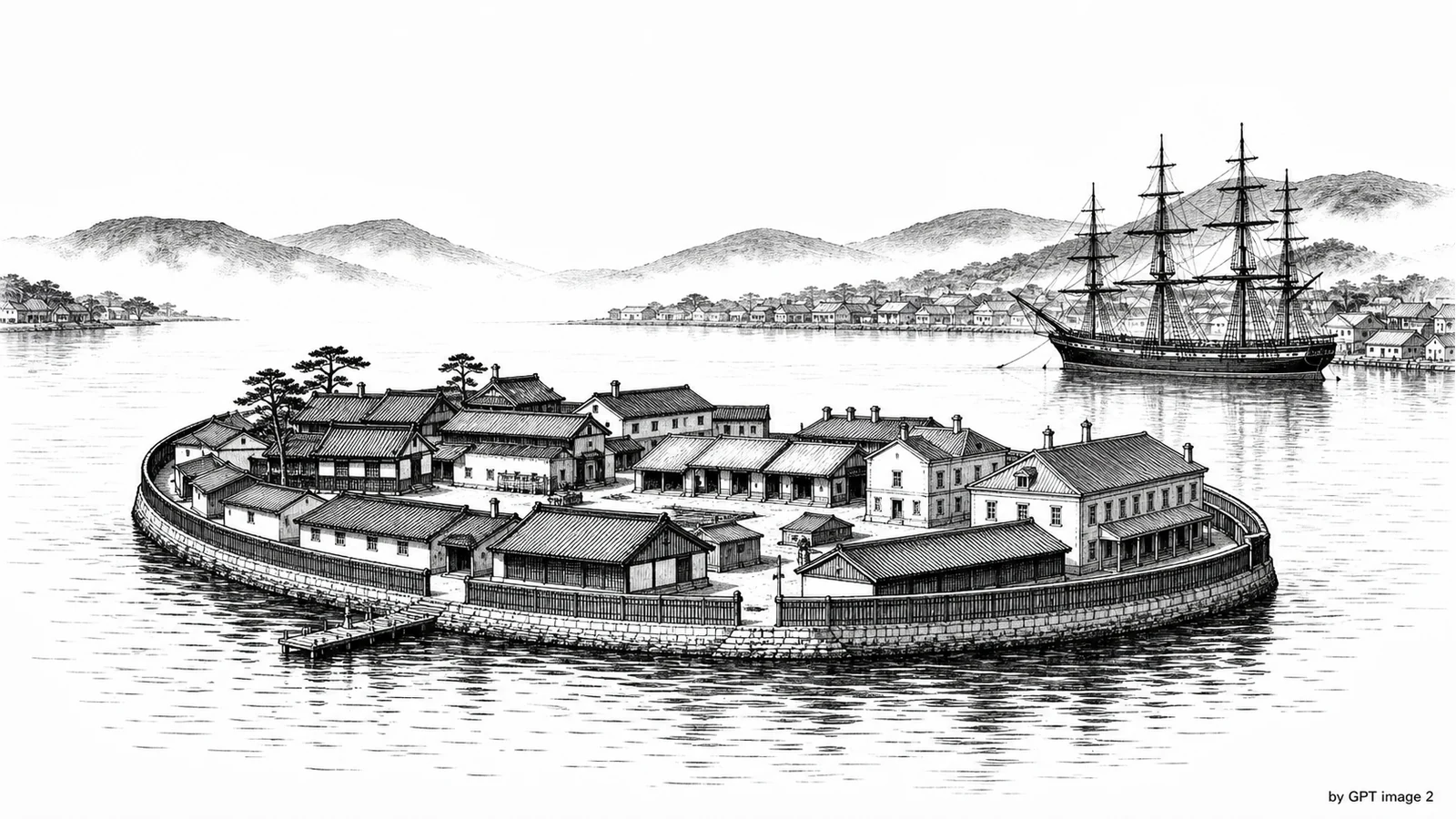
Nagasaki is the narrow gate to the outside world. Foreigners are on the margins of Edo society, but it is that marginality that sometimes lets them see things absent from the shogunate's documents. Dutch-learning scholars, interpreters, merchants, and foreign sailors can become inconvenient witnesses to yoma incidents.
Nagasaki incidents suit gaijin PCs. A foreign-language report that recorded a yoma, imported goods mistaken for Spirit Realm artifacts, and outside eyewitness accounts the shogunate wants suppressed are the material.
Dejima is not "an international city where foreigners come and go freely." It is a restricted contact point. That restriction produces more dramatic scenes. Objects and knowledge from the outside world enter, but who saw them, who translated them, and who confiscated the records is always the problem.
Signature scene material for Nagasaki:
- A foreign report misclassifies a yoma as an animal or a disease.
- A Dutch-learning scholar finds traces of Spirit Realm encroachment in forbidden anatomical records.
- An interpreter translates the same words with two different meanings to conceal an incident.
- An object that appeared to be an import is actually the packaging of a Realm Wandering Relic.
#The Five Highways
Highways are the blood vessels of an Edo campaign. Sankin-kotai, processions, smuggling, dojo pilgrimages, revenge journeys, temple pilgrimages, and yoma rumors all move along roads.
Highway combat is designed around narrow bridges, mountain paths, checkpoints, post towns, and ferry docks. co's zone combat fits this stage well. What matters is not the size of the map but who is blocking the road and who must pass through.
The Five Highways are best understood as the name for the major roads spreading from Edo to the provinces. The representative ones are the Tokaido, Nakasendo, Koshu Kaido, Oshu Kaido, and Nikko Kaido. There is no need to memorize all historical details. For play, deciding "what travels along this road" for each highway is enough.
| Road Type | Fitting Incidents |
|---|---|
| Coastal road | Harbors, storms, smuggling, a vanished procession |
| Mountain path | Mountain temple, tengu, abandoned village, bandits, a sealed mountain pass |
| Shogun's pilgrimage road | Official procession, checkpoint, disguised identities |
| Merchant company road | Cargo tags, warehouses, hired escorts, ledger manipulation |
| Pilgrimage road | Temples, funerals, onryo, a traveler hiding their identity |
A highway is a device for changing location and simultaneously a device for showing the same incident again from a new angle. An incident that seemed like a simple disappearance at the first post town may be linked by a black tag bearing the same crest at the third.
"The roads of Edo carry people; rumors arrive before the people do."