#The 5 Divinity Ranks — Lesser, Minor, Middle, Great, Imperial
Contents
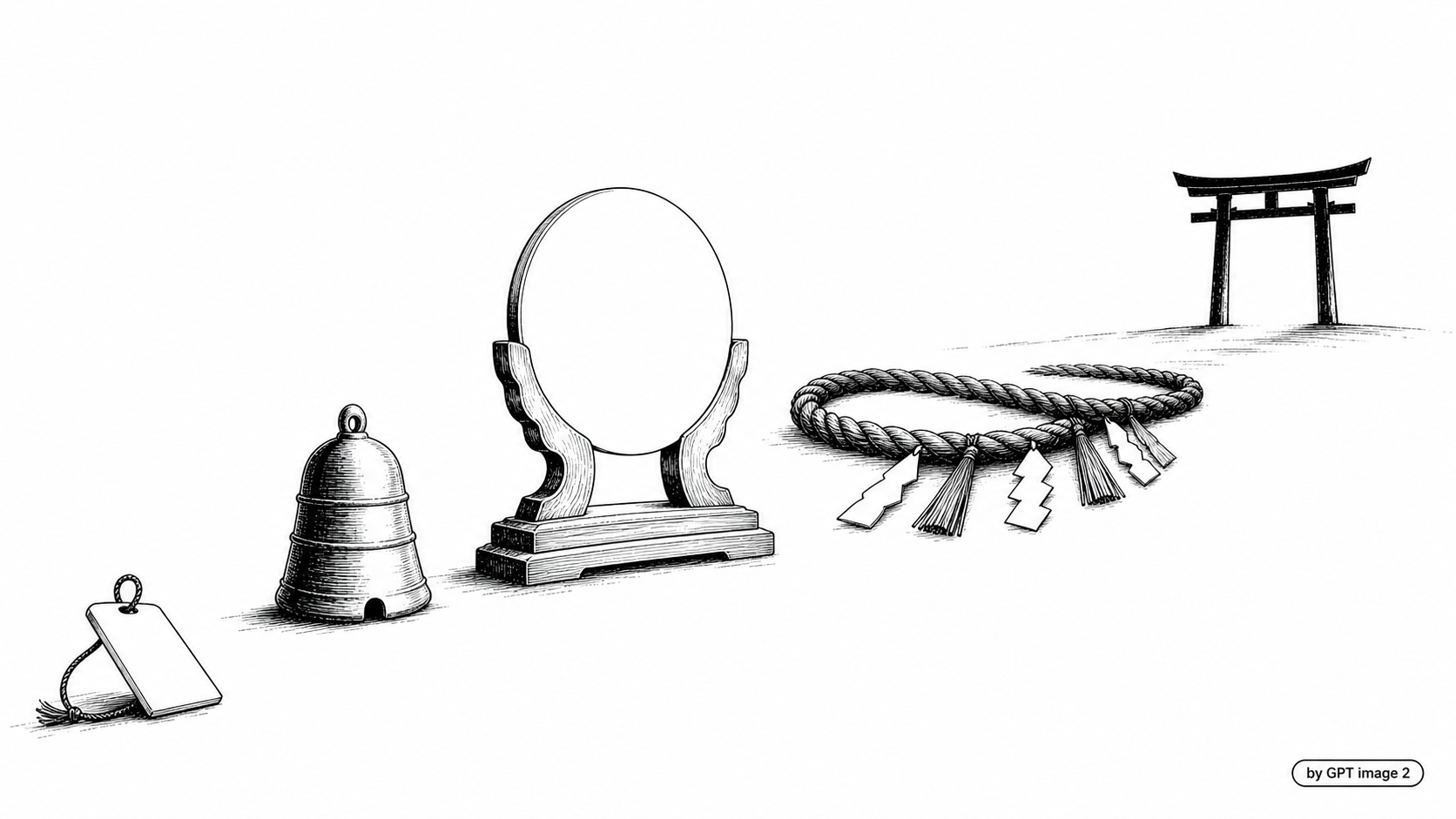
Canon — fc01 Divinity ranks. Every god is assigned to one of these 5 ranks. No being crosses between ranks — ascent and descent are narrative events, not checks.
#Scent — Five Roofs
The gods of Japan are beneath a roof. The palm-sized little shrine pasted to a kitchen pillar has a roof, and the deep inner sanctum of Ise Grand Shrine has a roof. A small roof covers one room; a great roof covers one country. The size of that roof is the size of the god.
The small breath exhaled within a single breath is the kitchen god; the cloud covering an entire mountain is a Great God; the sunlight spanning the whole sky is an Imperial God. Because their sizes differ, what can be expected of them differs too. One who asks a kitchen god about war has already knocked on the wrong door.
The principle of the five roofs — "Lesser is the seat, Minor is the village, Middle is the province, Great is the country, Imperial is the origin."
#Law — The 5-Rank Table
| Divinity | Name | Kanji | Domains | Archetype | Return Cycle |
|---|---|---|---|---|---|
| 1 | Lesser God | 微神 | 0–1 | kitchen god · gate god · dosojin | daily (日) cycle |
| 2 | Minor God | 小神 | 1–2 | village ujigami · main god of a small mountain | day–week |
| 3 | Middle God | 中神 | 2–3 | a province's great river · main god of a famous shrine | week–month |
| 4 | Great God | 大神 | 3–4 | nation-class · main god of a domain | season |
| 5 | Imperial God | 皇神 | 4–5 | origin · creation · guardian of the imperial house | year (年) |
The "domain count" is a ceiling. A Great God (Divinity 4) may hold only 1 domain — it simply cannot exceed 4. A narrow Great God exists.
#Divinity 1 — Lesser God (微神)
#Scent
A god that lingers only in this room. This stone, this tree, this kitchen hearth. Gods who have never left the house and never will.
A size satisfied by a single cup of water set out in the morning. Even when it has a name, it is rarely called, and even nameless, its absence shows no sign. Yet for as long as it is present, no impurity can dwell in that narrow seat.
"People build the house; the god guards the roof." — folk proverb
#Law
- Divinity: 1
- Domains: 0–1 (may be none. Even if present, extremely narrow: "the fire of this kitchen," "the threshold of this gate.")
- Base Class: generally none (pure divinity). If any, Commoner 1–3 dan.
- Return: each dawn, an offering as small as a cup of water or a handful of rice is enough to restore Divine Authority.
- Expected Combat Power: zero. Divinity cannot intervene in combat checks.
Examples: kitchen god (Sanbo Kojin), gate god, dosojin, well god, an object-god dwelling in an old utensil.
#Divinity 2 — Minor God (小神)
#Scent
The elder of one village. The master of one mountain. A god the size to which villagers call out a name, and which answers to the name.
Because it is present the village knows no lean year, and in the season it sleeps the village withers little by little. Cut off the clan's rites and it withers and is forgotten; let the clan gather again and offer rites, and its vigor returns. A god that grows dim together when the village collapses.
"One who drinks the water knows the god of the spring." — ubusuna (産土) faith
#Law
- Divinity: 2
- Domains: 1–2 (a region name 1 + a regional specialty 1 is a common format)
- Base Class: Commoner 3–5 dan / miko 2–4 dan / monk 2–3 dan.
- Return: a small daily offering + a village rite 1 time per month.
- Depletable Authority: 2 per day per domain.
Examples: Torikawa ujigami (land god of a particular village), Yamashiro ujigami, the main god of a small mountain.
#Divinity 3 — Middle God (中神)
#Scent
The province knows its name. A great shrine is its seat. One province relies on it for the harvest, and two provinces lean on its mediation.
A thick handle of folk faith. A samurai prays to it before going to battle, and a merchant throws money before its gate before trading. The scale of the rite is larger than that of a Minor God, and in proportion its influence is broader. But it is not an entire country — that seat belongs to a Great God.
"A Middle God is the face of a province. When the province shakes, its name shakes too."
#Law
- Divinity: 3
- Domains: 2–3
- Base Class: arahitogami · celestial 3–6 dan / monk 5–7 dan.
- Return: a shrine's monthly rite (月祭) · a quarterly great festival restores large Divine Authority.
- Depletable Authority: 2 per day per domain + 1 middle-authority per week.
Examples: the major Seven Lucky Gods (Benzaiten, Ebisu, Daikoku, Bishamon), Tenjin (Sugawara no Michizane), the Kumano Sanzan, Sanno Okami.
#Divinity 4 — Great God (大神)
#Scent
The country knows its name. Its main shrine (本社) is equal to the country's castle, and a samurai house without its name is rare.
The language of the storm, the language of grain, the language of war — it speaks in a different tongue for each domain, but that tongue reaches across heaven and earth. Susanoo's wrath brings rain all summer long, and Hachiman's name saves the life of one samurai. A Great God holds a share of the nation's fortune.
"A Great God is the name of the land and the name that guards that land." — from the Hundred Chapters of the Divinities
#Law
- Divinity: 4
- Domains: 3–4
- Base Class: arahitogami · celestial 8–10 dan (main path). For a fragment or proxy, any dan + 1 domain reduced.
- Return: a seasonal great festival. One of them is required at the main shrine (本社).
- Depletable Authority: 3 per day per domain + 1 great-authority per month.
Examples: Susanoo · Okuninushi · Inari · Hachiman · Takemikazuchi · Tsukuyomi · Ninigi · Konohanasakuya.
#Divinity 5 — Imperial God (皇神)
#Scent
The origin. Before its name, the other gods bow low. Where its domain ends, the world ends; when its domain began was the beginning of the world.
Their number is inherently few. Three — Izanagi · Izanami · Amaterasu. The couple who made the world, and the sun that lights the world. All narrative hangs beneath them.
Yet an Imperial God is also not omnipotent. Izanagi could not bring his wife back from Yomi, and Izanami parted from her husband forever. Amaterasu once hid in a cave because of her brother. The story of an Imperial God is written in what could not be done.
"Being the origin does not mean knowing every road. The origin is merely the beginning of one road." — Kiki commentary
#Law
- Divinity: 5
- Domains: 4–5 (ceiling)
- Base Class: arahitogami · celestial 10 dan (main path). Anything below is expressed only as a "fragment or proxy of an Imperial God."
- Return: daily Divine Authority at a quarterly great festival; origin-authority (great authority) at a main festival 1 time per year (a national great festival).
- Depletable Authority: 4 per day per domain + 1 origin-authority per year.
Examples: Amaterasu Omikami · Izanagi · Izanami.
#Law — Movement Between Ranks
Divinity ranks do not rise or fall by a check. Ascent and descent occur only as narrative events:
| Event | Direction | Condition |
|---|---|---|
| Enshrinement (祭神化) | heroic spirit → Middle God | substantial offerings from folk or court · founding of a shrine |
| Great-Festival Revival | Minor → Middle · Middle → Great | revival of a village or province, a sharp rise in offering scale |
| Tatari Turn | rank held (nature inverted) | grudge · betrayal · lack of offerings |
| Main Shrine Extinction | Great → Middle · Middle → Minor | collapse of the main shrine · severance of offerings |
| Sealing the Origin | Great · Imperial → dormant (rank held) | a special shrine's sealing rite |
Every movement is at the GM's discretion, and is itself a campaign hook.
#Scent — One-Sentence Summary
"Lesser is the seat, Minor is the village, Middle is the province, Great is the country, Imperial is the origin."
These five roofs cover every god of Japan.