#When War Became Ordinary
Contents
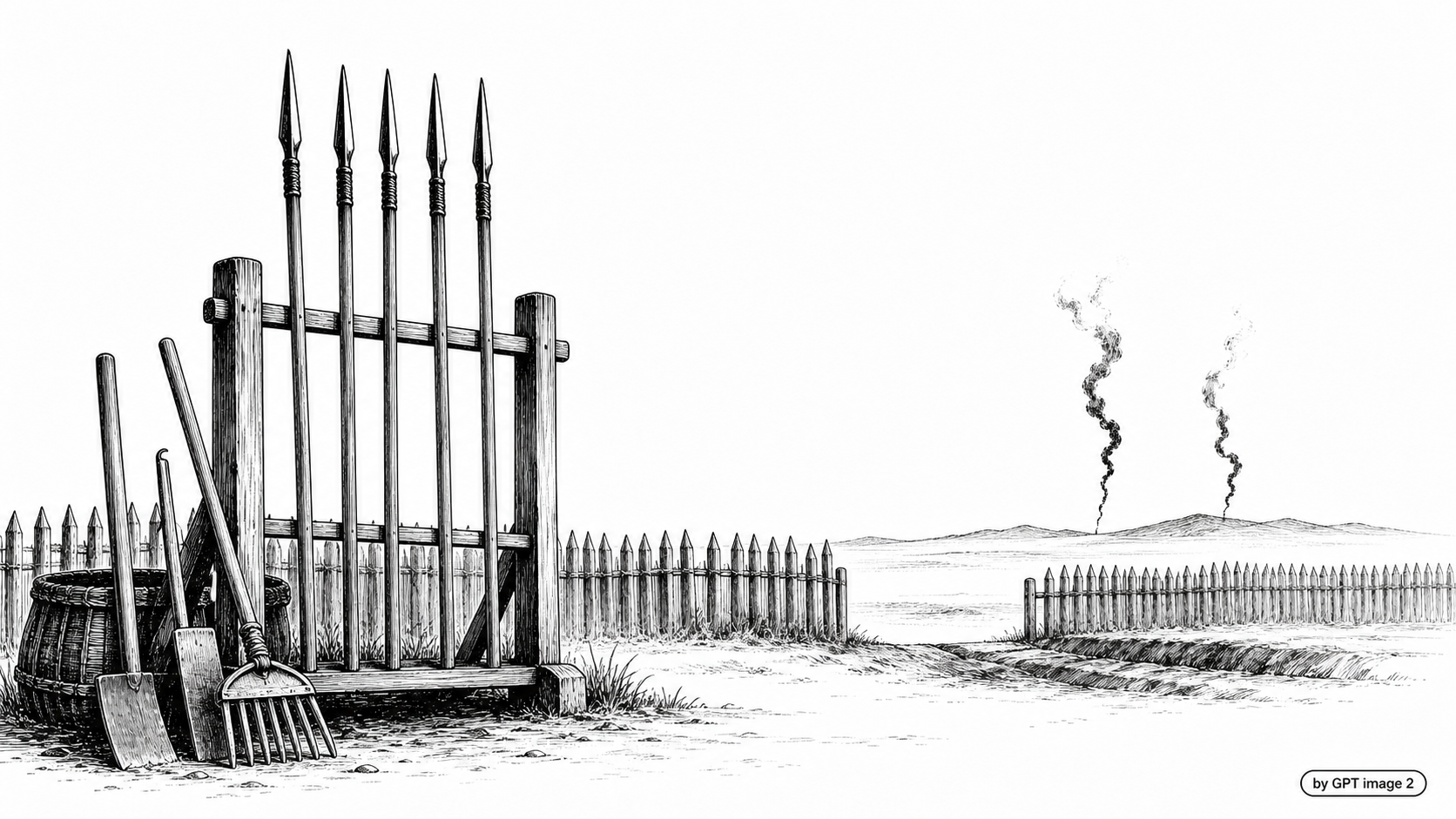
A child of this age has never seen an adult who does not know war.
#How War Came to Be There
War exists not as an event but as a season.
You plant seeds in spring, weed in summer, harvest in autumn, and in winter the neighboring daimyo comes — or our daimyo goes for them. This was felt like the rhythm of a year. In practice, though, the timing of actual campaigns varied by local harvest conditions, supply lines, and whether it was a siege or an open battle. Some wars targeted the autumn harvest; others were waged in the agricultural off-season, keeping troops tied up for months.
The phrase "a time of peace" sounds strange in this age. What people call a time of peace is merely the few months when fighting has stopped. Peace lasting years was almost unknown. People understood peace as "a moment to catch one's breath."
#Three Scales of War
#The First — Great Battle (大會戰)
Tens of thousands of soldiers clashing on an open field. Battles whose names endure: Sekigahara (1600), Nagashino (1575), Kawanakajima (1561, 4th engagement). And — the last edge of Sengoku, Hideyoshi's invasion of Joseon (Imjin War 1592 · Jeongyu War 1597) — a great battle carried across the sea. Over a hundred thousand Japanese soldiers boarded ships for Joseon; a great many of them never came back. Even after Japan's Sengoku had ended — the scars of that war lingered long on the fields of the Korean peninsula.
In truth, great battles are rare. For a single Sengoku daimyo, how many might occur in a lifetime? A great battle is a decisive fight — win and expand your territory, or lose and be annihilated.
The landscape of a great battle is vast and stark:
- Mounted samurai charge at the front. The crash of armor. The sound of hooves.
- Ashigaru spearmen stand like a forest and receive the cavalry. The sound of spear shafts snapping.
- Archers send down rain from behind. The sound of a thousand bowstrings layered upon each other.
- Teppo units, when present, erase every sound for an instant. The smell of gunpowder is what remains.
The landscape after the battle is even starker. Heaped bodies. Crows. Commoners picking through the burial goods of the dead.
#The Second — Skirmish (小競り合い)
These were far more common. Tens to hundreds of people collide on mountain paths, bridges, riversides. At the border of a neighboring domain, on the road carrying tribute, while out to seize a spy. Hitodori (人取り — person-raiding) — kidnapping and trafficking people from enemy villages — was also one axis of skirmishes. Not only soldiers but civilians became the "loot" of this war.
Most protagonists fought in engagements like this. Squad-sized, platoon-sized. With no name, no report filed — yet people died.
Skirmishes are ordinary. They can happen several times a month. Some soldiers say, "I fought three times this week."
#The Third — Siege (攻城)
Surrounding and assaulting a castle. At most months; at minimum days.
The protagonist of a siege is not the fighters but starvation. The attacking force surrounds the castle and cuts off supply. The people inside run out of food. Wells run dry. Disease spreads.
The Tottori Castle Starvation Siege (鳥取の渇え殺し · 1581) — a legendary siege conducted by Hideyoshi. After 3 months of encirclement, those inside the castle ate rats, boiled and ate leather, and eventually laid hands on the dead, so the accounts say. The Odawara Siege (1590) also dragged on 3 months, but this one is famous for the opposite reason — the feeble deliberations of the Hojo (北条) clan inside the castle — "Odawara Conference (小田原評定)" remains to this day a byword for an endless meeting that reaches no decision.
A siege ends in one of three ways — surrender, fall, or negotiation. Surrender means the castle lord cuts open his belly (seppuku) and begs that the lives of his retainers be spared. Fall means the walls are breached and everyone inside is killed. Negotiated peace was rare.
#And Plunder
The true ordinary of war was plunder.
At the border crossings between one province and another, soldiers took it as a given to "pull out whatever they liked from the fields." Chickens, pigs, vegetables, even people — young women in particular were taken to be sold.
This part — the part that the history of battlefields (戰場史) does not record — is what the commoners remember most clearly.
"Just because the war was over did not mean peace had come to us. When they said the war was over, it meant the young men of our village would not return. Even those who did come back came back empty-handed." — From the testament of a farmer of Mino Province (美濃), 16th century
#Who Fought
The armies of the Sengoku era were divided into three tiers.
- Samurai — warriors. They wore armor and carried long swords. Originally they rode horses. Professional soldiers sworn for generations to the lord of a single domain.
- Ashigaru (足軽) — infantry. In the growing season they were farmers; in the off-season they were levied and given spears and teppo. 70–80% of the whole army. Most of those who died at the front were these people.
- Shinobi (忍び) · rappa (乱破) — spies and assassins. Irregular forces outside any official rank. Everywhere, yet recorded nowhere.
#The Samurai's War and the Ashigaru's War
Even standing on the same battlefield, the war samurai and ashigaru experienced was different.
For samurai, war was a stage for honor. To cut down an enemy commander, to make one's name known, to be recorded by one's lord. Even in death, a record remains — "a battle trophy head (首級) was taken." That record becomes the stipend of one's children.
For the ashigaru, war was a one-time roll of fortune. Survive and go home; die and leave no record at all. No name, no face. Back in the village, a mother waited for several more years, and in the end placed a memorial tablet (位牌) at the empty seat.
Samurai have graves. Ashigaru have none. 99% of those who died in the Sengoku era were buried without a name.
#One More Thing That Made This Age's War Different
After the gates of the Spirit Realm opened, battlefields became doubled.
Onryo (怨霊) walk across fields still at war. The grudges of soldiers who died before have taken form and now cut down the soldiers who come next. There are two enemies — human enemies and yoma enemies.
Great daimyo, without exception before any campaign, sent onmyoji (陰陽師) or esoteric monks (密教僧) ahead to purify the battlefield. "Rites to cleanse defilement" became one pillar of war preparation. Neglect these rites — and a soldier on your own side turns his blade on his own comrades. The hand of a soldier possessed by an onryo moves against the soldier's own will.
One line was added to the evening prayers of samurai households:
"May the grudge of those I cut down today not return to me."
Because of that one line, the samurai of this age are not simply soldiers.
#Closing with One Scene
Evening on a field where the fighting has ended. Crows have gathered. One wounded ashigaru limps in the direction of his village. He has thrown away his spear — it was heavy. He has also shed his armor. Only a blood-stained hemp garment remains.
At the roadside stands a small stone of a wayside deity (道祖神, dosojin). He stops before it for a moment. Too long for a prayer; too short to be called no prayer at all. His lips move.
"Please let me not go to the next war."
The dosojin does not answer. An evening wind blows.
He walks again. His village comes into view. Far in the distance, someone's smoke for cooking rice rises. He is alive. Today he is alive.
Next season there will be war again.