#From the Night the Spirit Realm Opened
Contents
The one point where this world differs from the historical Sengoku era. The Spirit Realm opened.
#When Did It Open?
Nobody knows the exact date.
Some old monks say it was during the Onin War (1467) — that when Kyoto burned, the boundary melted in the heat of those flames. Some onmyoji say it was far, far earlier — that the Spirit Realm had always been leaking open a little, but the blood of the Sengoku years had pried the gap wider.
Among common people, two kinds of memory survive.
One grandmother's story: "Long ago, when I was a child, I had never seen a yoma. Even when I went into the mountains, even when I went to the river, there was nothing but the sound of the wind. But after one certain summer, every night I began to hear a cry from the distant peaks. Not a wolf. Not a bear. Something else. That is when it started."
One grandfather's story: "No, they were there when I was a child too. There was an old woman's ghost in the forest behind the village, and sometimes a hand would come up from the well. It just wasn't this many. Now there are too many."
The truth is probably somewhere between the two. The Spirit Realm had always been there a little, and the blood of the Sengoku years pushed the gap open further. So now there are too many.
#How Did People Come to Know?
This was not something learned through a single event. It spread slowly, village by village.
In the spring of one year, in a certain village, a farmer who had been plowing his fields disappeared. A few days later, his body was found in the mountains. There were no wounds on the body, and the face was — frozen in terror. An old woman called it "kamikakushi (神隠し)" — "hidden by the gods." It meant he had been carried off by a tengu (天狗) and returned. At first, nobody believed it.
The following month, the village next door had a similar incident. The month after that, a village across the river. About half a year on, the whole domain began to murmur. Only then did it reach the daimyo's ears. The daimyo summoned an onmyoji. The onmyoji went into the mountains, prayed for three days, came back, and spoke a single sentence.
"The gate of the Spirit Realm (霊界) is open."
This was the official discovery of one domain. Across the Japanese archipelago, this process was repeated dozens, hundreds of times — at slightly different moments, for slightly different reasons, from one daimyo to the next.
#And Daily Life Changed
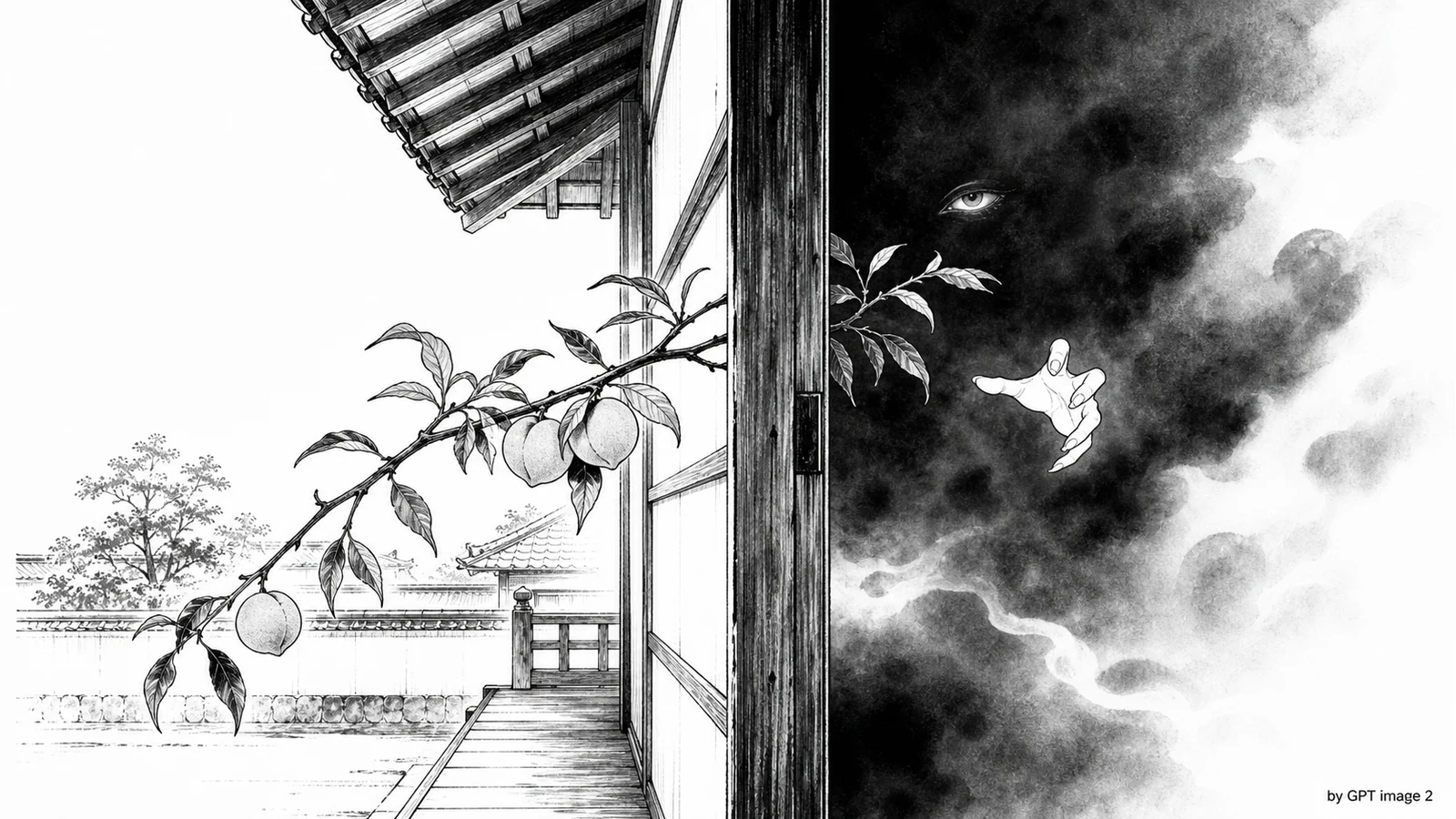
Once "the Spirit Realm has opened" becomes official fact, village life changes.
#The Rules of Night Change
In the old days, going out at night was fine. It was simply dark. Now, going out at night is dangerous. Doors are bolted. Talismans are pasted to the gates. Children are taught "do not call out names in the night." Because if you call a name, something nameless may answer.
#Festivals Change
The seasonal festivals (matsuri) grew more intense. Once they were little more than prayers for a good harvest; now the meaning of driving out defilement has grown dominant. The dances go longer, the fires burn larger, and more salt is scattered.
Ceremonies concentrate especially in the liminal seasons — the Higan (彼岸, the 7 days around the spring and autumn equinoxes) and the summer Obon (お盆, lunar month 7, mid-month). At Higan, it is said that this world and the next draw nearest to each other; at Obon, the souls of ancestors return. During this time, gaki (餓鬼) return alongside them, searching for the dead. And so at Obon's end, Shoryonagashi (精霊流し) — the rite of floating paper lanterns down the river to send the spirits back — is always performed.
#Funerals Change
How the dead are handled has become critical. Bury them carelessly, and they become onryo. A monk must read sutras without fail. The poor cannot find a monk to chant for them — so the family performs the rites themselves. And weeks later, that family begins to dream of the dead.
#Travel Changes
Those setting out on the road must bow before a dosojin (道祖神) without fail. They tuck a peach branch in their pouch. They make certain to be inside a village before nightfall. Sleeping rough (野宿) has become a genuinely dangerous thing.
#For the Samurai
For the samurai, the opening of the Spirit Realm means new enemies. And new allies.
#Enemies Have Multiplied
Once, only human enemies needed to be faced. Now — onryo must be faced too. Some of them rise again after being cut down; some scatter like shadows when struck with an arrow. Not all yoma are like this, but when you face enemies that are spiritual or close to incorporeal, an ordinary sword and spear alone will not be enough. And so samurai have come to learn exorcism techniques and to borrow the power of onmyoji and monks.
#New Allies Have Appeared
At the same time, onmyoji, esoteric monks, and shrine maidens have become comrades on the battlefield. They do not hold swords, but without them the battle cannot be fought. The sight of a samurai at the ready with a spear, a monk chanting nembutsu beside them — this is the battle formation of the Sengoku era.
"In battles of old, all you needed was a sword and a spear. In battles of today, you also need talismans." — A reflection from one aged warlord
#For the Daimyo
For the daimyo, the opening of the Spirit Realm means new sources of power.
#Organizing Onmyoji and Monks
Each daimyo house began to maintain its own corps of onmyoji, corps of exorcist monks, and corps of shrine maidens. These were not a matter of personal faith — they were political resources. Possessing onmyoji more powerful than those of a neighboring daimyo became as important as possessing stronger samurai.
#Those Who Tried to Use Yoma
Some daimyo tried to make use of yoma. They made pacts with oni from the forests to attack their neighbors, or cultivated onryo to use as spies. Daimyo like this tend to fall early — because yoma betray their pacts. But for a time they were powerful. And during that time, many neighbors crumbled.
"Yoma are a sword, not a hand. They may cut for a while, but in the end they will cut you." — A warning from one onmyoji
#A Closing Scene
In one village, a grandmother is telling her grandson a story as evening falls.
"When your grandmother was small, there was a tiger in the mountain behind the village."
"A tiger?"
"That's right, a tiger. Once evening came, even I stayed inside. Tigers are frightening, after all."
"What is there now?"
The grandmother pauses for a moment. She looks out the window. Darkness is descending. From the distant mountains comes a sound — a cry. Not a wolf. Not a bear. Something without a name.
"Now, you see. There is something more frightening than a tiger."
The grandson grips his grandmother's hand tight.
"But Grandmother put up talismans, so there is nothing to worry about."
The talisman at the doorway sways in the wind. It is the talisman that sways, not what stands beyond it — and now this is simply the natural order of the age.