#The Night You Meet a Yoma
Contents
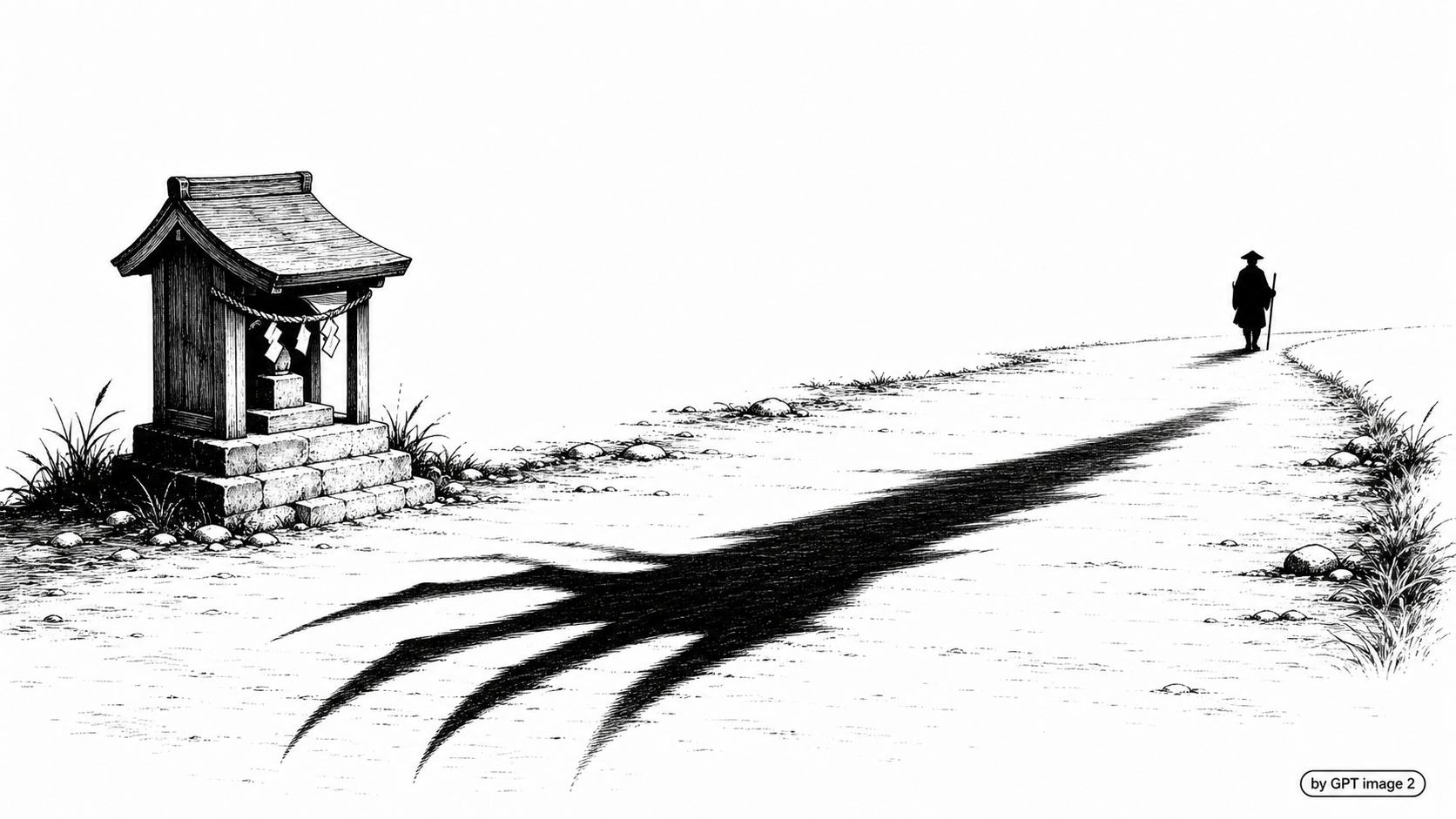
Yoma are not always met on the battlefield. More often — they are met in the kitchen, at the well, by the roadside.
#The Three Layers of Encounter
The ways of meeting a yoma fall into roughly three layers.
- The First Layer — a presence(氣配) that tells you something is there. You cannot see it, but you feel it. A rustling at the door, footsteps heard in the night, a cold wind with no reason behind it.
- The Second Layer — seeing it directly. With your eyes. A being that has taken on a shape.
- The Third Layer — interaction. It speaks to you, or touches you, or seizes you.
Most people experience only the First Layer for their entire lives. They feel only the presence, hear only the sound, and live on without ever knowing what it was.
The Second Layer is rare. But it happens. Those who have seen will never forget for the rest of their lives.
The Third Layer is rarer still. And returning alive is difficult.
#Presence
#The Most Common Signs
The signs that make common people feel "a yoma is nearby" are similar across the land.
- A chill with no reason — A warm summer night, yet one corner of the room fills with cold air.
- A scent with no reason — The fragrance of a flower not in that house drifts through the air. Or the smell of a stranger's sweat.
- The lamp flickers — No wind, yet the candle leans. Once. Twice.
- A child cries — A baby suddenly wakes from sleep and cries. No amount of soothing will settle it. Mothers on such nights pass their babies a talisman to hold.
- A dog barks — A dog barks furiously in one particular direction. Nothing is visible to human eyes.
- A shadow on the shoji — Something reflects on the shoji paper stretched across the door. Like a face, or like a hand. Open the door — and there is no one.
#How They Respond
When signs like these appear, common people:
- Scatter salt — Take a handful of salt together with rice from the kitchen and scatter it at the entrance.
- Touch the talisman — Check the talisman carried on the body. Check the talisman affixed to the door.
- Do not call out names — Whether a familiar name or a strange one, they do not call out carelessly. Call a name and a response may come.
- Do not extinguish the lamp through the night — A small flame in one corner of the room until morning.
Usually — it disappears when morning comes. When night goes, so does the yoma. This is the experience of common people.
#Seeing Directly
#When Does It Happen?
The cases in which an ordinary person sees a yoma directly are generally these.
- When lost on a mountain — Especially after the sun has set. In a place where the path has vanished — someone is standing there.
- When night-fishing at a riverbank — Something moves at the water's edge. It is not a fish. Something like a hand parts the water.
- When entering a vacant house — A house that has been empty for a long time. From inside, someone makes the sound of breathing.
- On the night after a funeral — A night when the soul of the dead has not yet departed.
- Near a battlefield — A field where fighting once took place. At night: the sound of screaming, the sound of hoofbeats.
#The Reaction of Those Who Have Seen
The first reaction of someone who has seen a yoma — in most cases they freeze. They cannot move. They cannot breathe. Several seconds, or several minutes. This time is called "being seized by the spirit".
When the freeze breaks — they run. Do not look back. Absolutely do not look back — this is the iron rule of this age. Look back — and it will be even closer than before.
Reach home after running — and call your own name three times. "Ichiro. Ichiro. Ichiro." By calling the name, the soul returns to its rightful place. If one seems to have forgotten the name — ask a family member. The family member calls it for you.
Even so, one falls ill for a few days. Sleepless nights follow. Time is the medicine.
#Conversing with Yoma
#Can One Converse?
Surprisingly — yes. Many yoma speak. In human language. With a human face.
- The fox (kitsune) transforms into a young woman and offers sake to a samurai.
- The tanuki transforms into an elderly monk and asks a traveler for directions.
- The tengu teaches swordsmanship to a yamabushi encountered on a mountain.
- Even the oni — speak human words. Some of them compose poetry.
This possibility of conversation is the peculiarity of Japanese yoma. Western monsters generally do not speak. Japanese yoma speak often. This makes the relationship with yoma more complex. Whether enemy or friend — it is not decided in a single conversation.
#The Rules of Conversation
Folk wisdom for conversing with yoma:
- Do not speak your true name — one whose name is known becomes seized by the spirit.
- Do not accept food — eat yoma food and you will not return. The taboo of "food from the other realm."
- Do not refuse a reward — if a yoma makes a gesture of gratitude, refusing it brings a greater disaster. Accept it — but do not leave what you have received in your house until morning.
- Do not lie — yoma see through falsehood. If a lie is discovered, they rage.
#Ways of Coexistence
And — many yoma have long coexisted with humans.
#The Village Fox
Most villages have one or two foxes living in them. They may be ordinary foxes, or they may be yoko (妖狐). The villagers leave food out for these foxes — a piece of aburaage (fried tofu) before the Inari shrine. The fox eats it — and does no harm to the village. Sometimes it helps — showing in a dream the location of a lost object.
#The Master of the Well
In old wells, something lives. A small being. At times it makes sounds from within the water. If the water grows murky — that means it is angry. Then people scatter salt and teach children: "Do not throw stones into the well."
#The Woman of the Privy
In many common households, there is a tradition that a beautiful yoma lives in the privy. Her name varies. If one encounters this yoma in the privy — one must politely say "Forgive the intrusion" and withdraw. Be rude, and the next day one falls ill.
The meaning of this coexistence is — yoma are not necessarily enemies. Keep the rules and one can live alongside them. The most pragmatic attitude of people in this age of Japan.
#Closing with One Scene
An old woman of a certain village is drawing water from the well late one night. The water she draws up is murkier than usual. She stops. She takes a pinch of salt from her pocket and scatters a little into the well.
"It seems I have disturbed you today. Please forgive me."
She says it to the master of that well. She does not call out a name. She simply thinks of the being as "that honored one" in her heart.
She draws water again. This time it is clear. As a sign of her gratitude — the next morning she places a single flower beside the well. Two days later, the flower has withered. That is the sign that the master of the well received the flower.
This old woman's granddaughter will one day learn this act. The granddaughter's daughter too. Life in this age continues in this way — yoma and people pretending not to notice each other, while tending to each other with care.