#The Faces of Yoma
Contents
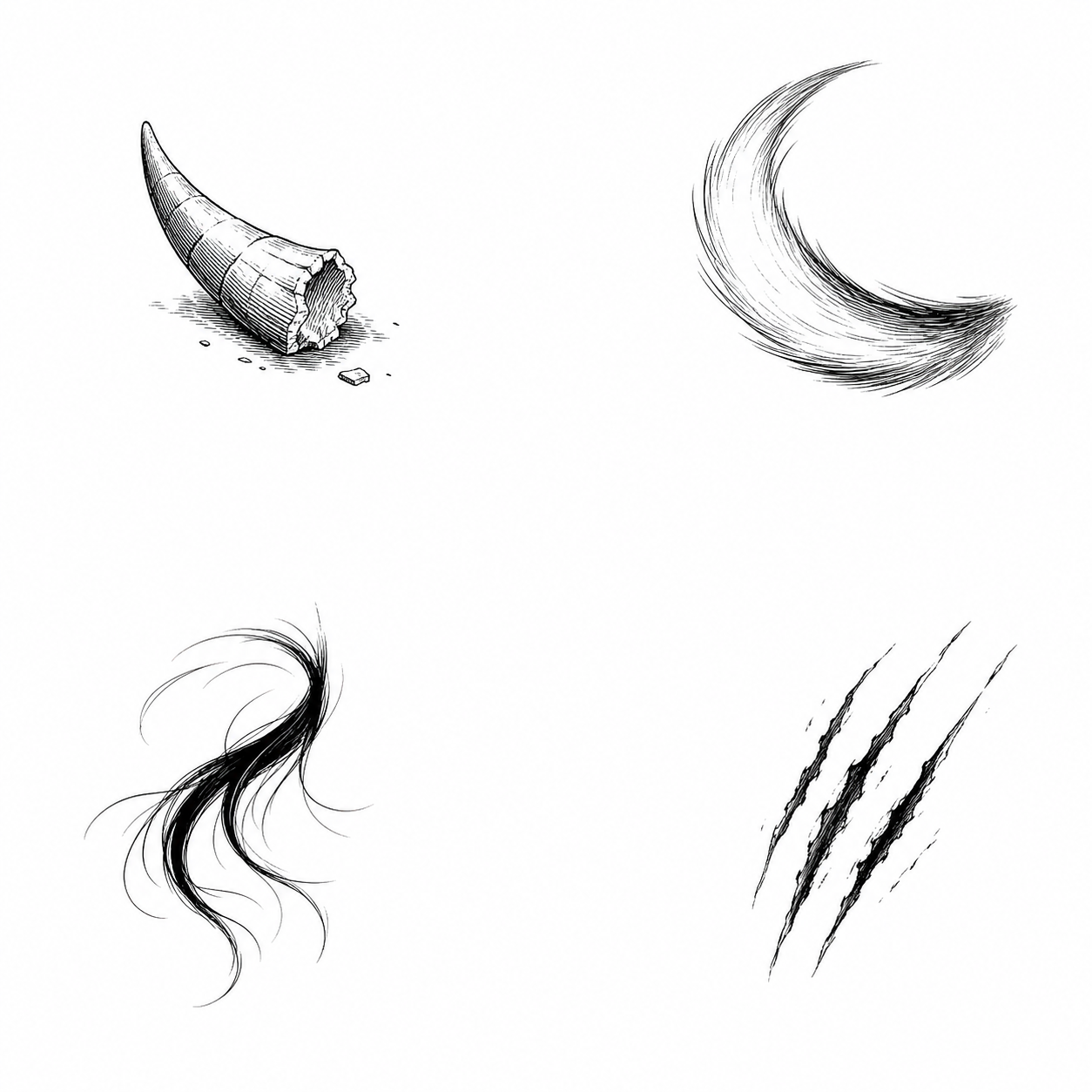
This chapter is not a field guide. It is not a chapter for memorizing lists. It is a chapter for gazing briefly at each yoma's face.
#Those Who Come from the Mountains
#Oni (鬼)
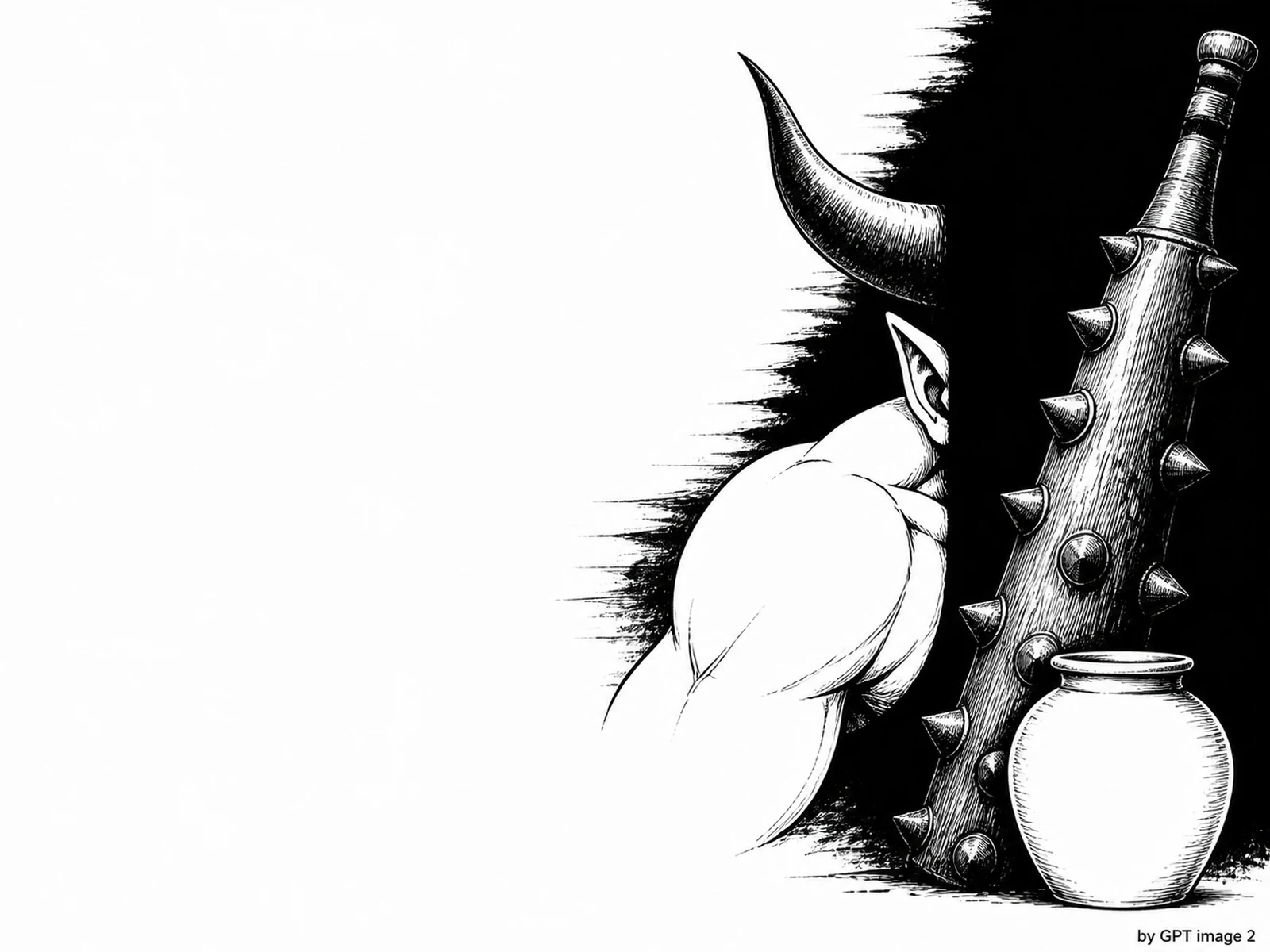
The most famous yoma. Red skin, blue skin, black skin. Horns. Fangs. An iron cudgel. Large — twice the height of a person, three times.
Oni live like a tribe. It is said there are villages deep in the mountains that belong only to them. There is a chieftain, and beneath him his followers. A people like us, yet different.
Oni love drink. Shuten-doji (酒呑童子) — whose very name means "the child who drinks sake" — is the most famous oni king. He lived on Oe-yama (大江山) near Kyoto and kidnapped human women. The story of how Minamoto no Yorimitsu (源頼光) and his four retainers — the Shitenno (四天王): Watanabe no Tsuna, Sakata Kintoki (the model for Kintaro), Usui Sadamitsu, and Urabe Suetake — got him drunk and then cut off his head is known to every Japanese person. These same Shitenno also vanquish Tsuchigumo (土蜘蛛) — the great earth-spider yoma. The dream of Sengoku warriors was to become heirs of Yorimitsu's Shitenno.
Oni are not evil. They simply live by different rules from ours. To them, humans are — sometimes food, sometimes entertainment, sometimes neighbors. Try to understand us from their perspective and you can understand why they take us. Understanding does not mean forgiving.
"Oni are the order of the mountain. When human order enters the mountain, there is a collision." — the words of a certain yamabushi
#Tengu (天狗)
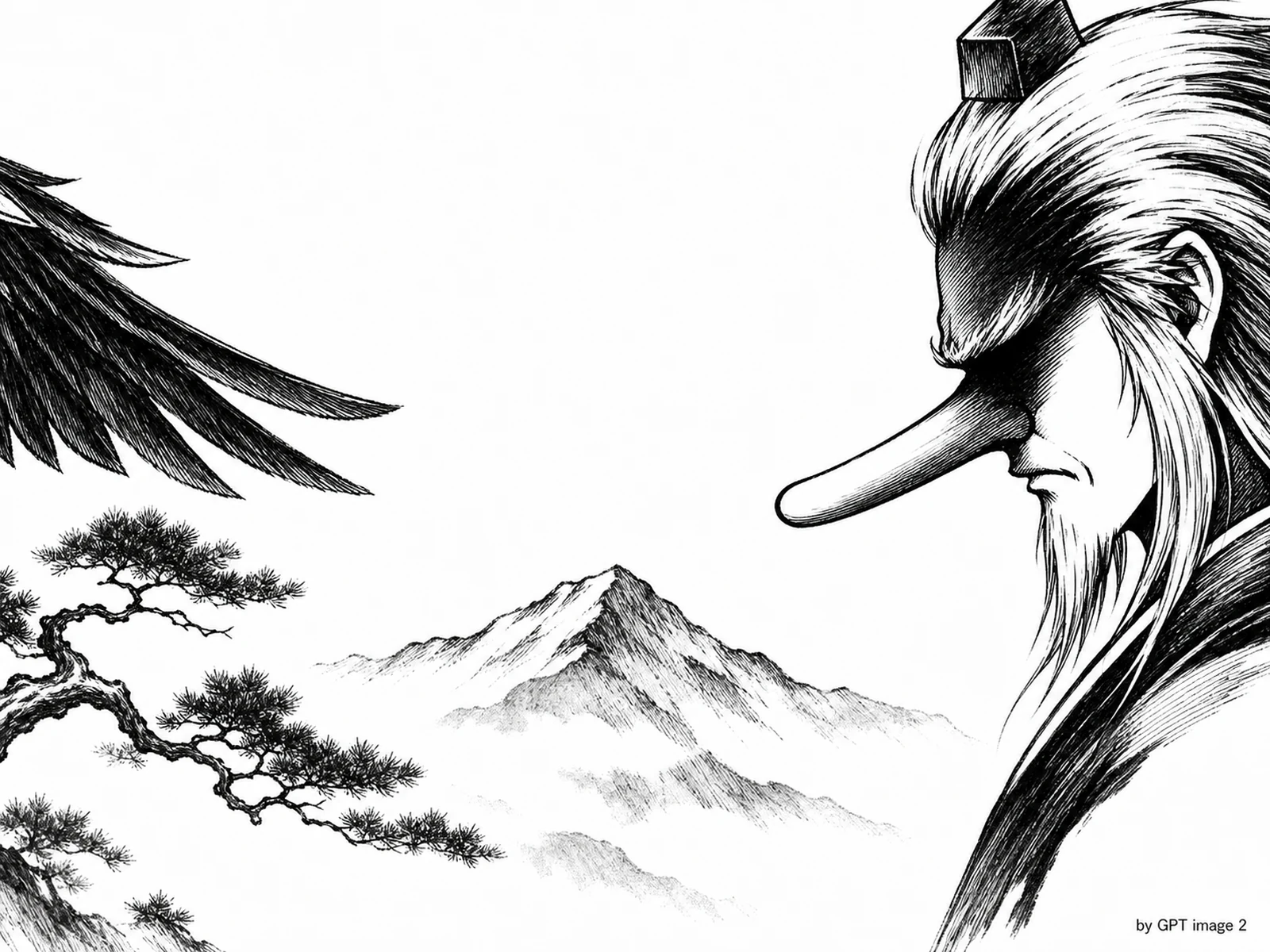
Master of the deep forest. A human body with the characteristics of a bird mixed in.
- Karasu-tengu (烏天狗) — a crow-like beak. Black wings. Roughly the size of a human.
- Dai-tengu (大天狗) — a long nose. A red face. The garb of a yamabushi. Sometimes with wings, sometimes without.
Tengu are arrogant. They believe themselves superior to humans. Speak to one and it sneers at you. Ignores you. Yet — outstanding warriors and yamabushi are sometimes accepted as students by tengu. After spending several months together deep in the mountains, the warrior's swordsmanship improves miraculously.
The problem with tengu is mischief. They deliberately lead lost humans deeper into the mountains. Laughing. Those who fall into a tengu's prank wander the mountains for days. They may never make it home.
#The Mountain Crone (Yamauba · 山姥)
A woman deep in the mountains with long hair and tattered clothing. Old, but enormously strong.
The traditions diverge — stories of eating people and stories of helping them both exist. That is probably accurate to life. Some yamauba are dangerous, some are kind. It depends on the demeanor of whoever encounters one. Be rude and you will be eaten. Be respectful and — you might even be fed.
#Those Who Come from the Water
#Kappa (河童)
A creature like a child of the river. Green skin. The build of a human child. Webbing on hands and feet. A shell on the back like a turtle.
A kappa's defining feature is the dish on top of its head. A small hollow that holds water. When that water dries — the kappa grows weak. So when dealing with a kappa, you make it bow — because when it bows, the water spills from the dish.
Kappa love sumo wrestling. They challenge passing humans to a match. If the human wins — the kappa keeps its word (it will not harm you in the river). If you lose — you are dragged into the river.
Kappa love cucumbers. Leave cucumbers by the riverbank and there is an old contract that the kappa will not harm that household. Even today, many villages place cucumbers by the river in summer.
#Umibozu (海坊主)
A giant bald monk from the sea. It appears on rough nights at sea. A black body. Sometimes it has no eyes.
A fisherman goes out to sea at night — and from between the waves an enormous face rises. The face of a bald monk. It speaks — "Are you suffering?" Answer wrongly and the boat capsizes. It is said there is no correct answer. Silence is best.
#Those Who Arose from People
#Onryo (怨霊)
The spirit of one who died harboring deep resentment. The most numerous in this era. Because there is so much war.
Their forms are many.
- A woman in white. Long black hair covering the face. No feet (floating without touching the ground).
- An armored warrior. No head, or the body cut in half.
- A child. Sometimes only the sound of weeping, with no form visible.
The distinguishing mark of the onryo — it is bound to a specific person, family, or place. If that binding is not undone — the curse continues through the generations. Resolving the individual's resentment is the only solution. Merely cutting an onryo down will not do — it will return.
#Ikiryo (生霊)
The spirit of a living person that takes form through intense obsession. The strangest yoma of all.
The person themselves believes their body is right where it should be. They work, eat, and sleep without anything seeming wrong. Yet a part of their soul is — standing at the window of the person they are obsessed with. At night. Watching that person through the window. The subject feels it. A cold presence is watching them from outside the window.
No one knows about the ikiryo — not the person, not the subject. Once it becomes known — it dissolves. But coming to know is the hard part.
The famous example is Rokujo no Miyasudokoro (六条御息所) from The Tale of Genji (源氏物語). Her jealousy becomes an ikiryo and kills her rival. She herself does not know. Only later, in a dream, by noticing a strange fragrance in her hair — does she finally realize.
#Gaki (餓鬼)
The spirit of one who starved to death. Dwelling in eternal hunger.
Their form is dreadful — a body of bare bones. The mouth is very small and the throat very thin, so nothing can be swallowed. Therefore they hunger forever. They gnaw at the corpses of battlefields. They seek to devour the souls of children.
Gaki are pitiable yoma. Their very nature is punishment. The greed of their living days returned as starvation after death. In Buddhist teaching, gaki are one stage of the six realms of rebirth (六道輪廻).
#Yuki-onna (雪女)
A woman encountered in the snow. Pale skin, black hair, white robes. Beautiful. Beautiful enough to make your flesh ache with cold.
She appears before someone stranded in a blizzard. She bids them come closer. Come close and — you freeze to death. But sometimes — she takes pity and lets them go. With a single condition. "Tell no one what you saw today."
Keep silent and — you survive. Speak and — she comes again.
There are many stories of those who broke this condition. Because human mouths are loose.
#Those Who Arose from Old Things
#Tsukumogami (付喪神)
A tool that has lived 100 years and been inhabited by a spirit. Most prevalent in this era. Because there are many abandoned objects. Because there is much war.
Many faces.
- Kasa-bake (傘化け) — an umbrella yoma. One leg, one eye, a long tongue.
- Chochin-obake (提灯お化け) — a lantern yoma. A paper lantern with a face.
- Boroboroton (暮露暮露団) — an old futon yoma. It smothers people.
- Ippon-datara (一本踏鞴) — a smithing hammer yoma that hops on one leg.
Tsukumogami are generally light-natured. Causing mischief, nothing more. But — if long-neglected resentment is mixed in, they become dangerous. A sword abandoned by its owner that becomes tsukumogami carrying 100 years of accumulated grievance — that is a dangerous yoma.
#Fox (狐) · Tanuki (狸)
Yoma that transform. Regulars of Japanese folklore.
- Fox — transforms into a young woman. Beautiful. Seductive. There are cases of living together and even having children — but the moment a tail is glimpsed in daylight, the true nature is revealed. Once found out, it vanishes.
- Tanuki — transforms into an old monk, or into objects, into anything at all. More mischievous than the fox. The fox is deadly; the tanuki is comedic.
Among foxes there are also sacred foxes (messengers of Inari) and yoko (harmful shapeshifters). The distinction is difficult. Even among themselves the boundary is blurred.
#Other Faces
- Messenger of Inari — the White Fox — messenger of the god Inari. Venerated, it is a god; harmed, it is a yoma.
- Nue (鵺) — a monster assembled from many beasts. A monkey's face, a tiger's body, a serpent's tail. Its cry in the night is harrowing.
- Kamaitachi (鎌鼬) — a small weasel-shaped yoma that slashes people mingled within the wind. The wound is there, but no blood flows.
- Rokurokubi (轆轤首) — a woman whose neck grows long at night. By day she looks like an ordinary human.
- Funayurei (船幽霊) — a sea ghost that comes to the boat begging for water. Give it water and — it sinks the boat. You must have a bottomless ladle prepared (the water falls through, so you can keep pouring forever).
The list is longer. Far longer. In the books of Japanese folklorists, hundreds of yoma species are recorded. This chapter — merely shows a few faces.
#How to Read These Faces
There is no need to memorize each yoma's name. Leave only an impression. Later in a session, when the GM says "an oni appeared" — it is enough if the oni's size, skin color, and the look of it wanting a bottle of sake can be imagined.
Yoma are not a list. Yoma are neighbors. You may encounter a neighbor without knowing their name. What matters is — what you will do after the encounter.
#In One Sentence
Yoma have many names and many faces. Each one of those faces — reminds us that this world does not belong to humans alone.