#04. Yagyu Muneyoshi — 柳生宗厳 · Founder of the Yagyu Shinkage-ryu
Contents
- Lifespan: 1529~1606 (age 77)
- Era: Late Sengoku ~ Azuchi-Momoyama
- School: Yagyu Shinkage-ryu (柳生新陰流) — see schools listed in co
- Aliases: Sekishusai (石舟斎) · a sobriquet of his late years
#Fiction Intro — "The Day He Threw His Master Three Times"
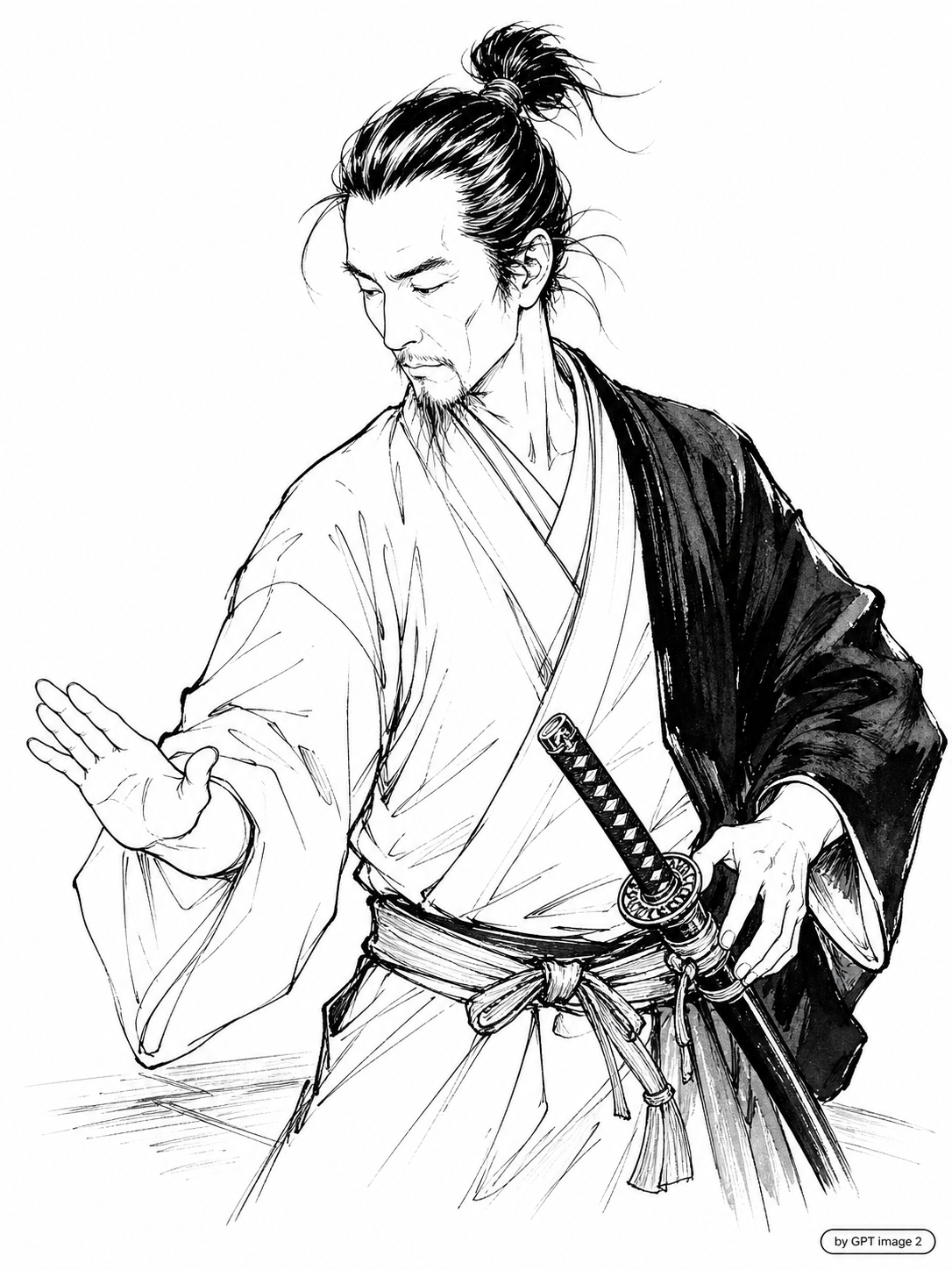
The year 1565. The village of Yagyu in Yamato Province. The dojo of the Yagyu house.
Kamiizumi Nobutsuna has come. Already he is renowned as a swordmaster of the Sengoku. The young Yagyu Muneyoshi receives him.
"Please teach me a single move."
Kamiizumi smiles. Muneyoshi charges first. Kamiizumi takes one step to the side. Muneyoshi's sword cleaves empty air.
"Once more."
Muneyoshi charges again. This time he changes the angle. With his bare hands, Kamiizumi snatches away Muneyoshi's sword. No-Sword (無刀) — the technique of taking a blade with bare hands. Muneyoshi falls to the ground.
Muneyoshi rises and charges a third time. This time with a completely different stance. Kamiizumi pauses for a moment.
"You are not trying to learn. You are trying to complete. I will entrust it to you — the next gate of my school."
After that day, Muneyoshi became Kamiizumi's foremost disciple. And the Yagyu house became the center of Japanese swordsmanship.
#Scent — A Life in History
#Life
Yagyu Muneyoshi — born in 1529 in the village of Yagyu in Yamato Province (present-day Nara Prefecture). The Yagyu house was originally a minor lord. From his youth he was absorbed in the sword. His early training was in the Shinto-ryu · Kashima Shinto-ryu lines.
1565, age 37. He meets Kamiizumi Nobutsuna. He duels Kamiizumi three times and is defeated three times. On the spot he begs to become a disciple. He then receives Kamiizumi's teaching for 5 years.
Around 1570, Kamiizumi acknowledges his completion of the Shinkage-ryu transmission. But Muneyoshi did not stop there — adding the Yagyu house's own interpretation, he established the Yagyu Shinkage-ryu (柳生新陰流). He carried on his master's name while affixing the name of his house.
1594 — age 65. He is said to have shown the secret arts of the Shinkage-ryu before Tokugawa Ieyasu. This meeting was the occasion on which his son Yagyu Munenori (宗矩) entered Ieyasu's service, and the later system of strategy mastership in the Edo shogunal house was cemented through Munenori.
At age 77 he retired under the sobriquet Sekishusai (石舟斎). He died.
#The Real Story
"The Demonstration Before Ieyasu" — the most famous anecdote. The tradition is strong that Muneyoshi showed his secret arts to Ieyasu in 1594 and, as a result, sent his son Munenori into Ieyasu's service. The Yagyu house as the shogunal house's strategy masters takes firm root afterward, in Munenori's generation.
"The Sword of One House" — Muneyoshi's achievement was not simply his own swordsmanship but founding a house. His son Munenori (宗矩) established the Edo Yagyu, and his grandson Yagyu Toshitoshi established the Owari Yagyu. Japan's "house of shogunal swordsmanship" begins from this one man.
"The Completion of No-Sword (無刀)" — the "technique of taking a blade with bare hands" that Kamiizumi opened, Muneyoshi perfected as a secret transmission of the house. Thereafter it is the symbolic technique of the Yagyu line.
#Tales
"The Origin of the Stone Boat (石舟)" — a large rock by the river where the aged Muneyoshi often went out. Its shape was like a boat, so it was called the "Stone Boat (石舟)." His figure sitting upon it in meditation was famous, and so the sobriquet Sekishusai was attached to him. To this day there is a "Stone of Sekishusai" in the village of Yagyu.
"Three Defeats Became One Victory" — his three losses to Kamiizumi were turned into legend in later ages. "The swordmaster whose loss became a win." He is remembered as the disciple who completed his master.
#Law — Lord-Grade Data
#School
Yagyu Shinkage-ryu (柳生新陰流) — listed in co (shared with the Shinkage-ryu + the Yagyu branch).
- Licensed · secret art: the Yagyu Shinkage-ryu
[Kata] No-Sword+[Kata] Life-Giving Sword. - Distinctive of the Yagyu branch: bare-hand techniques at its core (an expansion of No-Sword).
#Lord-Grade Sheet
| Item | Value |
|---|---|
| Class | Samurai 9-dan (head of the Yagyu house · also trained in Unarmed Combat) |
| Attributes | Courage 2 · Finesse 2 · Physique 3 · Wisdom 1 · Presence 0 · Fate 0 |
| Energy | 12 |
| Wounds | 7 (3 + Physique 3 + Tough 1) |
| Defense | Unarmored 10 / Armored 12 (Do-maru recommended; a battlefield build may use tosei gusoku 14) |
| Swordsmanship proficiency | +3 (Master) |
| Skills | Swordsmanship · Unarmed Combat · Intimidation |
| Key feats | Immovable Formation · Single-Combat Declaration · Guard Posture · Tough |
| Three Ways and Six Hearts | 忠 (Way of Loyalty) + 眞 (Way of Truth) |
| Special Rule | Aged — max Energy -1 each Lull Phase, floor 6 (half the original, rounded up) → common special rules |
#Unique Techniques
| Technique | Energy | Check | Effect | Limit |
|---|---|---|---|---|
| [Kata] Yagyu No-Sword (柳生無刀) | 3 | 2d10+Finesse+Unarmed Combat+2 >= Defense | On success, disarm. During the same round, the target's Defense -2. A technique reinterpreting Kamiizumi's No-Sword as practical Yagyu-style Unarmed Combat. | 1 time per round |
| [aptitude] The Eye of Sekishusai | 0 (constant) | — | At the start of combat, designate 1 enemy Lord/Elite. Defense +2 against that target's first attack, and +2 when detecting that target's Surprise Attack · Deceit-type Stratagems. | 1 time per combat |
#Fighting the Swordmaster
#Matchup
- Switching to bare hands: his Yagyu No-Sword is strong against an attacker focused on the blade. It is slightly weak against an Unarmed Combat PC.
- Old age: at age 77 — the Aged special rule applies (max Energy -1 each Lull Phase, floor 6). The longer a war of attrition drags on, the weaker he certainly becomes.
#Three Paths to Victory
#Path 1 — Head-on Duel (recommendation ★★)
- Unarmed Combat-focused fighting or ranged attacks are advantageous. His
No-Swordis specialized against a close-range swordsman. - A combination of squad attacks + varied weapons.
#Path 2 — Earning Recognition (recommendation ★★★)
- Knowing his
Eye of Sekishusaiand yet attacking in the predicted direction — that boldness makes him marvel. - Or charging a fourth time even after three defeats — recalling his own young days, he takes the PC as a disciple.
#Path 3 — Bypass (recommendation ★)
- Influence through his son Yagyu Munenori. But it is hard for Munenori to intervene directly with his father.
- Political pressure at the level of Ieyasu or a daimyo.
#Taking the Swordmaster as Your Master
#Approach
You go to the village of Yagyu. The dojo of the Yagyu house keeps its gate open to outsiders (unlike Kamiizumi — Muneyoshi took in many disciples). However, reaching licensure is extremely difficult.
#Conditions
- 忠 or 眞 Three Ways and Six Hearts. The Yagyu are a political house tied to the shogunal and daimyo families — rebels and heretics are refused.
- The tenacity to charge a fourth time even after losing three times.
- Respect for the traditions of the Yagyu house.
#Course of Study
- Years 1~3: The basic forms of the Yagyu-ryu. For someone already licensed in the Shinkage-ryu, shortened to about 1 year.
- Years 3~7: Transmission of the Yagyu's own No-Sword (bare-hand techniques).
- Full licensure: 5~10 years.
#Rewards
- Transmission of the Yagyu Shinkage-ryu: At full licensure,
No-Sword. Thereafter, if you reach Master of swordsmanship, theLife-Giving Sword. - Transmission of the Yagyu No-Sword secret to a select few.
- The title "Yagyu disciple" is valid even within the shogunal bakufu. One of the highest pedigrees in the warrior world.
#GM Notes
Yagyu Muneyoshi is the archetype of the "one who began as a disciple and became a master." His narrative is well suited to being presented to PCs as a "model of growth."
Scenario hooks:
- A PC, as his disciple, sets out to deliver the final teaching of his master Kamiizumi.
- The 1594 demonstration before Ieyasu — a PC appears as a witness to that scene.
- A backdrop in which the aged Sekishusai moves to resolve a small problem of the village (a yoma · bandits · an onmyoji incident).
"The three times I lost to my master are what made me a master." — Yagyu Sekishusai