#08. Sasaki Kojiro — 佐々木小次郎 · Founder of Ganryu (巖流)
Contents
- Lifespan: c. 1583–1612 (around age 29 · records unclear)
- Era: Early Edo
- School: Ganryu (巖流) — newly recorded in fc03
- Alias: Ganryu Kojiro · commonly Kojiro
#Fiction Intro — "The Time Beneath the Nodachi"
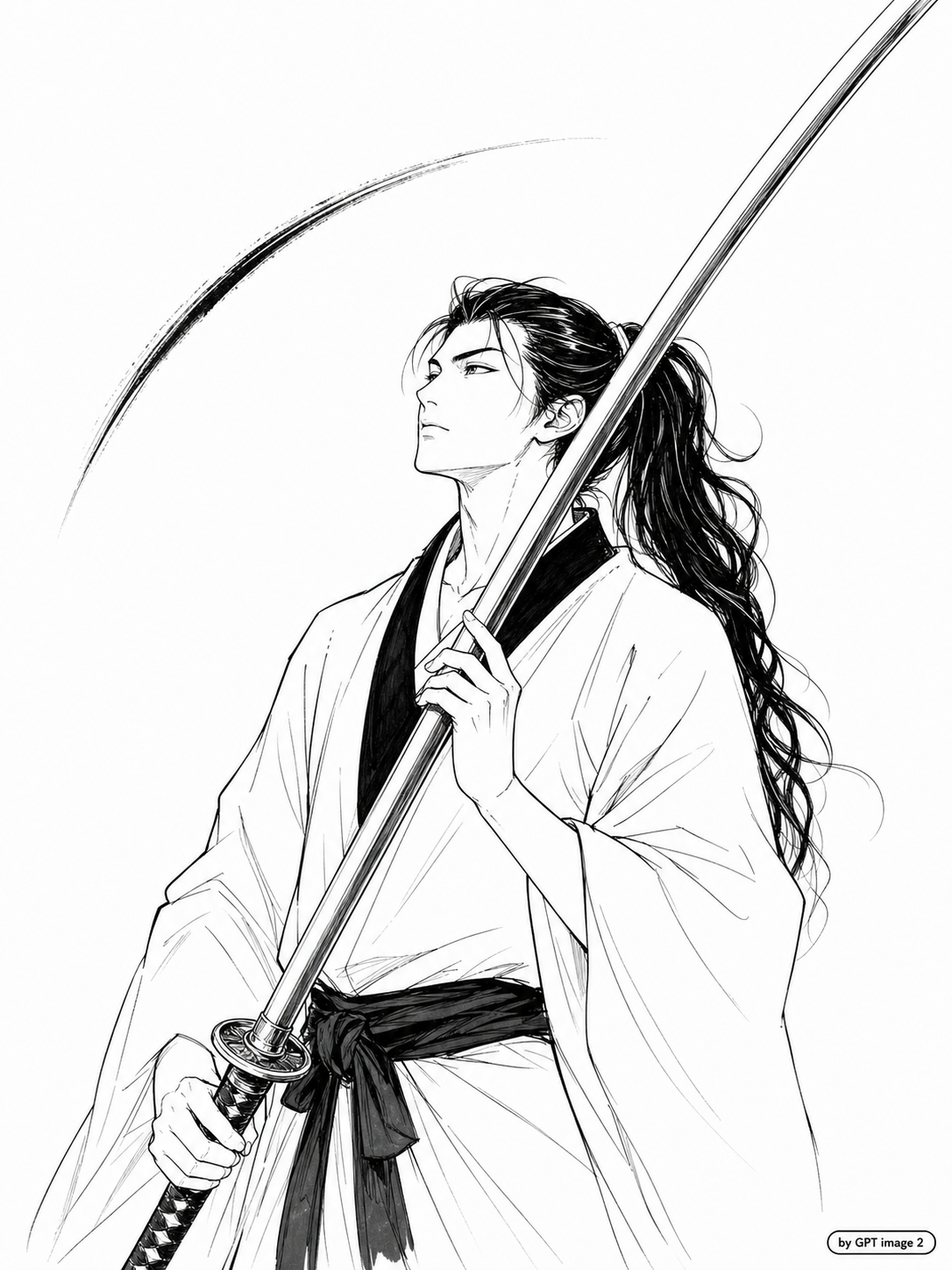
April 1612. The shore of Ganryujima (巖流島). Early morning.
Kojiro had already arrived three hours earlier. He stands with the long nodachi Monohoshizao (物干竿) — a long sword whose length nearly exceeds his own height — planted like a staff. The sun rises slowly.
One of his retainers asks beside him.
"Lord Kojiro, what if Musashi does not come?"
Kojiro does not answer. He watches only the sea.
"Could it be that he has lost his nerve?"
Kojiro speaks for the first time.
"No. He will come. With his tardiness he means to unsettle me. Foolish — I will not be moved."
But as time passed, when the sun had climbed overhead — Kojiro was already, little by little, being shaken. A small wavering he did not notice.
At last Musashi came. For the first time in his life, Kojiro — threw away his scabbard. That was his end.
#Scent — Life in History
#Life
Sasaki Kojiro — his dates cannot be confirmed precisely. Generally born around 1583, died at Ganryujima in 1612. Aged around 29.
Birthplace: the Fukui or Echizen theory is favored. In his youth he passed through several schools; one theory holds he was of the Toda Itto-ryu line · another that he had his own Self-Taught Style.
Ganryu (巖流) — the name of his Self-Taught Style. "The School of the Rock." Like Musashi's Niten Ichi-ryu, a personally founded school.
His signature weapon was Monohoshizao (物干竿) — a long nodachi with the nickname "the laundry-drying pole." Far longer than an ordinary katana. Making use of this reach advantage was the hallmark of Ganryu.
The duel with Musashi — April 13, 1612. Arranged by the Hosokawa clan of Kokura in Buzen Province. On the island of Ganryujima (near present-day Shimonoseki, Yamaguchi Prefecture). He lost and died.
#The Real Story
Tsubamegaeshi (燕返し · the swallow counter) — his signature technique. Combining the raising and the downward stroke of the sword into a single motion — resembling a swallow turning up and down. A technique that evades the opponent's blade while counterattacking at the same time.
Monohoshizao — the actual sword length was about 90cm or more. Far longer than the ordinary katana of the time (about 70cm). A tactic that overwhelms by reach.
The result of the Ganryujima duel: the common account is that Musashi killed Kojiro instantly by striking his head with a wooden sword. Some sources also transmit a different theory that "after he fell he was still breathing, and Musashi's retainer finished him."
#Night Tales
"The swordsman who lost to Musashi" — Kojiro is the foremost example of "a swordsman remembered for losing." Because of the one duel he lost, every story attaches itself to him. In later literature and film he is portrayed as a "young, beautiful, arrogant genius swordsman."
"The Secret of the Headband" — Kojiro's first stroke grazed and cut Musashi's headband. This is proof of the speed and accuracy of his sword. There is a tradition that Musashi himself admitted in his later years, "Had that blade been one inch deeper, I would have lost."
"The One Who Threw His Scabbard" — Kojiro throwing his scabbard just before the duel was a declaration of no intent to turn back. Musashi's single line, "the one who wins does not throw away his scabbard," was born at this moment. A maxim of later martial arts.
"Mahoujin Reincarnation tie-in": in co-09-10 he returns as a Kekka (血花). The anger and resentment at the moment just before his death is the seed of his demonization. This volume is the pure swordsman version before the demon.
#Law — Lord-Grade Data
#School
Ganryu (巖流) — newly recorded in fc03-03-00-new-schools.md.
- Licensed:
[aptitude] Long-Sword Reach (長劍射程)— long sword reach +1 zone. - Secret art:
[Kata] Tsubamegaeshi (燕返し)— a 2-hit strike; if the first hit lands, the second gets Critical Expansion. (The Mahoujin Reincarnation version adds automatic Critical Hits and Pierce.)
#Lord-Grade Sheet
| Item | Value |
|---|---|
| Class | Ronin 9-dan (perfected Self-Taught Style · long-sword specialist) |
| Attributes | Courage 2 · Finesse 3 · Physique 2 · Wisdom 0 · Presence 0 · Fate 1 |
| Energy | 13 |
| Wounds | 6 (3+Physique 2+Tough 1) |
| Defense | Unarmored 10 / no recommended armor (duelist, armor not recommended) |
| Swordsmanship mastery | +3 (Master) |
| Skills | Swordsmanship · Footwork · Perception |
| Key feats | Wind Blade · Preemptive Strike · Gale · Tough |
| Three Ways and Six Hearts | 覇 (Way of Hegemony) — strong competitive drive |
#Unique Techniques
| Technique | Energy | Check | Effect | Limit |
|---|---|---|---|---|
| [stance] Monohoshizao Frontal | 2 (maintained) | — | Set the long sword upright to the front. While holding a long sword, an enemy in the same zone takes -2 on its first Approach or first attack check. Defense -1 when the stance is disabled. | Maintained |
| [Kata] Tsubamegaeshi (燕返し) — Historical Original | 4 | 2d10+Finesse+Swordsmanship+2 >= Defense | Ganryu secret art. 2 consecutive strikes. If the first strike hits, the second gets Critical Expansion (doubles and adjacent pips all crit). No Pierce effect. | 1 time per round |
#Difference from the Mahoujin Reincarnation Version
The Tsubamegaeshi of the Kojiro heroic spirit in co-09-10 is automatic critical + 2 strikes + [Pierce all]. The historical original has no Pierce and is not an automatic critical. Demonization raised the technique to a transcendent level.
#To Fight the Swordmaster
#Matchup
- Reach advantage: approaching his Monohoshizao Frontal stance is difficult in itself.
- The arrogance of youth: weak to psychological warfare. As Musashi did, tardiness and provocation can disturb his composure.
#Three Paths to Victory
#Path 1 — Head-On (recommendation ★★)
- A short weapon or close-range Unarmed Combat to get inside his reach is advantageous.
- An attack that disables his
stance(luring him into moving). - Psychological warfare is more effective one-on-one than in a squad attack.
#Path 2 — Earning Recognition (recommendation ★★)
- Kojiro wants to be respected. Words like "you are stronger than Musashi" ease his guard.
- But he has a character that enjoys the fight itself, so turning him fully toward recognition is difficult.
#Path 3 — Bypass (recommendation ★★)
- Indirect influence through a patron such as the Hosokawa house.
- Exploit his youth and arrogance — make him believe he can win to lure him out.
#To Take the Swordmaster as Your Master
#Approach
Possible only before 1612 (he is dead thereafter). He was mainly active around northern Kyushu. He is under the patronage of the Hosokawa house — so approach through that house.
#Conditions
- 覇 in the Three Ways and Six Hearts.
- A young PC — Kojiro himself is young and prefers his own generation.
- Competitive drive · confidence — if you cower before him, he will not take you as a disciple.
#Course of Instruction
- Years 1–2: the basics of the long sword.
- Years 2–4: transmission of Tsubamegaeshi.
- Full licensure: around 3–4 years. Kojiro teaches quickly.
#Rewards
- Transmission of Ganryu: at full licensure,
Long-Sword Reach. Then upon reaching swordsmanship Master,Tsubamegaeshi(the historical original version). - A chance to obtain a Monohoshizao-type long sword.
- His name — the name of one who lost to Musashi, but a central figure in the night tales of Japanese swordsmen.
#Caution
Kojiro died in 1612. In a campaign set after that, he is already dead. The time for a PC to become his disciple is short. A scenario hook of "intervening to stop the Ganryujima duel" is possible — can history be changed?
#GM Notes
Kojiro is a swordsman of tragedy. His scenarios are generally "can his end be stopped" or "witnessing his youthful days." The duel with Musashi is portrayed as inescapable fate, but the possibility of an alternate history is also left open.
Scenario hooks:
- The night before the Ganryujima duel — can the PC meet Kojiro and persuade him to flee.
- A scene where he is drawn into a political intrigue of the Hosokawa house.
- A scene tracing back the "seed of resentment" of the
co-09-10Kekka demon version.
"The one who throws his scabbard dies. And yet I threw my scabbard." — words handed down as the dying testament of Sasaki Kojiro