#07. Miyamoto Musashi — 宮本武蔵 · Founder of Niten Ichi-ryu (二天一流)
Contents
- Lifespan: 1584–1645 (age 61)
- Era: Early Edo
- School: Niten Ichi-ryu (二天一流) — the Lord-Grade data borrows the "Nito-ryu" slot from
co. see schools recorded in co - Alias: Musashi-no-kami · his late-life title Niten (二天) · commonly "Musashi"
Historical basis: This volume records Niten Ichi-ryu (二天一流) as the historical school name. The
co"Nito-ryu" is treated only as a rules-side slot designation.
#Fiction Intro — "Until the Boat Comes"
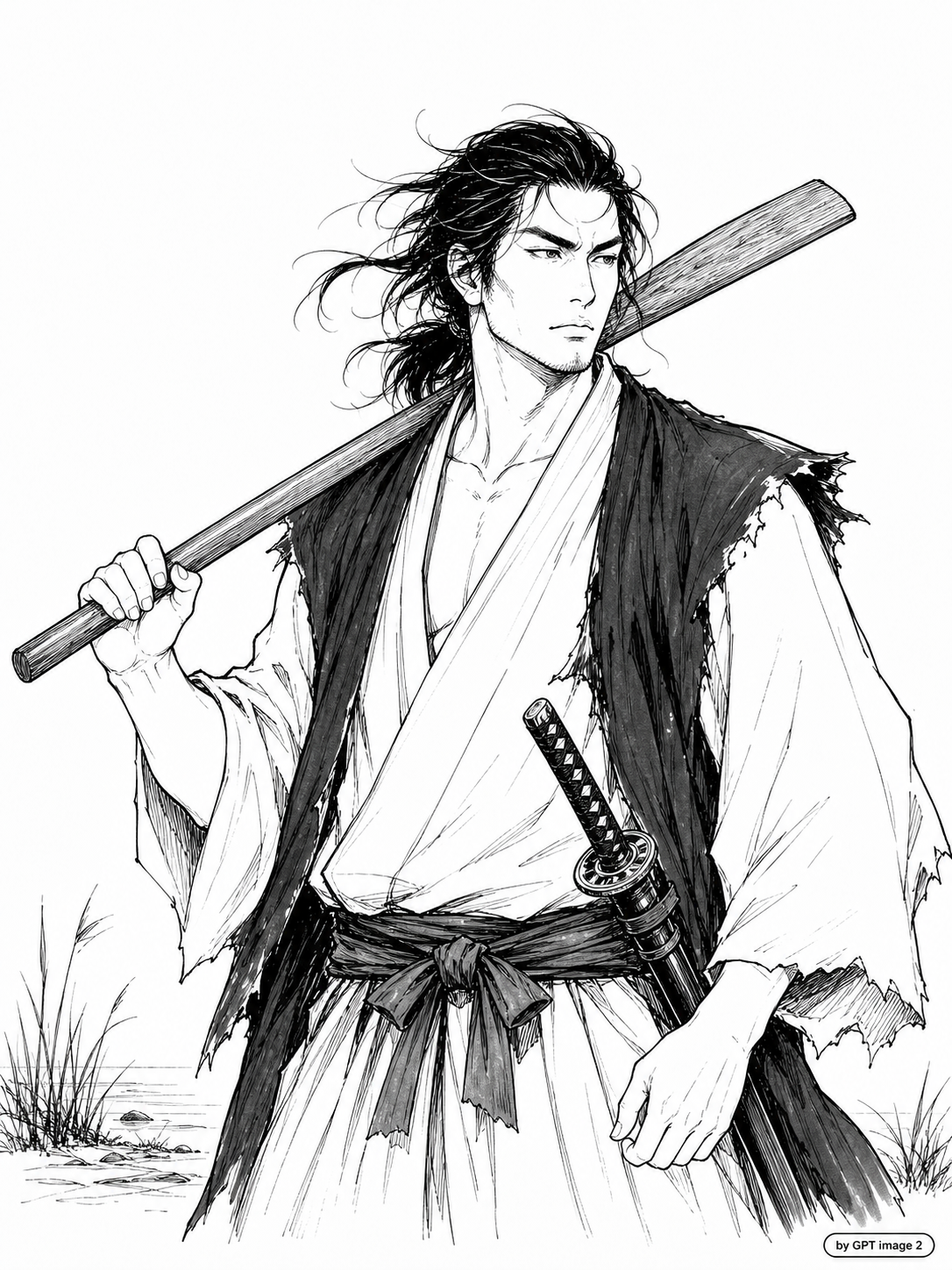
April 13, 1612. Early morning. The shore of Ganryujima (巖流島).
Musashi arrived at the shore two hours late of the appointed time. Across the already low-tide sea, Sasaki Kojiro had long been waiting.
Stepping off the boat, Musashi holds a wooden sword carved from an oar. Not a live blade. He walks toward the shore.
Kojiro rages.
"You are late, Musashi!"
Wordlessly, Musashi approaches one step at a time. Kojiro draws his sword. The long nodachi Monohoshizao (物干竿). Kojiro throws away his scabbard — a declaration of his own resolve.
Musashi tosses out a single line.
"Kojiro, you have already lost. The one who wins does not throw away his scabbard."
The two blades meet. Kojiro's first stroke cuts Musashi's headband. It nearly struck home. But in that instant Musashi's wooden sword strikes Kojiro's head.
Kojiro falls. Musashi turns and boards the boat again. By the time he left the island, Kojiro had already breathed his last.
#Scent — Life in History
#Life
Miyamoto Musashi — his formal name is treated here as Shinmen Musashi-no-kami Fujiwara Harunobu (新免武蔵守藤原玄信), with Musashi as the common name. "Shinmen Takezo" is treated as a later novel/pop-culture youth name, not this volume's historical baseline. Born in 1584 in Harima Province or Mimasaka Province (records diverge). His father was a jitte (十手 · implement) martial artist. From childhood he was raised to be a warrior.
Age 13 — the protagonist of the legend of his first duel victory. He is said to have defeated a Shinto-ryu swordsman named Arima Kihei. Many later biographies record this as the start of dozens of bouts.
Around age 20 (1604 tradition) — he is said to have dueled the Yoshioka family (吉岡家) of Kyoto several times. This fighting greatly raised Musashi's fame, but it is hard to conclude that the entire Yoshioka house vanished outright over this affair. Later sources preserve a tradition that even in early Edo, Yoshioka Kenpo carried on both a dyeing trade and the transmission of swordsmanship.
Age 29 (1612) — the duel of Ganryujima. He defeats Sasaki Kojiro. (the fiction above)
After age 50 — he immersed himself in martial study and painting, calligraphy, and philosophy. He wrote "The Book of Five Rings (五輪書)", a representative work of Japanese martial arts, and in painting too he left masterpieces such as "Shrike on a Withered Branch" (枯木鳴鵙図).
1645 — at age 61. He died in the Reigando (霊巌洞) cave of Kumamoto Domain just after completing the Book of Five Rings. Until the moment of death, he did not let his posture break.
#The Real Story
The legend of over 60 bouts undefeated: Musashi is commonly said to have gone undefeated in around 60 bouts over his lifetime. The exact count, however, rests more strongly on later biographies and tradition than on historical records.
"The Book of Five Rings": a work of martial philosophy completed in a cave just before his death. Five scrolls: Earth (地) · Water (水) · Fire (火) · Wind (風) · Void (空). To this day it is read as a classic of martial arts, management, and military matters. It is writing composed as a philosophy of life, not of swordsmanship.
Nito-ryu (二刀流): his most famous symbol. The technique of wielding the daisho (大小 — long sword and short sword) at once. Unorthodox for its time. The one who broke the common notion of "one sword in one hand."
Painting and calligraphy: his paintings are still highly regarded. Works such as "Shrike on a Withered Branch" (枯木鳴鵙図) survive, and his brushwork too is held to carry a swordsman's tension.
#Night Tales
"The two-hour tardiness of Ganryujima" — the anecdote that Musashi deliberately arrived late to disturb Kojiro's composure. With that psychological warfare he had already half won. The tactical part of the actual duel is not precisely confirmed — several traditions exist.
"The first duel at 13" — the story of beating the Shinto-ryu swordsman Arima Kihei with nothing but a wooden staff. A legend that reveals the violence of the young Musashi.
"The Dream of the Withered Tree" — a tradition that in his later years Musashi painted a single withered, dead tree all his life. His philosophy of the sword is projected onto that tree.
"Mahoujin Reincarnation tie-in": in co-09-10 he returns as a Shurado (修羅道). His "Berserker Rage" trait is the warped form, through demonization, of the guilt he lost through his many duels.
#Law — Lord-Grade Data
#School
Niten Ichi-ryu (二天一流) — applies the co "Nito-ryu" slot.
- Licensed:
[aptitude] Niten Ichi-ryu— simultaneous use of twin swords. - Secret art:
[Kata] Ganryu (巖流)— both swords at once for 3 Wounds (critical 4).
Historical / formal distinction:
- Historically, Niten Ichi-ryu is a separate school of Musashi's lineage, and not of the same line as the Itto-ryu (Ito Itto-ryu, Ono-ha Itto-ryu, etc.).
- This volume fixes the historical name as Niten Ichi-ryu (二天一流) and, on the rules side, borrows only the technique from the
co"Nito-ryu" slot.
#Lord-Grade Sheet
| Item | Value |
|---|---|
| Class | Ronin 10-dan (perfected Self-Taught Style) |
| Attributes | Courage 3 · Finesse 3 · Physique 2 · Wisdom 0 · Presence 0 · Fate 0 |
| Energy | 13 |
| Wounds | 7 (3+Physique 2+Tough 2) |
| Defense | Unarmored 10 / no recommended armor (wandering duelist, armor not recommended) |
| Swordsmanship mastery | Automatic success (Sword Saint) |
| Skills | Swordsmanship · Footwork · Stratagem |
| Key feats | Wind Blade · Ronin's Two Swords · Demon of the Core Zone · Tough 2 |
| Renown Title | Sword Saint (Saint of swordsmanship) |
| Three Ways and Six Hearts | 覇 (Way of Hegemony — everything for the sake of winning) + a late-life 眞 tendency |
#Unique Techniques
| Technique | Energy | Check | Effect | Limit |
|---|---|---|---|---|
| [aptitude] Nito-ryu Perfected (二刀流 完成) | 0 (always) | — | When using Nito-ryu, you may freely change the declaration order of the main and off-hand weapons, and once per breath you may append an off-hand defensive technique for 0 Energy. The perfected form of Niten Ichi-ryu. | Always |
| [Kata] Pinnacle of Five Rings (五輪の極) | 5 | 2d10+Courage+Swordsmanship+2 >= Defense | 3 consecutive strikes with the swords in both hands. On success 3 Wounds, on critical 4 Wounds. If both weapon techniques have already been used in the same breath, 1 additional Wound. | 1 time per battle |
#To Fight the Swordmaster
#Matchup
- Almost no weakness: Courage 3, Energy 13, Wounds 7. Even without armor, as a Sword Saint a head-on duel itself is difficult.
- Master of psychological warfare: tardiness, provocation, and other manipulation of the mood before combat.
#Three Paths to Victory
#Path 1 — Head-On (recommendation ★)
- Requires several 10-dan-grade PCs + a squad + Divine Artifact / devotion technique support.
- Attack after luring out and wasting his
Pinnacle of Five Rings, a 1-time-per-session technique.
#Path 2 — Earning Recognition (recommendation ★★★)
- He shows respect to one who is not shaken by his psychological warfare.
- If during the duel a PC waits for his tardiness and meets it without flinching — he may say "you are different" even before they fight.
#Path 3 — Bypass (recommendation ★★)
- In his later years he is taking on disciples. Entering as a disciple lets you avoid a one-on-one duel.
- A political connection to Kumamoto Domain is possible — the Hosokawa house.
#To Take the Swordmaster as Your Master
#Approach
Go to Kumamoto. In his later years Musashi stayed near Reigando as a guest (客人) of the Hosokawa house. You can knock on the gate.
#Conditions
- 覇 or 眞 in the Three Ways and Six Hearts.
- The resolve to walk the path of the Self-Taught Style — Musashi says, "Do not become a copy of me." He takes those who learn the technique but add their own interpretation.
- Being able to read and write is favored.
#Course of Instruction
- Years 1–2: the basics of Nito-ryu.
- Years 3–5: oral transmission of the philosophy of the Book of Five Rings.
- Full licensure: usually about 5 years. Musashi judges quickly.
#Rewards
- Transmission of Niten Ichi-ryu: at full licensure,
[aptitude] Niten Ichi-ryu. Then upon reaching swordsmanship Master,[Kata] Ganryu. - Part of "The Book of Five Rings" transmitted orally (provided to the PC as reading material).
- For a select few, the secret of Pinnacle of Five Rings.
- The name "Musashi's disciple" is one of the finest credentials in the samurai world.
#GM Notes
Musashi is "the name of an age." His appearance always becomes drama. Scenarios are mainly a recreation of one of his duels or a recollection of his later years.
Scenario hooks:
- A recreation of the Ganryujima duel — the PC takes part on Musashi's or Kojiro's side.
- A conversation with him before the Book of Five Rings is finished — a philosophical session.
- A yoma incident in Kumamoto — the aged Musashi takes up the sword again.
- A contrast with the
co-09-10Shurado demon version.
"A thousand days of training is called forging (鍛); ten thousand days of training is called tempering (鍊). Only when the two come together does a single sword form." — Miyamoto Musashi, The Book of Five Rings