#10. Yagyu Munenori — 柳生宗矩 · Perfecter of Edo Yagyu
Contents
- Lifespan: 1571~1646 (age 75)
- Era: Early ~ mid Edo
- School: Yagyu Shinkage-ryu (柳生新陰流) — see co school entry
- Aliases: Yagyu Tajima-no-kami (柳生但馬守) · "the shogun's instructor"
#Fiction Intro — "The Shogun's Swordsmanship Hour"
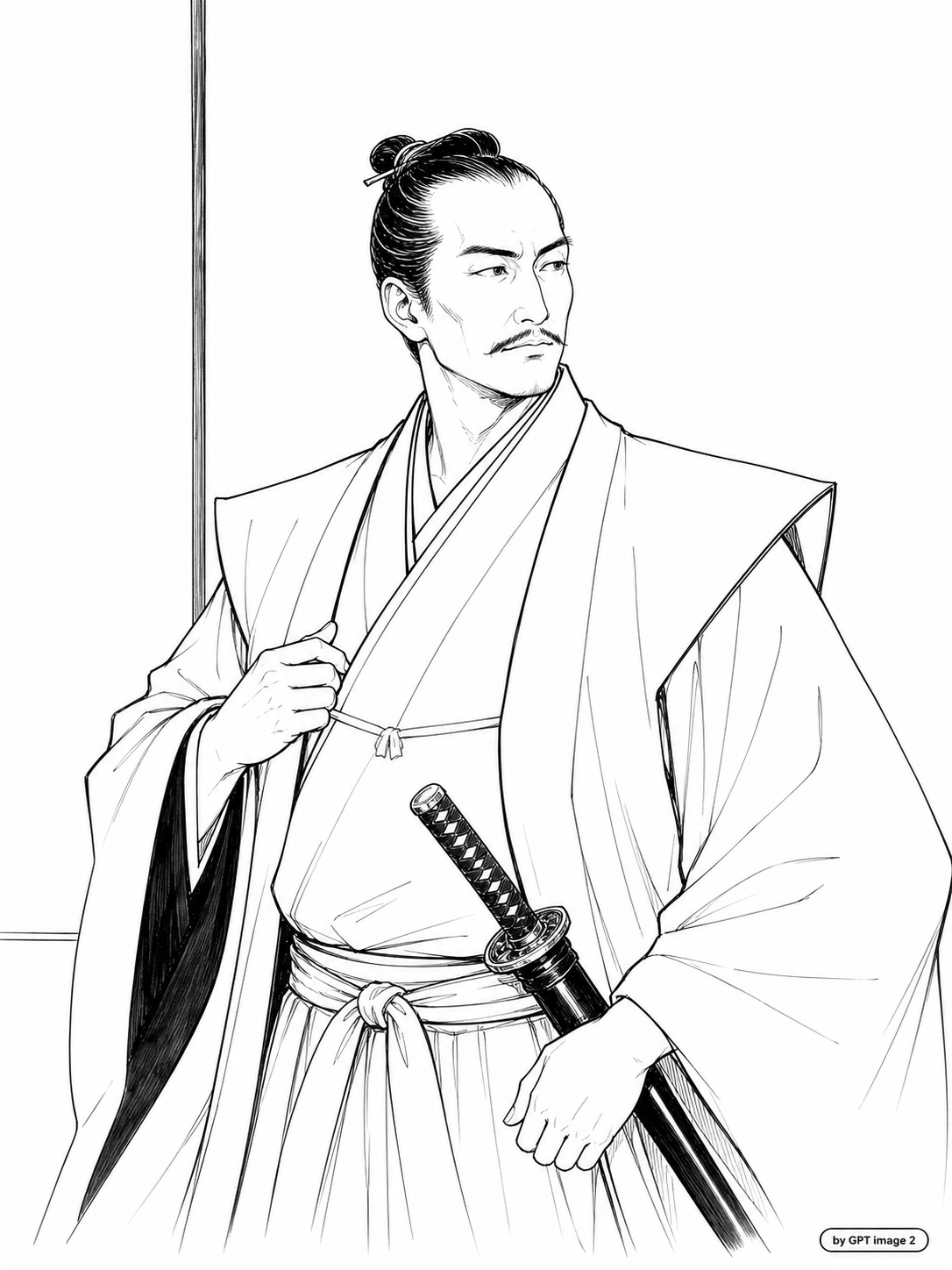
The 1620s. The Inner Court of Edo Castle. Shogun Tokugawa Hidetada is holding a wooden sword. Across from him stands Yagyu Munenori.
"Munenori, my mood is not good today."
"Then all the better, my lord. To keep one's stance even when the mind is disturbed — that is the very essence of the sword."
The shogun sighs. He swings the wooden sword. Munenori steps back exactly one pace and receives it. The shock reverberates through the shogun's arm.
"You read my anger."
"No. I read your breath, my lord. Anger reveals itself in the breath."
The shogun lowers his wooden sword.
"Munenori, you are no swordsman. You are a bureaucrat."
"The two are not different, my lord. One who reads a single breath — reads a single nation."
#Scent — Life in History
#Life
Yagyu Munenori — 1571. The fifth son of Yagyu Muneyoshi (Sekishusai). Not being the eldest son, he was at first fated never to inherit the house.
In 1594, after his father Muneyoshi performed before Ieyasu, Munenori too was introduced to Ieyasu and entered service. At this stage he was less the shogunal house's formal sword-method instructor than a man taken on as a retainer; thereafter he built up achievements and political standing to become the central figure of the Yagyu house.
Instructor across 3 generations of Tokugawa shogun: Ieyasu (1st) → Hidetada (2nd) → Iemitsu (3rd). He personally took charge of the education of the 3rd shogun, Iemitsu, in particular.
Edo Yagyu (柳生) — the branch through which Munenori was active, centered on Edo. His elder brother's line is the Owari Yagyu (the lineage of Yagyu Toshitoshi). The two branches coexisted throughout the Edo period.
Awarded the shogun-direct office of Tajima-no-kami (但馬守) — a high official directly under the shogun. An official post of a warrior. A daimyo-class stipend of about 10,000 koku.
He wrote the swordsmanship treatise "Heiho Kadensho (兵法家傳書)" — a work linking swordsmanship to a philosophy of governance. Together with Musashi's "The Book of Five Rings," it is one of the two great classics of Japanese martial philosophy.
Died at age 75.
#The Real Story
Politicizing "the life-giving sword": He extended the life-giving-sword philosophy of his father and his teacher (Kamiizumi) into politics. The interpretation that "the sword that gives life" is not merely about duels but is the principle of governing a nation.
The three volumes of "Heiho Kadensho":
- "Setsuninto (殺人刀)" — that killing a bad person is giving life to a good person.
- "Katsuninken (活人劍)" — the way of giving people life by something other than the sword.
- "Muto (無刀)" — ultimately, the state in which no sword is needed at all.
Fusion with Zen (禅) thought: Munenori was a lifelong friend of the Zen master Takuan Soho (沢庵宗彭). Takuan's "Fudochi Shinmyoroku (不動智神妙録)" — a letter explaining the union of sword and Zen — was addressed to Munenori. This is the origin of "Zen swordsmanship."
The Shimabara Rebellion (1637-38): a Kirishitan peasant uprising. Munenori took part on the shogunate side as a swordsmanship instructor (a policy advisor rather than an actual field commander). It was then that his "Setsuninto" philosophy was put to the test.
#Night Tales
"The dialogue with Takuan" — the exchanges between Munenori and the Zen master Takuan became classics of later tea ceremony, swordsmanship, and Zen Buddhism. "Where to place the mind" is the core theme.
"Instructor of the 3rd shogun" — Iemitsu, the 3rd shogun he educated, was the man who built the strongest shogunate in Japanese history. Munenori's "swordsmanship education" is judged to have been, in effect, the shaping of the shogun's character.
"He was not the eldest son" — a small reversal in his narrative. Had his brother not died, he would never have inherited the house. A chance of fate made one pillar of Japanese sword history.
#Law — Lord-Grade Data
#School
Yagyu Shinkage-ryu (柳生新陰流) — in co (the same school as his father Muneyoshi).
- Licensed · secret art: Shinkage-ryu
[Kata] Muto+[Kata] Katsuninken.
#Lord-Grade Sheet
| Item | Value |
|---|---|
| Class | Samurai 10th dan (scholar dual class) |
| Attributes | Courage 2 · Finesse 1 · Physique 2 · Wisdom 2 · Presence 1 · Fate 0 |
| Energy | 11 |
| Wounds | 6 (3+Physique 2+Tough 1) |
| Defense | Unarmored 10 / Armored 14 (tosei gusoku recommended, shogunate official field type) |
| Swordsmanship proficiency | +3 (Master) |
| Skills | Swordsmanship · Military Science · Negotiation · Stratagem |
| Key feats | Immovable Formation · Tactical Direction · Overall Command · Tough |
| Renown Title | Confucian General (儒將) (samurai+scholar dual-class Renown Title) |
| Three Ways and Six Hearts | 忠 (Way of Loyalty — shogunal house) + 眞 (Way of Truth) + 慈 (Way of Compassion) |
#Unique Techniques
| Technique | Energy | Check | Effect | Limit |
|---|---|---|---|---|
| [aptitude] Reading the Breath (呼吸を読む) | 0 (always on) | — | At the start of combat, the GM reveals the first target or first tactical axis of 1 enemy Lord/Elite. Negotiation · Stratagem checks +2. | Always on (including out of combat) |
| [Kata] Immovable Sword (不動の劍) | 4 | 2d10+Finesse+Swordsmanship+2 >= Defense | A defensive form that receives the opponent's attack. On success, 2 Wounds + the target cannot take its first action on its next round. The embodiment of Takuan's immovable wisdom. | 1 time per round |
#To Fight the Swordmaster
#Matchup
- A swordsman of politics: more than raw force, position and power are his weapons.
- Master of Negotiation: likely to try to settle things by dialogue before a fight.
#The Three Paths to Victory
#Path 1 — Head-on Duel (recommendation ★)
- Armored, his Defense is 14; in an unarmored duel, his Defense is 10. Either way, breaking through
Immovable Swordis difficult. - Squad attacks are essential.
#Path 2 — Win His Regard (recommendation ★★★)
- Respect him through dialogue. Show that you know philosophy · letters · Zen thought, and he will value the PCs.
- He prefers relationships over fights. Becoming his friend is easier than defeating him.
#Path 3 — Circumvent (recommendation ★★)
- Indirect pressure through the shogun · Takuan · other high figures.
- His political weakness — you can exploit the tension with rivals within the shogunate (the Ono-ha Itto-ryu side).
#To Take the Swordmaster as a Master
#Approach
Go to Edo. The Yagyu dojo is open to high-ranking samurai, but as a shogun-direct instructor, approaching him usually requires a domain lord's recommendation. For an ordinary ronin it is difficult.
#Conditions
- The 忠 Three Ways and Six Hearts.
- An aspiration to the dual path of letters and arms — Munenori teaches not the sword alone. Learning · Zen · a political sense come together with it.
- A stance that does not oppose the shogunal-house order.
#Course of Study
- Years 1~2: the basics of Shinkage-ryu (the same as what his father taught).
- Years 3~5: instruction in the thought of "Heiho Kadensho." The union of sword and Zen.
- Years 6~7: training in political sense — observation of and participation within the Edo shogunate.
- Full licensure (menkyo kaiden): 7~10 years.
#Rewards
- Transmission of Yagyu Shinkage-ryu:
Mutoat full licensure. After that,Katsuninkenonce you reach swordsmanship Master. - A transcribed copy of "Heiho Kadensho" is provided.
- To a very few, the secret transmission of Immovable Sword.
- A record within the shogun's shogunate — the road to a political career opens.
#GM Notes
Yagyu Munenori is "the swordsman of a statesman." His scenarios are diplomacy and negotiation rather than combat. A Lord-Grade sheet is provided, but his true worth shows in dialogue scenes more than in actual fighting.
Scenario hooks:
- Resolving an intrigue within the Edo shogunate — the PCs become Munenori's eyes.
- Appearing as an advisor on the shogunate side against the backdrop of the Shimabara Rebellion.
- A discussion with the Zen master Takuan — the PCs are witnesses to that scene.
"To win without using the sword is the sword. To govern without using words is politics. The two are the same." — Yagyu Munenori, "Heiho Kadensho"