#Taira no Kiyomori (平清盛)
Contents
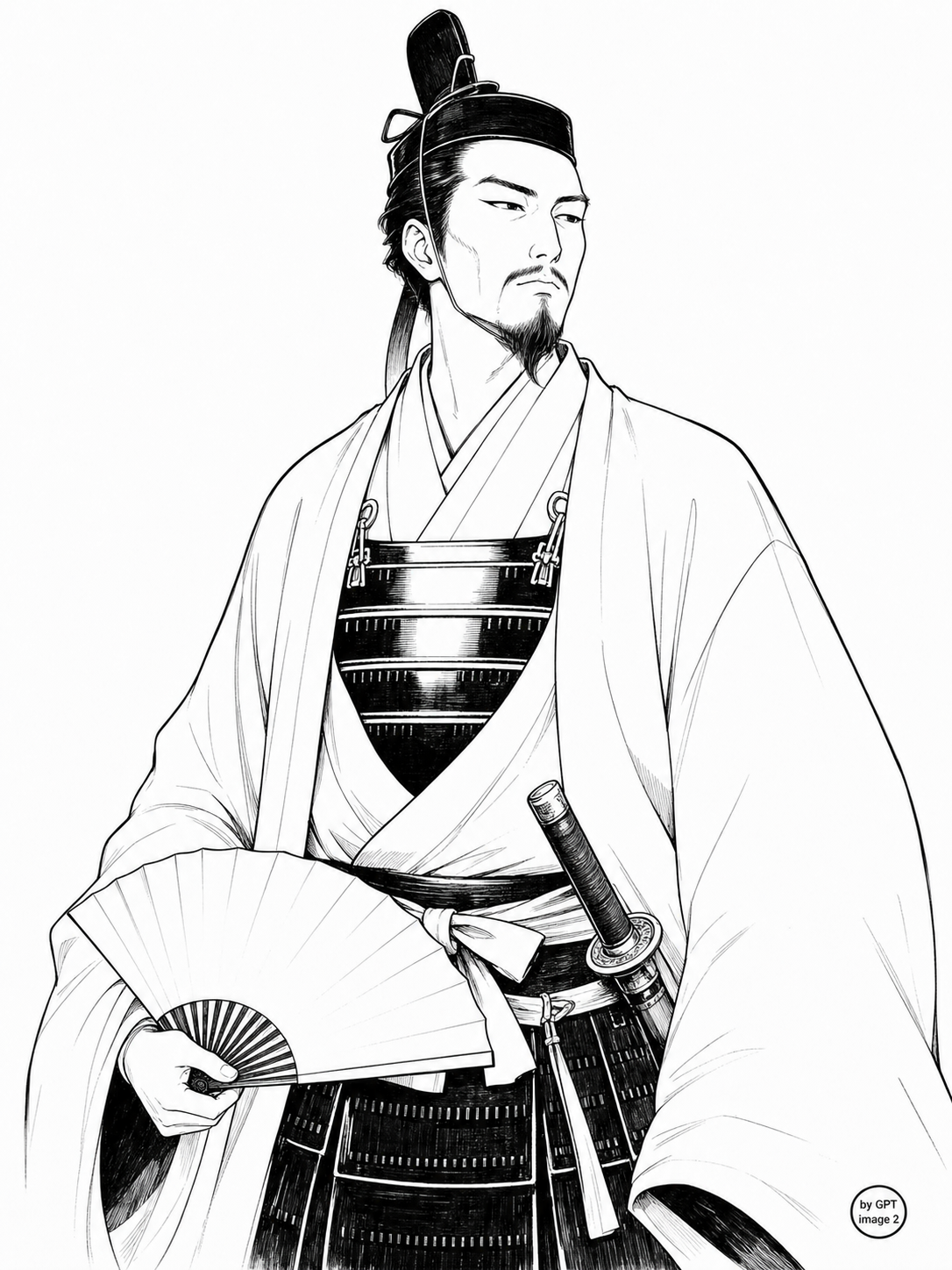
Fiction-Only + Canon (fc04-internal only). The character sheet of this document is fc04-internal Canon. Kiyomori is human and is not a yoma — the figure to whom this volume's war principle (human political strife) applies most strongly.
#Opening Fragment — The Shadow of the Crimson Banner
Kiyomori loved the moon. For under the moonlight even a crimson banner looked black. When it looked black, blood, glory, and sin all became for a moment the same color.
A young retainer asked, "My lord, they say that as the moon waxes full, so too does the house."
Kiyomori raised his cup. "The full moon does not last long. That is why it is beautiful."
"Then are you not afraid?"
He laughed. "Fear is a luxury of the lowly. Once you climb to the heights, even the time to be afraid must be entrusted to others."
But as the night deepened, a cold wind rose up from the sea. The banner swayed greatly once, and beneath the moonlight its shadow rippled like a wave.
Kiyomori believed the realm had come into his hands. But the sea is not a thing one grasps in the hand; it is the place where, in the end, all is taken back. That truth no one could yet speak.
#Scent — Glory Like the Full Moon, an End of a Single Breath
Spring of Jisho 5. A dwelling in Fukuhara. An old man lies on his bed. The old man is hot as if boiling. People try to pour cold water over his body, but the moment the water touches it turns to steam and vanishes. He raves.
"Bring me... the head of Yoritomo. Place it... before my grave. No other memorial offering is needed..."
These are the last words he left to his children. A few days later, he dies. After his death, a black mark remained where his body was cremated, and that mark did not vanish for a year — so the later Tale of the Heike recorded.
4 years after his death, the Heike clan sinks in the sea at Dan-no-ura. When the young Emperor Antoku, held in his grandmother's arms, asks "Where are we going?", his grandmother answers — "There is a capital beneath the sea, too."
This is the end of Taira no Kiyomori. The one who rose, the first of warrior origin, to Chancellor of the Realm; the one who stood at the summit of a glory that declared "He who is not of the Heike is not a person"; the one who died without seeing his own house perish within a single generation.
#Core Data
| Item | Value |
|---|---|
| Name | Taira no Kiyomori (平清盛) |
| Lifespan | 1118~1181 (age 64) |
| Era | Late Heian (the age of Emperor Go-Shirakawa and the cloistered rule) |
| Warrior House | Heike (平家) main line — the Ise Taira |
| Father | Taira no Tadamori (忠盛) — by one account, an illegitimate son of Cloistered Emperor Shirakawa |
| Court Rank | Chancellor of the Realm (太政大臣) — 1167, the first of warrior origin |
| Death | 1181, intercalary 2nd month. A fever at Fukuhara |
| After Death | The fall of the Heike at Dan-no-ura (1185), 4 years later |
#Life — The One Who Rose to the Summit of the Warrior Houses
#The Hogen Rebellion (1156)
The imperial house split in two, and the Fujiwara split in two. The deciders were the warrior houses. Kiyomori sided with Go-Shirakawa together with Minamoto no Yoshitomo (義朝) and won.
As a result of this rebellion, the warrior houses became, for the first time, the agents of political decision. It is the turning point of the late-Heian rise of the warrior. For the detailed timeline, see fc04-01-03-warrior-dawn.md.
#The Heiji Rebellion (1159)
3 years after Hogen. Minamoto no Yoshitomo conspired with Fujiwara no Nobuyori and raised arms. Kiyomori suppressed it. Yoshitomo was killed while fleeing, and his third son Yoritomo survived at a young age and was exiled to Izu — this is the one who, 26 years later, destroys the Heike.
As a result of this rebellion, Kiyomori became the sole warrior power-holder. The Minamoto house was all but annihilated.
#Maternal-Kin Politics — His Daughter Tokuko
Kiyomori married his daughter Tokuko (徳子) to Emperor Takakura (高倉天皇). In 1178 Tokuko bore a prince (the later Emperor Antoku), and in 1180 Antoku acceded as Emperor — Kiyomori became the Emperor's maternal grandfather. He reproduced, as a man of warrior origin, the maternal-kin politics the Fujiwara house had practiced throughout the Heian.
#"He Who Is Not of the Heike Is Not a Person"
The summit of the Heike clan's glory. Every high office in the capital was filled with the Heike. "He who is not of the Heike is not a person" — this one line, said to have been spoken by a Heike retainer, is the self-perception of the Heike at their summit.
The warrior houses rose to the Fujiwara's seats — the point at which the "kuge ≫ buke" balance maintained throughout the Heian collapsed. For details, see fc04-01-02-kuge-buke.md.
#The Anti-Heike Movement
When the balance broke, backlash began. The Shishigatani conspiracy of 1177 (a plan by the cloistered-emperor's side to overthrow the Heike). The uprising of Prince Mochihito in 1180. The Fukuhara transfer of the capital in the same year — Kiyomori moved the capital to Fukuhara (modern Hyogo), but it failed in 6 months and reverted to Kyoto.
In the same year (1180), Yoritomo raised arms in Izu, and the Minamoto clan answered across the realm. It is the start of the Genpei War.
#1181, the Death of Kiyomori
Jisho 5, intercalary 2nd month. Kiyomori suddenly fell ill at Fukuhara. He raved from the fever and died within days. Age 64. The Tale of the Heike recorded that he died in retribution for burning temples — there was an incident in 1180 in which he burned the temples of Nara, including Todai-ji (東大寺).
#After Death — The Fall of the Heike in 4 Years
After Kiyomori's death, the Heike collapsed swiftly. His heir Shigemori (重盛) had died before him in 1179, so there was no suitable successor — after Kiyomori's charisma vanished, the Heike fractured.
Juei 4 / Genryaku 2, the 24th day of the 3rd month, in the solar calendar 25 April 1185. The Heike clan sank in the sea at Dan-no-ura (壇ノ浦). The scene in which the grandmother (Kiyomori's wife, Tokiko) held the young Emperor Antoku (age 8) in her arms and leapt into the sea is the summit of the Tale of the Heike.
#The Spiritual Aspect — This Volume's Treatment
#Kiyomori Himself = Human. Not a Yoma
He is the figure to whom this volume's war principle applies most strongly. Kiyomori is human, and both his glory and his end are explained entirely by human motives.
#The Spiritual Echo After the Fall of the Heike
But the result is different. The Heike clan who sank at Dan-no-ura:
- The onryo of the Seto Inland Sea — the sea where the grievance of the Heike clan lingered.
- The Heike-gani (平家蟹) legend — the crab said to bear a Heike warrior's face on its shell.
- The spirit of the Heike's Emperor Antoku — the young Emperor lingering at the place where he sank.
- The "Heike-gani (平家蟹)" legend of Dan-no-ura — a later variant.
This spiritual echo is not treated in this volume but is carried over to later volumes — in keeping with this volume's principle of "spiritual manifestation as the result of war."
#Itsukushima Shrine
Throughout his life Kiyomori deeply revered Itsukushima Shrine (厳島神社, Hiroshima). He developed the shrine on a grand scale under his patronage and regarded it all his life as his own guardian shrine. The god of Itsukushima is registered among the Middle Gods (3rd rank) of fc01-02-03-chushin.md — "Itsukushima Myojin (厳島明神)."
The relationship between Kiyomori and Itsukushima Myojin is treated briefly in this volume, in about one line to the effect that "a relationship with divinity reinforces a figure's political legitimacy." The detailed shrine data follows the same method as the fc01 Tenjin sheet — using the fc01 volume as-is; this volume does not create a new sheet.
#To Later Volumes
The spiritual echo after Kiyomori's death is carried over to fc05 (Edo) and fc02 (Sengoku). This volume treats only Kiyomori himself.
#Character Sheet (Canon — fc04-internal only)
Canon (fc04-internal only). Based on Kiyomori at his summit (around the Chancellor period of 1167).
Taira no Kiyomori — Main class Samurai 10-dan + Renown Title
Wounds: 7 (3 + Physique 3 + Tough 1)
Defense: 16 (o-yoroi + Chancellor's formality)
Energy: 13 (10 + Finesse 3)
Attributes: Courage +3, Finesse +3, Physique +3, Wisdom +3, Presence +2, Fate +2
School: Ise Taira lineage (its own License + secret art)
Domination contribution: +6 (squad + politics)#Main Traits
- Yabusame (Samurai 1-dan)
- The Way of Bow and Horse (Samurai 5-dan)
- Resolve (Samurai 9-dan) — 1 time/session, instantly heal a squad member
- Maternal-Kin Politics (its own secret art) — political checks +3, automatic connections among the Emperor's confidants
- The Authority of the Chancellor (Renown Title) — a subordinate NPC's next action +1 to hit and evade
#Signature — The Authority of the Chancellor
| Technique | Type | Energy | Limit | Effect |
|---|---|---|---|---|
| The Authority of the Chancellor | Tactic:Kata | Energy 5 | 1 time/session | The next 1-breath action of every subordinate NPC Kiyomori has commanded gains +1 to hit and +1 to evade. Area. (The [Tactic:Kata] definition is co-03-07 § 2.5 Squad Tactic Notation) |
| Command of the Maternal Kin | upkeep | Energy 3 | 1 time/scenario | A command or petition to 1 NPC of the Emperor's or Fujiwara's side. GM's discretion. Can bypass a scenario decision point. |
| The Named Blade "Kogarasumaru (小烏丸)" | Kata (Courage) | Energy 3 | — | A named blade of the Taira lineage. 2d10+Courage+swordsmanship ≥ Defense. On a hit, 2 Wounds. |
#Scenario Use
#PCs in the Period of the Hogen and Heiji Rebellions
PCs appear as warriors of Kiyomori's side or the Minamoto side. Main class Samurai 5~7-dan recommended. Human political strife — no yoma appear. The place for PCs to shine is sword and bow, and political resolve.
#PCs in Kiyomori's Summit Period
Between 1167~1180. PCs are informants amid court intrigue, or warriors of a Heike collateral line. Events like the Shishigatani conspiracy and the Fukuhara transfer of the capital are the scenario stage. A scenario in which the PCs discover a clue to the anti-Heike movement suits best.
#PCs in the Deathbed Period
Between 1180~1185. PCs are those who keep watch over the Heike's end. As far as Dan-no-ura — this is a tragedy scenario. It is powerful as a campaign's concluding scenario. For the detailed depiction of Dan-no-ura, see fc04-99-00-closing.md.
#To Fight Kiyomori / To Serve Him
#To Fight Kiyomori
This volume's most powerful human NPC. Kiyomori at his summit (around 1167) is all but impossible to destroy by direct assault. One of the following routes is needed:
- Exploit a political rift — exploit a rift within the Heike or on the cloistered-emperor's side, as in the Shishigatani conspiracy.
- Avoid a direct duel — approach through successors such as Shigemori or Munemori rather than meeting Kiyomori himself if at all possible.
- Time — Kiyomori dies a natural death in 1181. The PCs need only survive until that point.
#To Serve Kiyomori
A scenario in which a Main class Samurai PC becomes a Heike retainer. Conditions:
- Main class Samurai — other classes find it hard to enter the Heike retainer corps.
- Of Ise or Aki origin — or a marriage tie to the retainer corps after relocating.
- Proof of martial merit — distinction in the Hogen and Heiji Rebellions.
On success: the PC becomes a Heike retainer. But they have begun a campaign that runs until Dan-no-ura in 1185 — a recruitment with tragedy foretold.
#Tone — The Bell of Impermanence
The Tale of the Heike opens with the following passage — the self-perception of the late Heian, and an opening that foretells Kiyomori's fate.
"Gion shoja no kane no koe, shogyo mujo no hibiki ari.
Sara soju no hana no iro, josha hissui no kotowari o arawasu."
"The sound of the bell of the Gion shoja, the echo of the impermanence of all things; the color of the sala flowers reveals the truth that the prosperous must decline."
A sudden end at the summit of glory. An age in which the glory one human raised perishes before a single generation has passed. Kiyomori's sheet is powerful — but the central tragedy of this figure is that power does not necessarily prevent the end.
#In One Line
"In life he rose as far as Chancellor, and in death he became the shadow of a glory that did not last a single generation."
#References
#co — Classes · Scenarios · Heroic Spirits
co-04-character/co-04-07-classes/co-04-07-01-samurai.md— Samuraico-09-adventures/co-09-09-minamoto-specter.md— Yoshitsune heroic-spirit scenario (died 1189. The later reappearance of the one who destroyed the Heike)co-04-character/co-04-08-samples/co-04-08-22-heroic-spirit-catalog.md— Heroic-spirit catalog (Benkei 6-dan — accompanies Yoshitsune)
#Within fc04
fc04-01-02-kuge-buke.md— The warrior houses that rose to the kuge's seatsfc04-01-03-warrior-dawn.md— The timeline of the warrior's risefc04-99-00-closing.md— Dan-no-ura — the Heian finale
#Other fc Volumes
fc01-02-03-chushin.md— Middle God (Itsukushima Myojin)fc02-01-02-war.md— Sengoku war (for contrast)fc03-99-01-kenshi-roster.md— Swordmaster roster (Yoshitsune, Benkei — those who destroyed the Heike)
#External Sources
- The Tale of the Heike (平家物語)
The full moon, too, wanes, and the crimson banner, too, sinks beneath the waves.