#The Three Ways in Daily Life
Contents
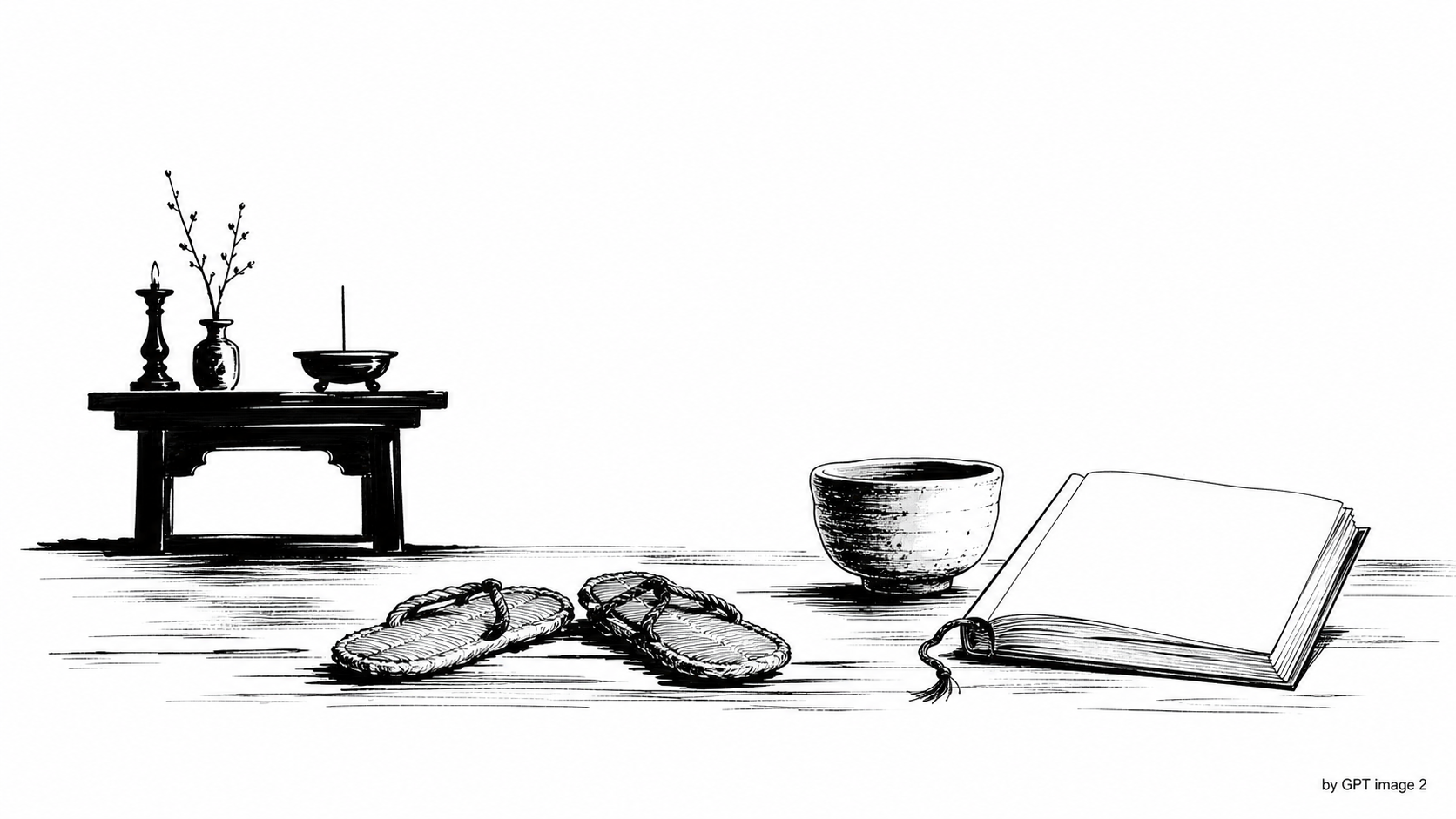
A person does not live by a single thought alone. In the morning he bows to his ancestors, at noon he reports to his lord, and at night he recites the nembutsu for the dead.
#Introductory Fragment — Four Bows of a Day
In the morning the low-ranking samurai Saemon bowed before the ancestral tablets. His mother held out a rice bowl and said, "Bring no shame upon the house." He left the house hearing the words of Confucianism.
At noon he received the lord's command. It was a command to handle the matter of an onryo in the village below the mountain. The document set down the scale of the damage and the locus of responsibility, but there was no name of the dead.
As the sun set, he met a monk at the temple. The monk first asked the name of the deceased and confirmed why the funeral had been delayed. "The tablet comes before the report," said the monk.
At night the ronin who had come with him set down his blade and counted his breath. "There are too many words," said the ronin. "Tomorrow, before the yoma, only one breath will remain."
And on the mountain road a hermit appeared. "Do not look only at the yoma. The well of that village has had its water-vein twisted since long ago."
That day Saemon heard four kinds of words. The words of the house, the words of the Buddha, the words of silence, the words of the mountain. Yet the choice had to be made with a single body.
#The Many Layers Within One Person
A person of premodern Japan does not move by modern identities alone, such as "I am a Confucian," "I am a Buddhist," "I am a Zen practitioner."
One samurai may offer Confucian loyalty to his lord, burn incense before the Buddhist altar at home, and learn Zen no-mind from his swordsmanship master. A village farmer may take part in the shrine festival, hold the funeral at the temple, and teach his child to be filial to his parents.
In Konsei Reiyotan too, if this overlap is brought to life, the figure does not become flat.
#The House
In the house there are ancestors. The ancestors are an object of Confucian filial piety, an object of the Buddhist memorial tablet, and at times remain in the form of a Shinto house-deity as well.
Moved into scenes, it goes as follows.
- Before going to war, a samurai bows before the ancestral tablets.
- A mother says to her son, "Bring no shame before the lord."
- An old servant wipes the dust from the Buddhist altar each day.
- A younger brother falls silent before the blade of his dead elder brother.
Here Confucianism and Buddhism are not divided but blend as the breath of the house.
#The Village
In the village there are a shrine and a temple together. The shrine connects with festival and purification, marriage and the naming of a child, and the bounty of the harvest. The temple connects with the funeral, the nembutsu, the memorial tablet, and the road of the dead.
Confucianism appears as the discipline of the village and the order of elder and younger, the authority of the village head, and the duty of parent and child.
When a yoma appears, whom do the villagers call first? It differs by the situation.
| Problem | The one called first |
|---|---|
| The voice of the dead | a monk |
| The defilement of well and forest | a shrine priest·shrine maiden, or a shugenja |
| A day of departure and an ill-omened star | an onmyoji |
| Betrayal within the village and the collapse of order | the village head, a warrior, a scholar |
| A silence and an attachment whose cause cannot be known | a Zen monk or a reclusive swordsman |
#The Battlefield
The battlefield is the place where Confucianism, Buddhism, Zen, and xian thought collide most roughly.
Confucianism sets the command. Who is the vanguard, who is permitted to retreat, who bears the responsibility for defeat.
Buddhism sees death. The funeral of the fallen, the arising of the onryo, the nembutsu left for the enemy, the karma of killing.
Zen sees a single breath. Whether fear stiffens the body, whether attachment slows the blade, whether one can accept the shadow of death.
A good battlefield scene arises when the three languages are heard at once. The general commands, the monk recites the nembutsu, the swordsman falls silent. And the yoma laughs.
#The Tea Room
The tea room is small. One sets down one's weapon and enters. One lowers the body and drinks the tea in a fixed order.
Here there is Confucian propriety. The order of who sits first, how one bows, and what words are discourteous.
There is Buddhist impermanence. The sense that the crack in the tea bowl, the old charcoal, and the once-only meeting pass away.
There is Zen silence. The moment when the sound of the boiling water comes to weigh more than words.
The tea room is good for an assassination scene, a reconciliation scene, and a Three Ways and Six Hearts shift scene alike. Precisely because there is no blade, the words are sharp.
#Education
In an Edo-style campaign, education is very important. The domain school, the private academy, temple education, the swordsmanship dojo, the master of tea, and the question-and-answer of the Zen monk are all education.
Confucian education teaches letters and propriety, filial piety and loyalty, history and rightful standing.
Buddhist education teaches the sutras, the funeral, the understanding of suffering, the nembutsu and practice.
Zen education gives no answer. When the disciple tries to find an answer, the master tells him to sweep the yard.
When you make a PC's master, deciding what education he received gives his manner of speech at once.
#The Funeral
The funeral is the stage of Buddhism, but Confucianism and Shinto cast their shadows too.
Confucianism asks the name of the dead and the house, and the duty of the child. Buddhism asks where the dead go. Shinto asks how to wash away the defilement of death. Zen sees the attachment of those who remain.
In Konsei Reiyotan the funeral is very important. If the funeral fails, it can lead to an onryo, transformation into a yoma, a curse upon the house, or the contamination of a divine precinct. But this too is not a new rule — it is the cause and effect of a scene.
#Daily-Life Scene Table
| Scene | Confucianism | Buddhism | Zen |
|---|---|---|---|
| Before departure | an oath to lord and house | a prayer for the rebirth of the fallen | a silence that accepts death |
| A meal | place and order | gratitude for life | the taste of plain rice |
| A letter | etiquette and title | karmic ties and impermanence | empty lines, short sentences |
| Master and disciple | duty and lineage | practice and compassion | question and silence |
| Punishment | rightful standing and responsibility | karma and repentance | a severance that cuts attachment |
| After a yoma subjugation | report and merit | offering and consolation of the dead | wiping the blade and not speaking |
Within one person's single day, the Three Ways do not walk apart but breathe together.