#Kageyama Castle 4-Mode Usage — One Castle, Four Times
Contents
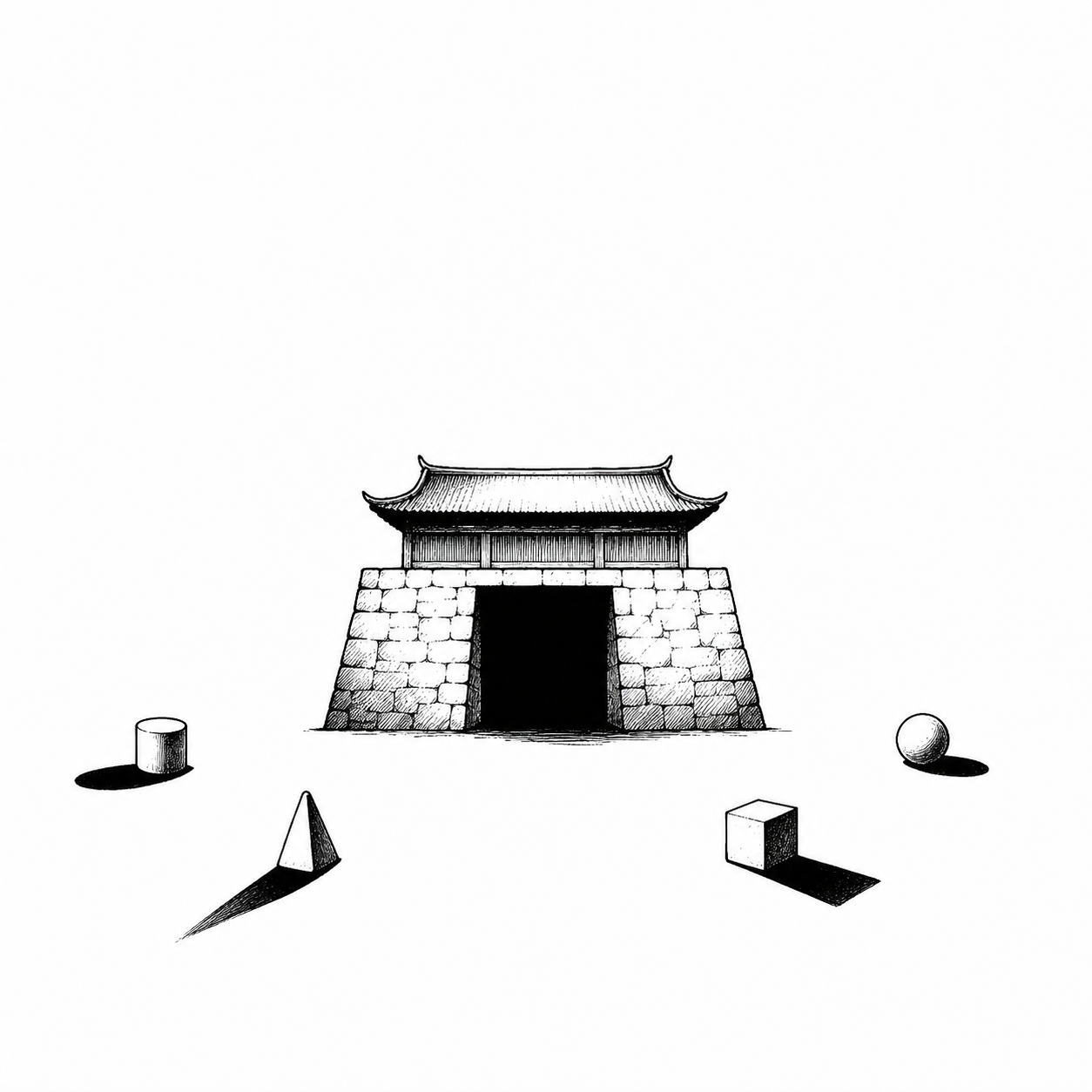
Campaign Module. This is the usage guide for reusing the one stage fixed by
07-01 Kageyama Castleas four faces: siege, defense, Infiltration, and ruins. It creates no new maps or new rules; it repositions the same structures and zone properties by mode (which 3~7 zones are drawn today) and reinterprets them (what the same structure becomes in each mode). It only cites the 03~06 guides and02-01·02-02, and does not redefine them — this is the demonstration of this volume's "one castle, four times."
#Scent — Same Gate, Four Gazes
Four people look at one otemon with different eyes.
- The attacker sees — a wall to break.
- The defender sees — the last line closed shut.
- The infiltrator sees — a shadow to slip around.
- The explorer sees — a collapsed tomb.
Same stone, four names. Kageyama Castle lives four times as one stage.
#§0 — How to Read This Document: Repositioning vs Reinterpretation
Scene Tool. This document only uses the stage from
07-01; it does not redefine it. No new numbers — only existing zone rules.
Two axes:
- Repositioning — choose the 3~7 zones to draw for today's scene from the full zone set in 07-01 (
02-01 §Law 4compression rule). Do not draw one castle on one map. - Reinterpretation — turn on different zone properties and scene pressures for the same structure by mode (
02-01 §Law 2·3). In siege, does the otemon block? In Infiltration, does it hide?
All four mode sections below use the same 4-slot frame (stage repositioning → structure reinterpretation → scenes/checks → mode shift).
#§1 — Structure ↔ 4-Mode Reinterpretation Master Table
Scene Tool. This unfolds the "GM hook (4 modes)" field from the
02-02 structure cardsinto one table (if a cell conflicts with the card, the card takes precedence).
| Structure | siege | defense and holdout | Infiltration | ruins |
|---|---|---|---|---|
| otemon | main gate Breakthrough (03 map) | Blockade and masugata pincer | karametemon (rear gate) bypass | broken door leaves |
| middle and inner castle gates | layered Breakthrough | retreat line | skip zones | collapsed inner kuruwa |
| narrow uphill path | fighting while climbing | rolling rockfall | mountain-shadow Infiltration | collapsed road |
| high watchtower | must be cleared before Breakthrough | shooting support | sleeping watchtower | collapsed watchtower |
| sannomaru yard | first foothold | first retreat line | outer perimeter entry | empty yard |
| ninomaru yard | second Breakthrough | command core | Infiltration between kuruwa | maze |
| honmaru | final Breakthrough (Core Zone) | last resistance line | direct Core Zone route | earthbound spirit throne |
| mountain/dry well | cut water source | drying clock | poison insertion and entry route | blood-water well |
| powder storehouse | arson target | heart of a long battle | powder theft | scorched residue |
| small shrine and shadow gate | Barrier destruction | spiritual wall | seal confirmation | sealed shadow gate |
| old secret passage | collaborator's back door | escape and relief route | main entry route | forgotten passage |
| castle town | pre-siege work | Popular Support=militia | Infiltration prep | abandoned town |
#§2 — Mode 1: Siege — "How Do We Open It?"
- Stage repositioning. Narrow uphill path + otemon + wall-top watchtower + ninomaru yard + honmaru entrance. Example maps:
co-05-0603 castle gate pressure battle, 19 mountain temple defense, 21 fortress counterattack. - Structure reinterpretation. otemon =
narrow pathBlockade Breakthrough (2d10+Courage ≥ 15) target / watchtower =high groundenemy firing position / honmaru =Core Zone boss lair. Fortress Defense =stone castle 15. - Scenes/checks. Substitute the reconnaissance → pressure → Breakthrough → honmaru scenes from
03-01and03-02. Odd Target Numbers (reconnaissance Perception 11/13, Blockade Breakthrough fixed 15, negotiation 13). - Mode shift. If stalled → Infiltration (secret passage bypass) / after occupation → defense (offense and defense reverse; now I defend it).
#§3 — Mode 2: Defense and Holdout — "How Many More Days Can It Hold?"
- Stage repositioning. Draw the same zones as §2, inverted into the defender's view — otemon=gate to close, watchtower=allied shooting/signals, mountain well and powder storehouse=supplies to defend, secret passage=double risk of collusion/escape.
- Structure reinterpretation. The same otemon shifts from siege's "Breakthrough target" into defense's Blockade point (assign Blockader, Defense +1) (
02-02 otemon). Well=supply depot/contamination, storehouse=fire attack hazard. - Scenes/checks. Substitute the closure, supply, reinforcement, sortie, search, Popular Support, and holdout-limit scenes from
04-01, plus the04-02 holdout clock(tick=scene).co-03-10: Popular Support ≥7 militia +1(cohesion 4), ≤2 cohesion -1 — numbers as written in co. - Mode shift. If the clock expires from a dry well or absent reinforcements → fall (siege side wins) / escape (leave by the Infiltration route).
§2 and §3 share the same map — this is the clearest proof of "repositioning."
#§4 — Mode 3: Infiltration — "What Do We Rescue Without Opening the Gate?"
- Stage repositioning. Use
Outside Zoneroutes (secret passage, sewer, cliff, roof) + castle town (information zone) instead of frontal zones. Outside Zone entry uses co as written (shinobi 0 Energy, Infiltration Master 4 points 2 Energy, Lightness Skill Saint 5 points). - Structure reinterpretation. The same watchtower becomes "surveillance route and guard-shift time"; well/kitchen become "infiltration route"; shrine becomes "Barrier evasion target." Cite
forest/brush,narrow interior, andtrapgimmicks. - Scenes/checks. Substitute rumor → disguise → route → guard shift → Core Zone from
05-01, plus the05-02 Infiltration maps. Among the 36 skills, only Infiltration, Perception, Negotiation, and Archery (if needed) — ranged action is Archery (not a separate gun skill), odd Target Numbers. - Mode shift. On discovery, immediately shift to a siege/defense scene (reuse the maps from §2 and §3). If the seal was already broken → foreshadow ruins.
#§5 — Mode 4: Ruin Exploration — "What Remains After Collapse?"
- Stage repositioning. Change only the state of the same zones to ruins — otemon=blocked/collapsed gate, watchtower=collapse hazard, storehouse=yoma-tainted/abandoned masterwork, shadow gate below shrine=weakened seal. Demonstration of 07-01 "current state: ruins."
- Structure reinterpretation. Reposition as
rockfall/collapse,Spiritual Contamination Zone(Fear Courage ≥ 11),spiritual vein, andBarrier. Spiritual elements referencefc08, but if absent, they are self-contained with co gimmicks + GM discretion. - Scenes/checks. Substitute approach, search, blocked gate, earthbound spirit, yoma-tainted storehouse, forgotten passage from
06-01, plus06-02 ruin d100. Exorcism and Perception odd Target Numbers, cleansing Exorcism ≥ 15. - Mode shift. On seal collapse → yoma suppression battle (Core Zone=lord-grade lair) / on survivor or descendant discovery → escort/negotiation scene.
#§6 — Connecting 4 Modes in One Campaign
The four modes are not separate scenarios; they are one castle's timeline. Example route where one campaign visits Kageyama Castle four times:
- Infiltration reconnaissance — border intelligence confirms the castle's weak points (dry well, secret passage). (On discovery → forced siege.)
- Siege — attack the castle using the discovered weakness. (On stalemate → holdout reversal.)
- Defense after occupation — defend the castle you seized against the counterattack. (If the clock expires → fall/escape.)
- Ruin revisit years later — return to the collapsed castle to face the sealed shadow gate.
The same stones become a stage four times — that is how this volume's 18 documents create depth from a compact page count.
#§7 — Quick Reference Links
- Master table 1-line summary = "same structure, four meanings" (§1).
- 4-mode central questions: siege=how do we open it / defense=how many days can it hold / Infiltration=what do we rescue / ruins=what remains.
- The entry point to open during play is
99-01 quick reference.
"Kageyama Castle is not one building — it is the lifetime of one stage, reading the same stones four times."