#Chapter 11 — Solo Mode: The Oracle
Contents
It is fine if you have no one to cross blades with yet. This chapter covers how, with no GM, you alone run a short adventure with this book alone. Having a companion is fine too — the oracle works just as it is even when a GM must open a world on the spot.
This chapter is the one layer in this book that is newly assembled. Even so, the tools you roll with do not change. There is no new die, no new table system. You lay onto the oracle the very grammar of 2d10, doubles, and the Critical Hit you have already learned. You simply hand the judgment the GM used to make — "is it there," "what does the enemy do" — over to the dice and a priority table.
This chapter is the only new-rules layer in the entire handbook. The solo oracle changes not a single other rule; it is an opt-in tool that fills only the GM's empty seat.
#1. The Promises of a Table Without a GM
A table you run alone has no referee. So for the table to keep rolling, a few promises must be set down first.
- You sit in two seats at once. One is your character's seat — the seat that decides what you want and where you point the blade. The other is the world's seat — the seat that rolls for what the world answers your character with. The oracle is the device that holds you back from taking sides in the second seat.
- Ask honestly. The oracle is useless on a question whose answer you have already decided. Roll only on questions whose answer really could go either way — "does a sentry stand at the end of the corridor," "did this merchant catch on to who I am."
- Accept the result that comes. If the oracle rolls "No," then in that world it is No. Do not reroll even if you dislike it. The unexpected result is precisely the force that keeps a table run alone alive.
#The Scene-Framing Loop
Solo play rolls in units of scenes (scene). One scene goes once around the following four steps.
- Declare the goal — decide in one sentence what your character means to accomplish in this scene. "Slip past the checkpoint," "learn the whereabouts of the yoma from the village headman."
- Oracle — ask the oracle the facts you need to set up the scene (§2). "Is there a sentry at the checkpoint," "is the headman cooperative." If needed, roll here too for whether there is an encounter (§3).
- Check / Combat — roll the actual check against the situation the oracle set up. For a skill check, follow the rules of Chapter 3; for combat, follow the solo combat procedure (§4).
- Record — write in the journal what happened in this scene and what has been newly fixed into the world (§5). The next scene's goal usually grows from here.
When one loop ends, move to the next scene and declare a goal again. A campaign is this loop stacked up over many turns.
Source: The solo scene loop is a new rule of this handbook (a Chapter 11 layer). The check, combat, and skill rules used are themselves cited from Chapter 3 (co-03-03–07).
#2. The Question Oracle
When a yes/no question you want to ask the world arises, roll the oracle. The grammar is just as you already know it.
#How to Roll
- Gauge the Likelihood that the question comes true as one of three: Likely, Even, Unlikely.
- Roll 2d10 and sum them, then add the ±2 modifier according to Likelihood.
- Read the value that comes up (modifier included) on the result table below.
| Likelihood | Modifier | When |
|---|---|---|
| Likely | +2 | It stands to reason. If things go as they naturally would, yes. |
| Even | ±0 | It could go either way. Fifty-fifty. |
| Unlikely | −2 | It would be a surprise. There is no good reason for it to be so. |
If you cannot gauge it, use Even. The oracle is a rough estimate, not a calculation.
Source: The 2d10 summing, the bell curve, and the modifier grammar are from co-03-01 §2d10 basic check. The ±2 Likelihood modifier and the 4-way result thresholds are a new rule of this handbook (a Chapter 11 layer).
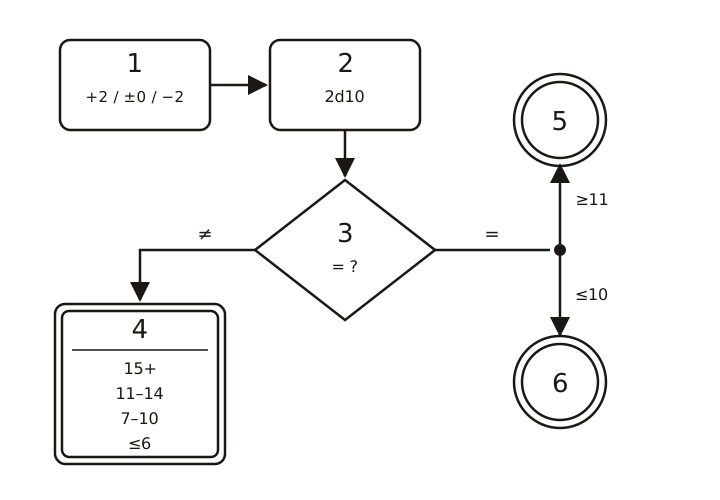
| Number | Meaning |
|---|---|
| 1 | Choose likelihood — likely/normal/unlikely (+2/±0/−2) |
| 2 | 2d10 + likelihood modifier |
| 3 | Check whether the dice are doubles |
| 4 | Read the 4-band result (when not doubles) |
| 5 | Good twist (doubles & final 11 or more) |
| 6 | Bad twist (doubles & final 10 or less) |
#Result Table (When Not Doubles)
Read the final value with the modifier added. If the two dice show the same face, go to the Twist rule below instead of this table.
| Final Value | Result | Meaning |
|---|---|---|
| 15 or more | Yes, and | Yes — and on top of it, something to your advantage comes with it. |
| 11 – 14 | Yes | Yes, just as asked. |
| 7 – 10 | No, but | No — yet a small opening or consolation remains. |
| 6 or less | No | No, just as asked. |
You fill in the "and" and the "but" with story. If Yes, and comes up for whether a sentry is "there" at the checkpoint — there is one, and on top of that he is dozing. If No, but comes up — there is none, but the footprints of a patrol that just passed are still wet.
#Doubles = Twist
If the two dice show the same face (1-1, 2-2 … 10-10), the oracle goes beyond a simple yes/no and delivers a Twist. It applies the grammar of the check's Critical Hit and Fumble as is.
- If the final value with the modifier added is 11 or more → Good Twist. Yes, and dramatically so. A turn far more favorable than expected opens up. (corresponds to a Critical Hit)
- If the final value is 10 or less → Bad Twist. No, and harshly so. The situation tangles far worse than expected. (corresponds to a Fumble)
A Twist is an event that swings the scene's direction hard. A new enemy bursting in, an unexpected betrayal, the discovery of a hidden passage, or the catastrophe of the ground giving way beneath your feet. What to put in is yours to decide, but treat its weight at the same grade as a Critical Hit or a Heavenly Mandate.
#3. Encounters
When setting up a scene, if you need "what do I run into here," roll the encounter table. First ask the oracle whether there is an encounter (usually Unlikely to Even), and if there is, roll the tables below. Here we carry only the Mob, Minion, and Veteran-grade range you can roll lightly even on your own — the yoma above that are the core rulebook's domain.
#Encounter Table (d10) — Mob, Minion, Veteran-grade
Roll one d10 and read what appears. The stats are carried over from the yoma bestiary of the core rulebook (co-08-02).
| d10 | Encounter | Grade | Key Stats |
|---|---|---|---|
| 1 | Nothing | — | A phantom of sound alone. It passes leaving only tension. |
| 2 | Zakki (雜鬼) swarm | Mob | Wounds 0 (instant death on declaring an attack) · Domination 0.5. No action of its own. |
| 3 | Ayakashi (妖) corpse-fire | Mob (naval) | Wounds 0 · Domination 0.5. Helpless alone; dangerous when dozens gather. |
| 4 | Gaki (餓鬼) | Minion | Wounds 1 · Defense 10. Claw-rend (2 Energy, Courage, 1 Wound) · frenzied bite (friend or foe alike). |
| 5 | Yoko (妖狐) | Minion | Wounds 1 · Defense 11. Claw (2 Energy, Finesse, 1 Wound) · Disguise stance · illusion evasion (reservation 1 / improvised 2). |
| 6 | Funayurei (舟幽靈) | Minion (incorporeal) | Wounds 1 · Defense 12 · incorporeal (physical d100 01–50 negated). Bailing ladle (ship flooding) · fog-calling. |
| 7 | Ogumo (大蜘蛛) | Veteran | Wounds 3 · Defense 13. Venom fang (1 Wound + poison) · spider silk (binding, no movement 1 round). |
| 8 | Kappa (河童) | Veteran | Wounds 2 · Defense 12. Arm-stretch (binding) · shirikodama (2 Wounds to a bound target). If the dish dries, Wounds 0. |
| 9 | Wandering Minion/Veteran yoma | Minion–Veteran | One of 4–8 above roams with no commander. Acts independently with Energy 10 (8 if weak, 12 if strong). |
| 10 | Twist | — | Apply the oracle's doubles rule to the encounter. The presence of a higher-grade yoma, or an unexpected ally. Decide it to fit this table's context. |
The stats in this table are enough to run combat on their own. If you want the full sheet, with its defensive techniques and special effects, it is in the yoma bestiary of the core rulebook (co-08-02).
Source: The Mob, Minion, and Veteran stat blocks are all from co-08-02 (Zakki, Ayakashi, Gaki, Yoko, Funayurei, Ogumo, Kappa). The wandering-yoma Energy 10 rule = co-08-02 §wandering yoma.
#Scent (香) Roll Table (d10) — The Encounter's First Impression
Whatever you have run into, that being comes first by Scent (香) before it comes into sight. Once the encounter is set, roll d10 once more to set that first impression. The descriptions below draw each individual's traits from the Scent passages of the core rulebook's yoma bestiary and compress them.
| d10 | First Impression (Scent) | Source Individual |
|---|---|---|
| 1 | A sound like a thin whistle flickers at knee height. If a blade grazes it, it simply scatters. | Zakki |
| 2 | The rasp of dry hide and the sound of swallowing come first. Its hunger does not tell friend from foe. | Gaki |
| 3 | A wild dog's crouch sliding through the underbrush — turn around, and it stands at your side wearing a fellow traveler's face. | Yoko |
| 4 | The mist thickens, and an empty boat draws near without a sound. Pale hands grope along the gunwale. | Funayurei |
| 5 | Sticky threads cling to your face. Raise your gaze, and in the dark eight eyes gleam at once. | Ogumo |
| 6 | The water pooled in the shallow dish atop its crown sloshes. Slick blue-green skin luring you to the water's edge. | Kappa |
| 7 | The calm water surface seethes for no reason, and pale corpse-fire spreads across dozens of points. | Ayakashi |
| 8 | The ground rumbles, and a low growl mixed with snorting breath is heard first. Something far larger than a man. | (a higher-grade presence — oni kind) |
| 9 | An omen of wind comes ahead. A gust rises in the valley, and something looks down from atop the mountain. | (a higher-grade presence — tengu kind) |
| 10 | No footsteps, only a chill comes ahead. The scrape of armor scales rubbing of their own accord. A premonition that the blade will pass through nothing. | (an incorporeal presence — onryo kind) |
8–10 are Scents that hint at the presence of a higher-grade being not on the table. If what came from the encounter table and this Scent are at odds, take that very discord as a clue — the real thing may not yet have shown itself.
Source: The Scent descriptions are an abridgment of the §Scent original text for each individual in co-08-02 (Zakki, Gaki, Yoko, Funayurei, Ogumo, Kappa, Ayakashi, and the presence of oni, tengu, and onryo).
#4. The Solo Combat Procedure
Once you enter combat, the GM does not move the enemy for you. In its place, an enemy action priority script takes that seat. When the enemy's turn (its own count) comes, run down the order below from the top and execute the first executable item. If you cannot meet a condition, drop to the next item.
#Enemy Action Priority Script
- Stance [stance] — if no stance is being maintained, there is Energy to spare, and this enemy has a stance technique, declare it first. (A stance is 1 at a time.)
- Limited technique (limited special attack) — if there is a
[License]technique or a strong technique with a limited number of uses like "1 per round" or "1 per combat," and it can still be used in that table, use this. Do not save it. - Basic attack — if the two above are impossible, fill a single breath with the standard attack technique (Attack A / Attack B, whichever's to-hit is favorable).
- Reservation (defensive reservation) — if there is no spare strength to attack, or the next hit is plainly foreseeable, reserve a defensive technique with the leftover Energy.
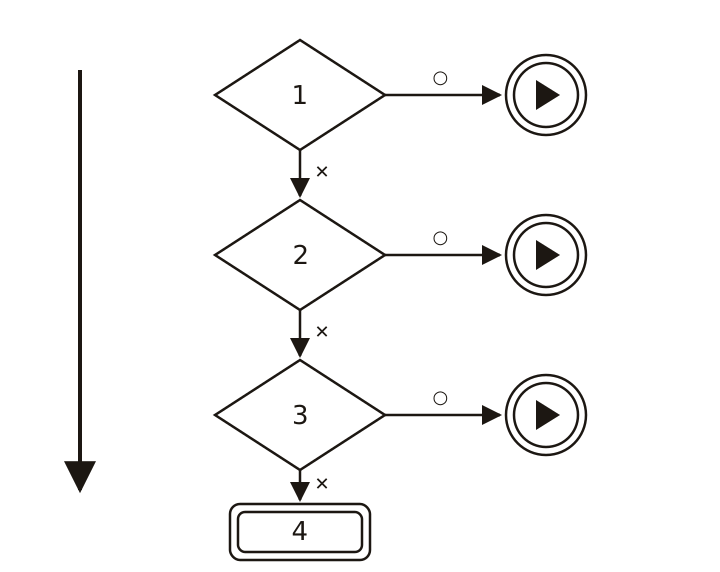
| Number | Priority |
|---|---|
| 1 | Stance |
| 2 | Limited technique |
| 3 | Basic attack |
| 4 | Reserve |
| ○ | condition met — execute that item and end this turn |
| ✕ | condition not met — go to the next item |
This script is the same rule as the enemy-AI policy of the Combat Simulator published on the official site — stance → limited technique → basic attack → reservation. Because the book and the tool use the same algorithm, the combat balance verified with the tool holds just the same when you roll it by hand at the table.
Source: The priority script = the same as the AI policy of the official Combat Simulator (carried on the site). The 1 stance slot, reservation/improvised, [License], and the round/combat limits are cited from co-03-04 · co-03-07.
#Handling Targets and Checks
- Target selection: In a 1:1, there is only one opponent. If you have a squad along (see Chapter 10), the enemy, unless it is an enemy squad following the squad-order rules, by default aims at your character (the most threatening unit).
- To-hit / damage: The enemy's attack check and damage are just as in the rules of Chapter 3. Roll to-hit with
2d10 + attribute + proficiency >= your Defense, and a hit = 1 Wound, a Critical Hit (doubles + success) = 2 Wounds (that value if the weapon states one). There is no damage roll. - Your defense: If there is a defensive technique reserved against the enemy's attack, it fires at 0 Energy. With no reservation you may use an improvised reaction, but the cost is 1.5× the base reservation cost (rounded up). There is 1 defensive reaction per hit.
- Fate Intervention: A character with Fate (Fate) can adjust one d10 by ±1 right after rolling 2d10. Once per combat for each point of the Fate modifier (at least 1 time even if Fate is low). The last intervention can be saved as a final bastion to make the to-hit of a lethal blow that would drop you to Wounds 0 miss outright.
#Win and Loss — A Design Where You Do Not Die
Solo combat too follows the Chapter 3 incapacitation rule. When Wounds reach 0, that unit is incapacitated and removed from the battlefield. On a table run alone, however, it is recommended to treat defeat not as death but as a branch — you are captured, or driven off, or escape alive having lost something important. Either way, the story continues. If life or death is at stake after combat ends, roll the death check (2d10 + max(Physique, Fate) >= 11, surviving gravely wounded on success).
Source: To-hit, damage, the Critical Hit 2 Wounds, Fate Intervention, incapacitation, and the death check are cited from co-03-01 · co-03-05. The "defeat = branch" recommendation is this handbook's solo design (a Chapter 11 layer).
#5. The Journaling Format
On a table run alone, the journal stands in for the GM's notes. If you do not write down what has been fixed into the world, you will ask the oracle the same question again in the next scene. The format is free, but if you fill the five fields below for each scene, the table will not come apart.
◆ Scene N — [Title]
  Goal    : (what you tried to accomplish in this scene)
  Oracle  : (question → Likelihood → result. e.g., "is there a sentry / Even / No, but — the footprints are wet")
  Turn    : (what actually happened through the check/combat, two or three lines)
  Fixed   : (facts newly set into the world — not to be re-asked of the oracle next time)
  Next    : (the thread of the next scene that grew from here)
The "Fixed" field is the heart of this format. Gather here the answers the oracle gave, the identities of the yoma you met, and the names and places you learned, and it becomes your own world dictionary. The longer the campaign runs, the more this list holds up the table.
#A Worked Example of a Single Scene
Let us actually roll the first scene of the Exorcism Pilgrimage seed (§6) with Masamune (1st dan) from the Chapter 5 walkthrough.
Scene goal: "Uncover the identity of what plagues this village."
- Question 1 — "Is the headman telling the whole truth?" He seems frightened, so gauge it as Even (±0). 2d10 =
[6,3], sum 9 → the 7–10 band, No, but. It is not a lie — yet he is not telling all of it either. He is afraid of something. - Question 2 — "Does what he is hiding have to do with the yoma?" You saw a torn ward at the village entrance, so Likely (+2). 2d10 =
[5,5]— doubles. Sum 10+2 = 12, 11 or more → Good Twist. Yes, and dramatically so — the headman breaks down and confesses. For the past three days, he says, his daughter's laughter has been heard from the shrine on the hill behind. His dead daughter's. - Encounter — the shrine path at dusk. Is there an encounter? Even.
[8,4], sum 12 → Yes. Encounter table (§3) d10 = 7 — Ogumo (Veteran, Wounds 3 · Defense 13). Scent roll d10 = 5 — "Sticky threads cling to your face…" The apparition of the shrine was no mere fox, but a spider. - The first breath of combat — Masamune (Energy 11) moves first. Horizontal cut (2)
[7,4], sum 11+3 (Courage + swordsmanship) = 14 ≥ 13, a hit; Ogumo's Wounds 3→2. Horizontal cut (2)[3,5], sum 8+3 = 11 < 13, a miss. With the leftover Energy, reserve a Parry (1). Now it is Ogumo's count — run down from ② limited technique of the enemy script (§4): it attempts spider silk (binding). From there it flows on just as in the rules of Chapter 3.
When combat ends, write it in the journal.
◆ Scene 1 — The Laughter at the Shrine
  Goal    : uncover the identity of what plagues the village
  Oracle  : does the headman tell the whole truth / Even / No, but — he is afraid
            does what he hides have to do with the yoma / Likely / Good Twist — a dead daughter's laughter
  Turn    : engaged Ogumo on the shrine path. Shaved off 1 Wound on the first round and parried the spider silk
  Fixed   : the headman's daughter is dead · an Ogumo dwells at the shrine · the ward at the entrance was torn
  Next    : what was the daughter's "laughter" — the spider's illusion, or something else
Two questions, one encounter, one breath of combat — this much is the actual bulk of a single scene. The three lines of the "Fixed" field become the foothold for the next scene.
#6. 3 Campaign Seeds
If you are at a loss for what to set as your goal, start from one of the three seeds below. Each seed sets the goal of the first scene and the grain of the questions you will often put to the oracle.
#The Wandering Swordsman (放浪劍客)
A swordsman who walks the road with no fixed destination. Moving from village to village, wherever he goes he seeks an opponent to test himself against and builds up a name. The first scene's goal is usually "find a swordsman worth crossing blades with in this town." Ask the oracle about the opponent's skill, temperament, and the pretext of the duel. If you want to roll out each and every duel for real, swap in the hatashiai rules (zn10, "The One-Ma Duel") — a mini-engine that handles a 1:1 duel by aiming distance (ma) rather than by zone, letting you actually cross blades with the swordmasters of fc03's Chronicle of Japanese Swordmasters. More than the win or loss, carve into the journal the Renown Title built up in the process and what you lose even in victory.
#The Exorcism Pilgrimage (退魔巡禮)
A pilgrim who tours, one by one, lands tormented by yoma. When you quell one town's calamity, the rumor of the next town calls. The first scene's goal is "uncover the identity of what plagues this village." This is the seed that uses the oracle and the encounter table (§3) most actively — you will keep asking what appears, what its weakness is, whether the villagers' words are true. The yoma you meet start at Mob, Minion, and Veteran-grade, and you track with the oracle whether an Elite or Lord-grade lies behind them. If you take the discord of the Scent (香) roll table as a clue, the tension of "the real thing is still hidden" comes alive.
#The Restoration of the House (家門再建)
The last scion of a house fallen in the wars. A long-breathed seed of gathering the scattered old retainers again, reclaiming the lost home ground, and counting the foes. The first scene's goal is "find the whereabouts of one old retainer." Ask the oracle often about the human heart — is this one still loyal, is this alliance to be trusted, who lies behind the rumor. Since negotiation and decision tend to be the center more than combat, it is especially important to keep piling up figures and relationships in the journal's "Fixed" field. As the gathered number grows, it naturally swells into scenes of leading a squad (Chapter 10).
#Summary
- The scene loop: Declare the goal → Oracle → Check/Combat → Record. This one loop is the unit of solo play.
- The oracle: 2d10 + Likelihood modifier (Likely +2 / Even ±0 / Unlikely −2). Final value 15↑ = Yes, and · 11–14 = Yes · 7–10 = No, but · 6↓ = No. Doubles = Twist (value 11↑ Good, 10↓ Bad — applying the Critical Hit and Fumble).
- Encounters: The d10 encounter table (Mob, Minion, Veteran-grade, cited from co-08-02) + the d10 Scent roll table for the first impression.
- Solo combat: The enemy moves by the priority script (stance → limited technique → basic attack → reservation) — the same as the combat-sim AI policy. Defeat = branch.
- The journal: the five fields of Goal, Oracle, Turn, Fixed, Next. "Fixed" becomes your own world dictionary.
- Seeds: The Wandering Swordsman (hatashiai · zn10 tie-in) · The Exorcism Pilgrimage · The Restoration of the House.