#Wounds and Defeat (戰力與敗)
Contents
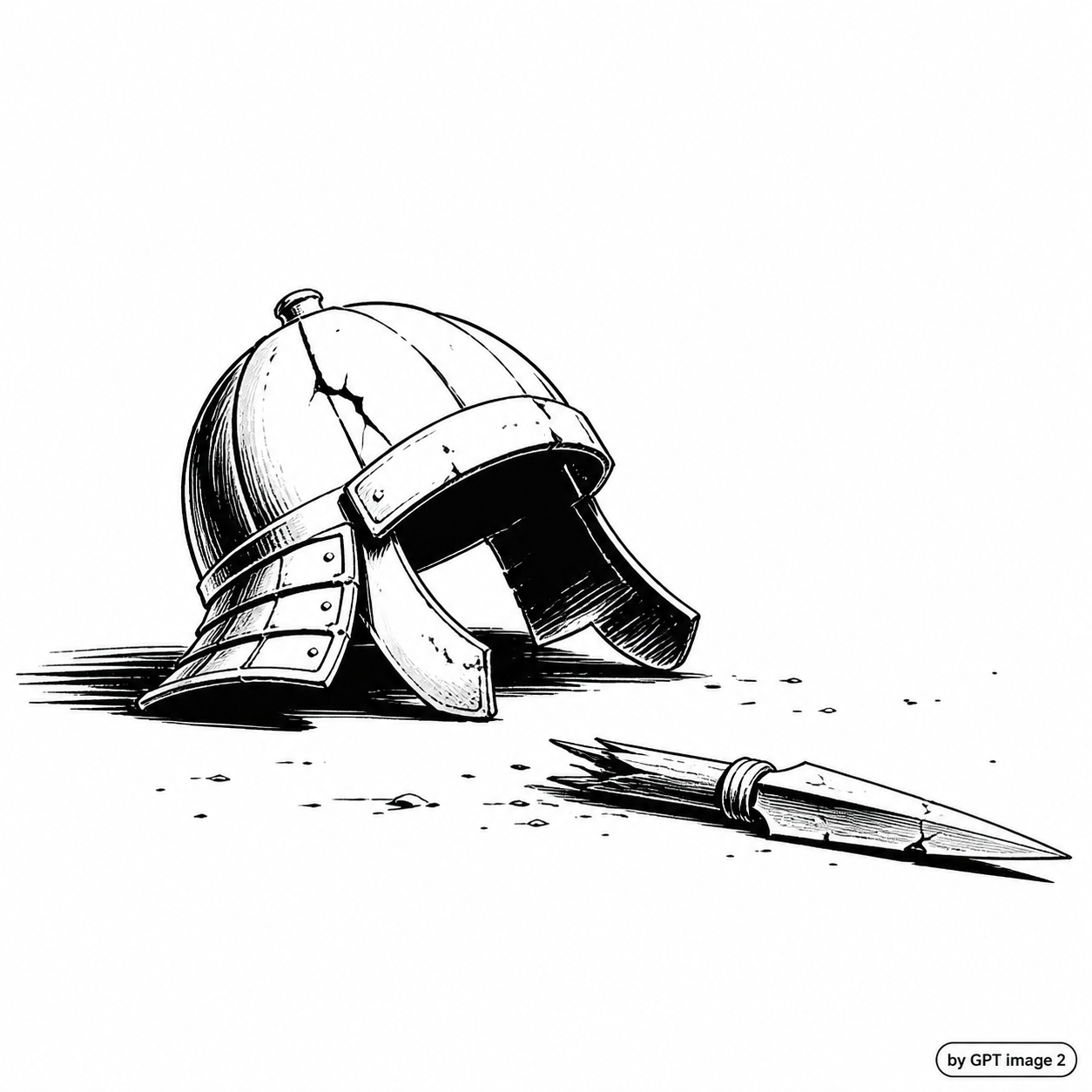
There are no hit points in this world. Heroes are measured by how many fatal wounds they can endure while still standing.
Related Entries: Basic Axiom §3 · Attributes §Physique · Dice System §Doubles · Unit Grades
Supporting Axiom: Axiom 3 (universal Wounds system)
#Wounds (戰力)
#Scent — The Weight of Injury
One ashigaru falls to one sword cut. A battle-hardened Veteran grits their teeth and keeps hold of the blade after three fatal wounds. A legendary warlord, drenched in blood from head to toe, still takes the enemy commander's head.
Wounds are not numbers. They are the weight of each cut through flesh and scrape along bone.
#Law — Rule
- If an attack breaks through Defense and hits → reduce 1 Wound (base).
- Critical Hit → reduce 2 Wounds.
- Special weapons/techniques → 2 Wounds or more (individually stated).
- Wounds reach 0 → Incapacitated.
Wounds by Grade:
| Grade | Wounds | Calculation |
|---|---|---|
| Mob | 0 | Dies immediately when attacked |
| Minion | 1 | Fixed. Hit = instant death. |
| Veteran | 2~3 | Fixed value (scenario setting) |
| Elite | 3~4 | Fixed value (scenario setting) |
| Lord | 3 + Physique (體) | Can grow. Physique +2 → 5 Wounds. |
Combo Fatigue and the short-weapon Core Zone bonus are covered in Energy Cost Handling §Rule 4.
#Defense (防備)
#Scent — The Grace of Iron
Armor is life. The difference of one light armor piece decides whether a blade skims past or bites into flesh. But heavy armor makes breathing hard and movement dull.
#Law — Rule
Attack hit check: 2d10 + attack modifier >= target Defense
| Armor | Defense | Energy Penalty | Notes |
|---|---|---|---|
| Unarmored | 10 | — | base |
| Light armor (leather, mail) | 12 | — | ashigaru standard |
| Heavy armor (tosei gusoku) | 14 | -1 Energy | can be offset by Physique (體) |
| Heavy battle armor (o-yoroi) | 16 | -2 Energy | Physique +2 or higher recommended |
| Shield | +1 | — | one-handed weapons only |
Heavy Armor Energy Penalty: When wearing heavy armor, maximum Energy decreases. Offset it by Physique (體) modifier.
- Example: heavy armor (-1 Energy) + Physique +1 → penalty 0. Heavy battle armor (-2 Energy) + Physique +1 → effective -1 Energy.
Unarmored Base Defense by Grade: The "Unarmored 10" in the table above is the base value for PCs, humans, and Veteran (練) grade or higher enemies. Lower yoma and rabble have dull skin and reactions, so their base Defense is lower — Mob (雜) grade = 8 · Minion (卒) grade = 9 · Veteran/Elite/Lord grade and PC = 10. Armor, shield, and evasion bonuses are added on top of this grade base value. (Mob and Minion grades are usually unarmored, so 8 and 9 are their Defense directly. The [Pierce]/[Direct] floors below also follow this grade base value.) If an individual stat block specifies a lower Defense than this, that value takes precedence (intentionally weak — soft-bodied, small-form yoma, etc.).
#Defense and Bypass System (防禦·貫通體系)
#Scent — Armor, Evasion, Soul
A warrior's Defense is not one thing. Steel armor stops blades, trained evasion avoids arrows, and barriers and blessings turn away curses. Attackers' techniques are likewise divided: a thrust that finds gaps in armor, a direct hit that allows no evasion, a cut that passes through the body and reaches the soul. This system puts that division on one page.
#Law — 3 Bypass Families and Auxiliary Notation
Every weapon, technique, Relic, and class technique in the core and expansions standardizes armor-bypass effects into the 3 families [Pierce], [Direct], and [Incorporeal]. Defense -N is treated as a status/weakening effect, and [Break] as an auxiliary equipment-damage effect; neither counts as a separate bypass family.
| Notation | Category | Effect | Floor | Duration |
|---|---|---|---|---|
[Pierce N] | defense bypass | Ignore N points of Defense from armor and shields. No effect against unarmored enemies. | target base Defense (Mob 8 / Minion 9 / Veteran+·PC10) | 1 time (this attack) |
[Direct N] | defense bypass | Ignore N points of Defense other than armor and shields (evasion, stances, barriers, terrain, blessings except natural armor, etc.). Armor and shield protection remains. | base Defense + armor/shield additions | 1 time (this attack) |
[Incorporeal] | defense bypass | Bypass Defense itself (ignoring even armor, natural Defense, and base Defense). Apply graded exemption by Exorcism rank. | — (see Exorcism Exemption Table) | 1 time (this attack) |
Defense -N (no brackets) | status/weakening | Final Defense itself -N. Simple reduction regardless of source. For binding, weakening, and debuff effects. | 2 (automatic-hit grade) | stated effect duration |
[Break] | equipment damage auxiliary | The armor/shield reduction from the paired [Pierce N] applies permanently until repair. If target equipment is higher grade than the executing equipment, only the break component is immune. | same as paired [Pierce] | until repair, maintenance, or replacement |
N Notation: [Pierce] and [Direct] may use a number or all. Do not attach N to [Break]. If permanent damage is needed, write it together, such as [Pierce 3] + [Break].
Critical, weakness, and divine-item added Wound effects operate independently from these tags. They are applied as additional Wound reduction after the check and do not affect Defense calculation.
Armor/shield additions are the armor values above the grade base value (Mob 8 / Minion 9 / Veteran+·PC10) in the Defense table, plus shield +1. Shields are treated as part of armor, so [Pierce]/[Direct] calculation and [Break] grade comparison/damage handling treat shields the same as armor.
#[Pierce N] — Find the Gaps in Armor
Scent: Cutting a warrior in o-yoroi head-on is foolish. The blade only rebounds from steel scales. But armor always has gaps: shoulder seams, inner thighs, the sight slit of a helmet. Precise thrusts, fangs, and arrows find those gaps.
Calculation:
- Target Defense = base Defense (Mob 8 / Minion 9 / Veteran+·PC10) + armor/shield additions + other bonuses (stances, barriers, terrain, etc.).
- Reduce N points from armor/shield additions (up to all).
- The result has a minimum = target base Defense. Even if the armor addition becomes 0, the defense of flesh itself (the grade base value) remains.
- Other bonuses remain.
- Reductions from other sources (defenseless, stance penalties, etc.) stack separately.
Natural Armor: Some yoma (oni, iron-armored turtles, bone-armored beings, etc.) have "natural armor +N." [Pierce N] applies equally to natural armor when stated. If the text does not state it, GM decides.
Examples:
- Uchikatana thrust
[Pierce 2]: heavy armor enemy (Defense 14, armor +4) → 12 (armor reduced to +2). Unarmored enemy (10) → 10 (no effect). Matches intent. - One Stroke of the Home Province
[Pierce all]: heavy battle armor enemy (Defense 16, armor +6) → 10. Unarmored enemy → 10 (no effect). - Teppo shot
[Pierce all]: heavy armor enemy (Defense 14, armor +4) → 10. Cover, stance, and barrier bonuses remain. - Defenseless +
[Pierce all]: heavy armor + defenseless (-4). Pierce → 10. Defenseless stacks separately → 6.
#[Direct N] — No Evasion Allowed
Scent: Some attacks cannot be dodged: precise shuriken throwing, guaranteed-hit ninjutsu. Evasion, stance, barrier: none of them can escape the exact incoming line. But the armor is not pierced. Steel is steel.
Calculation:
- Target Defense = base Defense + armor/shield additions + non-armor bonuses.
- Reduce N points from non-armor bonuses (up to all).
- The result has a minimum of (base Defense + armor/shield additions). Armor protection remains.
- Reductions from other sources (defenseless, etc.) stack separately.
"Non-Armor Bonus" Category (affected by Direct):
- evasion/infiltration check bonuses (shinobi doubles, master of evasion, etc.)
- Defense bonuses from [stance] stances (Immovable Formation, defensive stance, etc.)
- Defense bonuses from barriers/sacred ground (onmyoji barrier formation, arahitogami sacred ground, etc.)
- terrain/cover bonuses (brush, rocks, behind buildings)
- spell/blessing Defense bonuses (exorcism barrier, squad formation bonus, etc.)
"Armor/Shield Bonus" Category (not affected by Direct, remains):
- armor additions (light armor +2, heavy armor +4, heavy battle armor +6)
- shield +1
- Defense increases from techniques attached to armor/shields (for example, +1 from o-yoroi [aptitude] "shoulder catch," a masterwork cuirass's "unyielding steel" bonus, etc.)
- natural armor (oni scales, turtle shell, iron-armored insect carapace, etc.)
Classification Principle: If the bonus comes from "physical protection such as steel, bone, or scales," classify it as armor. If it comes from "technique, spell, faith, or terrain," classify it as non-armor. If unclear, use the text or GM ruling.
Examples:
- Precise shuriken throw
[Direct 2]: heavy armor enemy using Immovable Formation (stance +2) → Defense 16 (10 + armor 4 + stance 2). Direct 2 → remove stance +2 → 14 (armor remains). A small shuriken is hard to dodge, but does not pierce steel scales. - Ninjutsu assassination
[Direct all]: light armor enemy inside barrier (+2) → Defense 14 (10 + armor 2 + barrier 2). Direct all → remove barrier → 12. Armor remains. - Unarmored enemy with barrier (+2) hit by
[Direct all]: Defense 12 → 10. Floor = 10 + armor 0 = 10.
#Defense -N — Binding and Weakening Debuff
Scent: Some powers do not pierce armor; they make armor itself useless. Snake paralysis poison stiffens muscles, a grudge curse breaks will, and a kusarigama binds the body so it cannot move. This is not attack penetration, but defense weakening.
Use: This notation is not an attack's "pierce," but a status/debuff applied to the target. Effects such as poison, curse, binding, fear, and weakening reduce the target's final Defense itself for a certain time.
Calculation:
- When the effect triggers, target Defense = current Defense - N.
- Minimum 2 (extreme state, effectively automatic hit).
- During the effect duration, all attackers roll against this reduced Defense.
Notation Location: This tag is written on debuff-inflicting effects. Examples:
- Dokuchushi curse insect parasitism: "target suffers Defense -1 each round (until parasitism is removed)"
- Bloodflower Dance of Charm: "on failure, Defense -2 next round"
Difference from [Pierce]:
[Pierce N]: applies to 1 attack check. Reduces only bonuses from armor and shields.Defense -N: a status for a duration. All attackers benefit. Reduces all sources of Defense.
#[Incorporeal] — Pass Through Flesh, Reach the Soul
Scent: Some blades pass through armor, pass through flesh, and reach the soul. An onmyoji spell, a yoma curse, a single stroke of a spirit talisman. No matter how many layers of armor, no matter how swift the evasion, that strand reaches toward the soul. Yet the mind of a practitioner can strike that strand back.
#Exorcism Exemption Table
Exemption from spiritual attacks and exemption from incorporeal evasion are handled separately. If one Novice point fully nullified spiritual attacks, it would force the mandatory build of "you are foolish not to take Exorcism Novice," so protection is graded by rank.
| Exorcism Rank | [Incorporeal] Attack Handling | Incorporeal Evasion Exemption |
|---|---|---|
| Not Held | bypass Defense itself (fixed Target Number 10; attack roll required) | 50% nullification (d100 01~50) applies |
| Novice (1 point) | normal Defense -2 (Pierce-grade weakening) | exempt |
| Trained (2 points) | normal Defense -1 (almost normal) | exempt |
| Licensed (3 points) or higher | normal Defense applies (full exemption) | exempt |
| Master (4 points) | normal Defense (no additional bonus; core Master already has +3 check bonus) | exempt |
| Saint (5 points) | normal Defense (core Saint already has automatic success) | exempt |
Design Principles:
- Having Novice is enough to "fight spirits normally": incorporeal exemption + partial protection against spiritual attacks (-2).
- From Licensed (3 points), exemption from
[Incorporeal]Defense bypass: the attack is not nullified; resolve it against normal Defense. - Master and Saint receive no additional spiritual bonus: the core check bonus and automatic success are reward enough.
Incorporeal Defense Exceptions:
- Some masterwork or divine armor explicitly has "[aptitude] Incorporeal Defense +N." In that case, it stacks with the Exorcism exemption against
[Incorporeal]attacks (example: no Exorcism + Incorporeal Defense +2 armor = Target Number 12). - Related techniques and maneuvers can also grant Incorporeal Defense. See core co-04-09-06 Exorcism Skill (Mystical) related techniques.
User Notes:
- This table applies only to the defender's Exorcism rank. The attacker's Exorcism rank has no effect.
[Incorporeal]applies to attacks by incorporeal yoma, blows from spirit talismans and spirit swords, onmyoji spells, soul-drain techniques, curse activations, etc.
#[Break] — One Stroke that Shatters Steel
Scent: If [Pierce] means finding a gap in armor, [Break] means smashing the armor itself. A single stroke from Muramasa splits an enemy commander's cuirass, and a zweihander Meisterhau shears through chain armor. Once broken, armor cannot be worn again until it is hammered back into shape at a forge.
Definition: [Break] is not independent defense bypass, but an auxiliary equipment-damage effect. It is usually written together, such as [Pierce N] + [Break], and leaves the armor/shield reduction applied by that attack until repair, maintenance, or wearing new armor. Effects that directly corrode or hold equipment should be written in text, such as "equipment damage N points" or "weapon sealed for 1 round," instead of using the [Break] tag.
Calculation:
- Apply the paired
[Pierce N]to this attack as usual. - Compare the target equipment with the executing equipment (or the grade stated in the technique).
- If the executing equipment grade is at least the target equipment grade, permanently apply the same reduction to the target armor/shield.
- If the target equipment grade is higher, only the
[Break]component is nullified. Normal damage and the paired[Pierce N]apply normally. - Reductions from other sources (defenseless, stances, etc.) stack separately.
Trigger Conditions (consistent across core and expansions):
- Critical Hit + explicit effect: secret arts, Divine Artifacts, or yoma abilities with text such as "on critical hit,
[Pierce N] + [Break]" or "on critical hit, damage weapon/armor." - High-rank secret arts and Divine Artifacts: some Divine Artifacts and Tatsujin techniques grant
[Pierce N] + [Break]on a decisive blow. - Large weapon effects: some effects from blunt/heavy weapons such as tetsubo, zweihander, and kanabo (individually stated).
#Grade Matching — Weapon and Armor Grade Limit
You cannot break masterwork armor with a supply katana. Divine armor can only be broken by divine arms. A [Break] effect triggers normally only when the executing equipment grade is equal to or higher than the target equipment grade.
Grade Hierarchy (core and expansions):
| Grade | Weapon Example | Armor Example |
|---|---|---|
| Supply | ordinary katana, yari, bow | light armor, heavy armor, heavy battle armor (non-masterwork) |
| Fine Work | artisan-made uchigatana, kodachi, etc. (07-01 official goods) | refined armor (official goods, non-masterwork) |
| Masterwork | co-07-02 Masterworks · 2nd expansion 40-03·40-04 | masterwork armor (black armor, etc.) |
| Divine Artifact | core Divine Artifacts · foreign relics · 1st Spirit Realm relics | divine armor (Aegis, Achilles' shield, mithril cuirass, etc.) |
Rule:
- Executing equipment grade ≥ target equipment grade:
[Break]triggers normally (permanent until repair). - Executing equipment grade < target equipment grade: target equipment is immune to the
[Break]component. Normal attack damage and the paired[Pierce N]are handled, but no equipment damage occurs.
Examples:
- Supply katana attacks masterwork armor with
[Pierce 2] + [Break]→ this attack's[Pierce 2]applies, but masterwork armor is immune to[Break]. The armor is not permanently damaged. - Masterwork kanabo attacks an ordinary heavy armor enemy with
[Pierce 3] + [Break]→ ignore 3 armor points on this attack, and those 3 points disappear until repaired. - Excalibur (Divine Artifact) attacks an enemy commander in masterwork armor with
[Pierce 4] + [Break]→ Divine Artifact ≥ masterwork, so 4 armor points disappear until repaired. - Masterwork katana attacks divine armor (Aegis) with
[Pierce 3] + [Break]→[Pierce 3]applies, but divine armor is immune to[Break].
#Repair and Recovery
| Method | Time | Cost | Effect |
|---|---|---|---|
| Emergency Patch | 1 lull (upkeep maneuver slot) | free | Temporarily restores only +1 armor addition. Limited to 1 time for the same armor. Rope and seam emergency work. |
| Camp Repair | 1 hour after battle ends | tools and spare parts (1 gold) | Restores +2 armor addition. Possible in wilderness and mountain roads. |
| Forge Repair | 1 day after battle ends (artisan work) | 30% of armor price | Fully restores armor addition. Requires village/city forge. |
| Masterwork/Divine Armor Repair | 3~7 days | 50% of armor price + same-grade artisan (masterwork/divine artisan) | Masterwork/Divine Artifacts cannot be repaired in 1 forge day. Same-grade artisan required. |
| Wear New Armor | immediate (purchase separate) | new armor cost | Immediate recovery. |
Emergency Patch Limit: Only 1 time for the same armor. From the second damage onward, camp or forge repair is required.
#Design Intent (3 Families + Auxiliary Notation)
[Pierce]= "finding gaps in armor." Stronger against thicker armor, no effect on unarmored targets.[Direct]= "neutralizing evasion." Does not pierce armor, but neutralizes technical/spell protection. Precision shooting, guaranteed ninjutsu hits, etc.[Incorporeal]= "reaching the soul." Without Exorcism it bypasses physical Defense in favor of Target Number 10, but still requires an attack roll; Licensed or higher applies normal Defense.Defense -N= "debuff." Poison, curse, binding, weakening. Lasts for a duration. A target state, not the attacker's technique.[Break]= "physical damage." Leaves the paired[Pierce]reduction until repair. The break component does not apply to higher-grade equipment.
#Notation Location Convention
Keep the check formula in the single form 2d10 + modifier >= Target Number. [Incorporeal] never skips the attack roll; use Target Number 10 or normal Defense according to the defender's Exorcism rank. State the 3-family tags and auxiliary notation in the effect field.
| Technique | Type | Energy | Check | Effect | Limit |
| Thrust | Attack B (Finesse) | 2 | 2d10+Finesse+Swordsmanship >= Defense | [Pierce 2]. 1 Wound. | — |
The calculation of Defense values (base + armor + other → apply tags → final) belongs to the tags. Debuffs (Defense -N) are written without brackets, either in bold (**Defense -N**) or in text. They describe a target state, not an attack technique, so do not use tag marks.
#Aim Focus (照準集中) — Energy → Tag Scaling
#Scent — Add More Force, Pierce Deeper
A sniper's arrow is not just an arrow. The archer holds their breath, stares at the target, and draws the string farther. Given time, accuracy deepens. Spear penetration is the same. Pulling the arm farther back and twisting the waist one beat more finds the gap in steel scales.
This § rule is the mechanism for "add more force, pierce deeper." It gives the player a choice: how precisely will you shoot?
#Law — Basic Rule
Target: Only techniques whose text explicitly states *Aim Focus [Direct] allowed* or *Aim Focus [Pierce] allowed*.
Mechanism: Voluntarily spend additional Energy N on top of the technique's base Energy to grant or improve the relevant tag by N steps.
- Techniques allowing
[Direct]: additional N → grant[Direct N](grant to a technique with no original tag, or stack onto existing[Direct M]→[Direct M+N]) - Techniques allowing
[Pierce]: additional N → grant[Pierce N](same stacking rule)
#Law — Cap Rules
| Restriction | Value |
|---|---|
| Additional Energy cap | up to Finesse (技) modifier (Finesse +0=0, Finesse +2=2, Finesse +5=5) |
| One-breath limit | base Energy + additional Energy ≤ 5 (follow 03-04 One Breath. With Speed master +2, 7) |
| Allowed techniques | only where specified by technique (cannot apply to all attacks) |
| Tag mixing | cannot grant [Direct N] and [Pierce N] at the same time (only one tag type allowed by the technique) |
Overload: If the one-breath limit 5 is exceeded, apply the core overload check (03-04 §Overload) normally. In other words, "reckless Aim Focus" is possible, but if the check fails, all Energy is lost + defenseless.
#Law — Declaration Timing
Declare Aim Focus when the technique is activated, together with the Energy spend. Energy is spent regardless of check result (independent of hit and critical hit).
#Examples
Example 1 — Pierce the Vitals (tanto license, base [Pierce 2]):
Finesse +3 shinobi activates Pierce the Vitals:
- base 2 Energy + additional 3 Energy (Finesse +3 cap) = 5 Energy (fits one-breath limit)
- result:
2d10+Finesse+Ninjutsu >= Defense | [Pierce 5]. 2 Wounds. Bleed on critical. - heavy armor enemy (Defense 14, armor +4) → ignore all armor +4 → 10 (floor)
Example 2 — Thousand-Year Arrow (Hoya-ryu secret art, no base tag):
Finesse +2 gaijin activates Thousand-Year Arrow:
- base 4 Energy + additional 1 Energy (one-breath limit 5 allows only 1) = 5 Energy
- result:
2d10 + Courage + Archery +4 >= Defense | [Direct 1]. 2 Wounds. Anywhere on battlefield. - enemy in Immovable Formation (stance +2) → stance -1 → Defense -1
Example 3 — Piercing Arrow (daikyu license, base [Pierce 2]):
Finesse +0 gaijin activates Piercing Arrow:
- base 3 Energy + additional 0 = 3 Energy (Finesse cap 0, so no scaling)
- result:
2d10 + Courage + Archery +1 >= Defense | [Pierce 2]. 2 Wounds. 1 Wound to enemy behind. - heavy battle armor enemy (Defense 16, armor +6) → armor -2 → 14
Finesse +3 gaijin uses the same technique:
- base 3 Energy + additional 2 (one-breath limit allows only 2) = 5 Energy
- result:
[Pierce 4]. 2 Wounds. - heavy battle armor enemy → armor -4 → 12
#Design Intent
- Flatten tag utility:
[Direct]and[Pierce]tags are not fixed values per technique, but work dynamically based on player investment choices - Connect resource economy and balance: rule the natural feeling that spending more Energy increases precision
- Finesse-modifier-based cap: technical characters gain real advantage in sniper builds
- Licensed technique scaling: low-dan techniques do not receive the strongest tags as fixed values; they become stronger only with additional investment
#Critical Hit (会心)
#Scent — The Moment the Blade Tip Appears
Anyone who has stood on a battlefield knows: out of 100 sword strokes, there is one moment when everything fits perfectly. The enemy's opening, your breath, and the path of the blade converge in one instant. That is a critical hit.
#Law — Rule
Trigger: Double (same face) + check success.
Effect:
- Base: reduce 2 Wounds (2 times a normal hit).
- Special Weapons: nodachi critical hit = 3 Wounds. teppo critical hit = 2 Wounds + pierce (1 Wound to enemy behind as well).
- [Light] (輕量) Weapons/Techniques: a critical hit does not increase Wounds (stays at 1 Wound). However — (a) effects that explicitly set the critical-hit Wounds (nodachi +1 Wound, the Renown Title "Earth's King" barehanded 3 Wounds, etc.) take precedence with that value, and (b) if a specific class/trait explicitly states "treated as a normal attack" (the wildlander's Kamuy's Hand), the standard critical hit (2 Wounds) applies. Effects that grant only the critical hit without setting Wounds (shinobi ambush, Jigen-ryu first-stroke stance) are capped by Light's 1 Wound. → Light weapon list
- Technique Linkage: some techniques grant additional effects on a critical hit.
Heavenly Mandate (double 10): also consult the decisive moment table (d100). A miraculous result that overturns the battlefield.
Synergy with Fate Intervention: Spend Fate (運) to turn 4-5 into 5-5, forming a double and triggering a critical hit. This is the strongest use of Fate (運).
#Fumble (失着)
#Scent — The Foot Slips
Doubles are not only blessings. If the dice show the same face and the check fails, fate is smiling on the enemy. The blade misses, posture collapses, and an undefended back is shown to the foe.
#Law — Rule
Trigger: Double (same face) + check failure.
Effect: Apply Defenseless. GM may add further effects:
- drop weapon (1 Energy to pick up)
- stance collapse (next action Energy +1)
- foot slip (forced movement)
Karmic Retribution (double 1): see the critical mistake table (d100). Weapon destruction, accidental hit on ally, self-injury, etc.
#Defenseless (無防備)
#Scent — Showing Your Back
Defenseless is the most dangerous state on the battlefield. Posture breaks, defense opens, and the enemy's next blow cannot be avoided. A warrior staggering in the middle of the enemy line after failing a forced breakthrough, or the instant a blade slips from the hand on a fumble: that is defenseless.
#Law — Rule
Infliction Conditions:
- Fumble (double + failure)
- failed Breakthrough
- failed Core Zone Exit
- effects of some techniques/spells
Effects:
- Immediately release any maintained [stance].
- Defense -4.
- Cannot declare a new [stance], reserve defense techniques, or use evasion/counterattack-type defense techniques.
Removal: Automatically removed when your next action starts. If a lull comes first, removed during the lull phase.
No Resistance: Defenseless is already a confirmed result from check failure, overload, fumble, and so on; do not roll a separate resistance check.
#Incapacitated (戰鬪不能)
#Scent — Falling
The instant Wounds reach 0, the warrior drops to a knee. They can no longer raise a blade or give orders. Whether that means death or unconsciousness is known only after the battle ends.
#Law — Rule
- Wounds 0 → incapacitated. Cannot act; removed from the zone (fallen).
- A lord becoming incapacitated → that faction's squad Cohesion -1 (commander lost).
- Death Check: roll after combat ends. Success on
2d10 + higher of Physique (體) or Fate (運) >= 11→ survive with serious injury. Failure → death.
Last Bastion of Fate Intervention: You can use Fate Intervention to make the hit check of the attack that would reduce Wounds to 0 miss. "Avoiding a fatal wound by heavenly luck" is the most dramatic use of Fate.
There are no hit points in this world. You stand, or you fall.