#Field Notes and Margins
Contents
#Scent — Field Notes and Margins
Fiction-Only — Field notes are written by people who meant to finish the thought later. Sometimes later never arrived.
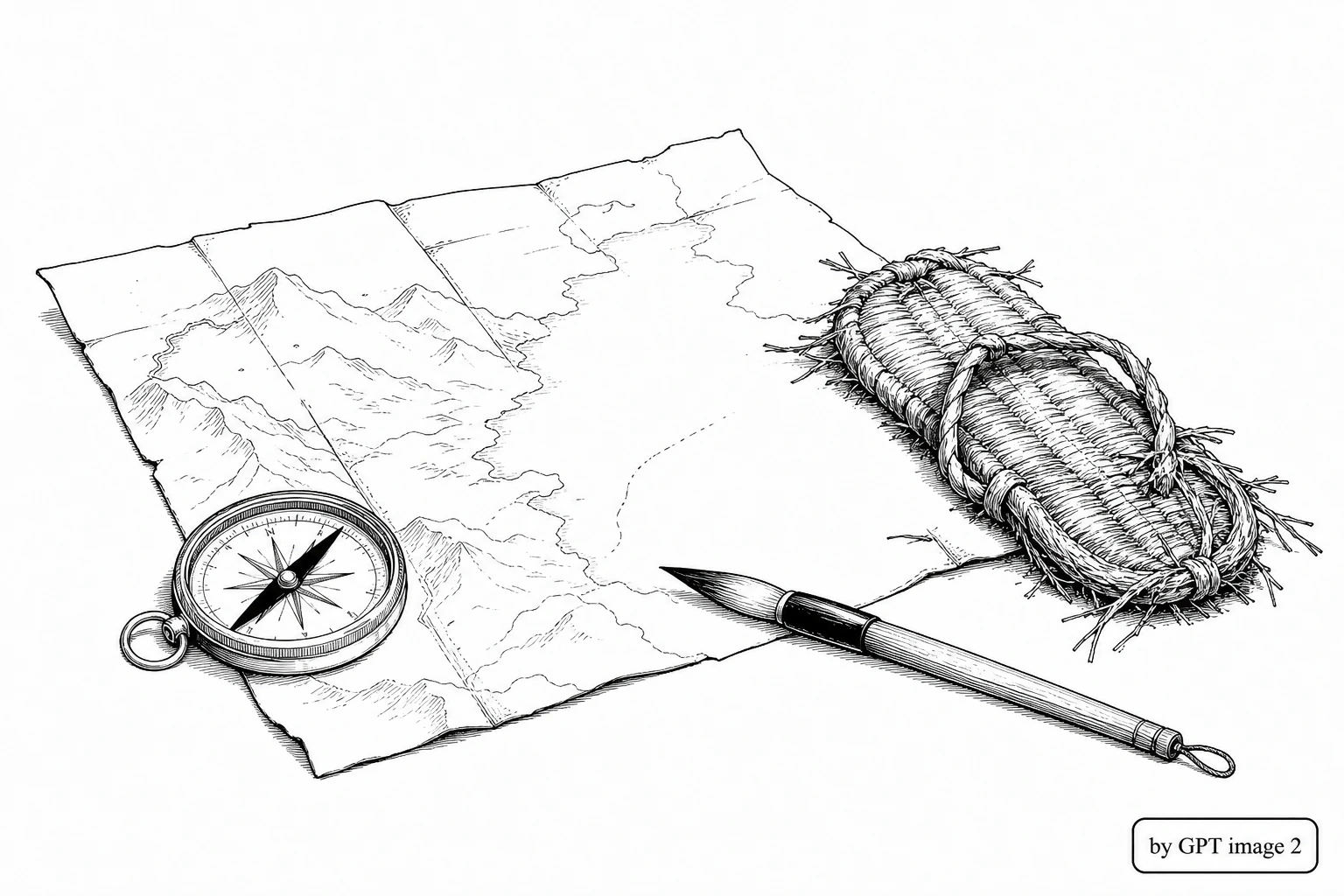
The map had been folded through the village name until the ink broke. In the margin, beside a road that was not drawn, someone had written: "Do not ask the guide why he knows this way. Ask why he is afraid of the other one."
#Table — Notes
| # | Field Note | Loose Edge |
|---|---|---|
| 1 | "The guide counts bridges under his breath. There are more counts than bridges." | What invisible crossings is he including? |
| 2 | "Found old arrowheads in the paddy, all pointing uphill." | Who shot from below into the mountain? |
| 3 | "The villagers deny the shrine exists, but sweep the path every morning." | What does denial protect them from? |
| 4 | "Map error: river bends left here only after sunset." | Does the river move, or does the map become honest at night? |
| 5 | "Do not camp where the cicadas stop together." | What commands the insects? |
| 6 | "The ash in the ruined storehouse tastes of salt, not wood." | Was the fire sea-born, ritual, or bodily? |
| 7 | "Enemy tracks vanish beside the plum tree. Our scouts refuse to step over fallen petals." | What boundary do the petals mark? |
| 8 | "A child corrected my pronunciation of the dead lord's name. I had not spoken it aloud." | Who heard the mistake first? |
| 9 | "The battlefield grass grows taller around places where no one fell." | What fell there instead of soldiers? |
| 10 | "One mile north of the pass, all compass needles lean toward the same abandoned sandal." | Whose direction remains inside the sandal? |
| 11 | "The old woman said the hill was hollow. I laughed. Then it coughed." | Is the hill alive, occupied, or remembering a buried army? |
| 12 | "Do not draw the third torii. It appears on its own if the map is kept dry." | Why does water prevent the gate from appearing? |
| 13 | "Met a hunter carrying arrows with no heads. He said heads would be rude." | What quarry must not be wounded? |
| 14 | "The abandoned checkpoint has fresh footprints only on the roof." | Who approaches authority from above? |
| 15 | "A fox watched the burial and looked disappointed when the wrong man cried." | Which mourner was expected? |
| 16 | "The road dust settled into characters after the cavalry passed. Nobody could read them twice." | Was the message changing, or were the readers? |
| 17 | "The well rope is worn from below." | Who draws the bucket down? |
| 18 | "A banner fragment found in the marsh bears our crest, but the battle was next week." | Did someone lose a future banner? |
| 19 | "Locals hang bells on graves to warn the dead when officials come." | What do the dead do with warning? |
| 20 | "At noon the shrine shadow points toward a house that was dismantled ten years ago." | What remains at the shadow's destination? |
| 21 | "A fish was found in the mountain spring with river mud in its mouth and a written prayer in its belly." | Who sent a fish upstream? |
| 22 | "The lord's hunting party returned with one extra horse and no extra rider. The horse had court manners." | Who trained it, and why did it return riderless? |
| 23 | "The cave mouth closes when thanked." | Who taught the cave gratitude, and what counts as thanks? |
| 24 | "Scratch marks inside the palanquin. The passenger outside swore she enjoyed the ride." | Who rode inside, and who arrived outside? |
#Table — Margin Tone
| Tone | How To Use It |
|---|---|
| Calm | The writer has seen worse, which may make the note more alarming. |
| Frantic | The note may preserve fear more accurately than fact. |
| Corrective | The writer is arguing with an earlier record or an official map. |
| Practical | The note may be the only surviving procedure for a local hazard. |
| Ashamed | The writer knows why the fragment matters and refuses to say. |
#Note — Using Notes
Field notes are useful when the party travels, scouts, researches, or inherits another group's failed investigation. They should feel partial: a record of one sensory detail, one warning, one wrong assumption, and one thing the writer did not live to compare.
When using a field note, place it near a physical route. Let the note be useful once, then misleading once, because the land or the people have changed since it was written.