#Edo Backstreet · Kaidan Campaign
Contents
Campaign Module. A Kaidan and black-market campaign set deep inside the city.
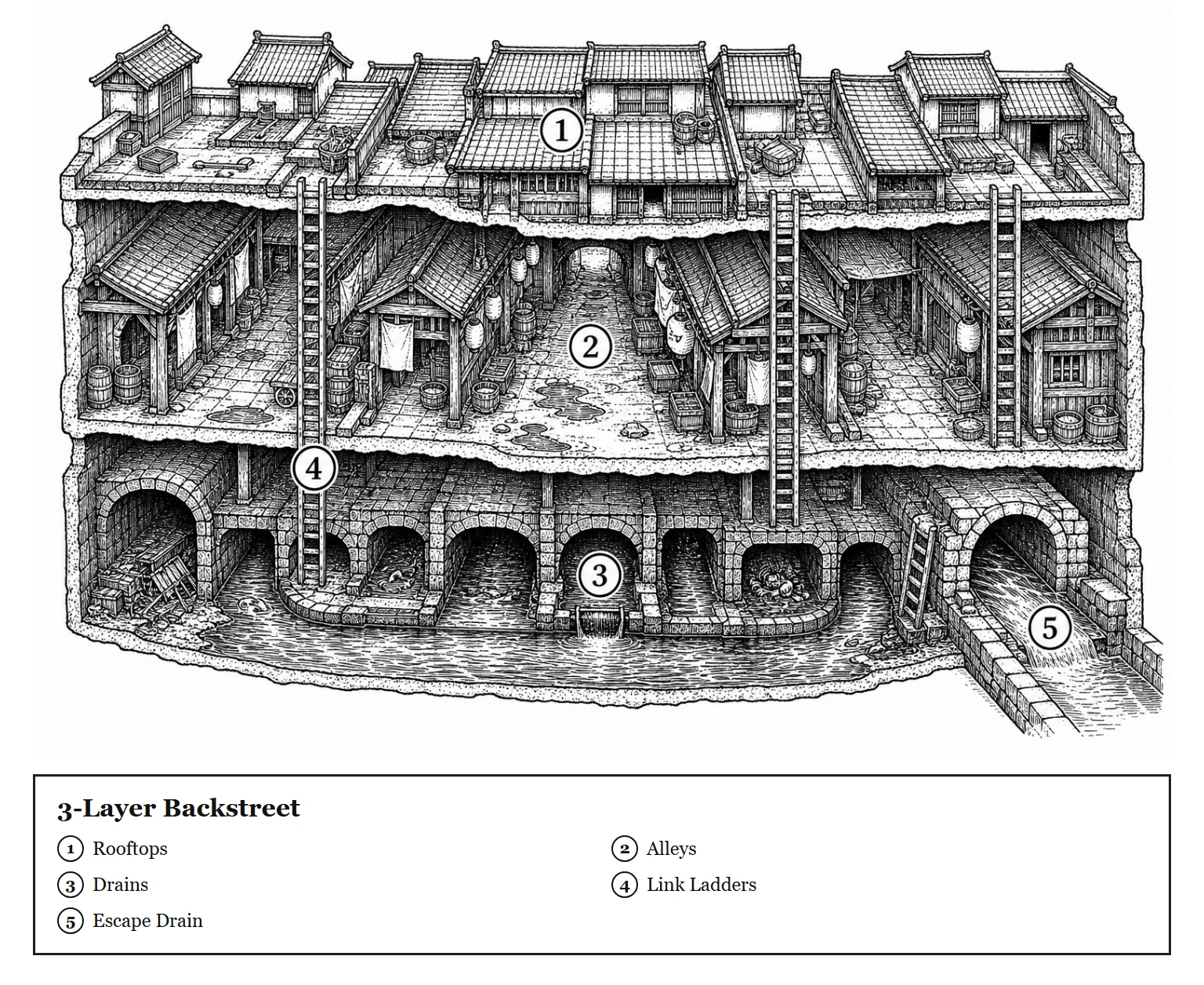
#Scent — Alleys Are Wider at Night
Edo's alleys are more complex than any map. By day they are lanes where merchants and children pass; by night, the Hundred-Tale Society's messenger, the yakuza's errand-runner, and the shogunate's informant walk them while avoiding each other. The city campaign shows how deep that narrow lane can go.
#Law — City Layers
- Divide the city into three layers — official order, yoma ecology, and black-market goods — and place incidents across them.
- Which layer the PCs ally with determines the clues, antagonists, and protected witnesses available to them.
- Favor endings of balance-shift, deal-breaking, ledger recovery, and name preservation over full purification.
#Scene Commentary — The City Does Not Disappear
The resolution of a city campaign is usually not full purification. Remove the yoma from one alley and another name remains in another; burn the black-market ledger and someone still has a copy. The city is not an antagonist — it is a living stage. What the PCs changed, and what they left untouched, is what matters.
This frame grows stronger with more recurring NPCs. Have the bathhouse keeper, the pleasure-quarter guide, the Hundred-Tale Society messenger, the shogunate informant, and the gambling-den errand-runner appear in each incident with a slightly different attitude. When players start asking "whose side should we take this time?", the city comes alive.
Axes of a city-frame scene:
- The person spreading the rumor.
- The person converting the rumor into money.
- The yoma trying to protect the name inside the rumor.
#Session Application — Prepare Recurring NPCs
- First scene: Make one of the bathhouse keeper, pleasure-quarter guide, or Hundred-Tale Society messenger a familiar face.
- Complication: That familiar face is dealing with a different faction in the next incident.
- Final question: Do the PCs save the city — or ally with one of its layers?
#Core Conflict
The Hundred-Tale Society wants to protect the yoma's name; the Black-Tag Gang wants to sell it.
#City Campaign Stages
| Location | Incident |
|---|---|
| Tenement | Eyewitness account, disappearance, neighbor's secret |
| Bathhouse | Kaidan circulation, Akaname, Hundred-Tale Society messenger |
| Pleasure quarter | Jorougumo, Black-Tag Gang, kept ronin |
| Theatre | Oiwa-type onryo, Kaidan performance, entertainer testimony |
| Warehouse | Yoma goods, smuggling, merchant escort |
| Bridge | Night-road yoma, blockade, pursuit |
#The City's Three Layers
The first is the city of people. Money, rumors, jealousy, debt, love, and grudges move here.
The second is the city of yoma. The Hundred-Tale Society manages this layer — Nurarihyon mediates which yoma may live in which alley, which Kaidan should spread, and which should be buried.
The third is the city of goods. The Black-Tag Gang tries to convert yoma and Kaidan into money. In this layer, yoma are not kin — they are merchandise.
#City Campaign Resolutions
In the final session, record the yoma that vanished, the yoma that changed names, the humans who were punished, and the ledgers that remain. Then establish which layer of the city the PCs allied with, what that choice protected, and what it abandoned.
"Edo's alleys are narrow. But at night, they grow deep enough that someone who entered by one name can leave by another."