#Japanese Imperial Gods — Divinity 5
Contents
Canon — Imperial God stats. Divinity ranks, domains, and Divine Authority are Canon within
fc01. When referenced from other fc, ex, or scenarios, treat them as optional material.
#Scent — The Three Gods of the Source
The Imperial Gods are three. A father who lost his wife, a mother betrayed by her husband, a sister who hid in a cave because of her brother. The stories of these, who stand at the top of Japanese myth, are by no means tidy — rather, they are the beings who failed the most and were wounded the most deeply.
Being of the source does not mean having everything. They, too, are gods only within their own realms. Even the creator couple could not cross each other's boundary line, and even the sun lost once to a sibling's rampage and hid.
This limit makes the story. A perfect god has nothing to tell. The reason Japanese myth is alive is that its Imperial Gods were not perfect.
"The source is only the beginning of one road. It does not know all roads."
#Law — Common Rules for Imperial Gods
- Base class, main path: arahitogami · celestial, 10 dan.
- As a fragment or proxy: a lower dan + divinity only (a reduced version with 1 domain).
- Return: daily Divine Authority requires a quarterly grand rite; Source Authority requires a national-scale main rite 1/year.
#Izanagi — 伊邪那岐
#Scent
The first father of creation. Together with Izanami, his sister and wife, he gave birth to the islands, gave birth to mountains and rivers, gave birth to countless gods. When the fire god Kagutsuchi burned his mother's body and killed her, he cut the child down — and from the blood, many gods flowed out again.
Having lost his wife, he descends all the way to Yomi. Seeing his wife's form rotting in the dark, he fled out and held off the pursuing army of death with three peaches. The name of these peaches is Okamuzumi (意富加牟豆美命) — the reason peaches are still believed to have the power to drive away evil.
Crossing back over the boundary, he washed his body in a river. From that rite of purification (misogi · 禊), three gods were born — Amaterasu from his left eye, Tsukuyomi from his right eye, Susanoo from his nose.
He is the father who created, lost, and purified.
"From that time, the peach drives away evil. Because Izanagi pledged a promise to its name."
#Law
#Base Stats
- Divinity: 5 Imperial God
- Domain count: 4
#Domains and Divine Authority
| Domain | Divine Authority |
|---|---|
| Creation | Island Raising — manifest a small island or 1 zone upon the sea (Source Authority 1/year). |
| Paternal right | Bloodline Sanction — recognize a specific person's birth/lineage check as an auto-success. |
| Purification (misogi) | Misogi — remove 1 instance of impurity, curse, or Tatari corruption at a stroke (in-domain check). |
| Boundary (Yomi and this world) | Pinning the Rock of Yomi — seal the boundary of this world and Yomi for a set time (blocks the backflow of heroic spirits and Tatarigami). |
#Base Class (Recommended)
- Main: arahitogami 10 dan · celestial 10 dan.
- Fragment: an onmyoji who officiates the rite of purification, 5~7 dan + divinity 2~3.
#Relationships
- Wife: Izanami (severed. Scenes where the two appear together are rare — this severance itself is the axis of the narrative).
- Children: Amaterasu · Tsukuyomi · Susanoo.
- After the land-yielding, he barely intervenes in earthly events.
#GM Note
Izanagi's purification domain is good to use as a fixer for Tatari and curses. But he cannot enter the realm of Yomi — because he was betrayed by his wife. This is the heart of the limit narrative. If a player asks, "Couldn't we get Izanami back by asking Izanagi?", answer with a clear "No."
#Izanami — 伊邪那美
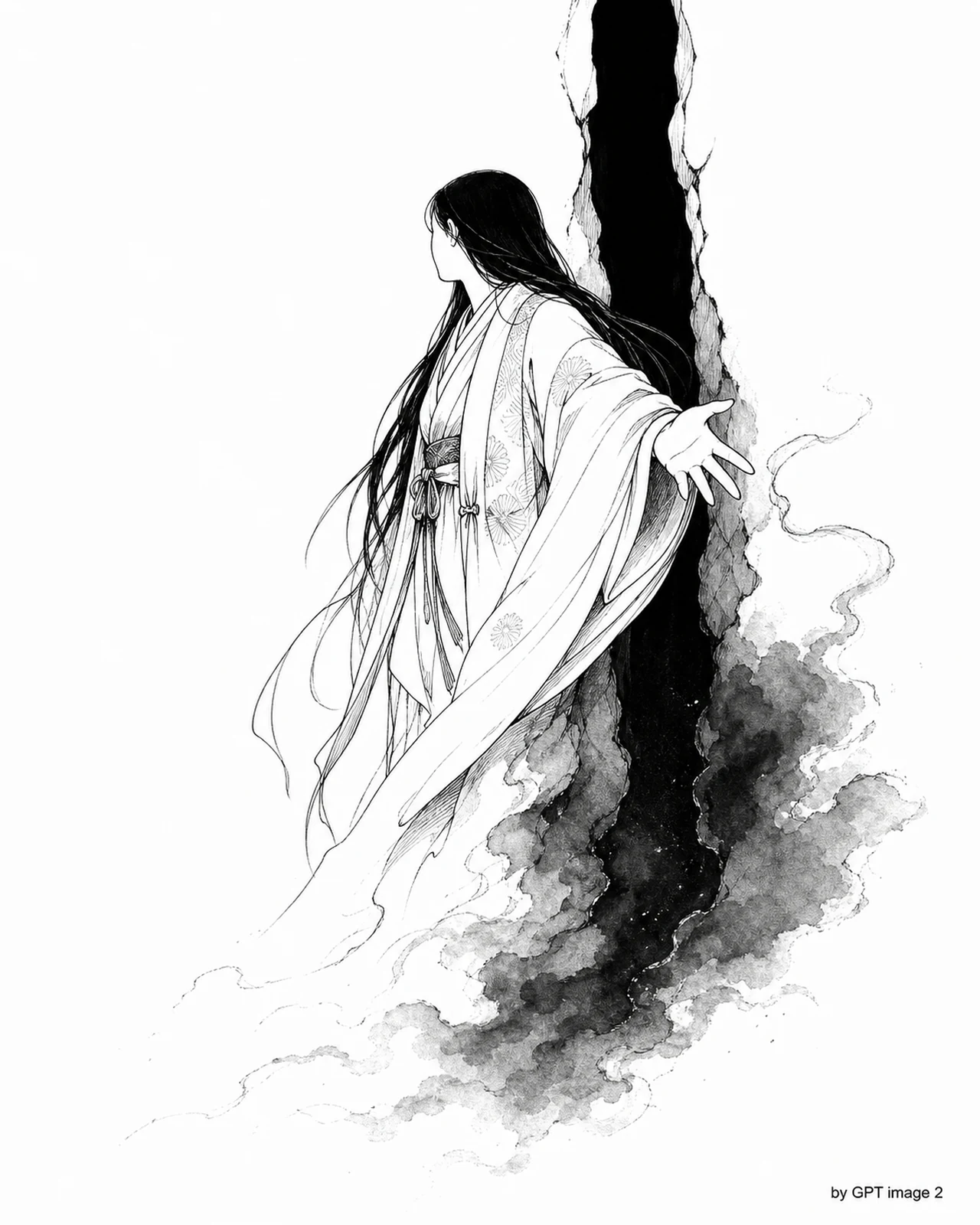
#Scent
The first mother of creation. While giving birth to the world together with Izanagi, in the moment of giving birth to the fire god Kagutsuchi, she was burned by the fire and died. Even from the urine and vomit she shed as her body burned away, gods were born — even her death was creation.
Having descended to Yomi, she became the queen of the dead (死者). When her husband came after her she was glad — but the moment he broke the taboo and saw her rotting form, she vowed to kill a thousand a day in this world. It was a vow set on the opposite side of love.
This vow is the origin of death. From that day, people died.
"Husband, if you do this, I will take away a thousand of your people each day." — the Kojiki
Her story holds not only wrath. She wanted to see her husband, told him not to leave, and longed for him. Because that emotion remains, Izanami is an Imperial God who still moves even now.
#Law
#Base Stats
- Divinity: 5 Imperial God
- Domain count: 4
- Risk of Tatari conversion: high — the "thousand a day" vow itself is already a Tatari-like disposition.
#Domains and Divine Authority
| Domain | Divine Authority |
|---|---|
| Creation (motherhood) | Blessing of Fecundity — auto-success on the checks of pregnant women and new life within a zone. |
| The dead (死者) | Call of Yomi — summon 1 dead person for a temporary conversation (not a resurrection). |
| Maternal right | Matrilineal Approval — pin the eye to 9 on a check that takes the mother's side. |
| Plague · the role of death | Thousandfold Vow — lay a foreboding of death over the relevant zone (targets in the relevant zone make a Mental Save (2d10+Courage ≥ 13), and on a failure, Wounds -1. A reduced reflection of Izanami's "thousand a day" vow). |
#Base Class (Recommended)
- Main: arahitogami 10 dan (including the branch of conversion into a Tatarigami).
- Fragment: miko 5~8 dan + divinity 3 (one who has lodged a shard of Izanami).
#Relationships
- Severed from her husband. Hatred and longing intermingled.
- Commands the many lesser death-gods of Yomi.
#GM Note
Izanami is the hardest Imperial God to stage. She is neither a simple enemy nor a simple ally. Her heart toward her husband and her grudge against the world coexist. When you bring her on, aim for a moment where the players are shaken emotionally just once. A scene that begins in wrath and ends in longing suits her best.
#Amaterasu Omikami — 天照大神
#Scent
The sun goddess born from Izanagi's left eye. The lord of Takamagahara (高天原 · heaven) and the bloodline progenitor of the Japanese imperial house, which continues even now.
Her most famous story is the Heavenly Rock Cave (天岩戸) incident. Angered by her brother Susanoo's violence, she entered the cave and shut its door — and in that moment, the world sank into darkness. The other gods prepared dance and light before the cave. When the goddess Amenouzume loosened her clothes and danced a comical dance, all the gods laughed. At that laughter, curiosity arose — "Is there one outside who shines more than I?" — and Amaterasu opened the door a crack. Through that gap a mirror shone in — and she stopped, seeing her own light within the mirror. In that moment the door was pulled open, and the sun rose again upon the world.
"Even the sun hides once. But it returns without fail."
The heavenly descent (天孫降臨) — she gave her grandson Ninigi three treasures (the Three Sacred Treasures: mirror, magatama, sword) and sent him down to earth. Ninigi's descendant became the first Emperor Jimmu. The narrative that Japan's kingship came from her begins here.
Her main shrine is Ise Jingu (伊勢神宮). The tradition of the periodic reconstruction (式年遷宮), rebuilding every structure every 20 years, continues to this day. A way of enshrining an "eternally new god."
#Law
#Base Stats
- Divinity: 5 Imperial God
- Domain count: 5 (the highest cap)
#Domains and Divine Authority
| Domain | Divine Authority |
|---|---|
| The sun | Sunlight Parting — disable part of the mist, darkness, or barrier in 1 zone (Great Authority 1/month). |
| Imperial authority | Proof of Bloodline — declare of any bloodline-related check, "the truth is thus." |
| Ancestral divinity | Summons of the Forebears — call forth 1 ancestral heroic spirit for counsel (1 GM hint). |
| Weaving | Thread of Order — resolve 1 instance of a Confusion or Frenzy state. |
| Rice | Field of Fruition — guarantee one season's yield. |
#Three Sacred Treasures
- The mirror (Yata no Kagami · 八咫鏡), the magatama (Yasakani no Magatama · 八尺瓊勾玉) — belonging to Amaterasu. Recorded in the core
co(../co/co-07-weapons/co-07-03-divine-artifacts.md). This document narrates only the relationship. - The sword (Kusanagi no Tsurugi · 草薙剣) — what Susanoo obtained from the Yamata no Orochi and offered to his sister. See
fc01-02-02-taishin.md.
#Base Class (Recommended)
- Main: celestial 10 dan + Imperial God.
- Fragment · proxy: miko 10 dan (head-shrine grade) + divinity 3~4 (a domain-reduced version).
#Relationships
- Siblings: Tsukuyomi (moon), Susanoo (storm).
- Grandson: Ninigi → ancestor of the imperial house.
- Head shrine: Ise Jingu. The annual main rite peaks every year of the periodic reconstruction.
#GM Note
Amaterasu is the god most burdensome to bring directly into play. Her appearance alone overwhelms a campaign. General principles:
- Appears only in the main-rite scene at Ise Jingu.
- Appears indirectly only through a fragment or a miko's oracle.
- When you do bring her on directly, only once per campaign, at the decisive moment.
The Heavenly Rock Cave concealment can be reproduced in play — if you incur Amaterasu's wrath, she "hides" for days/a season and the sun weakens. Depicting the world during this time itself becomes a scenario.
#Law — Comparison Table of the 3 Imperial Gods
| Item | Izanagi | Izanami | Amaterasu |
|---|---|---|---|
| Divinity | 5 | 5 | 5 |
| Domain count | 4 | 4 | 5 (the highest cap) |
| Current activity | rarely intervenes | confined in Yomi (influence is great) | centered on Ise Jingu |
| Head shrine | Taga Taisha (多賀大社), etc. | various places (few clear primary main shrines) | Ise Jingu |
| Risk of Tatari conversion | low | high | low (there is concealment, but Tatari is rare) |
| Frequency of use in play | rare (a fixer) | a narrative-grade threat | a single climax |
#Scent — In One Sentence
"The three gods of the source — even they were gods only within their own realms."