#Great Gods of Japan — Divinity 4
Contents
Canon — Great God stats. These 8 kami are the beings who, in Japanese myth, take charge of protection and calamity on the scale of a nation or domain. The rank most often encountered in a samurai campaign.
#Scent — The Names That Cover a Nation
The sound of a single village fading is small. The sound of a nation shaking is great — a Great God is a name that can bear that scale.
When Susanoo weeps, summer becomes the long rains. When Okuninushi sleeps, the rice of Izumo does not ripen. When Inari turns away, the price of rice in the marketplace leaps tenfold. When Hachiman does not call a name, the samurai's bow strays from its target.
These kami are part of the nation. People till their fields, sharpen their blades, and name their children in these kami's names. When the roof of a main shrine (本社) collapses, some corner of the nation collapses with it.
"A Great God is the name of a land, and the name that guards that land." — The Hundred Chapters of the Divinities
#Law — Common Rules for Great Gods
- Main base-class path: arahitogami / celestial, 8th–10th dan.
- As a fragment or proxy: any dan + reduced to 1 domain + Divinity 1–2.
- Return: a seasonal great festival. One of these must be held at the main shrine (本社).
- Daily benefit: 3 uses per domain.
- Great Authority: 1 use per month per domain.
#Tsukuyomi — 月読
#Scent
The moon born from Izanagi's right eye. Amaterasu's sister and brother both. The quietest kami in the myths — almost none of his words are recorded.
A single episode explains him. When the goddess of food, Ukemochi (保食神), drew food from her mouth to serve him, Tsukuyomi deemed it unclean and killed her. Hearing this, Amaterasu was enraged, and from that day day and night were divided forever.
"Those who cannot be in one place. So the sun and the moon never meet."
His nature is fastidiousness. He holds a light much like his sister's, but where she is embrace, he is rejection. When he sees the unclean, he withdraws or removes it — he does not converse.
#Law
#Base Stats
- Divinity: 4 Great God (borderline rank — between Divinity 4 and 5. This supplement assigns 4.)
- Domain count: 3
#Domains and Divine Authorities
| Domain | Divine Authority |
|---|---|
| Moon | Lunar Phase Lock — lengthen or shorten the hours of night (one zone, one night). |
| Night | Concealment — darkness covers a target in a zone, raising detection difficulty sharply. |
| Purity (潔) | Expel the Unclean — push 1 defiled or Tatari being out of the zone (not damage). |
#Base Class (Recommended)
- Main: celestial 9th–10th dan + Great God.
- Fragment: moon-rite miko 6th–8th dan + Divinity 2–3.
#GM Note
Tsukuyomi is best portrayed as "the kami without words." Even when he appears, he barely opens his mouth. If a player crosses a line, he leaves quietly (until the next full moon). A character who threatens through the anxiety of absence rather than direct confrontation.
#Susanoo — 須佐之男
#Scent
The storm born from Izanagi's nose. The youngest of the three kami. A composite kami in whom violence and heroism dwell in one body.
In the heavens of his sister Amaterasu he trampled the fields, smeared dung in the sacred palace, and caused the death of a priestly goddess — in this uproar his sister hid in the heavenly rock cave, and he was banished from heaven. A rough brother who fell to earth with his tongue cut and his beard plucked out.
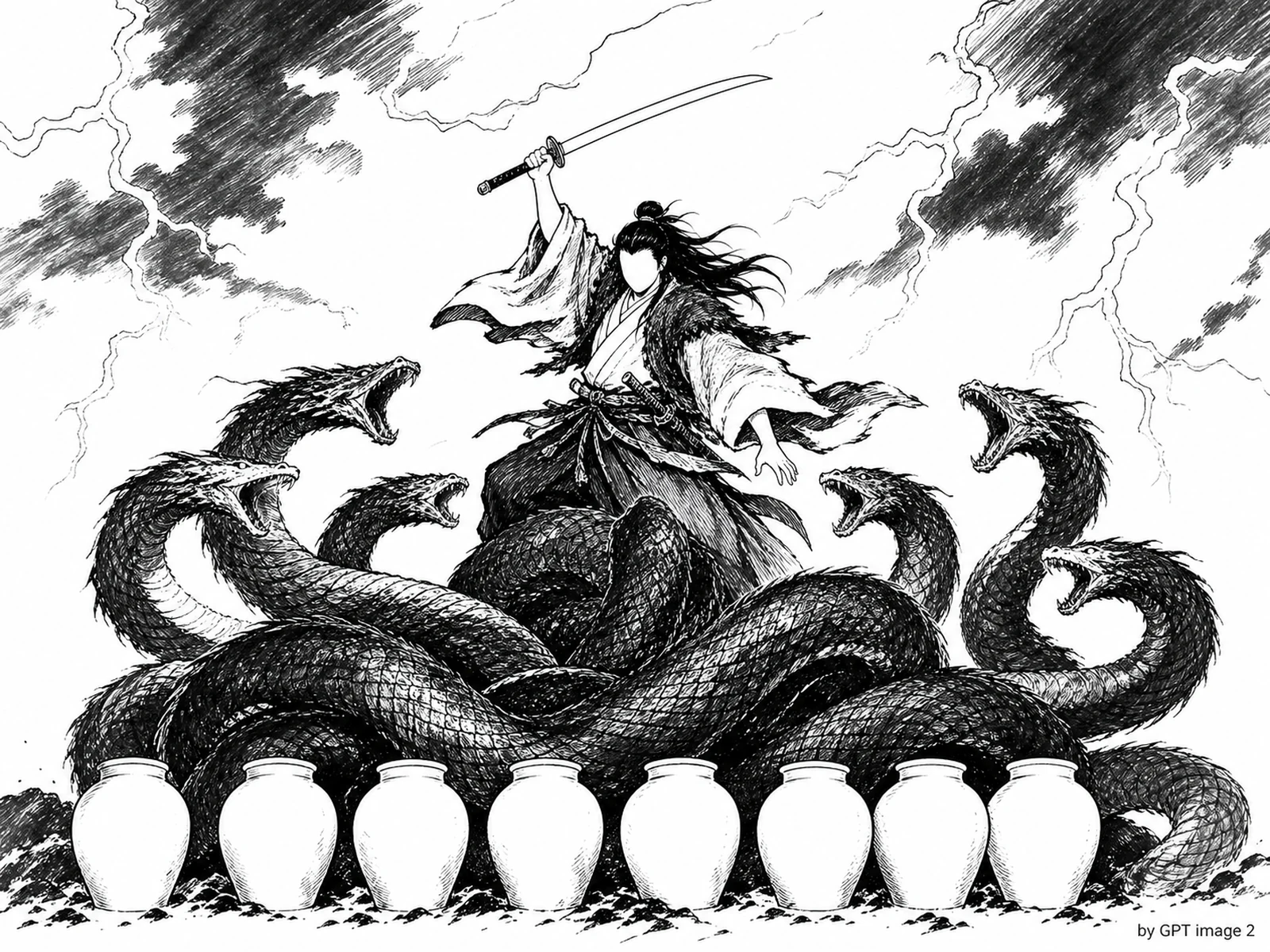
Yet on earth he became a hero. By a river in Izumo he met the princess Kushinadahime, about to be offered to Yamata no Orochi (八岐大蛇) — the great serpent of eight heads and eight tails. Susanoo made the Orochi drunk with eight tubs of sake and cut it apart one piece at a time. From its tail came the Kusanagi no Tsurugi (草薙剣) — the sword of the Three Sacred Treasures — which he offered to his sister in reconciliation.
"To bring disorder upon the world and to save the world both dwell in one name." — Susanoo lore
He became king of Izumo, and from his bloodline came Okuninushi. The founder of the Izumo line (the earthly line).
#Law
#Base Stats
- Divinity: 4 Great God
- Domain count: 4
#Domains and Divine Authorities
| Domain | Divine Authority |
|---|---|
| Storm | Cry of the Thunderstorm — greatly amplify disturbance and confusion within a zone. Penalty to enemy Command and morale checks. |
| Sea (海) | Wall of Waves — 1 zone barrier on a coast or body of water. |
| Hero | Monster-Slayer — one die locked to 9 on checks against mythic-tier yoma. His unique domain. |
| Ritual Blade | Kusanagi Flash — one check is an automatic Critical Hit (Great Authority). |
#Three Sacred Treasures — Kusanagi no Tsurugi
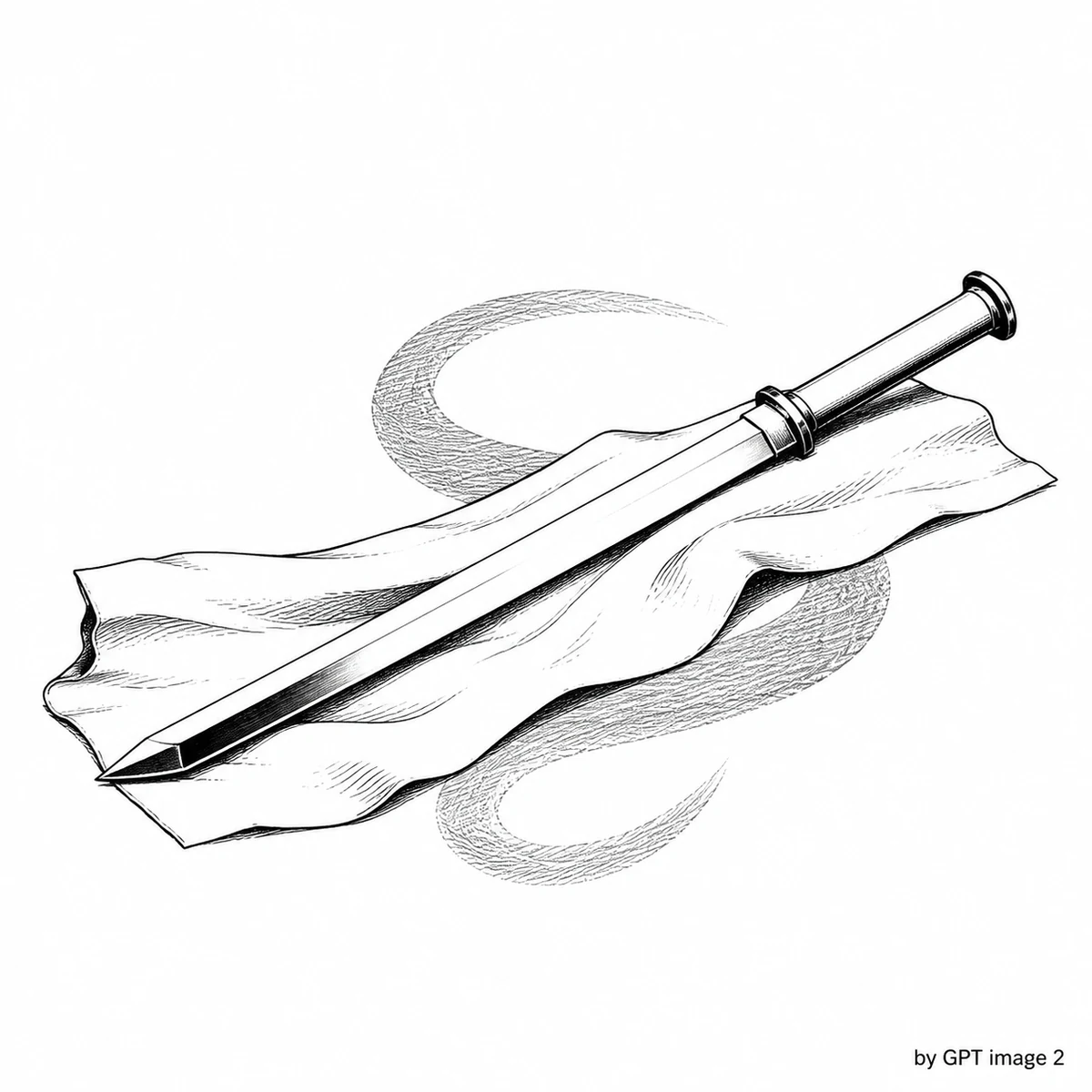
The sword Susanoo obtained from the Orochi's tail and offered to Amaterasu. Recorded in the main co Three Sacred Treasures document. This document confirms only its origin.
#Base Class (Recommended)
- Main: arahitogami 10th dan + Great God.
- Fragment: samurai 7th–9th dan + Divinity 2–3 (a warrior who inherited Susanoo's wrath).
- Rarely: conversion to Tatarigami (when the violence grows excessive and tips over to the unclean side).
#Relationships
- Sister: Amaterasu (a cycle of reconciliation and sparks).
- Descendant: Okuninushi (6th-generation descendant).
- Spouse: Kushinadahime.
- Izumo (出雲) — present-day Shimane Prefecture. The land where he descended to earth, and where his descendant Okuninushi built a kingdom. "The Izumo line" refers to his bloodline.
#GM Note
Susanoo is the kami "trustworthy and untrustworthy at once." He may help the players, but when his mood sours he soon summons a storm. The Orochi-slaying narrative is easy to reproduce as a scenario — with Susanoo himself, or a fragment he sends down.
#Okuninushi — 大国主
#Scent
A 6th-generation descendant of Susanoo. King of Izumo. A figure who died twice and was revived twice.
His brothers were countless, and they hated him. They shoved him into the den of Ikumaki (a great serpent), set a trap from which he could not spring up, and ordered him to run across a burning mountain. He died twice. Yet he was revived with the help of a mouse, with the help of a snake, and by the mother kami's art of regeneration.
As much as he was given life, he shared life. He healed a wounded white hare, cured the sick of the earth, and taught agriculture and fishing. He built a nation on earth — the great realm of Izumo.
Yet when the heavenly grandson Ninigi, descendant of Amaterasu, demanded the earth, he did not fight but ceded it. This is the Transfer of the Land (国譲り) — "the event in which the king of the earth handed his nation over to heaven." In return he received the eternal dedication of the Izumo main shrine.
"I hand over the nation I built with my own hands. Yet the name of this land remains in my name." — Okuninushi lore
The Transfer of the Land is a narrative turning point. It is here that the legitimacy of earthly kingship "coming from heaven" was established. And in Izumo, "the memory of the side that was made to yield" remains even now — a "lost power" hook often used in play.
#Law
#Base Stats
- Divinity: 4 Great God
- Domain count: 4
#Domains and Divine Authorities
| Domain | Divine Authority |
|---|---|
| Izumo (国) | The Bounds of Izumo — one die locked to 9 on checks within the Izumo domain. |
| Healing | The Twice-Revived — restore 1 person on the verge of death (Great Authority, 1 use per season). |
| Agriculture & Fishing | Blessing of the Harvest — automatically succeed one season's harvest. |
| Bonds (縁結び) | Thread of Fate — decisively bind or loosen the relationship between two people (GM's discretion). |
#Base Class (Recommended)
- Main: arahitogami 10th dan + Great God.
- Fragment: a monk of the healing schools 7th–9th dan + Divinity 2–3.
#Relationships
- Ancestor: Susanoo.
- Brothers: most of them tried to kill him out of jealousy.
- Wives: many (incarnations of the Bonds domain).
- Main shrine: Izumo-taisha (出雲大社) — still the center of the lore that all kami gather there 1 time a year.
#Appearance & Symbols
- A gentle male kami. Close to small animals such as hares, mice, and snakes (the mouse that saved him is especially famous).
- A small mallet — note: this is the later combination, in folk belief, of Daikokuten's mallet. It was not originally Okuninushi's symbol.
- Thick cloth · a hoe.
#GM Note
Okuninushi is the Great God most favorable to players. Because he endured much hardship himself, he is generous to those who struggle. A PC entering the Izumo domain receives his help at least once. A hook using the memory of the Transfer of the Land — letting a faint regret for "the lost earth" show through deepens the narrative.
#Inari — 稲荷 (Ukanomitama · 宇迦之御魂)
#Scent
The kami of grain. Her true name is Ukanomitama, but the name Inari is far more widely known. Her guardian animal is the White Fox (kitsune).
Farmers worship her, smiths worship her, merchants worship her, and even the pleasure quarters worship her. It is said that one-third of all shrines are Inari shrines. The broadest face of folk belief.
"Follow the long row of red torii (鳥居), and Inari is everywhere."
She has many faces. In one session she appears as a kami of commerce, in another as the woman of the forge, and in yet another in the shape of a fox. Betrayal and caprice are one side of her — Inari's help always comes with conditions. There is no blessing without a price.
#Law
#Base Stats
- Divinity: 4 Great God
- Domain count: 4
#Domains and Divine Authorities
| Domain | Divine Authority |
|---|---|
| Grain & Rice | Harvest Adjustment — shift the abundance or failure of one village at the GM's discretion. |
| Fox (kitsune) & Transformation | Mask of Change — temporarily alter one person's appearance (a check within the domain). |
| Commerce & Money | Price Manipulation — overturn the price of one item in one market. |
| Forge & Handicraft | Fire of Tempering — grant a temporary advantage to 1 weapon (Critical Hit range +1). |
#Base Class (Recommended)
- Main: arahitogami 8th–10th dan + Great God.
- Fragment: merchant Commoner 5th–7th dan + Divinity 1–2 (the fox kami's blessing).
- Kitsune transformation body: sometimes a yoma variant operates with Inari's permission.
#Appearance & Symbols
- Both male and female (varying by region). Attended by white foxes.
- Red torii, fried tofu (aburage), a sacred jewel.
#GM Note
Inari is the kami with the most faces. Appearing as a kami of commerce in one session, the woman of the forge in another, and a fox in yet another is no contradiction. It is good to weave betrayal and caprice into the staging — Inari's help always comes with conditions.
#Hachiman — 八幡
#Scent
The kami formed by the posthumous deification of the 15th Emperor Ojin (応神). A special case of a heroic spirit elevated to a Great God.
He is the kami of the samurai. In the Sengoku period there was no samurai house that did not enshrine his name. They pray before going to battle, recite his name as they draw the bow, and bow their heads after victory. Usa Jingu (宇佐神宮) is the main shrine, and there are **more than 4 man (myriad) Hachiman branch shrines** throughout the land.
"When you draw the bow, do not forget the name of Hachiman. Only with his name does the arrow reach the target." — a samurai maxim
He is fair. But he is on no one's side — when two samurai pray at the same shrine and cut each other down the next day, he sends a fragment down to both. Whatever the result, it is not his concern. He merely watches over all who loose the bow.
#Law
#Base Stats
- Divinity: 4 Great God
- Domain count: 4
#Domains and Divine Authorities
| Domain | Divine Authority |
|---|---|
| War | Tidings of Victory on the Field — automatically succeed the morale check of one allied squad. |
| Archery | One Arrow, One Flash (一矢一閃) — automatically Critical Hit 1 bow attack. |
| Protection of Warriors | Hardy Soul — temporarily raise one samurai's Wounds by +1. |
| Imperial Legitimacy (2nd tier) | Proof of the Banner — automatically judge the authenticity and legitimacy of a banner. |
#Base Class (Recommended)
- Main: arahitogami 10th dan + Great God.
- Fragment: samurai 5th–9th dan + Divinity 1–2 (the typical "part of Hachiman" situation).
#Appearance & Symbols
- A man of middle years clad in armor. Bow, arrows, sacred horse.
- A white banner, a dove (messenger).
#GM Note
Hachiman is the Great God most often laid onto a game. A Sengoku-era samurai prays to Hachiman before going to battle. That prayer is sometimes answered — this is the "samurai + Divinity 1–2" state. Scenario seed: see Hachiman of the Battlefield.
#Takemikazuchi — 建御雷
#Scent
The kami of thunder and the sword. A being born from the blood that flowed when Izanagi cut down the fire kami Kagutsuchi — a divinity that sprang from blood.
During the Transfer of the Land he was dispatched to earth as heaven's envoy. Famous is the scene in which he sat cross-legged atop a sword he had thrust into the shore of Izumo and demanded the cession from Okuninushi. A symbol of martial force — yet a martial force that overwhelms without using violence.
"To the one who sat at the sword's tip and asked, the king gave up his nation." — Transfer of the Land lore
Swordsmanship · the kami of each single stroke of the sword in particular. Many swordsmanship schools take him as their founder. Kashima Jingu (鹿島神宮) is the main shrine.
#Law
#Base Stats
- Divinity: 4 Great God
- Domain count: 3
#Domains and Divine Authorities
| Domain | Divine Authority |
|---|---|
| Thunder (雷) | Lightning Strike — 1 bolt of lightning on a zone (a strong attack check). |
| Swordsmanship | Cleave in Two — automatically Critical Hit 1 sword attack + [Pierce All]. |
| Valor (武勇) | Hold the Line — temporarily fix 1 Front Zone so it does not collapse. |
#Base Class (Recommended)
- Main: arahitogami 10th dan + Great God.
- Fragment: a samurai swordsmanship-school inheritor 6th–9th dan + Divinity 1–2.
#GM Note
Takemikazuchi is a kami "narrower but sharper" than Hachiman. If Hachiman is war as a whole, Takemikazuchi is the outcome of a single stroke. He also appears often as the founder of a swordsmanship school.
#Ninigi — 邇邇芸命
#Scent
Grandson of Amaterasu. The protagonist of the Descent of the Heavenly Grandson (天孫降臨). Bearing the Three Sacred Treasures, he descended to Ashihara no Nakatsukuni (the earth) and became the founder of the imperial house. His lineage leads to the first Emperor Jimmu.
His story is that of "the kami who has already done it all." After descending to earth, he took Konohanasakuya as his wife and saw children. With that, his great task was finished. He has almost no role in the myths thereafter — he is the kami who planted the imperial bloodline and withdrew to the rear.
"With a single descent, the kingship of the world was established." — Descent of the Heavenly Grandson lore
#Law
#Base Stats
- Divinity: 4 Great God
- Domain count: 3
#Domains and Divine Authorities
| Domain | Divine Authority |
|---|---|
| Descent of the Heavenly Grandson | The Line Between Earth and Heaven — receive a messenger or supplies sent down from heaven, once. |
| Imperial Lineage (Founder) | Testimony of the Founder — decisive testimony on every check concerning bloodline. |
| Three Sacred Treasures | Temporary Bestowal of a Treasure — lend 1 Divine Artifact to a PC for a while (one Critical Hit or one Divine Authority). |
#GM Note
Ninigi is a kami who almost never acts (because he has already planted the bloodline on earth). For him to appear is an event on the scale of "once in a thousand years." It is far more common for him to appear as a fragment — an NPC bearing a collateral bloodline of the imperial family manifests as a fragment of Ninigi.
#Konohanasakuya — 木花開耶姫
#Scent
Ninigi's wife. The goddess of flowers · cherry blossoms · childbirth · Mount Fuji. Like cherry blossoms, beautiful but short-lived, her blessing symbolizes "the transience of beautiful things."
She loved Ninigi, but Ninigi sent back her elder sister Iwanagahime (磐長姫) — the goddess of life long as the rocks. As a result, the imperial bloodline came to possess "a beautiful but short life." This is the origin of the human lifespan as the Kiki myths explain it.
"A flower is destined to fall the moment it blooms. Yet that brevity is the condition of beauty." — cherry-blossom lore
The main shrine is the Grand Shrine of Mount Fuji (Fujisan Hongu Sengen Taisha · 富士山本宮浅間大社).
#Law
#Base Stats
- Divinity: 4 Great God
- Domain count: 3
#Domains and Divine Authorities
| Domain | Divine Authority |
|---|---|
| Flowers & Beauty | Bloom of an Instant — manifest everything within a zone at its most beautiful for one moment (morale + domain-related). |
| Childbirth | Blessing of Safe Delivery — automatically succeed a childbirth check. |
| Mount Fuji (富士山) | Ash of Fuji — induce volcanic phenomena in the Fuji region. |
#GM Note
Konohanasakuya is a kami of lyrical tone. She appears in scenes of rites of passage, marriage, childbirth, and flower-viewing rather than combat. A time-limited blessing is her hallmark — her Divine Authority effects are powerful but short in duration.
#Law — Summary Table of the 8 Great Gods
| Kami | Domain count | Main domains | Campaign frequency |
|---|---|---|---|
| Tsukuyomi | 3 | Moon · Night · Purity | Medium |
| Susanoo | 4 | Storm · Sea · Hero · Ritual Blade | High |
| Okuninushi | 4 | Izumo · Healing · Agriculture & Fishing · Bonds | High (Izumo) |
| Inari | 4 | Grain · Fox · Commerce · Forge | Very high |
| Hachiman | 4 | War · Archery · Warriors · Imperial | Very high (samurai) |
| Takemikazuchi | 3 | Thunder · Swordsmanship · Valor | Medium (swordsmanship) |
| Ninigi | 3 | Heavenly Grandson · Imperial Founder · Treasures | Low |
| Konohanasakuya | 3 | Flowers · Childbirth · Fuji | Medium (lyrical) |
#Scent — In One Sentence
"Eight names that cover a nation — and on each name hangs one part of the nation."