#Outside Deities — Their Arrival Story and Rules
Contents
Canon — fc01 application of Outside deities. This document defines the rules for introducing gods that originate from outside Japan into a campaign set on the Japanese stage. Data for individual gods is in
fc01-03-01-foreign-entries.md.
#Scent — A Guest Stays Only Briefly
If Zeus comes to Japan, he is not Zeus.
Even should he try to strike Tokyo Bay with a thunderbolt, the master of this sky bears another name. Takemikazuchi dozes at Kashima; Susanoo gazes at his sister in Izumo. Zeus's thunderbolt is the thunderbolt of one who does not know this sky is not his own — it falls, but not as it once did.
This is what an Outside deity looks like while in Japan. It is the same Domain, yet it works only by half. Because there is no shrine, no offering, and few who know its name.
"One who has left grows smaller by as much as he has left behind." — Principle for handling Outside deities
#Law — Why Introduce Only "Some"
The setting of the main line of Konsei Reiyotan (混世霊妖譚) is Japan's Sengoku age + the trembling of the Spirit Realm. Outside deities are not the central axis of that setting. Yet for the following reasons, limited introduction is permitted:
- Catholic saints who entered together with the Kirishitan church — already partly covered in
fc01-02-06-minor-divinities.md. - The traditions of a foreign culture brought in through Nanban (南蛮) trade — the "beings of the otherworld" within the stories of Portuguese and Spanish sailors.
- Daoist and Confucian divinities and warrior legends that crossed over from the continent (Ming and Joseon) — some have already been absorbed as peninsular immigrant deities (
fc01-02-06-minor-divinities.md). - Expanding the campaign's tone — when the GM runs a crossover, multicultural, or alternate-history tone.
ex2 already holds foreign schools and foreign Divine Artifacts in abundance. The Outside deities of this supplement play the role of filling in that divinity axis — they hold only the gods of the Greek, Norse, Indian, and Lovecraftian lineages not found in ex2.
#Scent — The Four Routes of Arrival
"Gods do not come on their own two feet. Someone brings them in, or a door opens, or there is a misunderstanding — only then does a god cross over."
#Route 1 — With the Ships of the Nanban
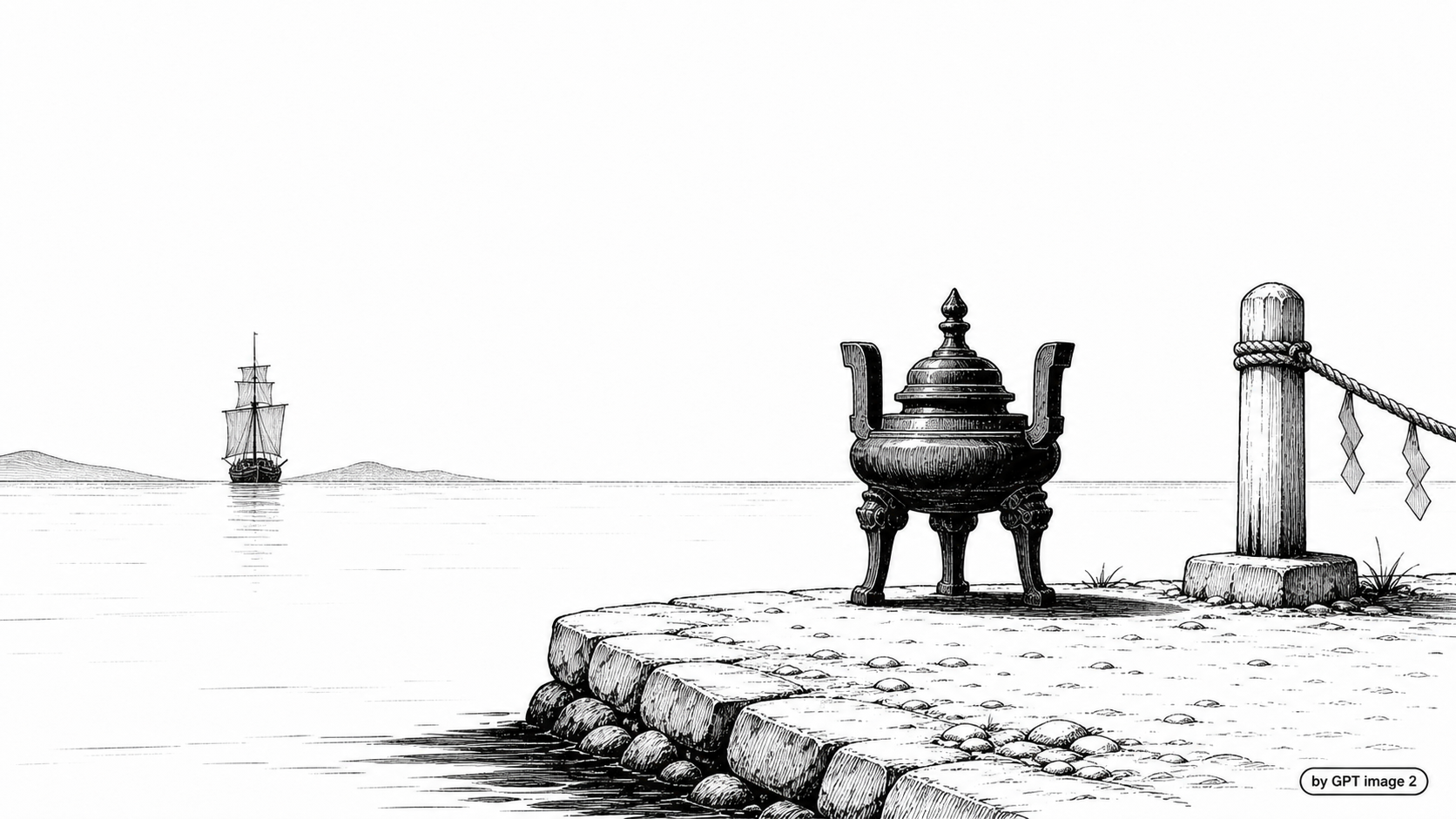
They are carried in aboard the ships of Portuguese and Spanish merchants and missionaries. Mainly Christian saints take this route. Rare among Outside deities.
#Route 2 — A Door Opened by the Aftershock of the Spirit Realm's Trembling
By the main-line setting, after the gate of the Spirit Realm opened, the spirit realms and divine realms of other cultures sometimes leak out as well. The Lovecraftian lineage in particular takes this route. It is rare, and usually a calamity-grade encounter.
#Route 3 — A Blessing Brought by Students, Trade, and Migrants
Ming and Joseon merchants, merchants bound for Siberia, Mongolia, and India. The Norse and Indian divinities appear temporarily along a very small number of northern and southern trade routes. Active only while the person involved enshrines them with personal prayer and devotion.
#Route 4 — The GM's Own Narrative Creation
The GM introduces them independently in a crossover, alternate-history, or fantasy-expansion tone. An arrival story must be recorded in at least one paragraph.
#Law — The Divinity Rank of Outside Deities (Principle of Attenuation - Canon)
Within Japan, an Outside deity operates at a Divinity rank 1 step lower.
Reason: because there is no shrine or offering within Japan, or only an extremely small one. Even a being originally of Imperial God rank operates within Japan like a Great God or Middle God.
Examples:
- Zeus (originally Imperial God, rank 5) → within Japan, Great God 4.
- Odin (originally Great God, rank 4) → within Japan, Middle God 3.
- Cthulhu (originally a separate system) → within Japan, fixed at Great God 4 (see the special clause).
#Exceptions to Attenuation
- If a shrine, church, or temple that enshrines the Outside deity in question has been built within Japan, the original rank is applied with no attenuation.
- If there is a patron of daimyo rank, a 1-step adjustment is possible at the GM's discretion.
#Law — Domain Conflict with Existing Japanese Gods
When an Outside deity's Domain overlaps with a Japanese god's Domain, follow the conflict rules of fc01-01-02-domains.md. Add to that:
- Same field, different Divinity — e.g., Zeus's "thunder" vs. Takemikazuchi's "thunder."
- Within Japan, the Japanese god takes priority. Even if the Outside deity is originally of higher Divinity, attenuation reverses this or makes them equal.
- Different fields — Zeus's "sky" and Amaterasu's "sun" are different fields, so there is no conflict. Each acknowledges the other's Domain.
#Scent — Cthulhu Is Special
"The other Outside deities are guests. Cthulhu is not a guest — he is merely asleep."
The gods of Greece, the North, and India are in human form. They can be handled as guests. But Cthulhu is different. He is an alien being that is hard even to call by the category of "god." His Domain is narrow, but no sanity remains in a human who enters within it.
fc01 classifies Cthulhu as a "god," yet applies rules different from the other Outside deities.
#Law — Cthulhu Special Clause
- Combat impossible — Cthulhu cannot be subdued by the PCs in combat. When he appears, only encounter, evasion, and madness saves are checked.
- Reinforced ban on intervention outside the Domain — Cthulhu's Domain is extremely narrow (the deep sea, madness, sleeping dreams). Outside it he does not work.
- No return — Cthulhu "is not awake." Once he sleeps, he does not move for years (年) at a time.
- The sole exception within Shinseiki — the other Outside deities use the general rules; only the Cthulhu lineage takes this special clause.
#Law — Recommended / Not Recommended Use of Outside Deities
#Recommended Scenarios
- Kirishitan-related scenarios → the saint lineage (see
fc01-02-06-minor-divinities.md). - Nanban-trade scenarios → Greek and Norse divinities as sailors' tradition.
- Sea-exploration scenarios → a deep-sea encounter of the Cthulhu lineage.
- Alternate-history and time-transcending scenarios → free introduction (compatible with the "time-transcending Eastern wuxia" tone of
ex2).
#Not Recommended Scenarios
- Pure Sengoku-era political scenarios → Outside deities are unnecessary.
- During a major main-line arc → inserting an Outside deity harms the tension.
- When a PC makes an Outside deity their "PC's guardian god" → the arahitogami and Tatarigami structure of the main line is more recommended.
#Scent — In One Sentence
"An Outside deity is a guest in Japan. A guest stays only briefly, and passes by quietly."