#Ashigaru — Fields by Day, Spear by Night
Contents
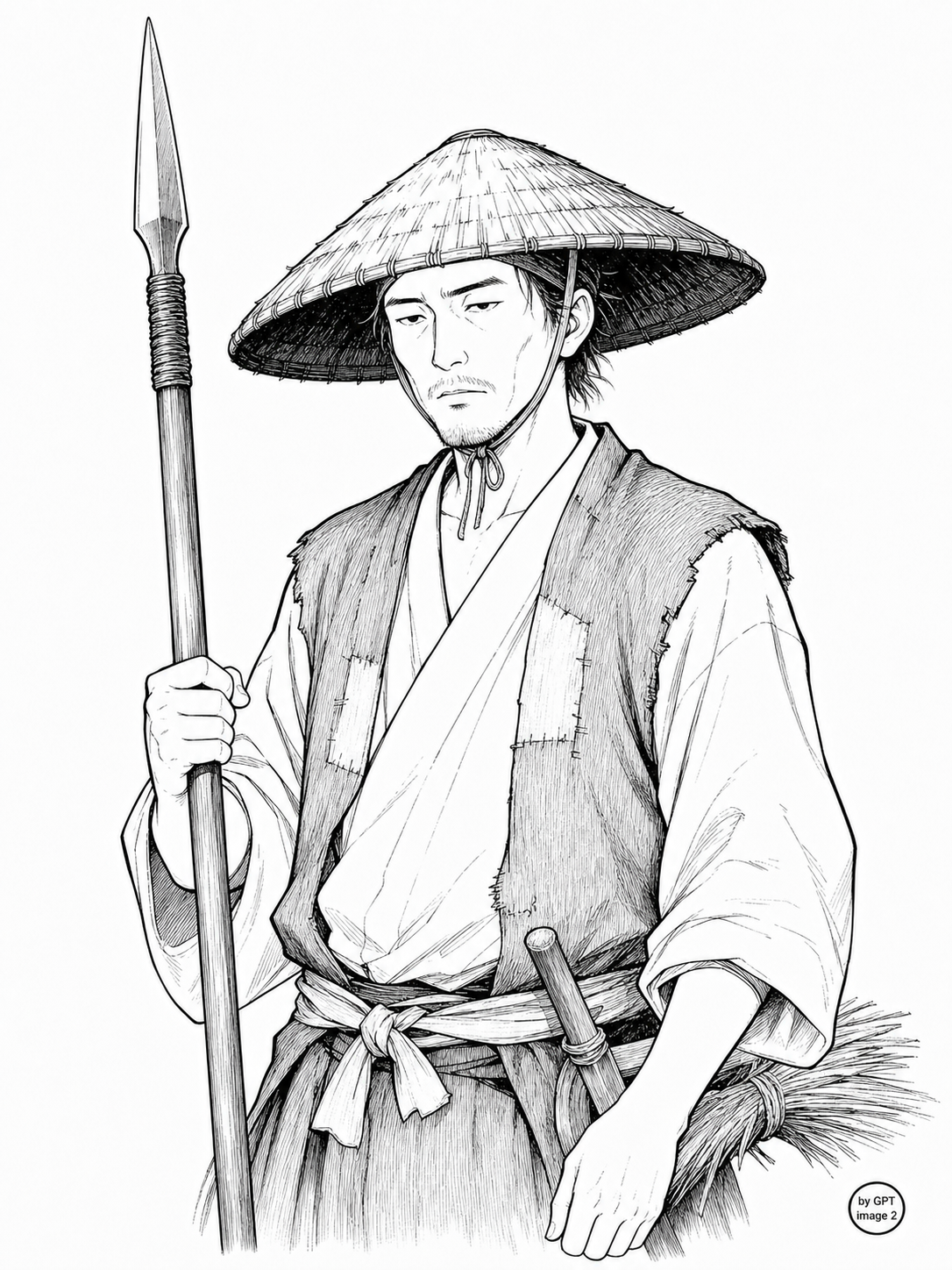
His name is not recorded. Nor is his face.
#The Name Ashigaru
Ashigaru (足軽) — read literally, "one whose feet are light." Light armor, no horse — either way, infantry who move fast. Not the regular warriors of the capital, but soldiers summoned when needed.
70–80% of any army in the Sengoku era is ashigaru. Samurai are conspicuous but few in number. Most of the dead are ashigaru. Most of the charges are carried out by ashigaru.
#Who Was He
Most often, he was a farmer.
One day a farmer is called to the village headman. "For this war, our village must provide five men." He was chosen from among the five. The criteria are unclear. A healthy young man comes first; after that, someone whose household can spare him. The eldest son is usually excluded — he must carry on the family line.
Selected, he appears at the muster ground a few days later. Short training — how to grip a yari, how to keep ranks, how to address his lord — for a few weeks. Then the battlefield.
#Arms
The ashigaru's arms are simple.
- Yari (槍) — the most common weapon. The ashigaru's nagae-yari (長柄槍, long-shafted spear) runs 3–6 meters — Oda Nobunaga's units were especially long, reportedly some reaching five ken (about 9 meters). Unwieldy alone. Only when many stand together like a forest does the formation take shape.
- Jingasa (陣笠) — a wide iron hat. Deflects arrows.
- Do-maru (胴丸) — a light armor covering only the torso. Humble compared to the samurai's o-yoroi (大鎧).
- Sword — useful to have, but many do not carry one. Mostly scavenged from samurai.
Some ashigaru receive a teppo (鐵砲). The matchlock arquebus that arrived on Tanegashima after 1543. Those who carry one are called teppo ashigaru (鐵砲足軽) and receive more training and slightly more stipend. In exchange, they are the first to die on the battlefield — enemy samurai make a point of targeting them.
#Fields by Day, Spear by Night
The ashigaru's life is divided into two layers.
#Farming Season (農繁期) — Spring, Summer, Autumn
He is a farmer. He plants seedlings, pulls weeds, and harvests. His wife works the loom; his child chases sparrows in the fields. If war comes during this season — the daimyo is in trouble. Farmers dragged to the front leave fields to rot. Next year there is nothing to eat. So daimyo tried to push large campaigns to the off-season if possible. In practice, however, the timing of war varied with local conditions and logistics, and autumn campaigns after harvest were far from rare.
#Off-Season (農閑期) — Winter
He is a soldier. He is called up. He goes to the battlefield for several months. If he comes back alive, he is a farmer again.
This double life is his entire existence. Some were called up nine times and survived nine times; others died on the first call. It is luck.
#On the Battlefield
#How He Dies
The ashigaru's death is not glorious.
- Caught in a hail of arrows — one of hundreds. No one knows who fired it.
- Stabbed by a spear — an enemy ashigaru's yari. They cross spears, and one of them goes down first.
- Trampled by a horse — an enemy samurai's mount passed through where he stood.
- Hit by a teppo ball — a lead round from far away. It punches through the iron jingasa.
- Infected after a wound — days of pain, a simple cut festers, and he dies.
Samurai have records stating "a head was taken." For ashigaru, only numbers remain. The post-battle report reads "123 dead." He is one of them.
#How He Comes Back Alive
If lucky, he comes back alive. A wound on the shoulder, a wound on the leg — but alive.
He returns home and spends months ill. His wife tends to him. On nights without snow he has nightmares — the things he saw on the battlefield. The spot where a friend died. The expression on an enemy ashigaru's face as the man fell, run through by his own spear. That face follows him for years.
When spring comes, he goes back to the field. His strength has not fully returned. But he must earn his rice. A neighbor says, "I'm glad you made it back." He smiles. Behind the smile are the things he saw on the battlefield.
#Plunder and Temptation
The ashigaru's moral failures often come from plunder.
To a poor farmer conscripted for war — a village in enemy territory is a temptation. Exhausted comrades ransack a house. They search for rice. Sometimes they take people as well. This hitodori (人取り, people-taking) — abducting civilians from enemy territory to sell as slaves or hold as hostages — was openly practiced on battlefields of this era. He sees it and wants to stop them — but exhausted comrades turn ruthless in the hours without a commander.
If he cannot stop himself — he too is a looter. Morally, a sinner. Legally, "ordinary conduct of an ashigaru in wartime." The boundary is blurred.
If he tries to stop them and fights with his comrades — he will be stabbed from behind on the battlefield tomorrow. By a comrade's yari.
The ethics of an ashigaru in this age are not clean. The conditions make cleanliness impossible.
#And the Yoma
Since the Spirit Realm opened, the ashigaru's battlefield has yoma as well.
A samurai can learn exorcism techniques, can receive a Divine Artifact. The ashigaru has none of that. He relies on a single talisman. The village miko pasted a cheap talisman inside his jingasa. He touches it once every day.
The talisman is cheap. It might ward off a weak miasma, but against a strong yoma it often falls short. When such an enemy appears — a samurai or someone skilled in exorcism must step forward. The ashigaru falls back and watches. He watches his own commander stand before the yoma.
If the samurai loses — the ashigaru runs. Running is not shameful. The ashigaru was never meant to have glory. Coming back alive is the good (善).
#Those Who Rise
And yet — the Sengoku era is the age of gekokujo. Even among ashigaru, there are those who rise.
The most famous example is Toyotomi Hideyoshi. Born into a farming family in Owari, he began as a menial servant of Oda Nobunaga, rose through the ashigaru ranks, and reached the position of tenka-bito — ruler of the realm. This is the legend of his life. Of course he was the exception. Most ashigaru live and die as ashigaru. But the fact that this exception was possible — changed the air of the age. The one who keeps somewhere in a far corner the thought "perhaps even I" — that is the ashigaru of the Sengoku era.
There was also another path: ikki (一揆). Kuni-ikki (国一揆) and Ikko-ikki (一向一揆) — armed uprisings in which farmers, monks, and lower-ranking warriors united against their lord. The Ikko sect in Kaga (加賀) drove out the lord and maintained "a land governed by the people" for a hundred years. The Ishiyama War of 1576–1580, in which Oda Nobunaga destroyed them, was the end of one such alternative path.
#The Grave of the Nameless
The bodies of ashigaru who died on the battlefield are buried together. Many in a single large pit.
The village erects a memorial tablet. If there is no name, it reads "our village's son." Who did not come back becomes certain only after several months have passed — because he did not return together with others from different villages. His mother waits through winter with "perhaps." Winter comes, spring comes, summer comes, and her son does not return.
Only then does the mother erect the memorial tablet. She carves a name — her son's name. That name is not in the ashigaru roster. Not in the daimyo's records. It is carved only in the small village shrine.
#In One Sentence
The samurai polishes his sword every day. The ashigaru tills his fields every day. When war comes, both take up a spear. Only one of them is recorded.