#The Holy — Monks, Onmyoji, and Miko
Contents
Those who never hold a sword also stand at the very front of this war.
#Four Lines
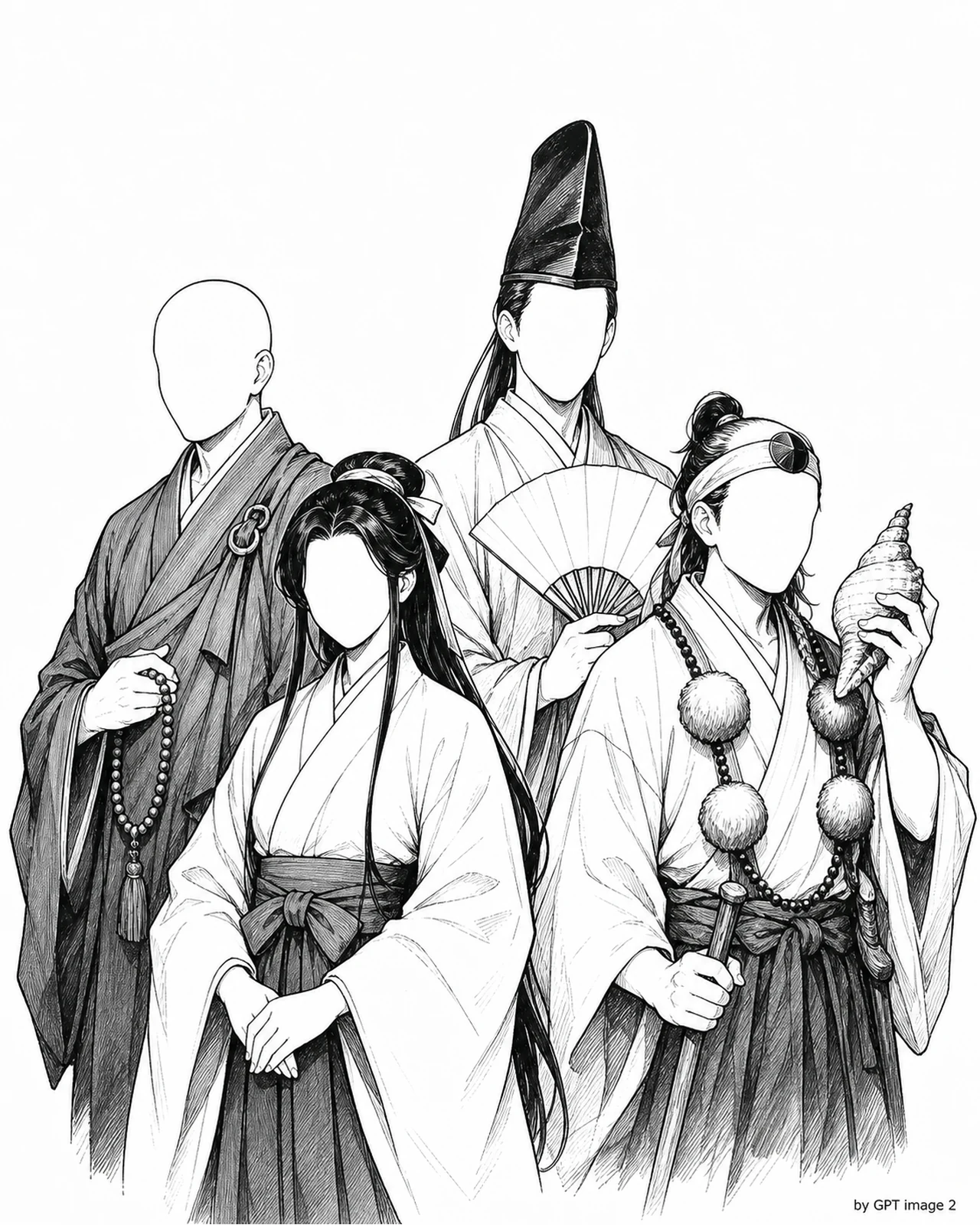
Japan's holy orders fall into four broad lines. In this age, all four coexist. They hate one another sometimes, and cooperate sometimes.
- Buddhist monks (佛教僧) — Those who follow the Buddha's teaching. Several major sects (Pure Land, esoteric, Zen, Ikko…)
- Kannushi and miko (神官·巫女) — The Shinto clergy. They serve at shrines and mediate between gods and humans.
- Onmyoji (陰陽師) — Specialists in divination and sorcery, blending Taoist and Shinto currents. Some hold formal posts in the Onmyoryo (陰陽寮).
- Yamabushi (山伏) — Mountain ascetics. Practitioners of shugendo (修験道), a blend of Shinto, Buddhism, and Taoism.
Below them: a miscellany — itako (spirit mediums), onmyoji's assistants, wandering monks, and even fraudulent monks.
#Buddhist Monks (佛教僧)
#Three Great Currents
Japanese Buddhism in this age runs in three broad streams.
- Jodo-shu (浄土宗) · Jodo Shinshu (浄土真宗, the Ikko sect) — Nembutsu chanted to Amida Buddha. The faith of the commons. The most widespread popular Buddhism. The foundation of the Ikko-ikki uprisings.
- Shingon (真言宗) · Tendai (天台宗) — Esoteric Buddhism (密教) — Mandalas, mantras, mudras. The Buddhism of exorcism and sorcery. Mt. Koya (高野山) and Mt. Hiei (比叡山) are the head temples.
- Zen (禅宗) — Rinzai and Soto — Meditation (zazen). The state of nothingness. The Buddhism of the warrior class. It touches the tea ceremony, ikebana, and swordsmanship.
Each daimyo favors a different sect. Oda Nobunaga sought to bring about the destruction of the Ikko sect, while Takeda Shingen cherished Zen.
#A Day
A day in the life of a monk at a great temple (大寺):
- 4 in the morning — Rise. Nembutsu. Wash the face with cold water.
- 5 to 7 — Morning practice. Recitation of sutras (読誦).
- 7 to 8 — Morning meal (rice gruel, vegetables).
- 8 to afternoon — Cleaning, study, counseling the faithful, exorcism rites, joint rites with miko, and more.
- Afternoon — Individual practice. Zazen or nembutsu.
- Sundown — Evening meal.
- Night — Final nembutsu. Sleep.
The monk at a small temple is far busier — he handles the funerals, weddings, namings of newborns, and prayers for the sick for all the village's people.
#Warrior Monks (僧兵)
Remarkably — some temples in this age maintain armies. Mt. Hiei is the prime example. Armed monks called sohei (僧兵), numbering in the thousands. They carry naginata (薙刀) and bows.
Oda Nobunaga's burning of Mt. Hiei in 1571 is famous. Thousands of warrior monks and non-combatant monks alike were killed. The act of "burning a Buddhist temple" was a profound shock to the age.
Mt. Koya (高野山), meanwhile, took a different path. The head temple of Shingon, a monastery deep in the mountains. Amid the chaos of Sengoku, it largely maintained military neutrality and became a refuge for defeated daimyo houses. However, Oda Nobunaga and Toyotomi Hideyoshi were exceptions. Nobunaga attacked Mt. Koya in 1581, and Hideyoshi attempted to burn it in 1585. Even so, for most factions, Mt. Koya remained a place they were reluctant to touch carelessly — on account of its sanctity, and because no one could know where or how its accumulated network of neutrality might work against them.
And the strangest example of all — the Ikko-ikki kingdom of Kaga (加賀). An autonomous community of Jodo Shinshu believers who governed an entire province without a daimyo for 100 years. It was called "a province held by the peasants (hyakusho no mochitaru kuni)". Until Oda Nobunaga brought it down through the Ishiyama War of 1576–1580 and a chain of subjugations, Kaga was a rare case in which religion was politics.
#Exorcism Rites
Since the Spirit Realm opened, the role of the esoteric monk has grown. They chant nembutsu in the name of Fudo Myoo (不動明王), draw mandalas to seal yoma, and purify impurity through goma (護摩) — a rite of burning wood in fire as prayer.
A temple's goma fire never goes out through the night. Sick people sit before that fire and chant nembutsu. The esoteric monk draws out the yoma clinging to their bodies in the fire's smoke. Some are helped; some are not. If they are not helped — that person dies, or goes mad.
#Kannushi and Miko (神官·巫女)
#Living at the Shrine
The Shinto clergy belong to a shrine (神社). The principal figure of the shrine is the kannushi (神官·神主), assisted below by the miko (巫女).
The kannushi is usually passed through bloodline — father to son. A family that has served a particular deity for generations. Only certain bloodlines may serve as kannushi at the Grand Shrine of Ise.
The miko is sometimes bloodline, sometimes recruited. A young woman enters the shrine and trains for several years before becoming a miko. A white kimono with a red hakama. White paper ornaments in the hair.
#A Day
- Dawn — Cleaning the shrine. Drawing water to fill the temizusha (手水舎). Replacing the peach branches with fresh ones.
- Morning — Offering shinsen (神饌) to the deity. Rice, salt, water, sake. The kannushi reads the norito prayer.
- Midday — Receiving visitors. Naming ceremonies for children (命名). Weddings. Shrine repairs.
- Evening — Evening rite. A single flame is lit.
- Night — Quiet. The shrine grows still. The miko does not sleep; she listens for the voice of the god (in some traditions, it is believed to be so).
#Kamigakari
The miko's special gift is receiving a god into her body. She deliberately empties her consciousness, and lets the god speak by borrowing her body. In this state, the sounds the miko makes are — not the miko's own voice. They are the god's voice.
Before an important decision of a great house, the house's miko performs this rite. Whether to go to war, which woman to marry, who to name as the next heir — such decisions are often settled by the god's words through the miko's mouth.
#The Village Miko
The miko of the great shrine and the village miko are different. The village miko is far poorer, and far busier. When a child falls ill, she runs. When an elder dies, she helps with the funeral. She braids the hair of a woman who will become a bride. She is the village's spiritual mother.
Since the Spirit Realm opened — her greatest work is writing talismans. She writes dozens of talismans every night. The villagers take them one by one and paste them to their homes. Her talismans are weaker than the expensive talismans of an esoteric monk — but she alone gives them every day. So people depend on her.
#Onmyoji (陰陽師)
#A Peculiar Class
Onmyoji — specialists in sorcery who blend Taoist yin-yang cosmology with Japanese Shinto and esoteric Buddhism. They were an official post belonging to the state institution called the Onmyoryo (陰陽寮) in the age of the ritsuryo system.
But — by the Sengoku era, the Onmyoryo is an institution left with form only. The court's real power collapsed long ago, and the practical succession of Onmyodo passed down through the hereditary lines of great families. Abe no Seimei (安倍晴明) of the Heian period is famous as the legendary onmyoji. His descendants are called the Tsuchimikado house (土御門家) and maintain the head lineage of Onmyodo. Great lords either summon people from this house or hire wandering onmyoji within their own domain.
#A Day
A day in the life of a great-house onmyoji:
- Observing the stars — Divining good or ill fortune from the heavens.
- Barrier — Erecting a Barrier around a residence or castle.
- Employing shikigami (式神) — Commanding shikigami through paper talismans. A small spirit moves as commanded by the talisman.
- Advising the daimyo — The daimyo comes for divination before an important decision. The onmyoji synthesizes the stars and the reading and answers.
#Wandering Onmyoji
Beyond great-house onmyoji — there are wandering onmyoji. They travel from village to village, reading fortunes, selling talismans, finding lost things. Among them are genuine practitioners and frauds. Ordinary people find it hard to tell the difference.
#Onmyoji on the Battlefield
Since the Spirit Realm opened, the onmyoji's battlefield role has grown. They erect pre-battle Barriers, seal onryo on the field, and see through the enemy's sorcery. They do not hold a sword — but they exert great influence on the outcome of battle.
A famous example: at the Battle of Kawanakajima, an onmyoji of the Uesugi side erected a Barrier and reduced the accuracy of the Takeda side's rain of arrows — legend. Whether it is true, no one can say.
#Yamabushi (山伏)
#Those Who Live in the Mountains
Practitioners of shugendo (修験道). A mountain-ascetic religion that blends Shinto, Buddhism, and Taoism. Yamabushi enter the mountains to train. Once they go in, they stay for months — sometimes years.
#The Look
- On the head, a small tokin (兜巾, a small cap)
- A neck cord called an irotsui (結袈裟)
- White robes
- On the back, a horagai (法螺貝, a conch-shell horn) — blown to signal each other in the mountains.
- In hand, a shakujo (錫杖) — a staff hung with rings and bells
Their appearance is impossible to forget once seen. The sound of a yamabushi's horagai descending from the mountain became the villages' sense of the seasons.
#Kumano
The heartland of the yamabushi is Kumano (熊野) — the Kii Peninsula. The pilgrimage road called the Kumano Kodo (熊野古道) passes through here. Walking this road is the pinnacle of training.
#Close to Yoma
The yamabushi are the clergy closest to yoma. Because they spend long stretches in the mountains — they see yoma often. Some yamabushi become friends with tengu. Some yamabushi themselves come to resemble tengu — their noses grow long, and wings appear on their bodies, or so the tradition says.
Whether or not the effects are real, common people treat yamabushi as those with strong spiritual power. When a difficult problem arises in the village — they call a yamabushi down from the mountain.
#How They Relate
These four lines coexist and compete.
- Temple vs shrine — When a single village has both a temple and a shrine, who takes charge of the funeral? In ordinary life, broadly speaking: the temple handles funerals, the shrine handles namings and weddings. The boundary is often blurry.
- Onmyoji vs monk — They compete for the daimyo's ear. Some daimyo trust the onmyoji; others trust the esoteric monk.
- Yamabushi vs everyone — The yamabushi mixes with all. They attend temple practice, join shrine rites, and share sorcery with onmyoji. A being of the boundary.
#Closing with One Scene
A plague swept through a mountain village.
The villagers were desperate. They called a miko. The miko wrote talismans every day. The effect was not great. They called a monk. The monk burned goma. The effect was not great. They called an onmyoji. The onmyoji erected a Barrier. The effect was not great.
At last — a yamabushi came down from the mountain. He walked once around the village and sat beside the well. He told the people:
"The source of the sickness is this well. Yoma have lodged in the well."
He took herbs he had brought from the mountain and scattered them into the well. The well turned black for several days. Then — it cleared. The plague stopped.
The people asked — "What was that?" The yamabushi smiled and answered:
"I do not fully know either. The mountain teaches."
That answer — it sums up the whole attitude of the holy in this age. Those who perform rites before what they do not know. Not possessing the answer, but making a gesture toward finding it.