#What Is a Swordmaster
Contents
There are many who handle a blade well. But few are called swordmaster.
#Scent — The Blade That Became a Name
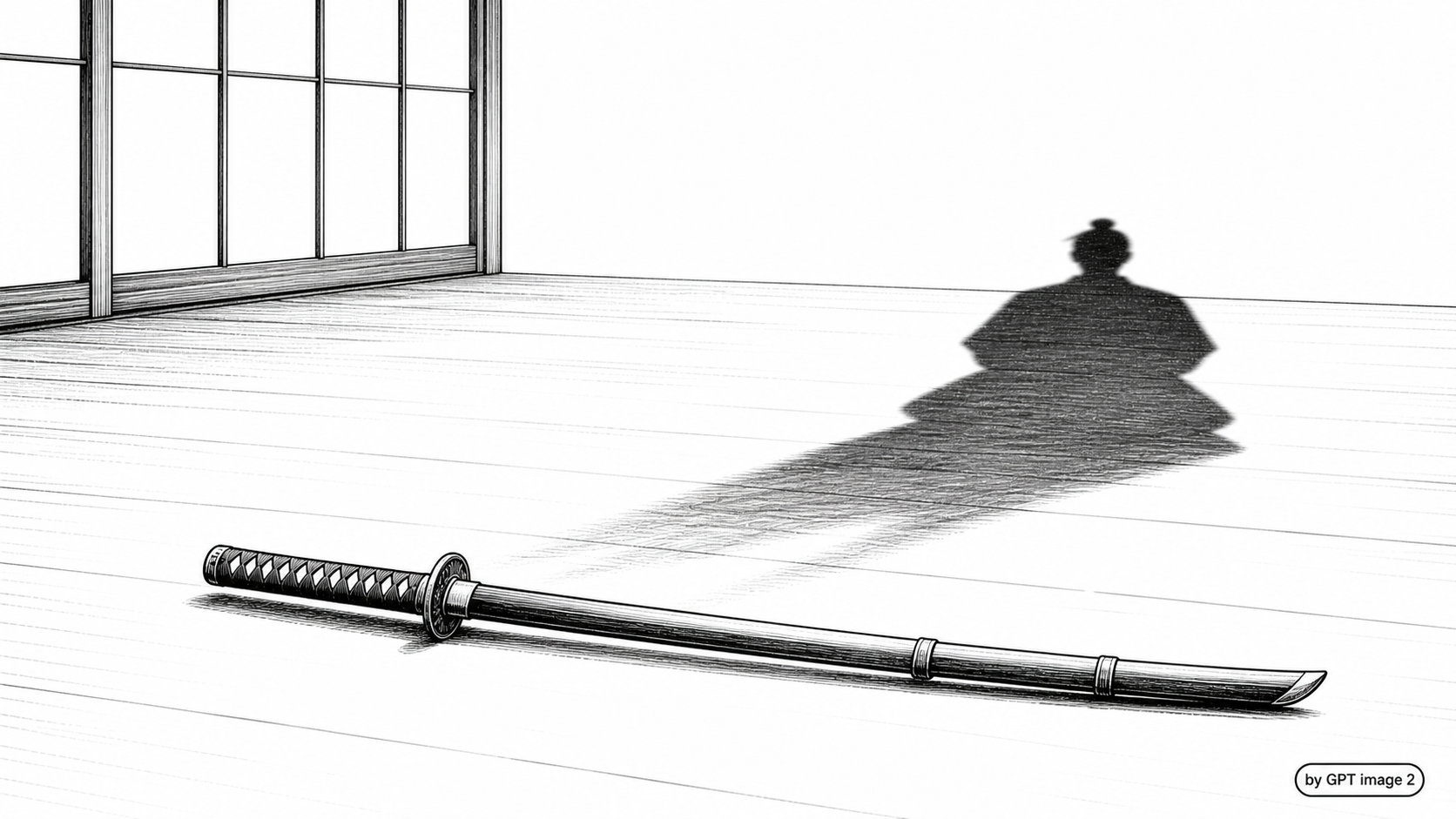
When, even a hundred years after a person has died, people still remember the mark of their blade. The two characters swordmaster are attached before their name.
A swordmaster is not simply a strong swordsman. Strong swordsmen are many. A swordmaster is one who, even among strong swordsmen, crossed a certain line — one for whom, beyond that line, the blade changed the shape of the person.
The people of this age called the name of that line by many things.
- Meijin (名人) — one whose technique is complete.
- Tatsujin (達人) — one who saw the principle beyond technique.
- Sei (聖) — one who reached the level of the Way (道).
- Shin (神) — one who stepped on the boundary of the human.
A swordmaster is, among these four stages, at minimum a Tatsujin, usually Sei or above. But it is not self-proclaimed — it is a name assigned by later ages. One who, while alive, called himself "Sword Sage (劍聖)" usually does not earn that name.
"A swordmaster becomes a swordmaster only after death. The living are merely 'excellent swordsmen.'"
#Law — The Three Conditions of Swordmaster Selection (Canon)
The criteria by which this volume selected 12 figures as "swordmasters":
#1. The Trace of a School
That he founded a school, or was a decisive inheritor of a school. That his technique did not end with the individual but was passed down through generations. This condition alone is not enough — but without it, one cannot become a swordmaster.
#2. A Recorded Duel
A duel or battle record that can be confirmed as fact. Legend alone does not make a swordmaster. There must be, in the historical record, whether a record of winning or a record of losing. One who has only legend becomes a figure within a night tale.
#3. Re-creation by Later Ages
That after death he was repeatedly reproduced in literature, theater, and folktale. In Japanese history, a swordmaster is always born twice — once as a real existence, once as a story. And the figure within the story sometimes grows larger.
Among those who possess all three of these conditions, this volume selected 12 figures. Those who possess only two of the conditions have their names listed only in the fc03-99-01-kenshi-roster.md Swordmaster Roster.
#Law — Common Kenshi Special Rule: Aged (高齡)
Age is the one opponent a swordmaster never beat. Some swordmaster sheets in this volume carry the Aged special rule.
- Aged: In combat, maximum Energy -1 with each Lull Phase (floor: half of the original maximum Energy, rounded up). If current Energy exceeds the new maximum, the excess is lost along with it.
- The reduced maximum recovers when the battle ends. In the next fight too he starts at the same maximum — and dims at the same rate.
- The subjects of application are specified on each sheet with the Aged notation. Applied in this volume: Iizasa Ienao (floor 6) · Yagyu Muneyoshi (floor 6).
Design intent: An aged swordmaster is as strong as in his prime for the first few rounds. The longer the fight drags on, the more his blade dims — the numeric implementation of "strong while he holds out." Cutting the stance and dragging out time is the one orthodox approach.
#Scent — The Four Faces of the Swordmaster
A swordmaster is not one face. The 12 figures of this book are roughly divided into four tendencies.
#Founder Type — Those Who Opened a School
Iizasa Ienao, Tsukahara Bokuden, Kamiizumi Nobutsuna, Ito Ittosai, Togo Shigekata. Their very lives are the process of making a technique. The blade they made is passed down through generations.
#Perfecter Type — Those Who Pushed a School to the End
Yagyu Muneyoshi, Miyamoto Musashi. They push one stage further the road another opened. Without them, that school would have remained an ordinary technique.
#Political Type — Those Who Held an Age with the Sword
Yagyu Munenori, Chiba Shusaku. A single blade becomes a tool of politics. Their training does not end within the dojo alone.
#Tragic Type — Those Erased by the Age
Sasaki Kojiro, the young men of the Shinsengumi. Even with talent, they are a case of meeting the wrong age. Half of swordmasters are always those who remained by losing.
A single figure does not converge into only one face. Musashi is a perfecter and a founder. Munenori is a political type and a perfecter. The reader may refer to this division loosely.
#Law — "If You Fight a Swordmaster"
The common principles of the "if you fight" section in the latter half of each chapter.
#The Meaning of Lord (主級)
The 12 figures of this volume are all rendered into numbers as Lord (主級). A Lord means — as a named individual unit, he stands on the battlefield with a sheet of the same form as a PC. Because a swordmaster is human, the base sheet follows the same attribute total as a general PC. That is, initial 4-point distribution + attribute +1 on odd-numbered promotion, with an attribute cap of +3.
However, a swordmaster is not a general-purpose adventurer but a human Lord NPC specialized in swordsmanship duels. The numeric form is the same as a PC of the same dan, but because his licensed techniques, secret-art techniques, and unique special abilities are concentrated on the duel, it is hard to win standing against him head-on alone.
#Boss Enhancement Options
If you want to use a swordmaster not as a mere dueling opponent but as a larger scenario adversary or obstacle, add the shared option rules below to the base sheet. These enhancements are not included in the base swordmaster sheet.
| Enhancement | Rule |
|---|---|
| Attribute Enhancement | Distribute a total of 3 additional points to Courage / Finesse / Physique on the sheet. At this time the attribute cap is not +3 but +5. Recalculate Energy and Wounds according to the changed Finesse and Physique. |
| Defense Enhancement | Treat him as wearing armor one step higher than the recommended armor on the sheet. The reference ladder is no armor 10 → light armor 12 → medium armor 14 → heavy armor 16 → masterwork armor 17. Even for an unarmored swordmaster to whom armor does not suit, treat the base Defense as 12 during boss enhancement. |
| Famed Blade Issue | If there is no designated weapon, choose 1 weapon from the masterwork catalog and have him equip it, renaming it as Blade of ○○. |
| [aptitude] Arrow Deflection | For ranged attacks only, a defense technique can be used for 1 Energy without reservation. It nullifies all [Direct] effects. |
| [Kata] Blade of the Ruler of the Realm | 3 Energy, 2d10+Courage+Swordsmanship. Attacks 1 enemy squad in the same zone or an adjacent zone. The result is applied as the hit-roll result of the Volley Fire / Attack Resolution Table. On a critical, additionally target squad Cohesion -1. 1 round. |
The order of application is attributes → recalculate Energy / Wounds → raise the Defense step → issue the famed blade → add the two techniques. For example, using Musashi as a boss obstacle, from the base Courage 3 · Finesse 3 · Physique 2 / Energy 13 · Wounds 7 / Defense 10, add 3 points to Courage / Finesse / Physique. If you set it as Courage 5 · Finesse 4 · Physique 2, Energy becomes 14, and even without wearing armor, Defense is seen as 12 because of the boss enhancement. Add Blade of Musashi, Arrow Deflection, and Blade of the Ruler of the Realm to this and it is complete.
#The Three Paths to Victory
Beating a swordmaster is one of three things.
#Path 1 — Head-On Contest (劔 vs 劔)
- Possible only if the dan is close or transcendent.
- Since the base swordmaster sheet is the same total as a PC, with a duel-specialized PC of the same dan the contest itself holds.
- However, because a swordmaster's licensed, secret-art, and unique special abilities are weighted toward the duel, it is hard for a general-purpose PC to win head-on alone.
- A swordmaster with boss enhancement options applied requires squad coordination, or the support of a Divine Artifact / devotion technique.
#Path 2 — Being Recognized (honor over victory)
- Even if you cannot win, gaining his respect is a narrative victory.
- Example: after a duel, receiving the single line "Your sword was good."
- This is, in fact, how many of the historical swordmasters' duels ended.
#Path 3 — Bypass (with something other than the sword)
- Indirect influence through his lord, disciple, or family.
- His weakness — most swordmasters have a weakness. Use the situation, not the sword alone.
- Those who gathered to kill a swordmaster generally fail, but those who gathered to break a swordmaster's will often succeed.
The "if you fight" section of each chapter specifies which of these three paths is the most realistic.
#Law — "If You Take a Swordmaster as a Master"
#The Four Stages of Instruction
Most historical swordmasters took disciples. The method roughly follows the next stages.
#1. Turned Away at the Gate (門前 追却)
The first time you knock on the gate of the dojo (or dwelling) — you are driven away. This is the first trial. Only one who, having been driven away once, comes again enters his field of view.
#2. The Test (試し)
On the second or third visit, a small test. Usually a trivial task such as sweeping the dojo · carrying firewood · standing up a wooden sword. Within that triviality he watches the stance.
#3. Apprenticeship (修習)
Once accepted, years of training. One kata (型) is repeated hundreds of thousands of times. There is no progression. One day the master says, "You now do the next kata."
#4. Full Transmission of the License (免許皆伝)
When the master fully recognizes him, full transmission of the license. He takes over all the kata of the school. Rarely, the secret transmission (秘傳) — the master's personal secret art — is also passed on.
#The Unit of Time
Instruction is 1 year to several decades. The campaign's time must flow that much. It cannot be learned in a single session. Instead, depict it as "growth across a long gap" — "3 years have passed. You are now a full-transmission holder."
#Reward
Upon full transmission of the license, the PC:
- Acquires 1 licensed technique of that school.
- Adds 1 secret-art technique depending on conditions (when the master is pleased).
- The master's name is attached to the PC's lineage — the PC is called "disciple of ○○" in the world.
- In the case of some swordmasters, 1 unique special ability.
The "if you serve" section of each chapter specifies that swordmaster's concrete conditions, trials, and rewards.
#Scent — The Final Premise
One thing to remember before reading this book.
A swordmaster is not remembered for winning. Even in lost battles some are remembered, and even in won battles some are forgotten.
What makes a swordmaster is not victory or defeat, but what resonance that blade left. It is fact that Musashi cut down Kojiro, but that does not mean Kojiro is not a swordmaster. Rather — because the losing side is remembered as a swordmaster, they sometimes leave more stories.
Without forgetting this point, open the twelve chapters.
"The blade makes the swordmaster. But what becomes a swordmaster is not the blade but the person."