#01. Iizasa Choisai — 飯篠長威斎 · Founder of the Katori Shinto-ryu
Contents
- Birth and death: 1387–1488 (died at 102 · tradition)
- Era: Mid-Muromachi
- School: Katori Shinto-ryu (香取神道流) — see the co-recorded school
- Alias: the Old Blade of Choi (長威) · his real name is Ienao (家直)
#Fiction Introduction — "The Last Kata (型)"
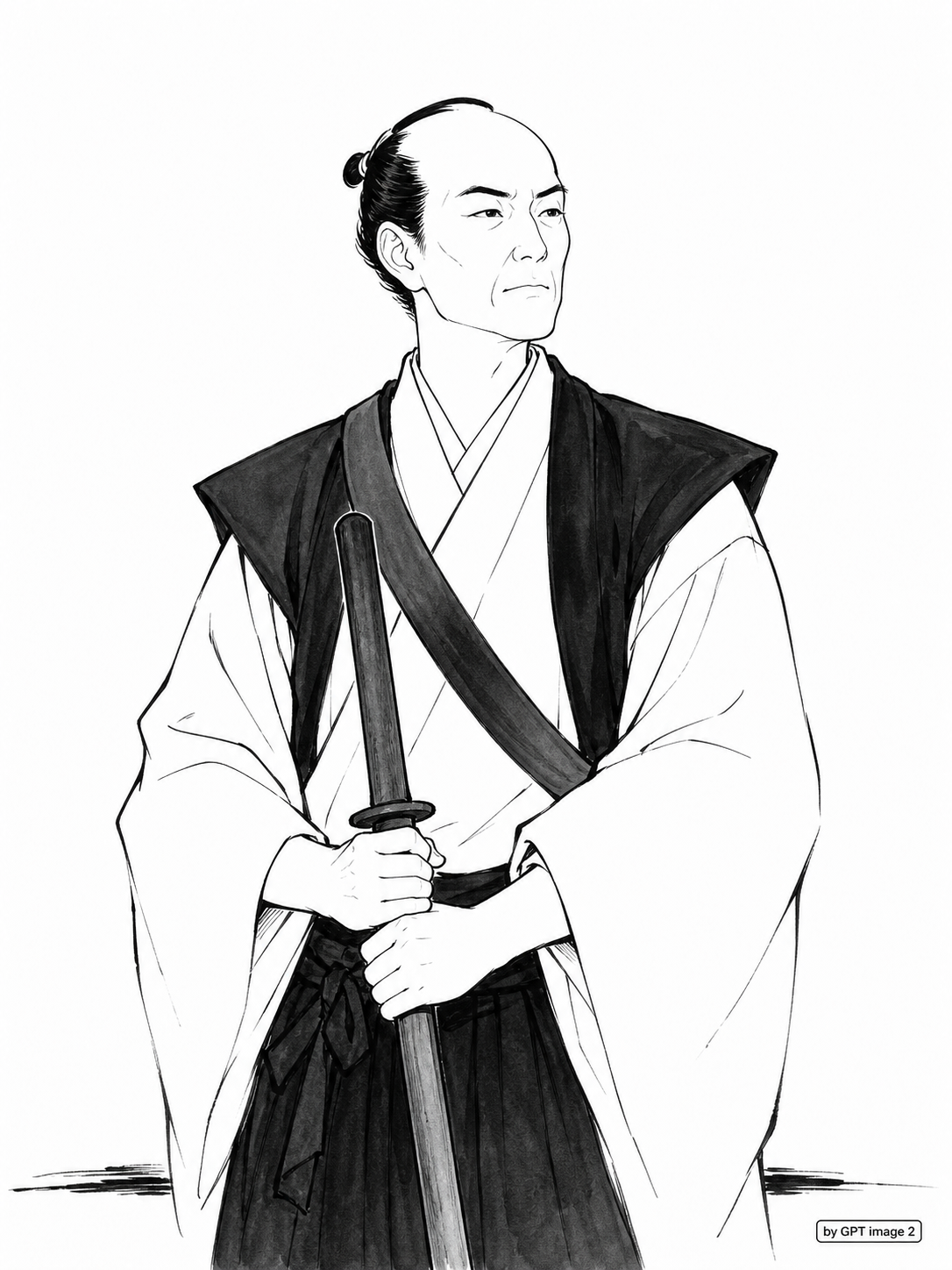
An autumn of 1447. A small courtyard deep within Katori Shrine. Maple leaves are falling.
An old man stands in the middle of the courtyard. White hair, white beard, yet his back is still straight. Beside him a wooden sword lies, a single blade.
Five young men stand surrounding him. Today is the day of Choi's final teaching.
"I will show you the first kata."
The old man takes up the wooden sword. A single movement. Just once. Though his feet did not even move, the wooden sword has been drawn through the empty air.
"This is the first kata."
The young men open their mouths. The old man continues.
"Ask me why I did not move a single step."
No one asks. The old man answers on his own.
"I am now past sixty, and leaping is heavy for me. But even without moving a single step, the enemy comes before my feet. That is the kata."
A maple leaf touched the tip of his wooden sword and was cut without a sound.
#Scent — Life in History
#Life
Iizasa Ienao (飯篠家直) — called by later ages by the title Choisai (長威斎). Tradition holds that he was born in 1387 and lived to 102. His actual birth and death are hard to confirm precisely, but it is certain that he was of the mid-Muromachi period.
In his youth he grew up in a family of priests of Katori Shrine, and along with the duty of guarding the shrine he devoted himself to swordsmanship training. His training was a thousand days (千日) of seated meditation and a thousand days of wooden-sword practice — it is said he dedicated 3 thousand days to a single kata (型).
Around the age of 60 he officially founded the Katori Shinto-ryu (香取神道流). As a priest of the shrine, he saw swordsmanship as an extension of Shinto rites (神事). He left behind the philosophy that "the sword is not a technique for cutting people down, but a technique for protecting people."
#The Actual Story
There is almost no recorded duel. More than the stories of his actually fighting, the names of those who learned from him remained more numerous. Among his disciples:
- Matsumoto Bizen-no-kami (松本備前守) — later continued into the Kashima Shinto-ryu. The master of Tsukahara Bokuden.
- Aisu Iko (愛洲移香斎) — the founder of the Kage-ryu (陰流). The grand-master of Kamiizumi's line.
That is, Iizasa Ienao is the founder (祖) of orthodox Japanese swordsmanship and the distant source of nearly every school.
Just before dying at 102, his last words are passed down:
"I have not once been able to wield a complete blade. Yet I am not ashamed."
#Night Tales
"A Thousand Days of Stillness (千日靜坐)" — the story that Choisai, in his 30s, sat in zazen without moving for 3 years before the main sanctuary of Katori Shrine. The priests took turns drawing water for him. On the day of the 3rd year, the god of Katori appeared and taught him the first kata directly. Thereafter, the folktale goes, "Choisai's seat" was marked within the shrine precincts.
"A Single Maple Leaf" — the anecdote that in his later years he cut a single falling maple leaf without a sound with his wooden sword. This is an archetypal scene reproduced in many later swordmaster night tales.
#Law — Lord-Grade Data
#School
Katori Shinto-ryu (香取神道流) — recorded in co.
- Licensed:
[stance] Stance of the Initiative— first attack +3, on Disable Defense -2. - Secret art:
[Kata] Heaven-Earth-Human— 3 consecutive strikes, on 3 hits additional 2 Wounds.
#Lord-Grade Sheet
| Item | Value |
|---|---|
| Class | Samurai 9-dan (the old swordmaster of the Katori source) |
| Attributes | Courage 2 · Finesse 1 · Physique 3 · Wisdom 2 · Presence 0 · Fate 0 |
| Energy | 11 |
| Wounds | 7 (3 + Physique 3 + Tough 1) |
| Defense | Unarmored 10 / Armored 12 (Do-maru recommended, limited to shrine-defense battles) |
| Swordsmanship proficiency | +3 (Master) |
| Skills | Swordsmanship · Perception · Stratagem |
| Key feats | Immovable Formation · Iron Wall Defense · Invincible Under Heaven · Tough |
| Three Ways and Six Hearts | 眞 (the peak of the Way of Truth) |
| Special rule | Aged — at every Lull Phase, max Energy -1, floor 6 (half of base, rounded up) → Common Special Rules |
#Unique Techniques
| Technique | Energy | Check | Effect | Limit |
|---|---|---|---|---|
| [stance] Stance of a Thousand Days | 2 (upkeep) | — | 1 stance slot. While upkept, an enemy in the same zone takes -2 on the first attack check, and Iizasa's first attack or counter is +2. Cannot be used at the same time as Stance of the Initiative. | upkeep |
| [Kata] The Last Single Cut (最の一刀) | 4 | 2d10+Courage+Swordsmanship+2 >= Defense | On success, 2 Wounds. On a critical, 3 Wounds + the target cannot take its first action in the next round. A finishing blow drawn out at the end of long training. | 1 per combat |
#If You Fight the Swordmaster
#Matchup
- Head-on contest: extremely difficult. His
[stance] Stance of a Thousand Daysstrongly distorts the exchange of the first breath. - Weakness: the Aged special rule — at every Lull Phase, his max Energy drops by 1 (floor 6). For the first several rounds he is still in his prime. But the longer his stance is forcibly broken and the fight drags on, the more surely the old swordmaster's blade fades.
#The Three Paths to Victory
#Path 1 — Head-On Contest (recommendation ★)
- Multiple simultaneous attackers. His
[stance] Thousand Dayswatches only one opponent at a time. - Simultaneous attack by a squad of 4–5 + 1 archer among allies supporting from range makes it theoretically possible.
- But you must finish before he uses
[Kata] The Last Single Cut.
#Path 2 — Being Recognized (recommendation ★★★)
- A 102-year-old man. Even if you cannot win, if you merely imitate the stance, he pauses for a moment.
- If the PC succeeds in receiving his
Stance of the Initiative— he will smile and say, "You have potential." This is the most common "victory." - Most of the disciples in actual history gained his recognition this way.
#Path 3 — Bypass (recommendation ★)
- Almost no weakness. He has no lord, and his family is already independent. There is no lever to threaten him with.
- The only weakness: Katori Shrine itself. If harm reaches the shrine, he moves — at this point you can lure him to a battlefield outside the shrine.
#If You Take the Swordmaster as Your Master
#Method of Approach
Go to Katori Shrine and request an audience from the priests. Usually you barely meet him after being turned away 2–3 times. At the first meeting, he shows only his silent, seated back — if you speak to him, you are turned away. Come three times and sit silently for one kaku (刻), and he turns around.
#Conditions
The Three Ways and Six Hearts of the Way of Truth (眞道) — he accepts only one who has cast off falsehood and vanity. More than skill with the sword, he watches for truthfulness toward the sword.
#Course of Instruction
- Year 1: cleaning Katori Shrine. You cannot even touch a wooden sword.
- Years 2–5: repeating only the first single kata thousands of times.
- Years 6–10: transmission of the remaining kata.
- Until full licensure: on average 10–15 years.
#Reward
- Transmission of the Katori Shinto-ryu: at full licensure,
[stance] Stance of the Initiative. Thereafter, if you rise to Master of swordsmanship,[Kata] Heaven-Earth-Human. - Rarely, transmission of the unique feat
Cutting with Eyes Closed— no penalty on attack checks even when sight is blocked. - The greatest of all: you inherit his name. The name "disciple of Choisai" is valid in any dojo across all of Japan.
#GM Note
Iizasa Choisai is the archetype of the "swordmaster who existed from the beginning." Scenarios in which he fights directly are rare; he mostly appears as a supporting character, master, or background figure. Though he is a Samurai 9-dan-grade old swordmaster, his low activity is a defining trait.
In a campaign, he is useful as a background element for building a PC as "a disciple of this swordmaster" or "one descended several stages from him."
Scenario hooks:
- A threat falls upon Katori Shrine, and the PC seeks out the reclusive Choisai to ask for his help.
- A succession dispute among Iizasa's disciples — the PC becomes entangled as a mediator or a party to it.
- As the sole witness to the old swordmaster's last kata, the PC revisits its meaning in a reflective scene.
"The first kata was easy. I still have not found the last kata." — words passed down as the dying testament of Iizasa Choisai.