#12. The Three of the Shinsengumi — 新選組 三人 · The Sword of Tennen Rishin-ryu
Contents
- Era: Bakumatsu (1863~1868)
- School: Tennen Rishin-ryu (天然理心流) — in ex2-10-01
- Members: Kondo Isami (近藤勇) · Hijikata Toshizo (土方歳三) · Okita Soji (沖田総司)
Note: This chapter treats the three together. Individual Lord-Grade sheets are presented for each.
#Fiction Intro — "The Night at the Ikedaya"
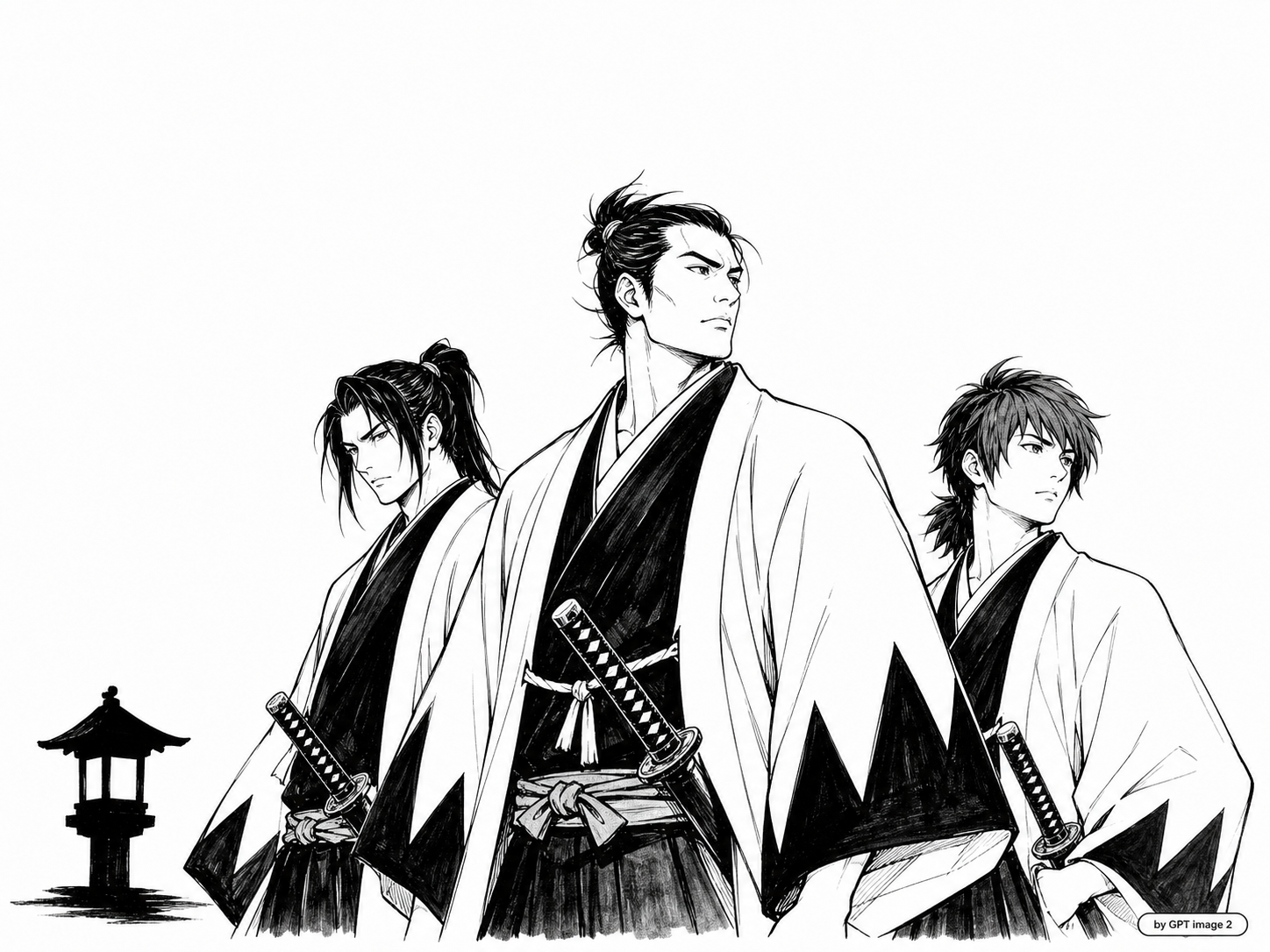
The 8th day of the 7th month, 1864. The Kyoto inn Ikedaya (池田屋). The night was deep.
Sonno-joi faction roshi are in conference. Suddenly, a voice from downstairs.
"I have business with the guests of the Ikedaya."
It is Kondo Isami. Hijikata and Okita follow behind. Just four or five men — inside are dozens of roshi.
Okita climbs the stairs first. His Tennen Rishin-ryu stance of Mui-shin (無畏心). The first blade flashes.
Blood runs down. Following behind, Hijikata speaks coldly.
"Cut down all who do not surrender."
The inn becomes a sea of blood in the darkness. That night the Shinsengumi cut down more than 10 men and bound some 20. The Ikedaya Incident (池田屋事件) — the most famous Shinsengumi exploit of the bakumatsu.
Stepping outside, Hijikata says a single word.
"We are the last samurai."
#Scent — Life in History
#Formation
The Shinsengumi (新選組) — 1863. A roshi corps gathered to escort Shogun Tokugawa Iemochi's procession to Kyoto (joraku). It later developed into a paramilitary organization in charge of Kyoto's defense and public order · the suppression of anti-shogunate forces.
At its center were graduates of the Shieikan (試衛館) dojo of Tennen Rishin-ryu (天然理心流) — Kondo · Hijikata · Okita and others were fellow disciples.
#Kondo Isami (近藤勇, 1834~1868 · age 34)
The 4th-generation head of the Tennen Rishin-ryu house. Master of the Shieikan dojo. Shinsengumi commander (kyokucho · chief).
Character: Of peasant origin. A man who became a warrior through his passion for the sword. Upright. Not cruel, but strict in discipline.
Death: arrested during the Boshin War in 1868. Beheaded. Age 34.
#Hijikata Toshizo (土方歳三, 1835~1869 · age 34)
Shinsengumi vice-commander (fuku-kyokucho). Nicknamed "Hijikata the Demon (oni)." The enforcer of Shinsengumi discipline. He established the 10 prohibitions (kinrei) — break them and you commit seppuku. This is the core of the Shinsengumi's cruel image.
Character: A strict, cold rationalist. He complemented Kondo's softer side. At the same time, he was a poet who wrote verse.
Death: he fought to the end even after Kondo's death. In the battle of Hakodate (函館), he was struck by a bullet and died in the 5th month of 1869. Age 34. His words were "I die as a samurai."
#Okita Soji (沖田総司, 1844~1868 · age 24)
Captain of the Shinsengumi's 1st unit (kumicho). The prodigy of the Shieikan dojo — recognized from childhood as a genius of Tennen Rishin-ryu. There is even a theory that he was "the strongest swordsman of the Shinsengumi."
Character: Bright and innocent, but cold-blooded once he draws his sword. He cuts people down while smiling. This contradiction is his charm and his terror.
Death: he died of tuberculosis in the 6th month of 1868. Age 24. A tradition holds that he collapsed coughing blood even in mid-battle. He fought while coughing blood at the Ikedaya Incident as well.
#Night Tales
The Ikedaya Incident (1864) — the same day as the fiction above. The event that made the Shinsengumi's name resound across the nation. To the anti-shogunate side, however, it is remembered as a "cruel massacre."
"The 10 prohibitions" — the discipline Hijikata set. Break them and you commit seppuku:
... This created the Shinsengumi's rule by terror.
- No acts that betray the way (do) of the samurai
- No defection from the Shinsengumi
- No unauthorized borrowing of money
- No unauthorized intervention in lawsuits (soshou)
- No private duels
"Okita's blood-coughing" — the anecdote that Okita fought even while vomiting blood in battle. His tuberculosis had already progressed in his early 20s. His short life becomes all the more a legend.
The Boshin War (1868-1869) — the civil war between the Meiji new-government army and the shogunate army. The Shinsengumi fought on the shogunate side. Kondo · Okita · Inoue and others die one after another in this period. Only Hijikata retreated as far as Hokkaido.
"The last samurai" — in the 5th month of 1869, when Hijikata died, the effective end of armed resistance on the Edo shogunate's side. Japan's age of the samurai ended on this day.
#Law — Lord-Grade Sheets of the Three Swordsmen
#School
Tennen Rishin-ryu (天然理心流) — in ex2-10-01.
- Licensed:
[stance] Mui-shin (無畏心)— attack +3, Defense -2. - Secret art:
[Kata] Onslaught Combo (殺到連撃)— a 3-strike combo, 1 round.
#Kondo Isami Lord-Grade
| Item | Value |
|---|---|
| Class | Samurai 7th dan (ronin → samurai in status) |
| Attributes | Courage 2 · Finesse 1 · Physique 2 · Wisdom 1 · Presence 1 · Fate 0 |
| Energy | 11 |
| Wounds | 6 (3+Physique 2+Tough 1) |
| Defense | Unarmored 10 / Armored 12 (Do-maru or chain light armor recommended, patrol/field type) |
| Swordsmanship proficiency | +3 (Master) |
| Skills | Swordsmanship · Military Science · Negotiation |
| Key feats | Immovable Formation · Single-Combat Declaration · Iron-Wall Defense |
| Three Ways and Six Hearts | 忠 (Way of Loyalty — shogunate) |
Signature technique:
[aptitude] Orthodoxy of the House— when using Tennen Rishin-ryu's[stance] Mui-shinor[Kata] Onslaught Combo, Energy is -1 (minimum 1).
#Hijikata Toshizo Lord-Grade
| Item | Value |
|---|---|
| Class | Samurai 8th dan (ronin → samurai → officer) |
| Attributes | Courage 2 · Finesse 2 · Physique 1 · Wisdom 3 · Presence 0 · Fate 0 |
| Energy | 12 |
| Wounds | 5 (3+Physique 1+Tough 1) |
| Defense | Unarmored 10 / Armored 12 (Do-maru or chain light armor recommended, patrol/field type) |
| Swordsmanship proficiency | +3 (Master) |
| Skills | Swordsmanship · Stratagem · Intimidation |
| Key feats | Retainer Command · Commander's Standard · Field Command · Tough |
| Three Ways and Six Hearts | 覇 (Way of Hegemony) — shifts to 眞 in his later years |
Signature technique:
[Kata] Sword of the 10 Prohibitions— Energy 2, 1 round. If the target has committed a breach of discipline such as Flight · betrayal · a private duel, attack check +3; otherwise +1. A sword of law enforcement.
#Okita Soji Lord-Grade
| Item | Value |
|---|---|
| Class | Ronin 9th dan (prodigy · head swordsman of Tennen Rishin-ryu) |
| Attributes | Courage 2 · Finesse 3 · Physique 1 · Wisdom 0 · Presence 1 · Fate 1 |
| Energy | 13 (currently 11, 9 during a tuberculosis fit) |
| Wounds | 4 (3+Physique 1, disadvantaged in long fights due to tuberculosis) |
| Defense | Unarmored 10 / Armored 12 (Do-maru possible, no armor by default) |
| Swordsmanship proficiency | +3 (Master) |
| Skills | Swordsmanship · Speed · Perception |
| Key feats | Wind Blade · Preemptive Strike · Gale · Demon of the Core Zone |
| Three Ways and Six Hearts | 覇 (Way of Hegemony) + 虛 (Way of Emptiness — one who accepts death) |
Signature techniques:
[Kata] Mitsudogiri (三段突き)— Energy 4, 1 round, 1 per combat. 3 consecutive thrusts on the same target. If all three strikes hit, an extra 1 Wound.[Curse] Tuberculosis— after combat, roll d100: on 01~20, coughing blood. Until the next scene, maximum Energy -2.
#To Fight the Swordmaster (common to the three)
#Matchup
- Masters of squad combat: the Shinsengumi do not fight alone. The three together, or together with their members.
- Tennen Rishin-ryu's aggressiveness: the Mui-shin stance sacrifices defense. Vulnerable to counterattack.
- Kondo: the legitimacy of the house and a head-on breakthrough. He holds out long and anchors the center of the members.
- Hijikata: discipline and command. While he lives, the Shinsengumi do not scatter easily.
- Okita: the fastest sword. He tears through the Front Zone in a short time, but collapses in a long fight because of his illness.
#The Three Paths to Victory
#Path 1 — Head-on Duel (recommendation ★★)
- A squad vs squad clash is the basis. PC squad + NPC support.
- Each individual swordsman has a weakness, but with the three together it is nearly impossible.
- Against Kondo: a fight of holding out head-on. Rather than defeating him, making him pull back once before his members is realistic.
- Against Hijikata: you must cut the chain of command. Disciplinary violators, false orders, and chaotic urban combat are effective.
- Against Okita: after avoiding the first burst, you must draw out his illness. Neutralize Okita first and the whole Shinsengumi's offensive breaks.
#Path 2 — Win Their Regard (recommendation ★)
- Kondo looks to loyalty toward the shogunate and bushido. Even a PC of the opposing camp can open a dialogue by declaring their conviction head-on.
- Hijikata looks to discipline over emotion. He speaks only to those who keep promises and respect the chain of command.
- Okita can, rarely, form a personal relationship thanks to his personal charm. An attitude that pities his sick body is, rather, counterproductive.
#Path 3 — Circumvent (recommendation ★★★)
- The collapse of shogunate politics — after the Boshin War, the Shinsengumi itself is disbanded.
- Kondo is weak to arrest and attacks on his cause. Make him bear responsibility as commander and it is hard for him to draw his sword.
- Hijikata is weak to someone posing as a disciplinary violator and to internal conflict. Make trouble within the Shinsengumi and he moves himself.
- Okita's greatest weakness is his illness. Long pursuit, humid nights, and consecutive battles swiftly whittle down his combat power.
#To Take the Swordmaster as a Master
Nearly impossible. The Shinsengumi is not an open dojo — it is a political organization. If a PC joins the Shinsengumi, they become a "comrade" but not a "disciple."
Possible paths:
- Enroll at the Shieikan dojo (Kyoto · Edo) → train in Tennen Rishin-ryu → a recommendation to join the Shinsengumi.
- Kondo can accept you as a disciple of the house. Formal training and an oath of loyalty are required.
- Hijikata is an organizational superior rather than a master. He teaches discipline · command · how to survive, more than swordsmanship.
- Okita can become an informal sparring partner. Possible only for a short period when his condition is not bad.
#Rewards
- Transmission of Tennen Rishin-ryu:
Mui-shinat full licensure (menkyo kaiden) by the Shieikan dojo's standard. After that,Onslaught Comboonce you reach swordsmanship Master. - The qualification of Shinsengumi member — the official sword of bakumatsu Kyoto.
- Risk: when the age tilts, you die with them. It is hard to survive to 1869.
#GM Notes
The three of the Shinsengumi are "those who lost to their age." Most of their scenarios end in tragedy. The 6 years of 1863~1869 are the period of their activity.
Scenario hooks:
- A reenactment of the Ikedaya Incident — the PCs fight on the shogunate side or the anti-shogunate side.
- A trial of a violator of Hijikata's 10 prohibitions — the PCs are the defendant or a witness.
- Okita's last battle — can he be saved, or will you fight at his side?
- The Boshin War — a long narrative of retreating as far as Hokkaido at Hijikata's side.
Tone: the tone of this chapter is romantic tragedy. They are drawn not as simple villains but as "those born into the wrong age." Their way (do) may be right, or it may be wrong.
"I die as a samurai." — the line transmitted as Hijikata Toshizo's last words
"When this blood-coughing stops, that is when I die. But for now, I must cut down more still." — Okita Soji (an original line, a reconstruction conveying his temperament)