#12 New Swordsmanship Schools
Contents
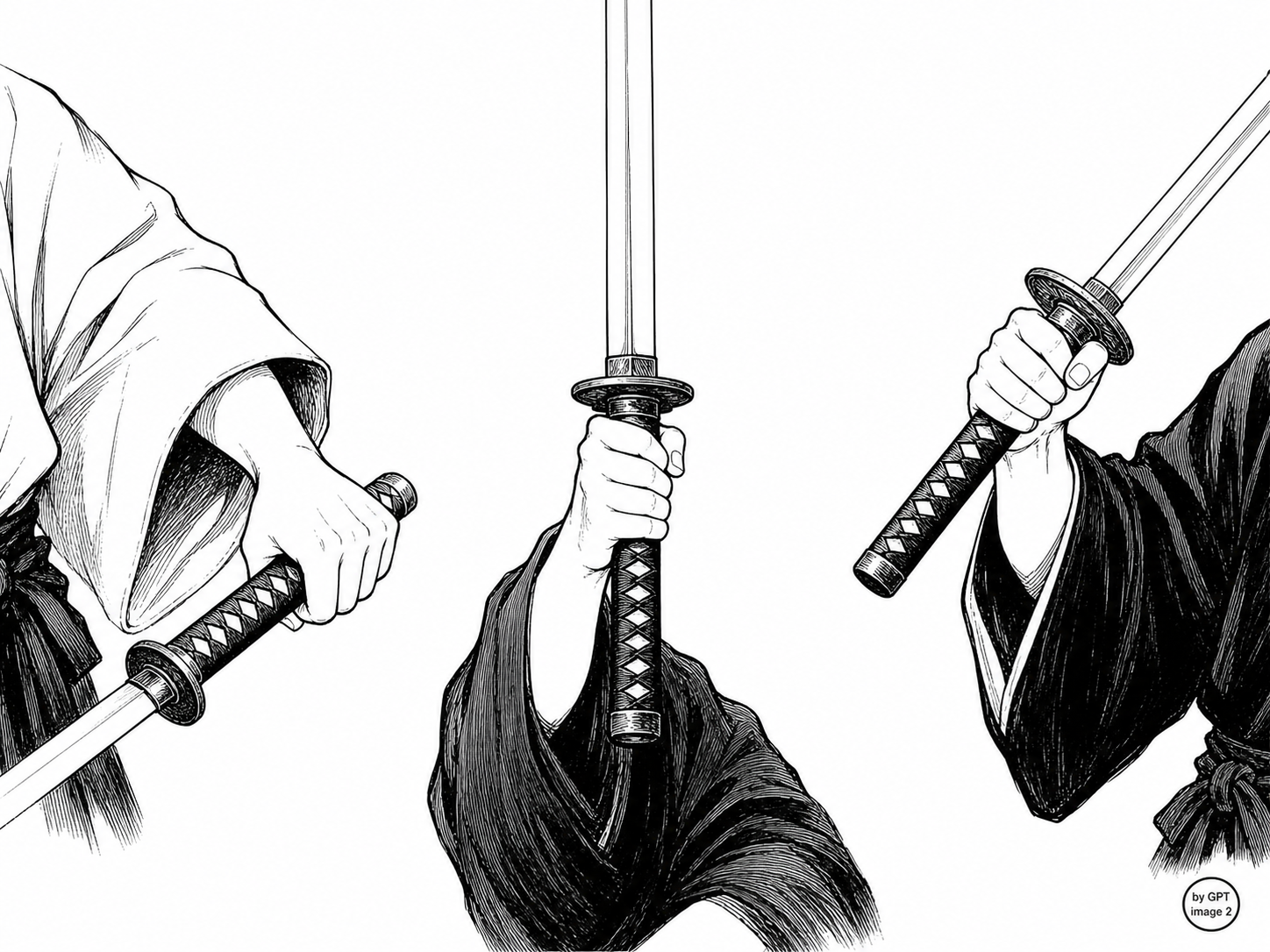
To the core 4 schools (Katori, Yagyu, Nito, Jigen), this expansion adds 12 new schools. Each school replaces the core Licensed Sword Guard (check +2, defense reservation cost -1) / secret-art Offense-Defense Unity (check +3, free counter) with its own unique maneuver.
#§ Scent — The Hundred Branches of the Sword
Every culture that has the sword has its sword art. From the Bakumatsu schools within Japan, to Joseon Sebeop across the sea, to the Central Plains' Tang Dao, to the West's Liechtenauer. This document records 12, but on the premise that they are merely "representative" and not exhaustive. The GM can add more with the homebrew guide in 21-cross-cultural-index.
#§ Law — 12 Schools
Unified Counter (反擊) Definition: In this document, a "counter" means a counterattack check made immediately after nullifying a melee attack with a defense technique (parry, evasion, etc.), following that same hit. Its activation follows the core Uchigatana One Flash (一閃) (co-03-07 §Weapon License Maneuvers) model — it rides on a reserved defense, an Energy 0 counter stands only when the school states it, and the 2-per-round cap (00-05 §7) then applies as-is. The counter bonuses of Single-Stroke Short Beat, One-Blade Severing, and Taiji Sword Dance all apply to this counter check.
#10-01. Tennen Rishin-ryu (天然理心流) — famous school · Japan Bakumatsu
- Source: Kondo Kuranosuke — main school of the Shinsengumi
- Era: established 1789, active in the 1860s Bakumatsu
- Culture: late-Edo / Bakumatsu Japan
Practical battlefield Swordsmanship of Bakumatsu warriors. Main school of the Shinsengumi (新撰組). Extreme aggression through the Fearless Heart (無畏心) stance.
- Bonus: accumulated practical experience — from the 5th combat onward, Swordsmanship check +1 additional.
- Restriction: distrust of fixed forms (型). Conflicts with the Yagyu-ryu "martial way" philosophy.
| Stage | Core Base | School Replacement |
|---|---|---|
| Licensed | Sword Guard +2·reservation-1 | [stance] Fearless Heart: Energy 2. during the stance, attack +3, Defense -2. 1 stance slot. |
| secret art | Offense-Defense Unity +3·free counter | [Kata] Onrushing Combo: Energy 4. 1 round. 3-hit combo on the same target. |
- Approach: handed down from the Shieikan dojo — limited to a Bakumatsu setting. Session 0 consent required (historical era).
- Play-type: extreme aggression, Shinsengumi role, practical swordsman
#10-02. Hokushin Itto-ryu (北辰一刀流) — famous school · Japan
- Source: Chiba Shusaku (千葉周作)
- Era: early 19th century (established in the 1820s, active in the Bakumatsu)
- Culture: late-Edo Japan
The systematic instruction of Chiba Shusaku (千葉周作). Established a textbook, produced disciples on a large scale. Mastery of fundamentals.
- Bonus: systematic textbook — Licensed/secret-art Energy -1 (minimum 1).
- Restriction: fundamentals-centric, lacking flashy techniques.
| Stage | Core Base | School Replacement |
|---|---|---|
| Licensed | Sword Guard | [aptitude] Thousand Forms: Swordsmanship fundamentals check +2 (basic attack/defense only, excluding special techniques/secret arts). Swordsmanship weapon defense technique reservation cost -1 (uchigatana 1→0; same as the core Sword Guard, reservation possible even at Energy 0 remaining). |
| secret art | Offense-Defense Unity | [Kata] Single-Stroke Short Beat (一刀短拍): Energy 3. 1 round. perform defense and counter simultaneously (Defense +2 + counter +3). |
- Approach: licensed at the Hokushin dojo in Edo. many disciples — easy to approach.
- Play-type: balanced type, systematic training, armed instructor
#10-03. Jikishin Kage-ryu (直心影流) — Secret Transmission · Japan
The philosophy of the "martial way" (武道). A mind-method whose aim is not killing. Wooden-sword centered.
- Bonus: sword of mercy — when the opponent can be spared, the check can be switched from killing to incapacitation.
- Restriction: weakened will to kill — attack -1 in combat against yoma.
| Stage | Core Base | School Replacement |
|---|---|---|
| Licensed | Sword Guard | [Kata] Non-Lethal Subdual: Energy 2. 1 round. on hit, disarm + faint instead of killing. |
| secret art | Offense-Defense Unity | [aptitude] Mind-Beyond Martial Way: win without fighting. used in pre-combat negotiation — opposed check +3. |
- Approach: transmitted from a reclusive swordmaster — narrative pursuit essential.
- Play-type: martial-way mind-method, non-lethal / mediation, swordmaster narrative
#10-04. Ono-ha Itto-ryu (小野派一刀流) — famous school · Japan
- Source: Ono Jirouemon Tadaaki (小野次郎右衛門忠明)
- Era: early Edo (established after 1608)
- Culture: Japan
A branch of Itto-ryu established by Ono Jiro (小野次郎). Simple in form. Defense-centered.
- Bonus: simple form — on acquiring the secret art (Master stage), refund 1 general technique slot (1 time only; the upfront cost at school acquisition is still paid).
- Restriction: being simple, it lacks higher tactics.
| Stage | Core Base | School Replacement |
|---|---|---|
| Licensed | Sword Guard | [aptitude] One-Blade Defense: Swordsmanship defense check +3 (instead of an attack bonus). |
| secret art | Offense-Defense Unity | [Kata] One-Blade Severing: Energy 4. 1 round. attack +4 only on a counter after a defense, Critical Expansion. |
- Approach: enrollment at a regular dojo. high public accessibility.
- Play-type: defense / counter, solid fundamentals
#10-05. Joseon Sebeop (朝鮮勢法) — foreign style · Joseon
Cultural origin: the Swordsmanship of Joseon officers. A stance system of 24 postures (勢).
- Bonus: posture (勢) stacking — while maintaining a [stance], you can additionally maintain 1 more [stance] of the same skill (Swordsmanship) (core stance slot 2). This effect is an explicit exception to the core §1-stance-at-a-time rule (this expansion §4 stance slot exception).
- Restriction: requires the Joseon-culture foreign Adaptation technique, or a Joseon-origin background. When maintaining two stances at once, single-breath limit -1 (core 5 → 4 — a mental-division penalty).
| Stage | Core Base | School Replacement |
|---|---|---|
| Licensed | Sword Guard | [stance] Mount Tai Posture: Energy 2. during the stance, Defense +2, attack +1. can stack with another stance. |
| secret art | Offense-Defense Unity | [Kata] Sky-Facing Posture Shift: Energy 3. 1 round. instantly shift from one posture to another + on the shift, attack +3. |
- Approach: Joseon-origin background (02-03), foreign Adaptation (Joseon), or a Joseon-officer teacher.
- Play-type: posture-focused, Joseon martial-house role
#10-06. Bonguk Geombeop (本國劍法) — foreign style · Joseon
Cultural origin: a traditional Joseon Swordsmanship. Recorded in the Muye Dobo Tongji (武藝圖譜通志).
- Bonus: 4-posture switching — auto-acquire 4 preliminary fundamental postures (Licensed-grade basis).
- Restriction: tradition-centered. lacks irregular techniques.
| Stage | Core Base | School Replacement |
|---|---|---|
| Licensed | Sword Guard | [stance] 4-Posture Cycle: Energy 1. during the stance, cycle one posture each round. on the cycle, choose attack +1 or Defense +1. |
| secret art | Offense-Defense Unity | [Kata] One Blade of the Homeland: Energy 5. 1 round. a special cut after completing the 4 postures. attack +5, Pierce All. |
- Approach: Joseon origin, experience residing in a Joseon barracks.
- Play-type: traditional Joseon officer, cycling tactics
#10-07. Liechtenauer-ryu (Liechtenauer-Ryu) — foreign style · medieval Germany
Cultural origin: the Swordsmanship of Johannes Liechtenauer. Two-handed-sword / greatsword centered. The wellspring of late-medieval German Swordsmanship.
- Bonus: greatsword specialty — check +1 to odachi / zweihander techniques.
- Restriction: no bonus with katana / dagger (greatsword only).
| Stage | Core Base | School Replacement |
|---|---|---|
| Licensed | Sword Guard | [technique] Zornhau (wrath cut): Energy 2. greatsword attack +2, Pierce 2. |
| secret art | Offense-Defense Unity | [Kata] Meisterhau (master strike): Energy 4. 1 round. attack +4 + on Critical Hit [Pierce 4] + [Break] (grade matching, recovery procedure per the core §Break. mapping: 00-05 §14). |
- Approach: Nanban-origin background (02-03), foreign Adaptation (Nanban / Germany).
- Play-type: greatsword swordsman, Western knight role
#10-08. Fiore (Fiore dei Liberi) — foreign style · Italy
Cultural origin: Fiore dei Liberi's "Flower of Battle". A synthesis of sword, dagger, wrestling, and spear.
- Bonus: integrated martial art — if holding the Unarmed Combat Licensed, Swordsmanship check +1, and the reverse also holds.
- Restriction: lacks single-weapon specialization. cannot become the "Master of everything."
| Stage | Core Base | School Replacement |
|---|---|---|
| Licensed | Sword Guard | [Kata] Close-Range Switch: Energy 2. 1 round. switch sword → dagger → Unarmed Combat in one breath + a check for each attack. |
| secret art | Offense-Defense Unity | [aptitude] All-Weather: apply the Offense-Defense Unity effect simultaneously in both Swordsmanship and Unarmed Combat. |
- Approach: Nanban (Italy) origin, foreign Adaptation.
- Play-type: all-purpose combat, distance-switch specialist
#10-09. Destreza (La Destreza) — foreign style · Spain
Cultural origin: Spain's La Destreza. Geometric Swordsmanship. Rapier-centered.
- Bonus: precise thrust — Critical Expansion on thrust attacks.
- Restriction: cutting attacks are ordinary — thrust only.
| Stage | Core Base | School Replacement |
|---|---|---|
| Licensed | Sword Guard | [aptitude] Technique of the Circle (圓): Swordsmanship check +2 (thrust only). threaten 3 targets in the same zone 1 time each. |
| secret art | Offense-Defense Unity | [Kata] Decisive Single Point: Energy 3. 1 round. thrust +4, Pierce All, instant-death check on Critical Hit. |
- Approach: Nanban (Spain) origin, foreign Adaptation.
- Play-type: rapier swordsman, master swordsman
#10-10. Tang Dao Compilation (唐刀集法) — foreign style · Ming
Cultural origin: the longsword (唐刀) techniques of the Ming era. Bold and wide-area. The Swordsmanship recorded in Qi Jiguang's Jixiao Xinshu (紀效新書).
- Bonus: wide-area cut — can attack 2 enemies in the same zone simultaneously (separate checks, only the first attack at ±0).
- Restriction: precise thrusts are impossible.
| Stage | Core Base | School Replacement |
|---|---|---|
| Licensed | Sword Guard | [Kata] Transverse Cut: Energy 3. 1 round. attack 2 targets in the same zone simultaneously. |
| secret art | Offense-Defense Unity | [Kata] Greatsword Wind-Cleave: Energy 5. 1 round. area attack on 3 targets in the same zone. |
- Approach: Ming-origin background, foreign Adaptation (Ming).
- Play-type: wide-area swordsman, Ming-army swordsman
#10-11. Shaolin Sword (少林劍) — foreign style · Chinese Zen
Cultural origin: the Swordsmanship of the Shaolin warrior monks. A sword of concentration based on Zen meditation practice.
- Bonus: focused state — apply the Licensed effect of Fighting-Spirit-exclusive skills to the Swordsmanship check.
- Restriction: presupposes a Zen Buddhist monk — recommend a "Temple-Raised" background or the esoteric monk class. a secular PC takes check -1.
| Stage | Core Base | School Replacement |
|---|---|---|
| Licensed | Sword Guard | [stance] Sword of Stillness (靜): Energy 1. during the stance, both attack and Defense +1. immune to Fear / Intimidation. |
| secret art | Offense-Defense Unity | [Kata] Breath Strike: Energy 3. 1 round. release from the Sword of Stillness stance. attack +4, concentration released. |
- Approach: residing as a Shaolin monk, or a Buddhist-monk background. not an easy approach condition.
- Play-type: Zen-monk swordsman, concentration / internal power
#10-12. Wudang Sword (武當劍) — foreign style · Chinese Daoism
Cultural origin: the Daoist Swordsmanship of Mount Wudang. A sword of non-lethality, evasion, and suppleness.
- Bonus: suppleness — evade check +2, counter Energy -1.
- Restriction: weakened will to kill — similar to Jikishin Kage-ryu. attack -1 against yoma targets.
| Stage | Core Base | School Replacement |
|---|---|---|
| Licensed | Sword Guard | [stance] Taiji Sword Dance: Energy 2. during the stance, evade +3, Energy 0 on a counter (auto-applies core §Energy cost handling). |
| secret art | Offense-Defense Unity | [Kata] Silk-Lifting (絲揚) Sword: Energy 3. 1 round. reserved (reactive) — when hit by a melee attack, if your evasion check (2d10+Finesse) ≥ the enemy's attack value, deflect that attack and turn it back onto the enemy (the enemy takes 1 Wound to itself by its own attack check value, 2 Wounds on a Critical Hit). only during the Taiji Sword Dance stance. 1 defensive reaction per hit: against a single hit, only one of the Silk-Lifting Sword deflection or the Taiji Sword Dance counter may resolve (pick 1). This is a restriction separate from the 2-per-round cap in 00-05 §7. |
- Approach: residing as a Daoist of Mount Wudang. or a Daoist-temple origin.
- Play-type: Daoist swordsman, evasion / counter
#§ Design Perspective
- Type distribution of the 12 schools: famous schools 3 (10-01·02·04) + Secret Transmission 1 (10-03) + foreign styles 8 (10-05~12). reinforces famous schools within Japan + emphasizes foreign styles.
- Technique sharing allowed: Hokushin Itto and Ono-ha Itto-ryu are the "Itto-ryu" lineage with some shared techniques — complies with this expansion's plan §4.4.0.
- Multi-layered approach conditions: historical-background restriction (Tennen Rishin-ryu), foreign-Adaptation premise (Joseon / Nanban / Ming lineages), class premise (Shaolin Sword).
- Coexists with the core 4 Swordsmanship schools: no core original modification. only widens the choice.
#§ Follow-Up Module Linkage
Use of these 12 schools in follow-up modules:
| School | Linked Module |
|---|---|
| 10-01 Tennen Rishin-ryu | 40-04-01 Tennen Rishin-ryu practical sword · 50-03 Kanto Semifinal (Bakumatsu era only) |
| 10-02 Hokushin Itto-ryu | 40-04-02 Hokushin Itto-ryu orthodox wooden sword · 50-02 Regional Qualifier |
| 10-05 Joseon Sebeop | 11-02 Joseon spear art · 12-02 Joseon horn-bow art · 25-03 Joseon squads · 50-04 Foreign Invitation |
| 10-07 Liechtenauer-ryu | 40-04-03 two-handed greatsword · 25-05 Western squads · 50-04 Foreign Invitation |
| 10-09 Destreza | 40-04-04 rapier · 15-05 jineta (Spanish ideological affinity) |
| 10-10 Tang Dao Compilation | 11-08 Qi Jiguang's spear art · 25-04 Ming/Qing squads · 18-01-02 Qi Jiguang's Jixiao Xinshu |
| 10-11 Shaolin Sword | 13-01 Shaolin fist · 25-04-04 Shaolin monk-soldiers · 20-04-01 Vajra-body austerity |
| 10-12 Wudang Sword | 13-02 Wudang fist · 20-03-01 lightness-skill mind-method |
| all schools | 21-cross-cultural-index (reclassification) · 80-02 school match-up table · 50-tournament (duel proving ground) |
"One blade begins in one nation, but one hand passes through all nations."