#What Heian Is
Contents
Fiction-Only. This document presents in prose the periods, politics, culture, and distance-from-yoma of the Heian era. There are no sheets and no numbers.
#Opening Fragment — A Long-Lasting Spring
The cherry blossoms fell every year, yet the people of the capital lived as though Heian would never end. The seasons of the palace were slow, and the hoofbeats of the frontier were still far off.
One spring day, a young noble asked an old poet. "How long will this city remain so beautiful?"
The old poet caught a falling petal on his fan. "Beauty lasts long. Only, that it lasts long does not mean it is safe."
"Those are ominous words."
"No. They are the words of the seasons." The old poet set the petal on his palm. "The longer the spring, the more a person forgets the winter. But winter does not fail to come simply because it is forgotten."
That evening, warriors arrived from outside the capital. Soil-stained armor and the breath of horses stood before the palace gate. Heian was still spring. But the first frost was already climbing up from the frontier.
#Scent — The Long Spring and Autumn of Four Hundred Years
In the late autumn of 794, Emperor Kanmu moved to a new capital. It was named Heian-kyo (平安京) — "the peaceful and stable city." That name became the name of the era itself, and that era lasted nearly four hundred years.
During Heian's four hundred years, the outside world too shook greatly. In Europe the Carolingian Empire split apart and Viking ships rowed up the rivers. In China the Tang collapsed and the Song arose. While all that upheaval surged in from outside, the Japanese archipelago was — at least on the surface — elegant and serene.
Beneath the surface there was another current. The endless politics of the Fujiwara house, the splintering of the imperial line, the rise of the frontier warriors, and the unseen things that lodged here and there throughout the capital. This volume deals with both the surface and the current.
#Period Divisions
| Period | Years | Features | Figures of this volume |
|---|---|---|---|
| Early | 794~967 | upkeep of the ritsuryo, active Kentoshi missions, dominance of Chinese culture | Michizane (845~903) — late Early |
| Middle | 967~1068 | the heyday of the Fujiwara regency. National-style culture. The center of gravity of this volume. | Seimei (921~1005) / Yorimitsu (948~1021) / Shikibu (c. 970 ~ c. 1019) |
| Late | 1068~1185 | Insei (院政) → rise of the buke → the Hogen and Heiji Rebellions → the Genpei War → the end | Kiyomori (1118~1181) |
In the period divisions, Michizane stands at the transition from late Early to early Middle. The other four figures were all active in the Middle and Late periods. Together, the five figures of this volume cover about three hundred of the four hundred years.
#The Dual Structure of Power — Emperor and Fujiwara
Power in Heian did not reside in one seat. The formal pinnacle was the Emperor (天皇), but the actual operator was the Fujiwara (藤原) house. From the late 9th century to the early 12th century, the Fujiwara clan, as maternal relatives of the Emperor, all but monopolized the seats of regent (摂政) and kanpaku (関白).
The Emperor was sacred but did not decide. Decisions were made in the mansion of the maternal relatives. To purify the darkness lodged in that mansion's garden, onmyoji came and went, and the ladies-in-waiting who resided in that mansion wrote monogatari. Politics, literature, and spiritual incidents all happened within the same space.
In the late 11th century a new current appeared. Insei (院政) — the form in which an abdicated retired emperor (joko) held the politics. A 3rd power, neither the Emperor nor the Fujiwara. When that balance broke, the Hogen Rebellion (1156) and the Heiji Rebellion (1159) occurred, and their deciders were the warriors. It was the beginning of the collapse of Heian's balance.
#The End of the Kentoshi and National-Style Culture
In 894, on the proposal of Sugawara no Michizane, the Kentoshi (遣唐使) missions were abolished. The decline of the Tang was the pretext, but in truth it was a signal that Japan no longer depended on the continent for all its models. Thereafter, Japan's own native style and aesthetics developed — this is called national-style culture (国風文化).
- Kana (仮名) script — a phonetic script derived from kanji. The tool of waka, diaries, and monogatari.
- Waka (和歌) — a fixed-form poem of 31 sounds. The core of noble socializing.
- Monogatari (物語) — prose tales. The Tale of Genji, The Tales of Ise, and so on.
- Kangen (管弦) — court music. Joined with gagaku.
- Incense (香) discernment — the game of smelling incense and guessing its name. A refinement of the nobility.
All of this happened at once within a single era. In the same court where Murasaki Shikibu was writing The Tale of Genji, Abe no Seimei was commanding shikigami to purify the darkness.
#City and Countryside
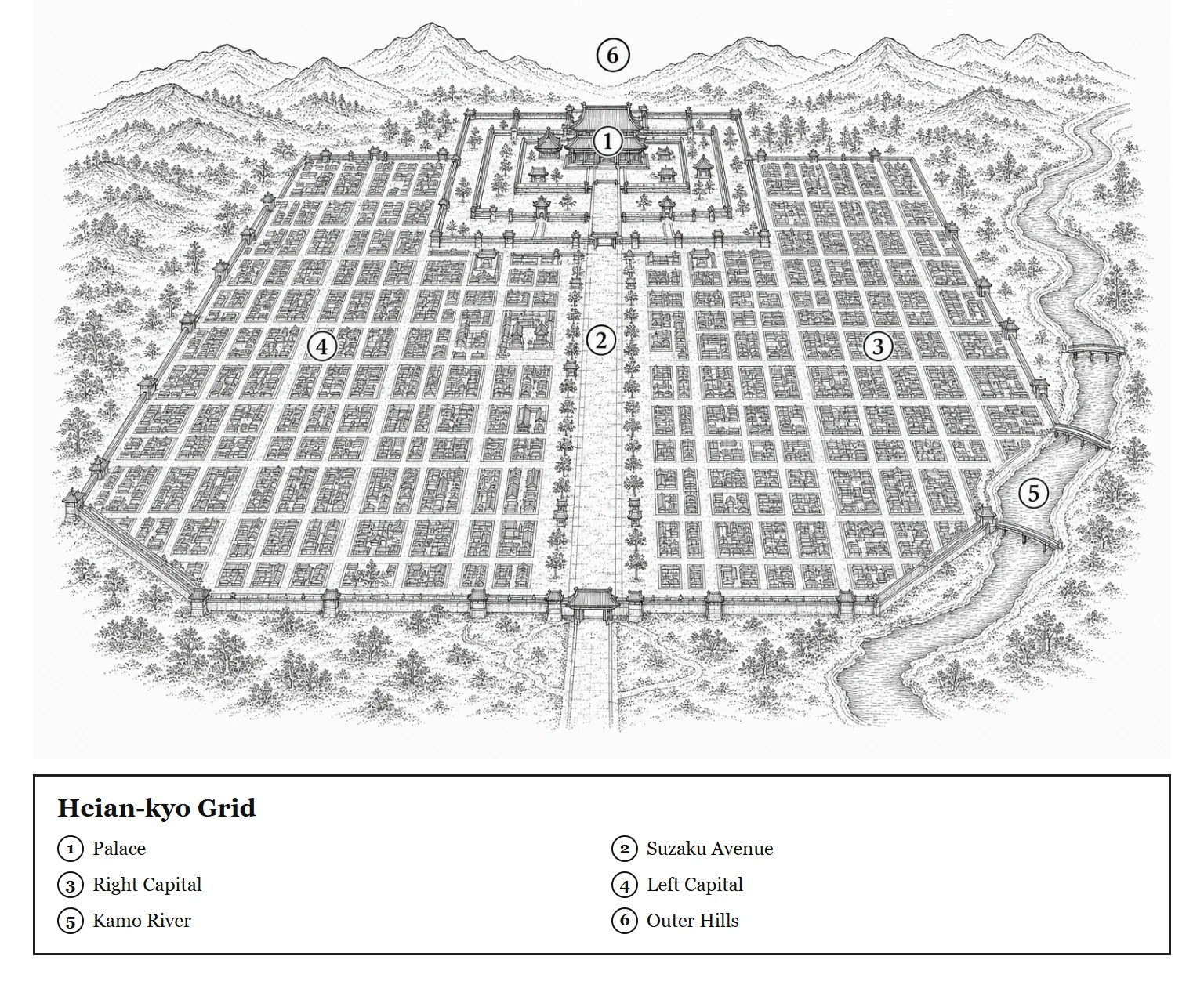
Heian-kyo was splendid. A grid-pattern city about 4.5km east to west and about 5.2km north to south. Noble mansions lined up around the Emperor's residence (the Dairi) and the government offices (the Daidairi).
But outside the city it was different. In the frontiers — the mountains of Tohoku, the plains of the eastern provinces, the coasts of the western provinces — warriors managed their domains and built up private armed force. They lived in a world different from the elegance of Heian-kyo, and that world would in the end bring Heian to its close.
The foreboding of an era's end — in the frontiers, war had already begun.
#The Era and Yoma
Heian's spirit realm is not closed, yet not wide open either. It differs from the "the gate of the spirit realm thrown wide open" model of the Sengoku era (fc02).
- There are faded gates here and there — in the mountains, by the rivers, on the mountain passes, at the bridges, on the outer fringes of the palace, at the temples
- Yoma are concentrated in the city — Kyoto and the mountains around it
- Cohabitation with the nobility — a part of daily life. Yoma are objects of coexistence rather than fear
The detailed spirit-realm model is laid out in fc04-05-06-alt-realm.md. The point to stress in this document is — the people of Heian knew that they walked the same roads as the yoma. They simply did not look.
#Citation — The Stillness of Deep Night
"Even after the night deepens and people fall asleep, the dew gathered at the tips of the grass blades does not dry, and the sound of the wind at the edge of the eaves does not cease. Someone is still awake."
— adapted from The Diary of Murasaki Shikibu
#In One Line
"A long peace is a false peace. What flowed beneath four hundred years of elegance — this volume asks."
#References
#co — Setting
co-02-lore/co-02-01-overview.md— era overview (the Sengoku main volume, but contrasted with the low spirit-realm openness of the pre-Heian stage)co-02-lore/co-02-04-regions.md— regionsco-02-lore/co-02-06-timeline.md— timelineco-02-lore/co-02-08-faith.md— faith
#Within fc04
fc04-01-02-kuge-buke.md— kuge/bukefc04-01-03-warrior-dawn.md— the dawn of the warriorfc04-05-06-alt-realm.md— the Heian spirit-realm model
#Other fc volumes
fc02-01-01-era.md— Sengoku era overview (for contrast)
The spring of four hundred years was long, and the shadow of that spring was long too.