#Chapter 1 — Prologue: The Door into This World
Contents
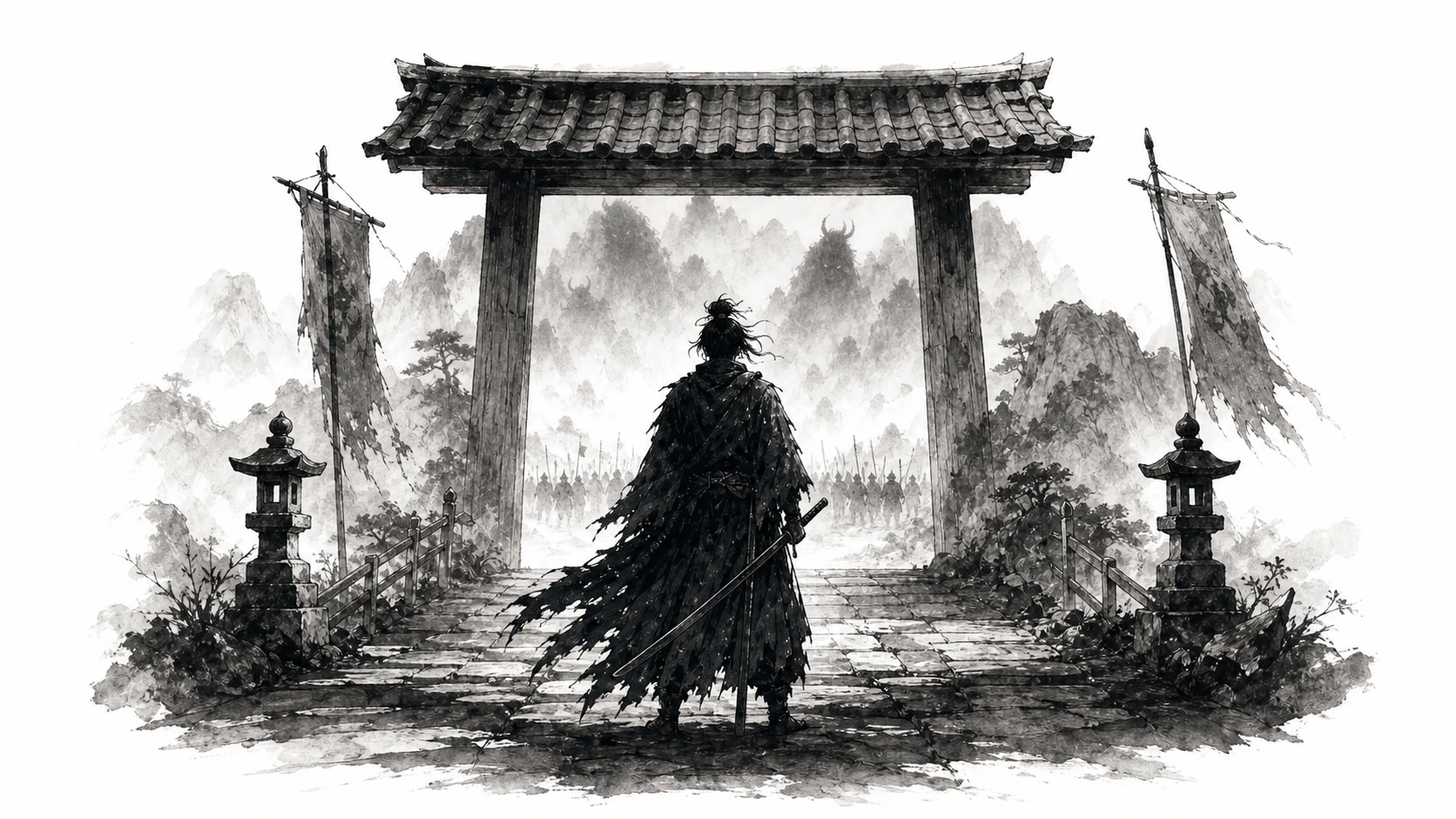
You are standing before a door. Beyond it lies a Sengoku age of blades and yoma. This chapter teaches you how to open that door.
It is fine if you have never played a TRPG. All you need is two dice, people to play with, and the will to follow a story through to its end.
#1. What Tabletop Roleplaying (TRPG) Is
This game is a kind of play called tabletop roleplaying, TRPG for short. You do not compete for points as in a board game, nor stare at a screen as in a video game. Instead people gather around one table and, with words and imagination and dice, build a single story together. Instead of winning or losing, what remains is a story — one found nowhere else in the world, made only at this table, yours alone.
A TRPG comes together when three things are present.
- The one who leads the story — the GM (Game Master). One person takes this role. The GM prepares the world, moves the characters and the enemies, and adjudicates what has happened. This is the one who sets the stage and shines the light.
- The people who live inside the story — the players. The rest take this role. Each makes one character and, as that character, experiences the world. Whether you become a samurai, an onmyoji, or a shinobi, that decision is yours. This book is for you, the player.
- The tool that decides what happens — the dice. Does the blade cut the enemy, or does the enemy dodge? Do you fall from the cliff, or barely cling on? You entrust this judgment not to a person's will but to the dice. Events not in the script are born here.
You do not need to memorize the whole rulebook. The GM can introduce rules as needed while everyone else learns through play.
Source: co-01-01 §What Tabletop Roleplaying Is · co-01-02 §The Outline of the World
#The Three Promises of This Game
Before you roll Konsei Reiyotan for the first time, have the table promise one another three things.
- The GM is a referee, not an enemy. The GM does not sit down to beat you. They move the stage so the story grows interesting. When a rule is unclear the final call rests with the GM, but that call is for the whole table.
- Respect the result of the dice. If a low roll came up and you failed, that failure makes the next scene. This is a game where the moment of one roll overturning the board comes often, and that overturning is the most interesting part.
- Your character can die. This world is dark fantasy. A single soldier falls to a single arrow, and your character too collapses if pushed too far. Yet death does not come carelessly — in the first session especially, roll it lethal only when the table agrees.
The morality of this world is not measured on an alignment table of good and evil. Instead the Three Ways and Six Hearts (三道六心) — three paths and six hearts — mark which direction a character walks. In the Three Ways and Six Hearts, a heart changing is not turning worse but turning — which was right cannot be known until the story ends.
Source: co-01-02 §Session in Play (Three Ways and Six Hearts)
#2. How to Use This Book
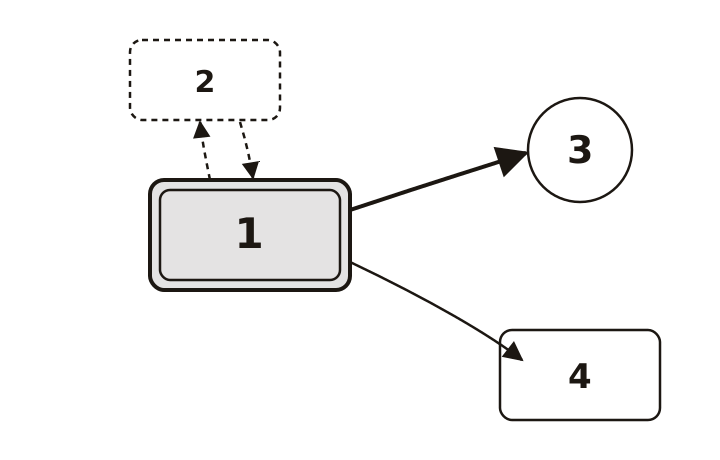
| Number | Meaning |
|---|---|
| 1 | Kenkaku Benran — start here (this book) |
| 2 | Quickstart — a 30-minute taste (optional, roll and come back) |
| 3 | Solo branch — First Sword and oracle |
| 4 | Core Rulebook — GM and depth |
Konsei Reiyotan has many books, but the only one you, the player, need to pick up right now is this one.
| Book | What | When to open it |
|---|---|---|
| Kenkaku Benran (this book) | The player's core book. Character creation, combat, growth, all the way to Solo Mode | Start here. The book you keep at your side during play too |
| Quickstart (QS) | A bundle for a first session you taste in 30 minutes with a finished character | When you want to just run one before making a character (optional) |
| Core Rulebook (CO) | The original that holds the world, yoma data, scenarios, and GM guidance | When you take on the GM's role, when you need deeper rules |
This book is your first book. You make a character, learn combat, and run even alone — as long as you need no supporting material, play comes together with this one book. If you want only a taste today, you can run a round with a finished character from the Quickstart and come back. The source footnotes attached to each rule are where the original sits in the core rulebook — follow them only when curious, and if the wording seems to conflict, the core rulebook wins.
To the one who has decided to be GM. First master this book — the GM must know what the players know. Then read the core rulebook. The yoma data, the twelve scenarios, and the guidance for running the game are all over there. The players need know only this book, and once the GM knows the core rulebook the table is complete.
#The Order to Read This Book
- If you are learning alone for the first time — after reading this prologue, make one character in the character-creation chapter, then go straight into the Solo Adventure "The First Sword" that follows. "The First Sword" is a numbered-paragraph gamebook you run alone without a GM. It is built so you pick up the rules one at a time — your first check, your first combat, reserved defense, Critical Hit and Fumble, a taste of squads — as you go through them. You do not die on failure. Defeat is only another branch of the story.
- If you want to keep rolling alone — after finishing "The First Sword," move on to the Solo Mode oracle rules. There is a question table and a scene-building procedure that stand in for the GM's seat, so even with no one to play with yet you can carry a short adventure forward with this one book.
- If you already have a table — after making a character, go straight to the combat and school chapters and prep your first session. "The First Sword" works at the table too, as practice for a new player.
Solo Mode is the special part of this book. It takes the state of "no one to play with yet" head-on and makes it possible, even alone, to learn the rules and run a story. The detailed rules are in the Solo Mode chapter later.
Source: qs-00 §This Game Is / The Core Loop · qs-03 §The Principle in One Line
#3. An Example of Play — How It Rolls
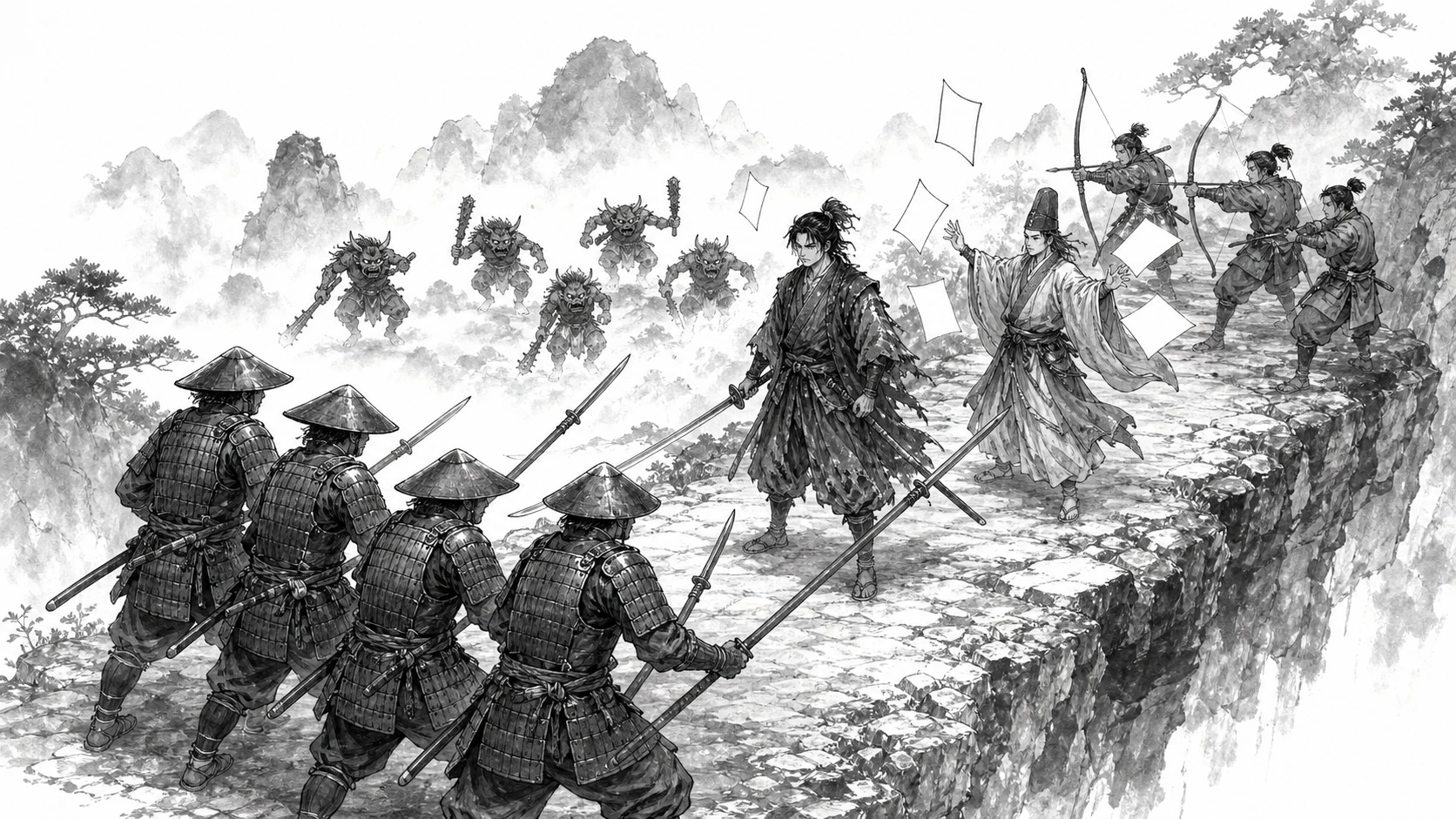
Explanation in words alone does not land. Let us look in on one scene, at what dialogue passes at an actual table. A GM and two players meet a lesser yoma on a narrow mountain path. Rules terms come out mixed in naturally, but for now feel only the mood of it — the exact meaning of each term you learn one at a time in the chapters ahead.
Cast
GM — leads today's story.
Setsuna (player: Hana) — samurai. The front-rank hand who stands ahead and blocks the pass.
Mina (player: Mei) — onmyoji. The rear-rank hand who works shikigami from behind.
GM: The mountain path narrows. Cliff and forest wall you in on both sides, and mist has settled to your feet. Then a red dot glows in the mist. Two, four... ten. Little ogres at a person's waist height. Kooni. Five lesser yoma with clubs come running, shrieking.
Setsuna: I'll block the front. I stand five ashigaru behind me and — I declare the Immovable Formation. I won't let this pass be given up.
GM: Good. The Immovable Formation is a [stance] specialty, so it costs 2 Energy. Since you are front rank, +4 is added to Domination in that zone. In exchange, while you hold this stance you cannot move. On a narrow path, Setsuna's side has sealed off this zone — for a Kooni to push in it has to beat a check.
Mina: I'll stay in the back. I bring out my shikigami Kami... I cast sorcery on a paper doll and float it in the air. And I order the three archers to fire a volley.
GM: An order costs Energy, but Mina's Wisdom is +2, so the order cost is discounted and 1 Energy will do. The archers take aim at one Kooni and fire. Roll the dice. It's 2d10 — roll two ten-sided dice together and add the faces.
Mina: (rolls) 6 and 7... 13 total.
GM: The Kooni has no armor, so its Defense is 11. A 13 clears it, so a hit. And a squad volley, if the total is 13 or more, drops two of them at once. Three arrows split the mist, and two Kooni go down where they stand.
Setsuna: My turn now, right? I cut the one charging me head-on. A horizontal cut.
GM: Roll. Your bonus is Courage +2 and Swordsmanship +1, so add +3 to the result.
Setsuna: (rolls) 8 and 5, 13 total. With the +3 that's 16.
GM: You cleared Defense 11 with room to spare. A hit. The Kooni has Wounds of 1 — Wounds is the value for how many mortal blows a thing can endure, and a lesser footsoldier or rabble is usually 1 — so one hit and it goes down. Setsuna's blade sweeps across, and one Kooni tumbles down into the mist.
Mina: Two left. One is coming around through the forest, after me!
GM: Right. But this map has no detour, so that one has to break through the front rank Setsuna is holding. It attempts a Breakthrough and... (rolls) 5 total. Far short of the target number 11. Breakthrough failed, so it staggers and stops on the spot and becomes Defenseless. Much easier to hit next time. And the last one left — it swings its club straight down at Setsuna.
Setsuna: Now — parry! I have one reserved.
GM: Good. A parry is a defensive technique that takes the enemy's blow on your blade when they attack, deflects it, and strikes back in the same motion. You reserved it ahead of time, so it triggers now without spending Energy. Give it a roll.
Setsuna: (rolls) 7 and 7! ...huh, the same number?
GM: The same number — a double. Sum 14 plus your bonus +3 makes 17, clearing Defense 11 with ease — a success. When a double comes up on a successful check, it's a Critical Hit, meaning a great success. Where you would have cut 1 Wound, you cut 2. The Kooni's Wounds was 1, so that's more than enough. As the parried club cuts through empty air — Setsuna's blade cleaves the last one clean in two. The mist lifts. Five Kooni lie scattered across the mountain path — and on your side, no one is hurt.
Mina: A first combat, and it went perfectly.
GM: This time. Next time it won't be this easy.
Nearly the whole skeleton of this game is inside that short scene. Checks (do you add a bonus to 2d10 and clear the target number), Energy (the resource spent on actions and the value that sets the order of moving), Wounds (how many mortal blows you endure), Defense (the target number that blocks an attack), Critical Hit (the great success that comes up on a double), and Squad Orders, Domination, and Breakthrough — for now just learn the names. From the next chapter on, one at a time, you will learn by making a character with your own hands and rolling the dice.
This scene is a small skirmish with a lesser yoma. An actual session layers on a squad's morale (Cohesion), the swapping of stances, and several rounds, and rolls along far more dimensionally. All of it this book unfolds for you in order.
Source: co-01-06 §First Combat (Session in Play) — Kooni Defense 11 · Wounds 1, Immovable Formation [stance] Energy 2 · front-rank Domination +4 · cannot move, Squad Order cost (Wisdom +2 discount 1 Energy), hit strength (Minion 13+ remove 2), Critical Hit (success + double · 1 → 2 Wounds), Breakthrough failure = Defenseless. The check formula · base target number 11 · double are in co-01-03 §Session in Play.
#Summary
- A TRPG is play in which one GM leads the world, the players each become a character and live, and the dice decide the result. Rather than winning or losing, you make a story together. This book is a book for the player.
- The three promises: the GM is a referee, not an enemy · respect the result of the dice · a character can die but does not die carelessly. Morality is marked not on an alignment table but by the Three Ways and Six Hearts.
- Start with this book. If you want a taste, the Quickstart (optional); for the GM and deeper rules, the core rulebook. If the wording seems to conflict, the core rulebook wins. Whoever takes on the GM's role masters this book, then reads the core rulebook.
- If alone, after making a character, go through the rules in the Solo Adventure "The First Sword," and carry the story forward with the oracle rules. Even with no one to play with, you can run it with this one book.
- The skeleton seen in the Example of Play: checks (2d10 + bonus ≥ target number, base 11) · Energy · Wounds · Defense · Critical Hit (double) · squads · Domination · Breakthrough. From the next chapter you learn them one at a time.