#Compose Your Own — Your One Verse
Contents
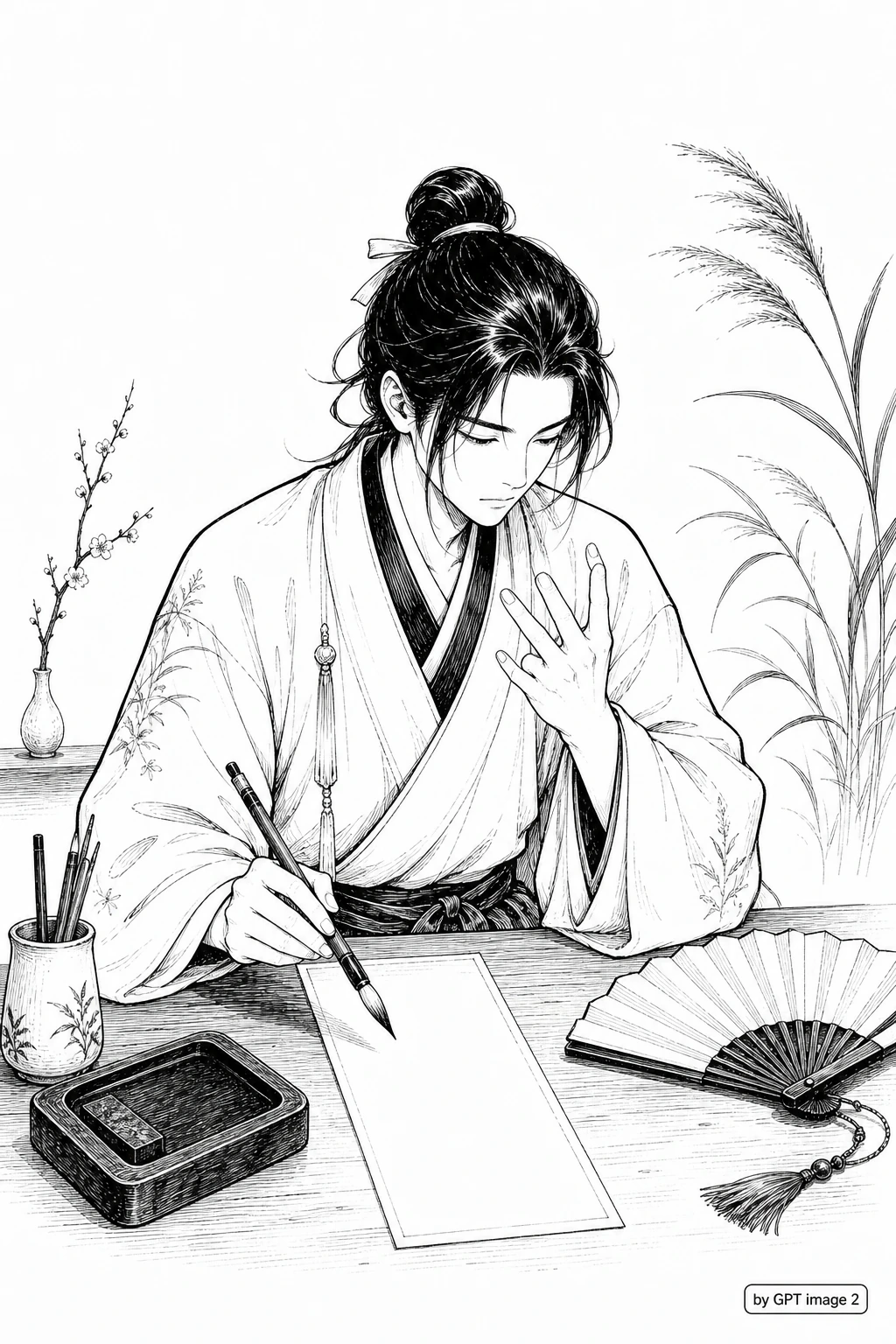
This document belongs to the front. There are no rules and no checks here. Composing a poem is not rolling dice but catching a single breath. The sample poems below were all newly composed for this issue and are Fiction-Only; to use them in a session, follow the opt-in guidance in
00.
#Example — Composing One Verse in Five Steps
Don't be afraid. A poem comes out in five steps. Begin with the 5-7-5 (haiku shape) you saw in Forms.
#Step 1 — Choose One Scene
A poem does not explain. It shows. Don't write the abstraction (sorrow, longing, transience) directly; catch the single visible scene of it. Instead of "I am sad," write "one empty bowl"; instead of "I miss you," write "a cooled teacup." As if aiming a camera at one spot only, settle on exactly one scene.
Bad example: "War is sad and life is fleeting" (that is explaining)
Good example: "On the fallen rampart a single blade of grass sways" (that is a scene)
#Step 2 — Put in One Season Word
Drive a season into that scene in a single word (the kigo from Forms). Cherry blossom means spring, cicada means summer, autumn leaves or the harvest moon mean autumn, snow or frost mean winter. One season word fills the whole poem with time and air. Put "summer grass" into the "fallen rampart" scene above — and a deep blue summer spreads over the ruins.
#Step 3 — Set It in the 5-7-5 Breath
Now set it into your native language by the substitution method of Forms. Count the syllables crisply (strict), or keep only the short-long-short breath alive (loose) — either is fine. In Korean you can count the characters; in English you keep the breath alive.
#Step 4 — "Cut" It Once
Somewhere between the second and third lines, cut it once to make a resonance (the kireji from Forms). Your own language has no kireji, so mimic it with a line break, an ellipsis (…), a comma, or an exclamation. In that cut silence the reader's heart pools.
#Step 5 — Trim the Excess
Finally, erase every word whose meaning survives without it. Words like "very," "really," and "it seems" are the enemy of a poem. The 17 sounds are a small vessel, so if even one word is wasted the scene blurs. Trim and trim again, leaving only the words you cannot help but keep.
#Example — Composing in Korean (Counting Syllables, the Strict Way)
Scene: Spring, a single camellia fallen in the courtyard of an empty old house. Don't write the person who left; show only the place they are absent from.
  (5)  madang-e hollo        ← ma·dang·e·hol·lo = 5 syllables ("alone in the courtyard")
  (7)  tteoreojin bulgeun dongbaek  ← tteo·reo·jin·bul·geun·dong·baek = 7 syllables ("a fallen red camellia")
(5) juul i eomne ← ju·ul·i·eom·ne = 5 syllables ("no one to pick it up")- Season word: "dongbaek (camellia)" (spring). Scene: empty courtyard + one fallen flower. Cut: the finality of the last "eomne (there is none)" itself makes the silence.
- Not a single character spells "I miss you." And yet the empty courtyard and the flower no one picks up speak longing whole.
Another, autumn:
  (5)  deungbul-eul kkeuni        ("when I put out the lamp")
  (7)  chang-e gadeuk chan dalbit —   ("moonlight brimming at the window —")
(5) jam-eun meolguna ("sleep is far away")- Season word: "dalbit (moonlight)" (the autumn harvest moon). Cut: the dash (—) at the end of the second line stands in for the kireji. The room grew brighter when the lamp went out, and so sleep grew farther — loneliness drawn without "lonely."
#Example — Composing in English (the Rhythm Way, Loose Counting)
In English it is easy to sound awkward if you force the syllables strictly into 5-7-5 (Forms). Keep only the short-long-short breath alive.
Scene: Winter dawn, an empty suit of armor beside a cooled hearth. Don't write the dead master; show only the masterless armor.
  Cold hearth at dawn —              (short)
  an empty suit of armor              (long)
holds the frost. (short)- Season word: "frost" (winter). Cut: the dash (—) at the end of the first line is the kireji. Scene: cooled hearth + empty armor + settled frost. It says all the sorrow of war without saying a word of it.
Spring, with the same breath:
  Petals on the path —
  the gate stands open
for no one.- Season word: "petals" (spring cherry blossom). The open gate and the fallen petals, and "for no one" — the futility of waiting stands on the scene alone.
#Example — Stretching Into a Waka (5-7-5-7-7)
Once the haiku sits in your hands, add 7-7 behind it to stretch into a waka (Forms). If the front 5-7-5 sets up the scene, the back 7-7 lays the heart onto that scene.
  (5)  madang-e hollo            ("alone in the courtyard")
  (7)  tteoreojin bulgeun dongbaek  ("a fallen red camellia")
  (5)  juul i eomne              ("no one to pick it up")
  (7)  bom-eun haemada ona       ← laying the heart with 7-7 ("spring comes every year")
(7) neo-neun oji annuna ("but you do not come")- Leave the front three lines (the scene) as they are, and the back two lines at last call out the person. If the haiku "shows and stops," the waka "shows and says one more word."
#Example — Writing a Jisei in Advance
The deepest practice (the jisei from When and Why). The form is free — haiku shape or waka shape. You need only decide "into what single scene will I compress one lifetime."
How to write it, three ways:
- Write the last landscape you see. A single scene like "falling cherry blossoms," "a guttering lamp," or "a dry field."
- Contemplate one life in one sentence. Whether regret, serenity, or a resolve never bent to the end — just one.
- Borrow a season to mirror your own life. If you die in spring, your brief glory; if in winter, the lifetime you endured.
Sample (a warrior's jisei, waka shape):
  (5)  kal-eul naerigo          ("laying down the sword")
  (7)  dorabo-ni hansaeng-i     ("I look back, and a lifetime")
  (5)  bomnun gatanne           ("was like spring snow")
  (7)  nokgi jeon jamsi huideon  ("white for a moment before it melts")
(7) geumajeo dahaeng-ira ("even that, a blessing")- Scene: the last motion of laying down the sword. Contemplation: he likens a life to "spring snow" — white for a moment, then melting. Serenity: he embraces even that as "a blessing." It is a line whose back stays straight in the face of death.
In play. When a PC or NPC falls, try asking the player for a single line of jisei. If there is no time to take all five steps, even just one scene of the last landscape is fine. With that one line, that death becomes the lasting legend of that place.
#Example — A Prescription for When You're Stuck
| Block | Prescription |
|---|---|
| I want to put in too much | Leave only one scene and discard all the rest. A poem is the work of trimming greed. |
| The syllables don't fit | In Korean, adjust the character count with a long and a short word of the same meaning (dongbaek→dongbaek-kkot, dal→dalbit). In English, drop the count and watch only the breath. |
| Explanation keeps creeping in | Erase every emotion word like "sad/fleeting," and swap it for one object in which that emotion is visible. |
| The ending falls flat | Cut once before the last line and set a silence (…, —, line break). |
| The season won't take hold | Just borrow a single word from the kigo table in Forms and drive it in. |
Now it is your turn to take up the pen. Five steps — one scene, one season word, the 5-7-5 breath, one cut, trimming the excess. Every poem is clumsy at first. But even the masters in
02once counted five and seven on their fingers. Your first one verse is the first practice toward your own jisei.
In thirty-one sounds, one lifetime is held. Breathe in that single breath, right now.