#When and Why — The Place Where Poems Are Made
Contents
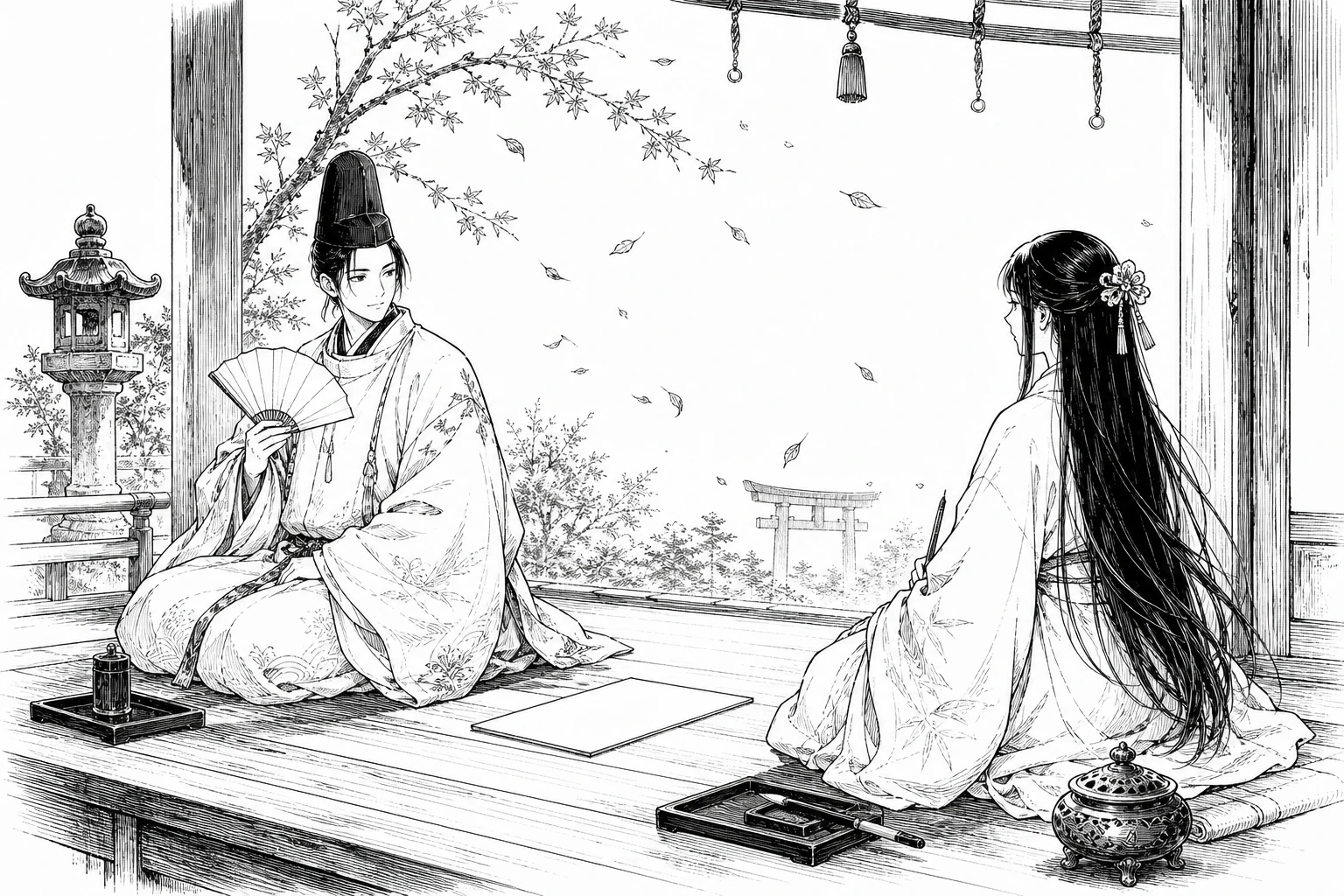
This document belongs to front. The cited poems and their authors and eras follow real literary history (Reference, Example). Session staging suggestions are Fiction-Only. Mind the periods — waka dates from the Heian era onward, but Basho's haiku belongs to the Edo period.
#Commentary — Poems Are Born from an Occasion
Poems did not come from the desk alone. Almost every poem had an occasion (場) — an occasion of facing someone, of departing, of dying. Know the occasion and you see the poem; know the poem and you see the person. We look at five occasions.
#Commentary — 1. Social: The Uta-awase and Renga Gathering
The uta-awase (歌合) is a court-and-noble poetry contest in which two sides are divided to compete over the merit of their waka. Each side submits one poem on the same topic (題, dai), and the hanja (判者, judge) ranks them. It was a great event of Heian-era noble society, and the celebrated poems born here were collected into imperial anthologies, establishing the poet's name.
In the age of the warrior houses, the renga gathering (連歌会) carried on that social stage (forms). For warlords, poets, and monks to gather in one place and link a hyakuin was at once elegance, politics, and diplomacy. One who could not compose a poem could not sit in that room — a poem was a certificate of status and cultivation.
Session staging. A daimyo of a hostile faction invites a PC to a renga gathering. An occasion where one competes not with the sword but with a single verse. Failing to fit in is a disgrace; producing an outstanding verse earns respect. (The atmosphere of such an occasion is treated in depth by the Arts issue.)
#Commentary — 2. Love and Parting
The love of Heian nobles began with waka and ended with waka. Before ever seeing a face, one sent a single poem to sound out the heart, and after spending the night together, parting at dawn, they exchanged the kinuginu no uta (後朝の歌, morning-after poem) — a waka sent on the morning of parting. If the reply poem was outstanding, the love continued; if it wilted, it cooled. The depth of love was, in short, skill at waka.
Example — Ono no Komachi (小野小町, mid 9th century, early Heian). A female poet famed for peerless beauty and outstanding waka. Her poem collected in the Kokinshu (古今集) sings of fleeting love and wilting beauty.
The color of the flowers / has faded away in vain — / a futile thing —
while this body watched the world / through the long spring rains (rendering the sense of "Hana no iro wa…")
Her mastery of the kakekotoba (掛詞, the homophonic pivot word) is superb — reading "the color of the flowers" over her own beauty, and "the long spring rain (長雨, nagame)" over "gazing lost in melancholy (眺め, nagame)." She put the impermanence of love and time into a single poem.
Example — Ariwara no Narihira (在原業平, 825–880, early Heian). The incarnation of elegance, transmitted as the model for the Ise Monogatari (伊勢物語, Tales of Ise). One of the Rokkasen (Six Poetic Immortals). His waka sing of love and parting, and the sorrow of passing time — his poem lamenting, over the moon and the spring, that "things are not as they once were" is read across a thousand years.
#Commentary — 3. Politics: Meaning Hidden in a Verse
In this era verse could be more dangerous than the sword. For an ambition that could not be spoken outright was written down hidden within a single verse of a poem.
Example — Akechi Mitsuhide (明智光秀) and the Atago Hyakuin. Just before raising the coup that shook the realm (the Honnoji Incident), Mitsuhide is said to have recited the hokku (the opening 5-7-5) at a renga gathering on Mount Atago (愛宕山).
"Toki wa ima / ame ga shita shiru / satsuki kana"
(the time is now / the rain falls [= rules the realm] / is it the fifth month)
On its surface it is merely a seasonal greeting of "the fifth month when the rainy season falls." Yet, it is transmitted that every single syllable can be read as a pivot word. "Toki (時)" is the same sound as the Toki clan (土岐氏), transmitted as Mitsuhide's original surname; "ame" is on the surface the seasonal rain (雨) while at the same time being a pivot word pointing to the realm (天, ame = ame ga shita, "all under heaven"). "Shiru" is the same sound as "to rule (知る/領る, shiru)" while on the surface also evoking the scene of rain "falling (降る)" — unraveled, it becomes "Toki (= I) now rule the realm." Later ages have read it as a meaning of rebellion hidden in a season word. Verse could thus be a cipher and a declaration.
This anecdote connects directly to the account of the renga Master Satomura Joha in the Arts issue, and to the commentary on original surname (本姓) and tsuji in the House issue. To unravel a single verse, one had to know even that person's bloodline and name. (The quote above places spaces between the verses to show the 5-7-5 syllable count — it is properly written linked into one line.)
#Commentary — 4. Travel and Season
Poems were also born on the road. The wandering poet put each and every scene into a single poem — cherry blossoms by the roadside, a hazy ferry crossing, a coast at sunset (the same scene as the travel landscapes in daily life).
Example — Saigyo (西行, 1118–1190, late Heian to early Kamakura). A wandering poet who cast off the status of warrior and took the tonsure. He spent his whole life wandering, singing of nature and impermanence (無常). The place of death he wished for is famous.
If it may be granted / let me die beneath / the spring cherry blossoms —
around that second month of the old calendar / when the full moon rises (rendering the sense of "Negawaku wa…")
And it is transmitted that Saigyo did indeed pass from the world around that time. This is the passage where the song of travel leads straight into a song of death (the spirit of jisei).
#Commentary — 5. Death: Jisei
The heaviest occasion. One leaves a single poem just before death (the jisei of forms). Because it is the act of one who will soon vanish compressing a whole lifetime into one breath, the jisei often mirrors that person most accurately.
Example — Matsuo Basho (松尾芭蕉, 1644–1694, Edo period). The figure who raised haiku into a deep art. The era must be pinned down precisely — he is not a person of the Sengoku period but of the much later early Edo (late 17th century). His most famous verse is not a song of death but one that caught the stillness of a single instant.
"Furuike ya / kawazu tobikomu / mizu no oto"
(an old pond / a frog leaps in / the sound of water)
At "an old pond (古池や)" he cuts once with the kireji "ya" (forms), and over that stillness a frog leaps in, and a single sound of water rises. Quiet and a single sound that breaks that quiet — 17 sounds become a universe. This is a haiku, and an achievement of the Edo period. To cite this verse in a Sengoku-period session, it must be handled strictly as "a celebrated poem of a later age."
For reference, the verse transmitted as Basho's actual jisei is "Tabi ni yande / yume wa kareno o / kakemeguru" (fallen ill on the journey / my dream wanders / over withered fields) — fittingly for a wandering poet, even in death his dream wanders the road.
Example — Ota Dokan (太田道灌, 1432–1486, late Muromachi). A warlord who built Edo Castle and a poet versed in waka. There is a jisei transmitted as one he left at the moment he was assassinated, caught in a plot.
Had I but known / such a time sooner / this one body —
had I not deemed it / a thing that never was (rendering the sense of the transmitted jisei)
Even in the instant of being cut down by the sword, the contemplation of a warrior who regards his own life as "a thing that never was" pervades it.
Example — Hosokawa Garasha (1563–1600, late Sengoku). Daughter of Akechi Mitsuhide and wife of the Hosokawa house. Just before Sekigahara, she refused to become a hostage. Because she was a Kirishitan (Catholic), for whom suicide was forbidden, it is transmitted that she did not use the sword herself but ordered a retainer and met her end. Yet the one poem transmitted as her jisei is the very aesthetic of Japanese poetry.
Because it knows it must fall / the flower of the world too / is flower-like —
the one who knows when to depart / is, at last, a person (transmitted: rendering the sense of "Chirinubeki / toki shirite koso / yo no naka no / hana mo hana nare / hito mo hito nare")
"Only the flower that knows when to fall is flower-like, and only the person who knows when to depart is person-like." It is the masterpiece of a jisei that embraced death as beauty (美). (Because Garasha is Mitsuhide's daughter, she connects by bloodline to the Atago Hyakuin of the politics section above — the bloodline reading of the House issue.)
#Scent — Account: For the Sake of the Last Line
Editor's note: a tale told by one old poet, set down here.
"When I was young I composed poems because I loved the occasion. To bewitch people, to win hearts, to catch the eye of my betters." The old man gazed into his cooled tea. "But having grown old, I find a poem was, after all, a lifetime of practice for the sake of a single line. That one line — I mean the jisei."
"The warrior composes it at the sword's edge, and the monk composes it lying on his bed. Even an old man who is nobody at all, like me, composes that one. To set down one's own death with one's own hand once — what is that if not the last freedom?"
He pushed a blank sheet of paper toward me. "You too should set it down in advance, once. So as not to be flustered when you die, compose it now while you live. It will sound absurd — but one who holds his own jisei keeps his back straight even before death." The sound of rain wetted the eaves. His blank sheet of paper looked, strangely, dependable.
Now that you have read this far, it is your turn to compose a poem of your own →
03 Compose Your Own