#Entertainer Special — People on the Stage
Contents
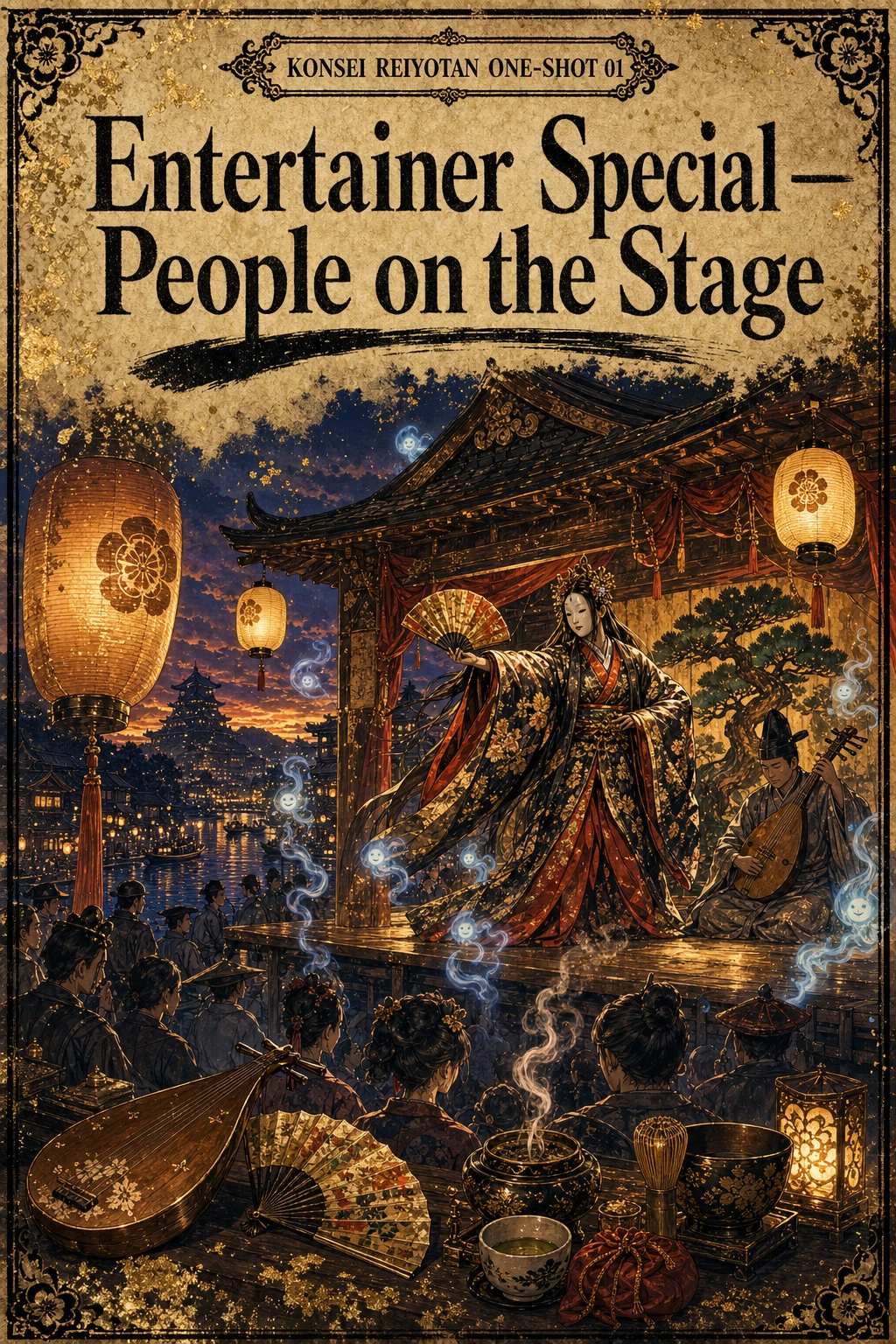
Scope declaration / opt-in. This issue is a single magazine article. Every Rule (法)·Data (資) this issue adds — performance checks, performance income, entertainer props — is a Variant under
co-99-01, meaning it is valid only when the table adopts it, and before adoption it does not affect theco/ex/fcbaseline. The character introductions and atmosphere prose (Scent) are Fiction-Only (staging reference, no checks), the tables are Summary, and the Note commentary is Reference Only. When numbers conflict, the canonicalcotakes priority.This issue does not replace the combat rules of the entertainer class. For in-combat maneuvers such as the war song, requiem song, and grand performance, that document is canon. This issue covers the out-of-combat performance that the class does not treat in depth — the stage, the audience, the income, the place where spirits (靈) are soothed.
#Brief — What This Issue Is
The Sengoku period was an age of the sword, but at the same time it was also an age of the stage. Daimyo returned from the battlefield and watched noh (能); a Sakai merchant paid the price of a whole castle for a single cup of tea (茶); a warlord facing rebellion hid his own fate, written into a single verse of renga (連歌). The common people wept at the Heike tale of a biwa hoshi, and on a makeshift stage by the river a single woman danced a new dance (kabuki) that soon opened an era.
This issue covers those people on the stage. There are two threads.
- Who was there — the real art forms and Masters of the Sengoku period. Noh, chado, renga, ikebana, kodo, Kano-school painting, and the street entertainers who became the basis of the entertainer class, such as the shirabyoshi, biwa hoshi, and yujo. (
01) - How the stage works — how to roll a performance once out of combat (performance check), how that performance becomes money (performance income), and how the GM runs that money and fame. (
02) - What you stand with — entertainer props such as the meibutsu biwa, the seven-color fan, the noh mask, and the meibutsu tea utensil. (
03)
#Meta Card
| Item | Value |
|---|---|
| Series | zn (one-shot series) Issue 01 |
| Title | Entertainer Special — People on the Stage |
| Character | Single-topic one-shot — the world of the out-of-combat entertainer (藝人) and supporting rules |
| Length | 4 documents (front + people·arts + performance·income + props) · reading time about 14 minutes |
| Blocks | Brief · Scent · Rule · Data · Table · Example · Note |
| Authority | opt-in (Variant) by default — see the scope declaration above for details |
| Dependencies | references co (entertainer class · Bearing · detailed economy). Readable standalone |
| Core version requirement | co >= 1.2 |
| Current version | v1.5 (zn01-VERSION) |
#Contents
| Document | Type | Contents |
|---|---|---|
01 People and Arts | Brief · Table · Scent | A list of Sengoku-period art forms + accounts of real-life Masters + street entertainers |
02 Performance and Income | Rule · Table · Example | Performance check (2d10+Presence+Bearing) · performance income (linked to the detailed economy) · worked example |
03 Props | Data · Table · Note | New props such as the meibutsu biwa·fan·noh mask·meibutsu tea utensil + GM Note |
99 Closing Fiction | Scent | "The First Beat by the River" — a cheerful vignette of a young biwa pupil at her first stage and a gruff old impresario |
Reading order: front (this document) → 01 → 02 → 03. To roll a performance once during a session, you only need to open the tables in 02.
Closing fiction. At the end of this issue is "The First Beat by the River" (pure Scent fiction) —
99.
#Production Notice
This issue is the pilot Issue 1 of the Konsei Reiyotan zn (one-shot) series. The art forms and people that appear are based on real Sengoku-period history, but their points of contact with the Spirit Realm (靈界)·yoma (妖魔) are fiction of this setting. The depiction of real people is staging-use Fiction-Only, and when using them as NPCs, the GM sets the numbers directly by the standards of co. All rules in this issue were reviewed as opt-in on top of the canonical co.
#AI Use Notice
A considerable part of this material was produced with the help of generative AI (LLM) in the processes of planning, drafting, prose tidying, and proofreading. The GPT Image 2 model was used in the image generation process. Claude Code and Codex were used for the Japanese and English translations. Final editing and the responsibility for publication rest with the creator.
If there are changes to domestic or international law regarding AI-assisted works, those laws shall be followed.
#Scent — One Sentence
"Where the sword stops, a song flows; when the song stops, the sword is taken up again — the entertainer lives in between."