#Daily Life in the Sengoku (戰國の日常)
Contents
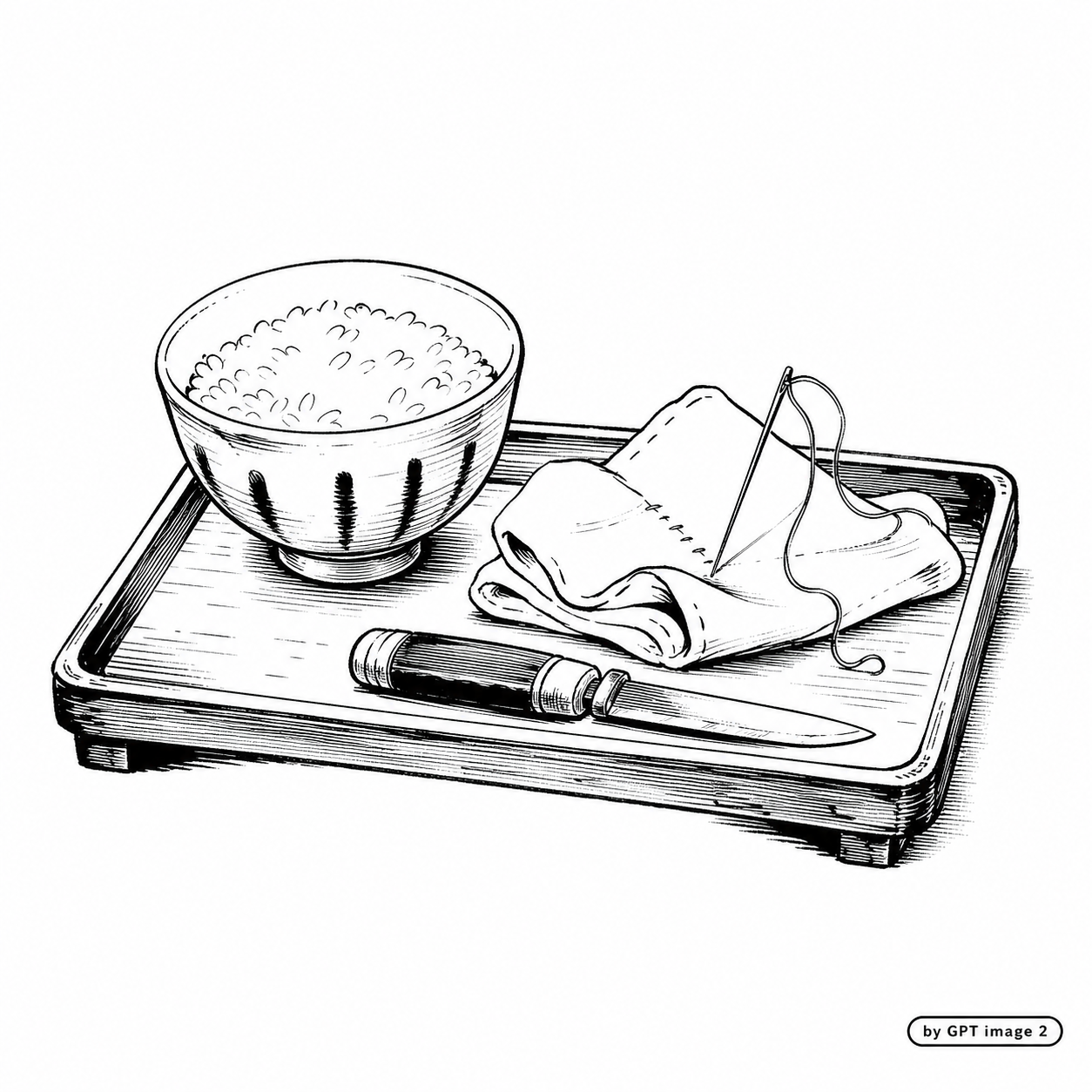
Combat is not everything. Between battles, people of the Sengoku period lived like this.
#Food and Sake
#Scent
A warrior on campaign eats barley rice (麥飯), miso (味噌), and, with luck, dried fish. A proper meal is usually possible only in a castle. Warm rice and sake at a tavern (酒場) are a small happiness between battles.
Sake is culture. Even oni love sake. Shuten-doji's raids for human sake are famous. Merchants carry sake to the battlefield to raise soldier morale, and onmyoji strengthen barriers with sacred sake (神酒) offered to the gods.
#Law — Game Effects of Food/Sake
| Situation | Effect |
|---|---|
| Battle after a proper meal | first round Energy +1 |
| Battle while hungry | First-round Energy -2. At each lull, lose 1 Wound on a failed 2d10 + Physique >= 11 check. |
| Battle after drinking sake | fear immunity. However, all checks -1. |
| Sacred sake (onmyoji only) | next Barrier/Sorcery check +2 |
#Society and Status
#Scent
The Sengoku period is a strict status society. Samurai, farmers, artisans, and merchants make up the world, while monks and shinobi exist outside those ranks. Hanyo belong nowhere, and wildlanders (Emishi) are treated as "barbarians."
But Sengoku chaos is shaking status itself. Commanders born as farmers build castles, merchants become richer than daimyo, and monks lead armies. The age of gekokujo (下剋上): those below overturn those above.
#Law — Game Effects of Status
| Situation | Check Modifier |
|---|---|
| High status negotiating with low status | +2 (authority) |
| Low status negotiating with high status | -2 (basic). If Fame is 4+, 0. |
| Hanyo/wildlander negotiating with an ordinary NPC | -3 (prejudice). Negated if background route A was chosen. |
| Merchant negotiating with anyone | -0 (gold ignores status) |
#Scenes of Travel
#Scent
The roads of the Sengoku are dangerous, but beautiful: mountain paths in cherry blossom, misted riverside ferries, coasts colored by sunset. Traveling warriors pause amid these scenes and walk toward the next battlefield.
Praying at a small roadside shrine (神社) calms the heart, and drinking from a village well eases fatigue. But if a Jizo Bodhisattva (地藏) in the mountains suddenly opens its eyes, or a stone lantern (石燈) lights by itself, yoma are near.
#Law — Travel Event d10
During travel, the GM rolls d10 to add atmosphere (not combat).
| d10 | Event |
|---|---|
| 1 | Cherry-Blossom Road: beautiful scenery. Every character reflects on the current Heart (心) of their Three Ways and Six Hearts. GM prompts an RP scene. |
| 2 | Roadside Shrine: if you pray, gain +1 Fate Intervention at the start of the next battle. |
| 3 | Wandering Merchant: consumables can be purchased. Price 1.5 times normal (remote area). |
| 4 | Ruined Tavern: you can shelter from rain, but strange sounds come at night. A successful Perception check(Target Number 13) reveals a yoko illusion → the yoko gives information. |
| 5 | Village Festival: villagers are holding a festival. If you participate, Fame +1 (that region). Entertainers can earn d10 gold by performing. |
| 6 | Wounded Soldier: a soldier lies by the road. If treated with medicine, they give information (a clue for the next scenario). If abandoned, they may become an onryo. |
| 7 | Bandits: an opportunity for negotiation, not combat. Pass with a successful Negotiation check(Target Number 13) or Intimidation check(Target Number 11). On failure, small combat (a squad of 4 Minions). |
| 8 | Hot Spring: resting in a hot spring fully restores Wounds + curse -1. However, you may be ambushed while defenseless (d100, 01~10). |
| 9 | Yoma Omen: spiritual energy is felt. If an Exorcism or Perception check(Target Number 11) succeeds, apply +10 to the next yoma encounter table (advance preparation). |
| 10 | Battlefield Relic: find an old weapon or armor on an ancient battlefield. Roll on the d100 loot table with -20. |
#Seasons and Festivals
#Scent
Even in the Sengoku period, the seasons turn: cherry blossoms in spring, Bon Odori (盆踊り) in summer, moon viewing in autumn, snowy landscapes in winter. During festivals, war pauses for a moment and villagers dance and sing. Yoma also mingle among humans at festivals, especially yoko.
#Law — Seasonal Effects (Campaign)
| Season | Combat Effect | Noncombat Effect |
|---|---|---|
| Spring | Frequent fog (ranged -1). Pollen gives Perception -1. | Travel is comfortable. Travel distance +10%. |
| Summer | Heat wave: heavy armor adds Energy -1. | Disease risk increases. On rest, 2d10 + Physique >= 11. |
| Autumn | Harvest season. Squad recruitment cost -50%. | Food is plentiful. Meal effects are guaranteed. |
| Winter | Snow: outdoor zones only movement Energy +1 (not applied indoors, in caves, or in the Core Zone). Fire attacks unavailable. | Camping is dangerous. On a failed 2d10 + Physique >= 11, lose 1 Wound/day. |
#Dreams and Omens
#Scent
Sengoku warriors take dreams seriously. If the dream on the night before battle is auspicious (吉兆), morale rises; if it is ominous (凶兆), anxiety spreads. Onmyoji interpret dreams and apply them to tactics, while arahitogami hear the voices of kami in dreams.
#Law — Dream on the Eve of Battle (d10)
The GM may optionally roll this before a combat scenario begins.
| d10 | Dream | Effect |
|---|---|---|
| 1~3 | Auspicious Sign: dream of victory, encouragement from ancestors | all allies gain first-breath Energy +1 |
| 4~6 | Ordinary Dream | no effect |
| 7~8 | Ominous Sign: dream of blood, vision of falling | ally squad Cohesion -1 (anxiety) |
| 9 | Prophetic Dream: sees one scene of the battle in advance | GM reveals 1 enemy tactic hint |
| 10 | Oracle: words of a kami or ancestor | RP event tied to a specific character's Three Ways and Six Hearts |
#Seasonal Festival Events (Campaign/Downtime)
Festivals return each season during a campaign. They connect with the season actions of Domain Management.
#Spring: Hanami (花見)
Drinking sake and composing poetry under cherry blossoms. The only day to forget war.
| Item | Effect |
|---|---|
| Participation | spend 1 gold. Fame +1 (participating region). |
| Entertainer Show | if an entertainer performs, additional Fame +1 + d10 gold income. |
| Negotiation Opportunity | unofficial contact with NPCs from hostile factions is possible. Negotiation +3 (festival mood). |
| Yoma Mingling | d100 01~15: yoko/tanuki disguised as humans join the festival. Detect them with a Perception check(Target Number 13). |
| Three Ways and Six Hearts | characters who participate in the festival can reconsider the direction of their Heart. GM prompts an RP scene. |
#Summer: Bon Odori (盆踊り)
The day when the souls of the dead return. Lanterns are lit and people dance.
| Item | Effect |
|---|---|
| Participation | if there is an incapacitated character, "conversation with the soul" is possible during Bon Odori (scenario-dependent). |
| Pacifying Onryo | if an esoteric monk/Pure Land monk reads sutras, onryo encounter chance in the region -20 (1 season). |
| Yoma Appearance | d100 01~20: real yoma (onryo/gaki) appear among the souls. |
| Yumekui | on the night of Bon Odori, a yumekui may appear in the village. It may be a benevolent appearance that eats nightmares. |
#Autumn: Tsukimi (月見)
Eating dumplings beneath the full moon and making wishes to the moon.
| Item | Effect |
|---|---|
| Participation | Gain +1 Fate Intervention use in the next battle. "Blessing of the moon." |
| Onmyoji Ritual | if an onmyoji performs a ritual at Tsukimi, everyone gains +1 Fate Intervention in the next battle. |
| Harvest Festival Link | if the autumn harvest is abundant, squad recruitment cost -50%. If it is poor, Ikko-ikki uprising chance rises. |
| Tengu | on a Tsukimi night, a tengu may appear and request a "martial bout." On victory, gain tengu respect + information. |
#Winter: Joya Festival (除夜祭)
The end of the year. The bell is struck 108 times to wash away worldly desires.
| Item | Effect |
|---|---|
| Participation | everyone removes 1 curse/status condition. "Wash away worldly desires." |
| Esoteric Monk Ritual | If an esoteric monk performs a goma ritual, then until the next season, an enhanced regional Spiritual Contamination Zone becomes normal, or a normal one is removed. It does not affect the personal Spiritual Contamination condition. |
| Winter Survival | During winter campaigns, make a camping check(2d10 + Physique >= 11). On failure, lose 1 Wound. Exempt if supplies are available. |
| New Year's Vow | if a character declares a New Year's vow, checks related to that vow gain +1 (1 season). Breaking the vow may shift the Heart. |
#Downtime Event Table (d10)
Between campaign scenarios, the GM rolls d10 to add noncombat events. Use this alongside the season actions of Domain Management.
| d10 | Event | Opportunity |
|---|---|---|
| 1 | Letter: a letter arrives from home/a mentor/an old companion. | scenario hook / introduction for a school-related quest |
| 2 | Dojo Pilgrimage: a character in a school visits a dojo in another region. | school NPC encounter / Licensed→secret art rank-up event |
| 3 | Secret Letter: a faction requests a secret mission. | scenario introduction / negotiation event |
| 4 | Yoma Rumor: yoma sightings nearby. | hunting request / exploration scenario |
| 5 | Training: free training time. | skill XP gain / school training |
| 6 | Merchant Visit: a wandering merchant brings rare goods. | equipment purchase / clue to a masterwork weapon |
| 7 | Festival Participation: participate in a local festival. | apply the seasonal festival event above |
| 8 | Refugee Influx: war refugees arrive at the village. | population increase / food problem / spy infiltration? |
| 9 | Ley Line Shift: the local ley line activates or becomes tainted. | feng shui master/onmyoji quest / zone alteration |
| 10 | News of an Old Enemy: rumor about an enemy/ally from a previous scenario. | campaign continuity / preparation for reappearance |
Even while the blade is set down, the world keeps turning.