#Orasho
zn08 closing story · Seriousness ★★★ · pure Scent (fiction). No rules or numbers appear.
Only after the fire is put out does the day begin.
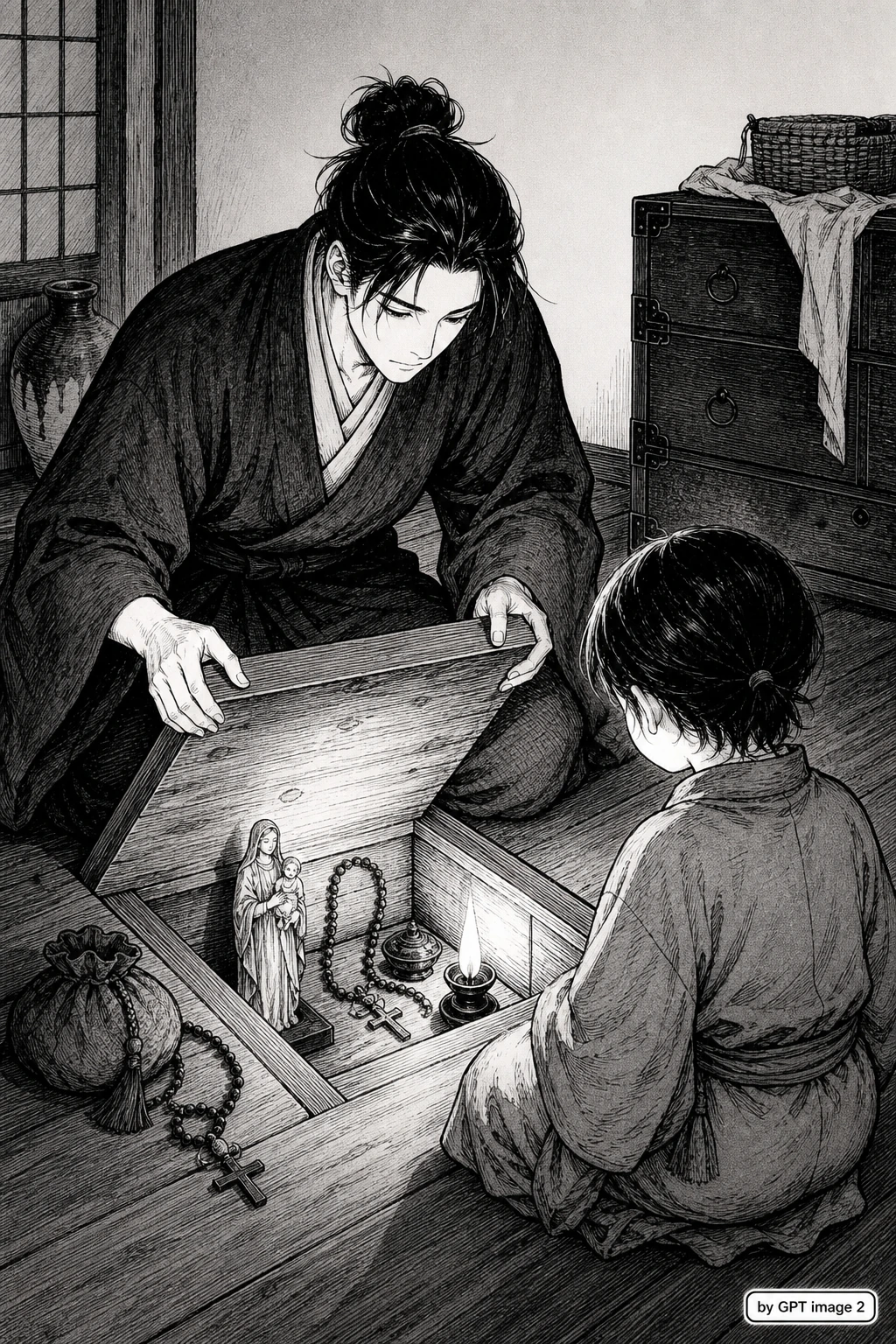
That is what the father was taught. By day he lives as the head of a household registered at the temple. With the villagers he bows his head at the toll of the temple bell, in spring he sweeps the temple yard, and where anyone can see he presses his hands together before the Buddha image. That hand is no lie. It is a hand that has lived a hundred years as a lie.
When night comes, it is different.
He stops up the gaps in the door, snuffs out the lamp, and lifts a single floorboard. Beneath it is a small box. Open the box and there is a single Kannon statue painted black. Anyone in the village who saw it would take it for a merciful Buddha. Only the father knows that the child held at its knee is not the Buddha's child. People call it Maria Kannon — another mother, clad in the Buddha's robes.
The father knelt before it. Tonight he was not alone.
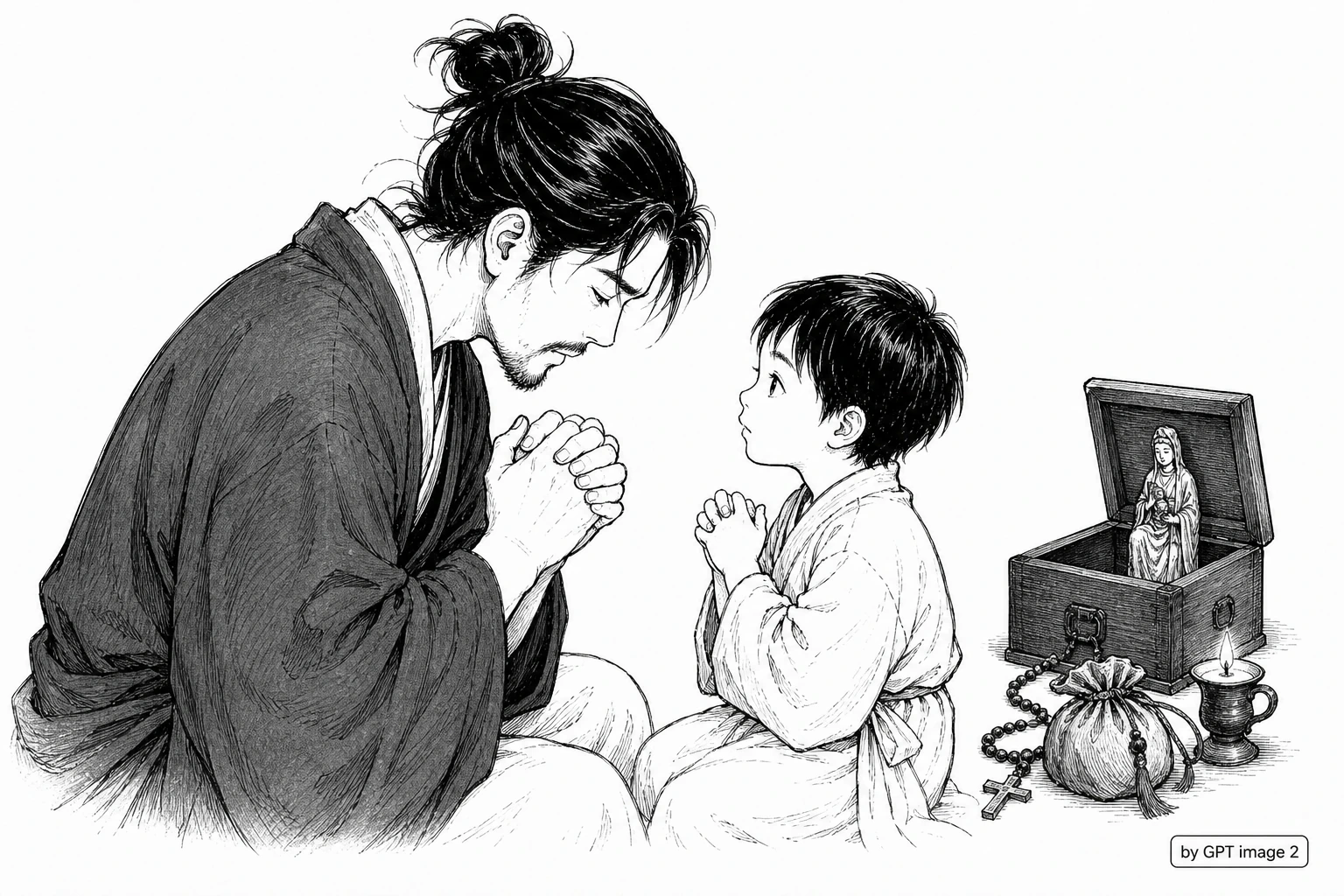
"Father, who is that?"
His six-year-old son asked from behind him. The father held his breath. The time had come to bring the child in, his wife had said before she died. From mouth to mouth. Because it would be found out if left in writing, by sound alone. That was how it had been carried on for a hundred years.
"Come here and sit."
The child came over and sat beside him. The father gathered the child's small hands and held them together. The hands were cold.
"From now on, you need only follow the words your father recites. Do not ask their meaning. Even your father does not know all of it."
And then the father opened his mouth. In a low voice, almost like breath.
Credo in Deus… Patrem omnipotentem…
The child's eyes went wide. It was a sound he had never heard. It was none of the tongues of this land. It resembled neither the sutra passage the monk chants at the temple, nor any sound heard at the shrine. Words worn down and worn down until they had lost their original shape, yet still trembling with holiness.
"…Father, what words are those?"
"Words that came from across the sea. From a very far place."
"Who is… Deus?"
The father held his tongue for a while. How should he explain it. One he himself had never seen. A hundred years since the priest vanished, and after all who could teach it had died, what remained was sound alone.
"You know that the kami are in the mountains and the Buddha is in the temple, yes?"
The child nodded.
"Deus is… not in the mountains, not in the temple. And yet they say he is everywhere."
"Everywhere?"
"In this room too. On the sea too. When you fall asleep too." The father chose his words slowly. "Here there is no grave of his, no shrine of his. That is why people fear him. Whatever is unknown is fearful, after all."
The child thought for a long while, then asked.
"Then must we… fear him too?"
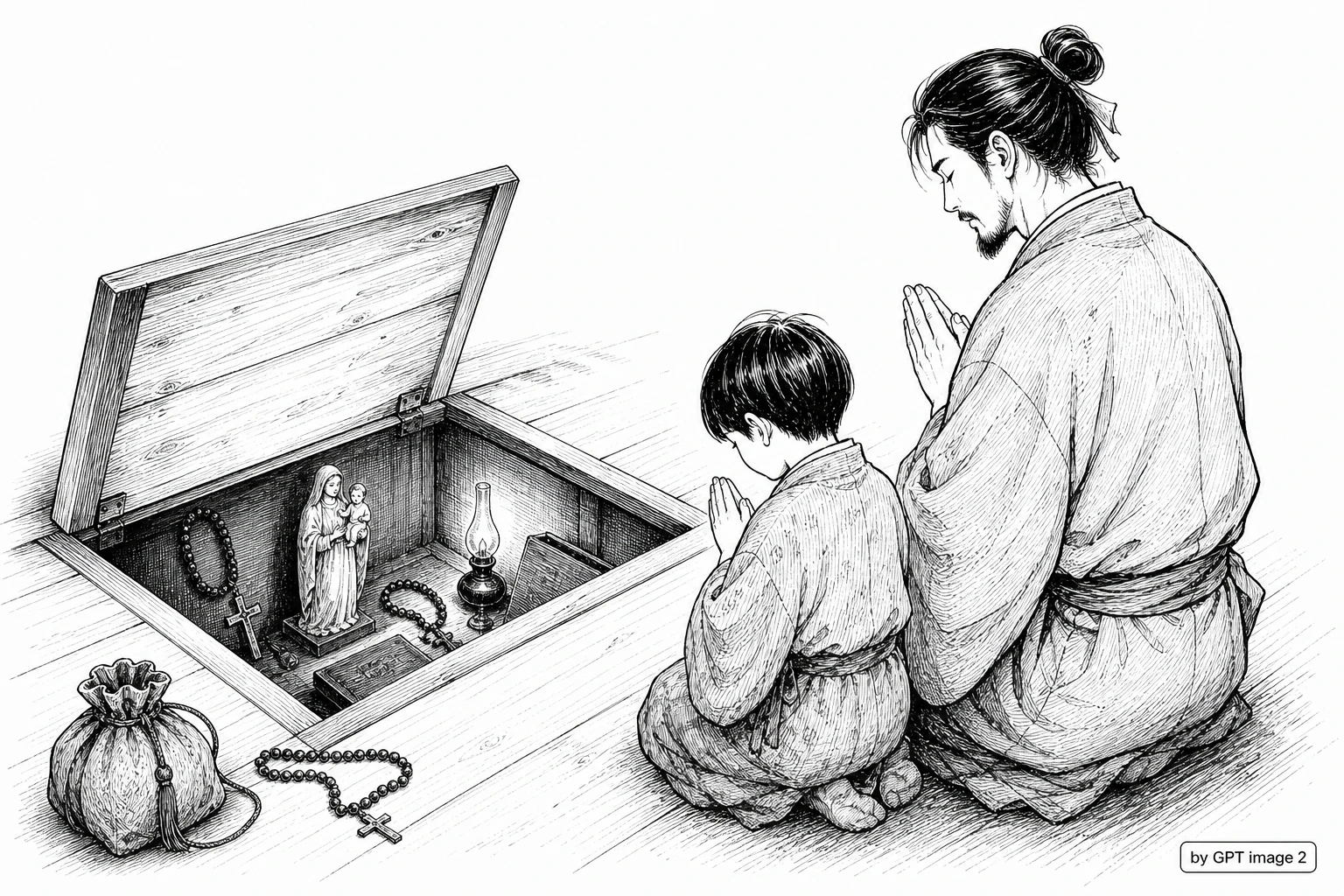
The father drew the child into his arms. In a room where not even a lamp could be lit, before the black Kannon beneath the floorboard, stifling even the sound of his breath for fear of being found out.
"No." The father's voice trembled. "It is not we who fear. We… only do not forget. So that these words, which a grandfather heard from his own grandfather, are never cut off."
Outside, the wind shook the door. The father instinctively laid his hand on the lid of the box. The sound of someone from the village passing along the night road with a lantern. Until the footsteps grew distant, father and son heard nothing in the dark but each other's heartbeats.
The footsteps faded.
The father opened his mouth again. Lower than before.
…Et in unum Dominum…
"Follow me."
The child moved his small lips. Following his father's sound haltingly, words whose meaning he did not know. That prayer, which must have first rung out at some harbor a hundred years ago, worn and blurred, was passing through the mouth of a six-year-old into the next hundred years.
The father closed his eyes. A prayer to a far-off god, to a guest who has not even a grave in this land, a prayer that might not be heard.
He recited it all the same. Because there was nothing else to pass on.
When dawn came he would bow his head before the Buddha image again. He would press his palms together at the toll of the bell. To anyone's eye they would be an ordinary father and son of a household belonging to the temple.
But tonight, beneath a single floorboard, a single thread of sound that had been cut off was joined once more.
(End)