#Designing in the Interlude — The Five Methods
Contents
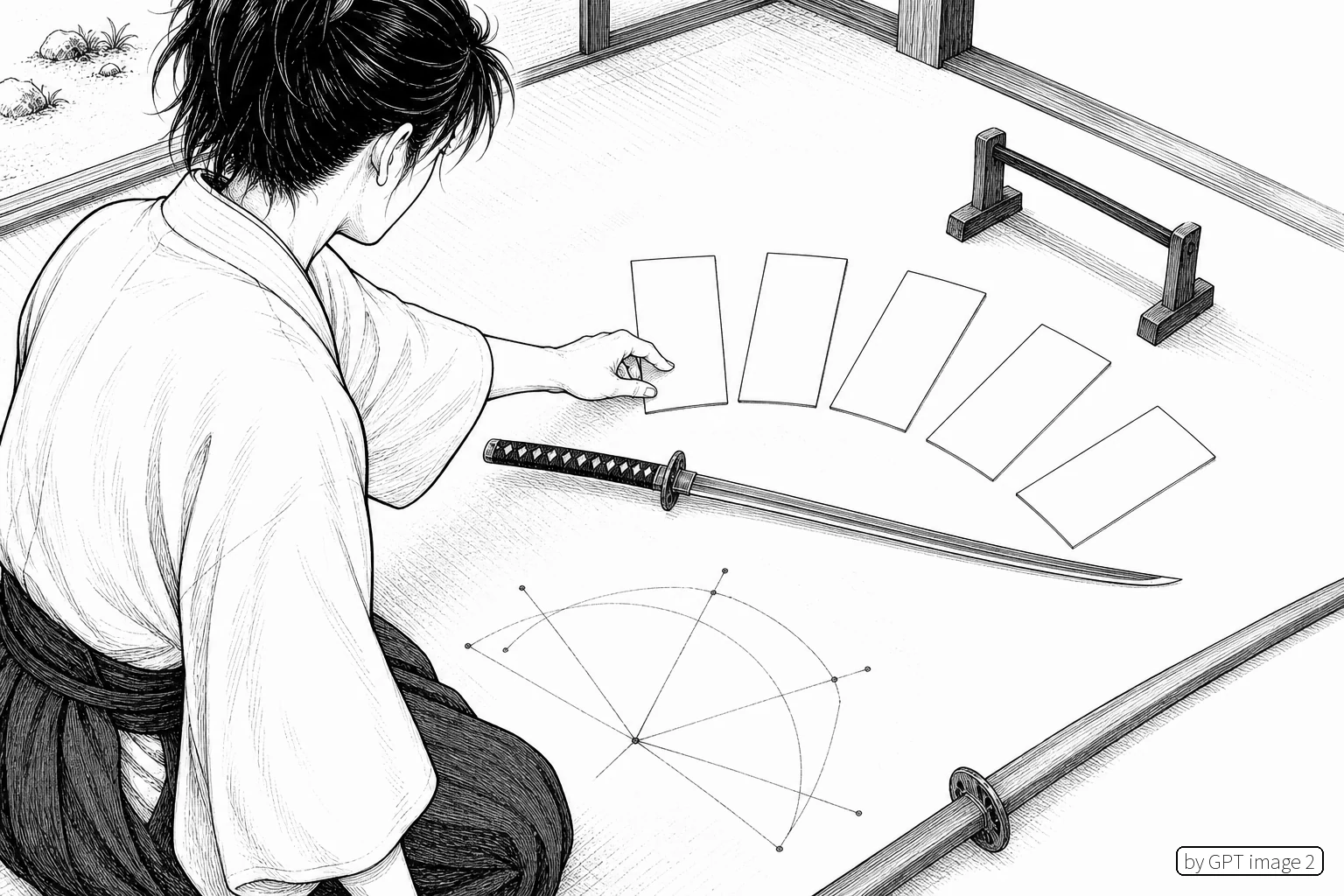
zn11 · Rule (Variant) + the five-methods table (Summary) + Notes (Reference Only).
#Rule — Designing in the Interlude
- Timing. In an interlude, choose 1 observation record on hand (
02).
The interlude (settled) = no mechanization, a purely narrative provision. It refers to an "interval" in which enough time for training and study can be secured. Usually it is the interval between the end of a session that forms one scenario unit and the start of the next. However, if the story affords enough time — a long journey, a siege, an overwintering, a spell of convalescence, and the like — you may design even mid-session. It is not turned into an independent action turn like a seasonal action.
- Interpretation. Choose one of the five methods below, and design 1 Licensed/secret art from that record (following each method's template).
- Filing (the stage gate). A technique you design slots into the Licensed-menu slot / secret-art slot of the target skill (per the starting setup in
01).
- A Licensed Self-Taught technique = the target skill is Licensed (3 pts) or above.
- A secret-art Self-Taught technique = the target skill is Master (4 pts) or above (per
co-04-02, Stage 2 or above & one of the class's designated 6 skills).
- Numbers. Energy, the resolution formula, and the effect follow co plus GM approval (in line with the fixed-modifier custom of ±1 to +3 in
co-08-02; resolution is2d10 + ability + skill >= target value, and target values use the odd-number ladder).
#Table — The Five Methods
Even from the same observation record, the chosen method changes the generated technique's Kata tag and the direction of the effect. From a single seed, several visions of a school can branch off. Each method takes on one tactical role.
| Method | Tactical role | Direction of design | Tendency of the generated technique (Kata) |
|---|---|---|---|
| Reproduce | Offense | Reproduce the watched technique as is | Inherits from the source observed ([Kata]→[Kata], etc.), somewhat weakened |
| Prevent | Seal | Keep that technique from occurring | [stance]/[aptitude], seals that lineage |
| Guard | Defense | Brace for when you take it | [Kata/defense] reaction, damage mitigation |
| Overcome | Counter | Win out against that technique | [Kata], a conditional counterattack. The favorite for a signature technique |
| Imitate | Transform | Take inspiration and rework it | Transplanted to a different Kata / a different ability |
#The design template of each method
A designed technique always takes the form of a [Kata]/[stance]/[aptitude]/[upkeep] technique, and does not occupy a weapon's licensed-technique slot or another school's slot.
Reproduce (Offense) — move a watched stroke into your own hand, nearly as is.
[Same type as the source observed] So-and-so (Self-Taught Style)
Energy: the source's Energy (do not lower; round fractions up; minimum 1)   Limit: the source's limit (cannot be eased; 1 per round is standard)
Resolution: 2d10 + (the source's ability) + (the matching skill) >= target value / Defense
Effect: reproduce the source's effect, degraded along <only 1 axis> of "number -1 / Wounds -1 / range narrowed to single-target".
       Compound effects, Critical Expansion, and other special rules are not inherited. Critical Hit = up to 1 special effect identical to the source's.
※ This method alone requires an observation record (you cannot reproduce from a blank).
※ Inheriting the stage: if the source is a secret art (a Master-stage school secret art, etc.), the reproducing side too must reach Master (4 pts).
Prevent (Seal) — keep that stroke from arising in the first place.
[stance / aptitude] So-and-so Seal (Self-Taught Style)
Energy: 0 (aptitude) / 2 declared (stance; 1 stance at a time)   Limit: — / sustained (auto-cancels on cancel or move)
Effect: when an opponent of the Kata tag specified in the observation record uses that technique, that resolution takes -2 (stance) / -1 (aptitude).
       Or nullify 1 activation prerequisite (reach advantage, a specific stance, the first-round initiative).
       Your own dodge/parry resolution against that opponent +1 (does not stack with another stance's Defense bonus; only the 1 highest applies).
       It has no attack power (Prevent specializes in "not letting it happen").
Guard (Defense) — on the premise of taking it, set up a receiving stance.
[Kata / defensive reaction] So-and-so Parry (Self-Taught Style)
Energy: 1 reserved / 2 improvised (if the source is powerful, 2 reserved / 3 improvised)   Limit: 1 per round
Resolution: 2d10 + technique + (the skill involved in defense) >= the opponent's attack-resolution value (if the receiving party is unarmed combat, bojutsu, etc., by GM agreement the ability may be reassigned to Body and so on)
Effect: on a success, nullify one strike of the specific lineage observed (rapid hits / pierce / area — specified 1:1 with the observation record).
       Even on a failure, damage -1 Wound (minimum 1). Critical Hit = nullify + your next attack +1 (within the one-breath limit).
       Critical Expansion is not granted (Overcome only).
Overcome (Counter) — win head-on. The favorite for a signature technique.
[Kata] So-and-so Breaker (Self-Taught Style)
Energy: 3-4   Limit: 1 per round (may be strengthened to 1 per combat)
Resolution: 2d10 + (Courage or Finesse) + (the matching skill) + 1 >= Defense
Trigger: activates only when the opponent used/declared, in the immediately preceding round, the specific technique observed/taken (or that group of Kata tags).
Effect: 2 Wounds on a hit, 3 Wounds on a Critical Hit. The <only method> that can explicitly grant Critical Expansion (a margin of 1 pip, if a success, also counts as a Critical Hit).
       When it is promoted to a signature technique (Heavenly Mandate), it gains +1 or [Pierce 2] (no extra slot; GM approval).
※ Being conditional, it is allowed a stronger bracket than an ordinary attack (within the range of the co-08-02 fixed modifier ±1 to +3, within the one-breath limit of 7).
Imitate (Transform) — borrow only the inspiration and rework it into something else.
[any Kata] So-and-so Revised (Self-Taught Style)
Energy: 2-3 (the source ±1)   Limit: 1 per round to one step stricter
Resolution: 2d10 + (an ability different from the source's; 1 of the 6) + (a different skill) >= target value (the odd-number ladder)
Effect: extract only 1 strength of the source and transplant it to a different Kata / a different zone (e.g., a sword's defensive counter -> an unarmed grapple counter,
       a ranged hit -> melee + zone control). The success effect is one step more modest than the original + a transplant-side situational bonus +1 (only when applicable).
Critical Hit = 1 small effect unique to the transplant side. No double-dipping — it may not simultaneously hold the same Kata and the same number as the original.#Rule — Incomplete -> Trial -> Mastered
A technique just designed is Incomplete. Until you succeed with it in real combat, it does not settle into your hand.
- Using an Incomplete technique: resolution -2.
- Each trial reduces the penalty by 1 step (-2 -> -1 -> 0). The more often you wield it, the more your body learns it.
- The moment you succeed, the penalty vanishes -> Mastered.
- GM alternative option: depending on the technique's nature, you may swap the penalty for "effect halved" or "Energy +1". However, to avoid confusion within one document, the standard rule is unified as "resolution -2, decreasing".
- Track multiple Incomplete techniques separately. The penalty reduction proceeds independently per technique (succeeding with one does not complete another).
- If Karmic Retribution (1-1) comes up during a trial, follow the critical-blunder table of
co-03-01as usual. The Incomplete technique itself does not break (the penalty stays put; GM discretion).
#A Critical Hit / Heavenly Mandate mid-experiment (Breakthrough)
In the midst of a trial, fate may suddenly cross your path.
- A Critical Hit during a trial. Mastered on the spot (the penalty vanishes at once) + a small extra bonus matched to the method and technique (granting Critical Expansion / +1 Wound / Energy -1 / one step of round, etc., granted by the GM).
- A Heavenly Mandate during a trial. Mastered on the spot + that technique crystallizes as the school's signature technique -> naming the school (discarding "Nameless So-and-so") + a modest permanent enhancement ([Pierce 2] or +1; no extra slot; GM approval). If you choose +1, even combined with Overcome's built-in +1 it is +2 in total at most (within the one-breath limit of 7 and co-08-02 ±+3; beyond that it does not accumulate).
- 1 signature technique per 1 school. * "signature technique" is a new term coined in this issue, not a term of the co canon.
The key — do not mistake the branches. A Critical Hit is "immediate, complete mastery" (that technique becomes your own). A Heavenly Mandate is "promotion to a signature technique + naming" (that technique becomes the school's face). A Critical Hit alone does not trigger naming. The 2 design examples below contrast this branching.
#Note — For the GM
- The approval standard. Can the designed technique be reproduced from "the seed watched + the method template + co's number customs"? Fixed modifiers are ±1 to +3 (
co-08-02), the sum of positive bonuses in one breath is roughly up to 7 (co-03-07 §2.7), and target values use the odd-number ladder. Do not let arbitrary numbers be slipped in. - Restraining a too-strong technique. Always grant high power either with a trigger/condition (Overcome), or one step more modest + a limited bonus (Imitate). There is only 1 signature technique, and a Heavenly Mandate's permanent enhancement is kept within a range that consumes no extra slot.
- Choosing among the five methods. If you want offense, Reproduce; if you want to erase the opponent's specialty, Prevent; if you want to take it and survive, Guard; if you want to surpass an arch-rival's stroke, Overcome; if you want to devise a different solution with the skills in hand, Imitate. Two PCs may set up different schools from the same record.
- The frequency of interludes. The interlude is not mechanized. Do not make it an independent turn like a seasonal action in domain management; entrust it to the "interval" of the story. Setting up one technique usually takes a run of sessions' worth of time — observation -> design -> several combats' worth of trials. That is fine.
- The distinction from Adaptation. The Self-Taught Style you grow is an option for every profession that can take a Self-Taught school. It is a different engine from "Adaptation" (
co-04-02 §Adaptation; borrowing the techniques of the 18 official professions under a frequency limit), exclusive to the 3 Outsider professions. In particular, the five methods' Imitate is "designing a new stroke from the seed of an observation record", and is kept strictly apart from Adaptation, which borrows an existing technique (an Outsider too, if they wish, may take a Self-Taught school with 1 technique slot).
#Example — A scene of design
Design example 1 (Karmic Retribution -> Overcome -> a Heavenly Mandate signature technique). The observation record is the continuation of 02 example 1 — the memory of the swordsman Sasuke (Swordsmanship Master 4 pts · Courage +3 · Finesse +2) being defeated by Ganryu's [Tsubamegaeshi (燕返し)] through Karmic Retribution.
- Design (interlude). Set up a stroke with the [Overcome] template.
  [Kata] Sori-gaeshi (反り返し) (Self-Taught Style)   Energy 4   Limit: 1 per round
  Resolution: 2d10 + Finesse + Swordsmanship + 1 >= Defense
  Trigger: only immediately after the opponent uses/declares, in the immediately preceding round, a 2-hit / wave-form technique (the group of Kata tags of Tsubamegaeshi).
  Effect: 2 Wounds on a hit, 3 Wounds on a Critical Hit. Explicitly grants Critical Expansion (Overcome only).
The inspiration — taking the reverse of Tsubamegaeshi's "second blade from the recoil of the draw," a counter that cuts down the half-beat in which the opponent bends back toward the second blade. Because it is a stroke of foresight, the Overcome formula's ability was set to Finesse rather than Courage. It is filed in the secret-art slot of the Swordsmanship Master stage (per co-04-02: Sasuke's Master stage = it takes up 1 of the techniques he holds at Licensed or above).
- Trial (Incomplete -2). A rematch with another Ganryu swordsman. At the first round, it activates immediately after the opponent declares Tsubamegaeshi.
- Trial 1: 2d10 [6,4] = 10 + Finesse 2 + Swordsmanship 3 + 1 - 2 (Incomplete) = 14 >= Defense 13 -> success (not a Critical Hit, since the pips differ). The penalty goes to -1.
- Reactivating in the next combat: 2d10 [9,9] = 18 + Finesse 2 + Swordsmanship 3 + 1 - 1 = 23 >= 13 -> success + [9,9] double = Critical Hit -> immediate, complete mastery (the -2 vanishes). 3 Wounds.
- * Here it is only a Critical Hit, so promotion to a signature technique has not yet occurred — this is the branch of "Critical Hit = immediate mastery / Heavenly Mandate = promotion to a signature technique."
- ★ The Heavenly Mandate route (a contrast). Had the trial's pips been [10,10] = total 20 = Heavenly Mandate — in addition to immediate, complete mastery, Sori-gaeshi crystallizes into the school's signature technique, Sasuke discards "the Nameless Sword" and names it "Han-gaeshi-ryu," and Sori-gaeshi permanently gains [Pierce 2]. The single defeat taken through Karmic Retribution is sublimated as a signature technique.
Design example 2 (Critical Hit -> Imitate -> naming withheld). The observation record is the continuation of 02 example 2 — the memory of the wild man Kuma (Unarmed Combat Licensed 3 pts · Body +3 · Courage +2) seeing through Ganryu's [long-sword reach] ([aptitude] · reach advantage) through a Critical Hit.
- Design (interlude). With the [Imitate] template, rework the polearm's "reach advantage" into a melee restraint (shifting the Kata from [aptitude] -> [Kata] = the mark of Imitate).
  [Kata] Kumi-ite (組み凍て) (Self-Taught Style)   Energy 3   Limit: 1 per round
  Resolution: 2d10 + Body + Unarmed Combat >= Defense
  Effect: on a success, grapple 1 target, and until the next round both may attack only the target in question (a freeze of ikkiuchi) + the target cannot move.
       The effect is one step more modest than the original (no attack bonus), with a transplant-side Core Zone bonus +1 (limited to a Core Zone where unarmed combat shines).
       No double-dipping — the +1 reach value is not inherited (you don't extend your reach — you close in and kill).
It is filed in the Licensed-menu slot of the Unarmed Combat Licensed stage (Kuma has Unarmed Combat Licensed 3 pts).
- Trial (Incomplete -2). In a grapple in a Core Zone, it activates against a Elite-grade oni (Defense 15).
- Trial 1: 2d10 [7,5] = 12 + Body 3 + Unarmed Combat 2 (Licensed) + 1 (Core Zone) - 2 (Incomplete) = 16 >= Defense 15 -> success (the freeze is established; not a Critical Hit). The penalty goes to -1.
- Reactivating in the next combat: 2d10 [8,8] = 16 + Body 3 + Unarmed Combat 2 + 1 - 1 = 21 >= 15 -> success + [8,8] double = Critical Hit -> immediate, complete mastery. The small effect unique to the transplant side, "-1 to escape resolutions too," fires on the Critical Hit.
- * It is only a Critical Hit, so promotion to a signature technique and naming the school do not occur. Kuma's Self-Taught Style remains nameless for now — only on the day a Heavenly Mandate comes up can it at last be named. It forms a pair with the Heavenly Mandate route of design example 1.
#Scent — A single line
"If five eyes see the same instant, from a single seed five schools are born."