#Tenpō-Tekken
#Scent — Tenpō-Tekken
zn13 end-matter story · Gravity ★★ · pure Scent (fiction). No rules or numbers appear.
That we raise a god today means we have lost.
I know it even as I crawl into the giant's chest. Only on the day a person admits that a person can no longer beat a person with a person's weapons does a person call a god. The sword would not do it, nor the bow, nor even the teppo. So we lay a god down inside the steel, and atop it we set the two of our lives.
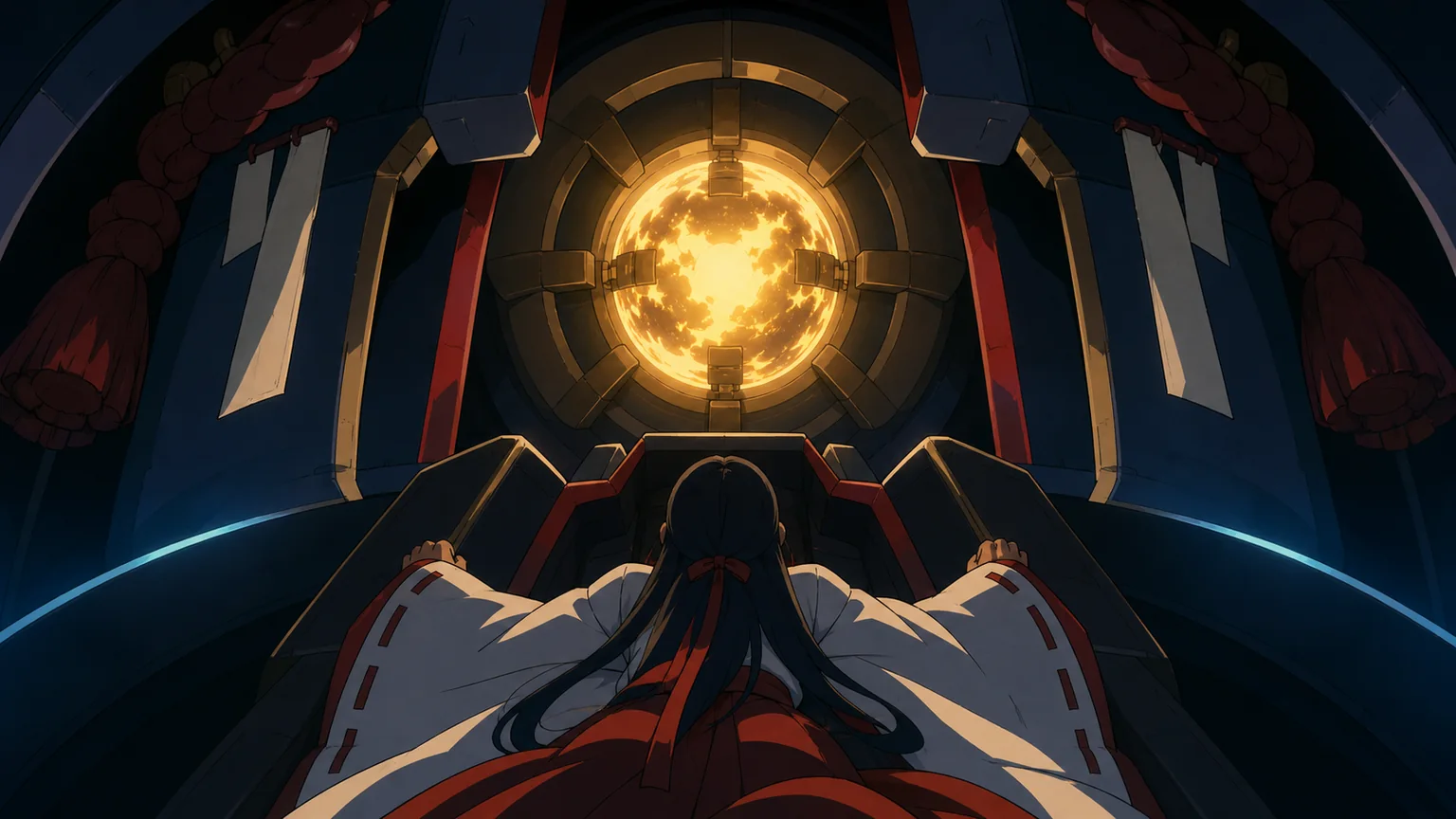
The Frame is no suit of armor. It is a coffin — a coffin to lay a god in. I do not step into it the way you don a suit of armor; I lie down into it, back pressed flat, the way a dead man lies down in his coffin. The very center of the chest, the deepest seat of all — the seat nearest the heart, the most helpless seat. That is my place. The miko's place. The place of one whose hands can soothe a god.
Jingo enters above, into the seat that grips the limbs. We have never cared for each other. That ronin-bred man holds the miko to be lowly, and I think him an ignorant brute who knows nothing but the sword. And yet, when our hands come near inside the coffin, there is no room left to hate.
"Ready to soothe it." From above, he asks — though it is hardly a question, more nearly an order.
"As long as you don't fall behind," I shoot back. And then we both go silent. Say one more word, and the god wakes.
The god wakes within the cold steel. The innermost part — the place where my back rests — warms first. A handful of warmth soon becomes a furnace, and the furnace soon becomes a sea of fire. The god warms the human body, and the human, so as not to burn to death in that heat, cools himself one mouthful at a time. At the first ignition I carve it into my flesh for the first time: the god is hot, and I must go cold. The moment I stop going cold, the giant stops too.
One heartbeat. Two.
And then the giant stands.
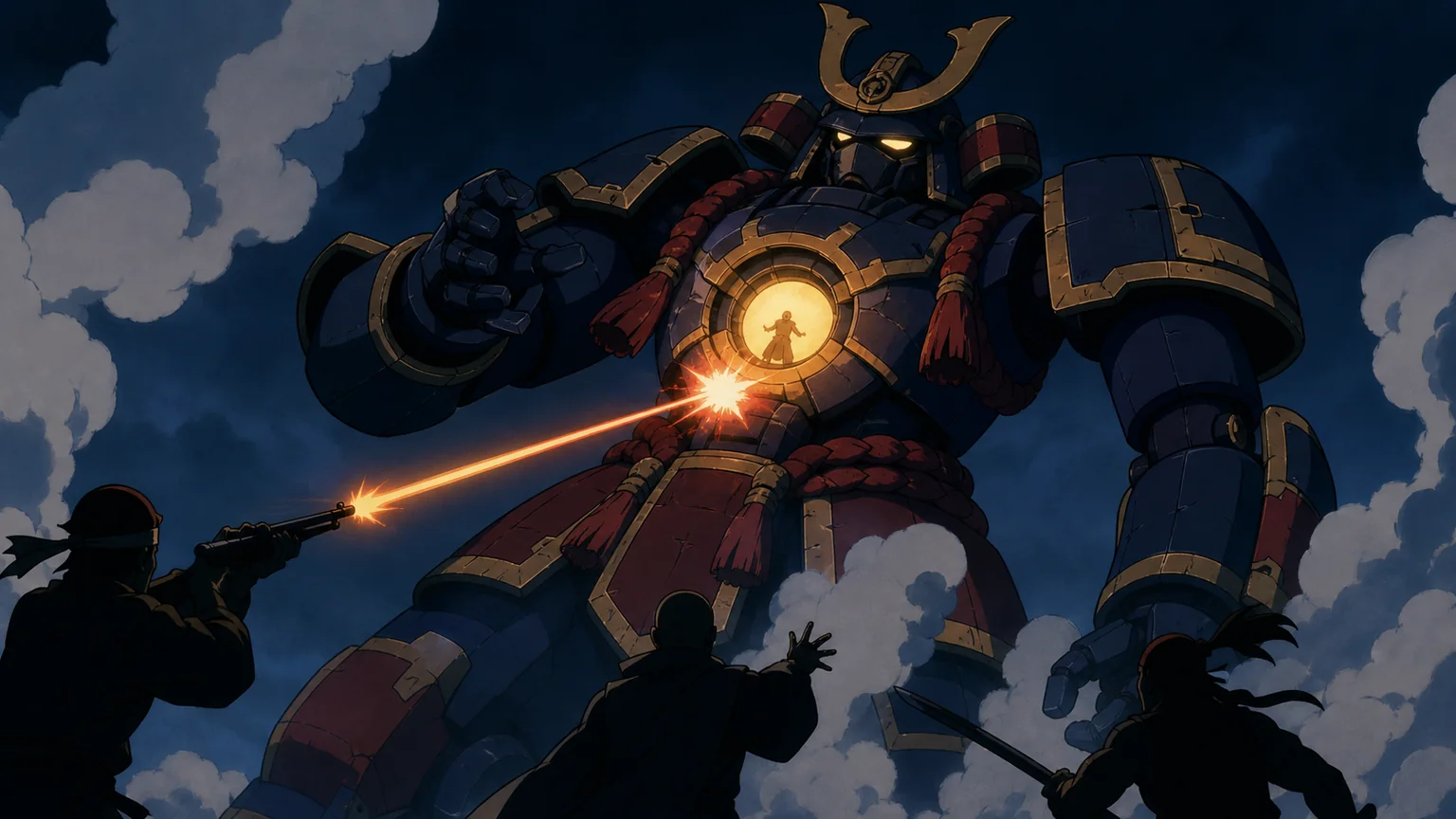
The earth's axis groans. One full beat just to straighten the knees, another beat to set the waist upright. We are sluggish — yet sluggish as we are, we blot out the sky. The footsoldiers underfoot are swallowed by our shadow, and only then do they raise their heads. The blood drains from their faces. Samurai, shinobi, teppo gunner alike — every one of them, for an instant, forgets his blade.
I watch those faces. From the very spot where we have admitted we lost, the god we called rises to its feet.
In an advance, there is time between one step and the next.
The enemy can fill that gap. He can fill it — and still, in the end, that one step crushes everything.
A company of the enemy levels its arrows at us. I watch the man draw his bow. The string meeting his cheek, the tremble in his fingers, even the fear that lives in that tremble — all of it, I see. By the time Jingo lifts the steel arm, the arrows are already in flight. We were late.
Late, we crushed him.
The steel fist comes down, a beat behind, upon the spot where the arrows struck. A single stamp, too vast to be refined. There is no finesse. No deft trick of cutting and cleaving. Only weight, falling from above to below. A handful of infantry cannot even reach us — their spear-points snap against the steel shin, their swords leave not a single scratch.
The most fearsome thing is that the enemy knows it.
The enemy knows we are slow. He knows he can count to three before one of our steps lands. Knowing it, still he cannot fill that single beat. Flee, and he is too late; block, and he is too late. We are the late ones — yet it is they who tremble before the fact of our lateness. Nothing is more fearsome than a death seen in full.
I reach upward and pour drive into Jingo's motion. I soothe the god, and I cool myself one more mouthful for the next step. One company vanishes, then another crumbles. We advance at the pace of a mountain walking, but with the weight of a mountain falling.
"Too late," Jingo says through clenched teeth.
"And we crushed it anyway," I answer.
This is how we borrowed a god. Not fast. Not clever either. Only — it does not stop.
And then, from beyond the mist, it rises.
A giant, and a thing like a giant.
A vast yoma, mist draped over it like armor. I do not know its name. There is no need to. It is as large as we are, as slow as we are, as heavy as we are. When it takes a single step, the whole field we have trampled tilts bodily. For the first time, our shadow is swallowed by another shadow.
This is no free victory. This is a true collision.
It raises an arm. The mist clots into a blade. I watch the arc of its descent — all of it. Seeing all of it, still we are late. As Jingo's steel arm rises to meet it, the blade of mist has already torn open our shoulder. A metal shriek like a giant's scream. The sound of a mountain falling in a single round.
And at the field's edge, another threat rings out. A teppo squad.
They do not aim for our armor. The very center of the chest, the deepest seat of all — they aim for the heart. They know: stop the giant's heart, and the giant stops. And I know it better than they do.
The heart is me.
That they aim for the heart means they aim for me. The steel may bear their shot, but a round that bores through that armor bites into the steel. Each time a shot strikes the chest, I feel the god shudder at my back. When the god shudders, the giant staggers. When the giant staggers, Jingo's next step falls later still.
"Suzu!" Jingo cries. For the first time, he calls my name. "Can you hold!"
The god is hot. I have already gone too cold; my fingertips are chilled. But one mouthful is left.
"Once is enough," I say. "Just once — don't fall behind."
The yoma raises its arm again. The longest windup. The greatest single blow. It means to end us. The mist veils the sky.
We too need a beat. A fist that comes only once does not come from a mere swing. You must empty a whole breath, and gather every degree of heat you have been cooling into the very center of the chest. I offer the god everything that remains, down to the last mouthful. At the very center of the giant's chest, the furnace becomes a sea of fire, and the sea of fire becomes a star. For one beat, we do nothing at all but fill. Jingo's hand and my hand — become, at last, one body. With no room to hate, and no room to hesitate.
And I, drawing up every last breath I have, give that single blow a name. A form without a name is no technique — only a habit. Call the name, and that one stroke shows itself — if it is a name worthy of a god's name, a name by which heaven comes crashing down.
"── Tenpō-Tekken (天崩鐵拳)!"
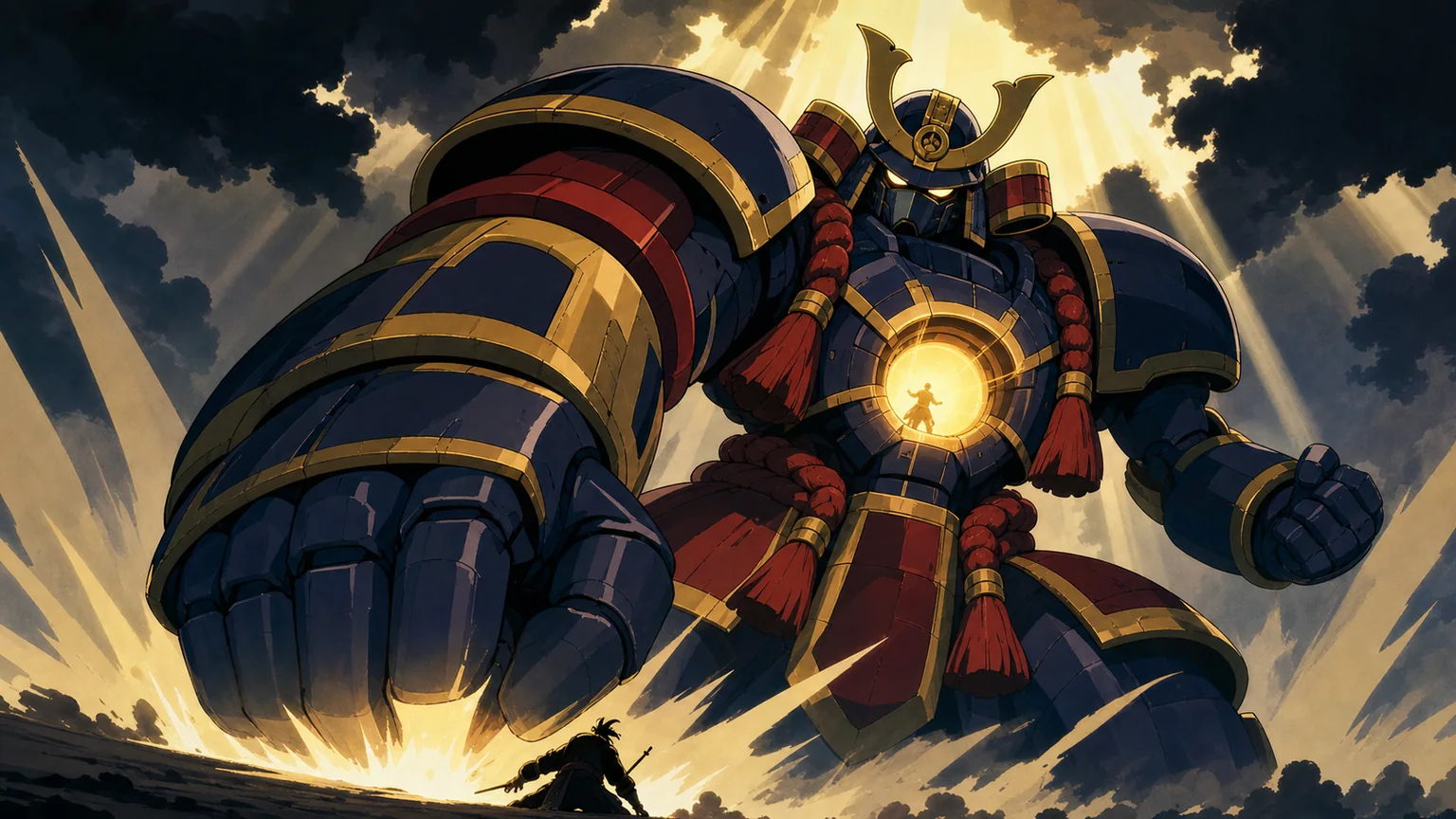
Jingo cries it out too, at the top of his lungs. The instant two lives call one name, the whole of the sky rides on the giant's fist.
Watching the yoma's blade come down in full, beneath it — a beat late — the steel fist drives in. Seeing all of it, we were late; and late, we crushed it. A fist that, once swung, can never be swung again bores upward through the chest of the mist. Every degree of heat we had gathered pours into that one point — and empties. My whole field of sight floods with white light.
The sound of a mountain falling does not, this time, come from our side.
The mist scatters. The thing that had been like a giant kneels before the giant. And slowly, it falls.
The giant cools.
The chest that had become a star sinks back to a sea of fire, to a furnace, to a handful of warmth. The steel turns cold again. Back still pressed flat, I soothe the god to the very last. Well fought, I tell it; now lie down. The god lies down obediently — as it came, into the coffin.
The chest opens, and we climb down from the giant. Jingo descends first and holds out a hand. I take it. His fingertips are still cold. The price of cooling the god by offering myself, one mouthful at a time, with every breath. It is no tragedy. It is the price paid. The god is hot, and I go cold one mouthful at a time — because I lay down in this place knowing it.
"Miko," Jingo says. And then, for the first time, he hesitates. "── You weren't late. Not at the end."
I laugh. It is not that he wasn't late. We were always late, and only won while late. But I do not correct him.
"Had you been a single beat faster, there'd have been no need to call a god at all."
"Next time," he says. That is all. We still do not care for each other. Only — we raised one god, one time. That much is enough; for today, it is done.
Borrowed power must be repaid. Cage a god in steel, and the steel grows to resemble the god — heavy, slow, unable to stop. And one who borrows a god borrows the god's will along with it. I have paid that price with every breath, and I will go on paying it.
Leaving the cooled giant at our backs, we walk.
This one step goes not on legs of steel but on my own two legs. Cold, but mine.
(End)