#Heian / Genji / Heike Masterwork Blades
Contents
Canon (fc05 internal new) + Fiction-Only. This document treats the masterworks listed in
co-07-02as links, while presenting volume-only new data for the unlisted Heian blade (Usumidori). Heian warriors fought differently from later samurai — the context of cavalry, mounted archery, and court authority is maintained.
#Opening Fragment — The Sound of a Blade at Court
On a Heian night, nobles did not draw their swords. The sword sat inside a display cabinet, and before the cabinet stood an incense burner. Yet when someone spoke the name Higekiri aloud, the candle flame in the room wavered once.
"Did you hear a sound just now?" a young handmaiden whispered.
The old noble laughed. "The sound of a blade does not come only from the scabbard. When a name grows old, the name too rings like metal."
Outside, rain fell, and far off the hoofbeats of warrior houses could be heard. The politics of the capital still moved by the brush, yet the names of the blades had already entered the room.
"Did those blades truly cut down yoma?" the handmaiden asked.
The old noble added a little more incense. "What matters is not so much what was cut, but what the one who heard the name came to fear. The blades of the Genji and the Heike cut the breath of an age before they cut any man."
When those words ended, a very faint metallic note rang from deep inside the cabinet. No one opened it to look.
#§ Scent — Four Centuries of Lore
Four centuries, from the 794 transfer of the capital to Heian-kyo to Dan-no-ura in 1185. Upon that span the blades of one house earned their names, one house fell, and as one house departed — those blades were scattered.
The Genji (Minamoto) and the Heike (Taira). Which house a single blade attaches to changes the tales told of that blade. Even a blade by the same smith of the same era cuts down oni in Genji hands, yet is enshrined at a shrine in Heike hands.
This chapter gathers the blades of Heian. They may reappear in the hands of later Muromachi and Sengoku swordsmen, but the weight of the name rests on Heian.
#§ Law — Blades of the Genji
#Higekiri (髭切) · Hizamaru (膝丸) — A Pair
| Item | Value |
|---|---|
| Original data | co-07-02 § Higekiri · § Hizamaru |
| Smith | A pair by the same smith (lore). In the cutting test, one blade cut through the beard, the other through the knee. |
| Heian-era tale | The Shuten-doji subjugation and the Rashomon incident of Yorimitsu and the Four Heavenly Kings. Watanabe no Tsuna severs the arm of Ibaraki-doji with Higekiri. |
| Post-Heian tale | Passed to Minamoto no Yoritomo in the Kamakura period. A shogunate treasure. Partly lost after Dan-no-ura. |
| Use in this volume | The two blades need not always appear as a pair. The effect when paired is GM discretion (box below). |
GM box — When the two are a pair (optional) : When a PC holding a Nito-ryu license equips both blades at once, after using one weapon's masterwork technique, the other weapon's masterwork technique Energy is -1 on the next breath. Both masterwork techniques follow § round-N counter independence. However, the single-breath Energy cap still applies as is.
#Usumidori (薄綠) — Yoshitsune's Blade [New]
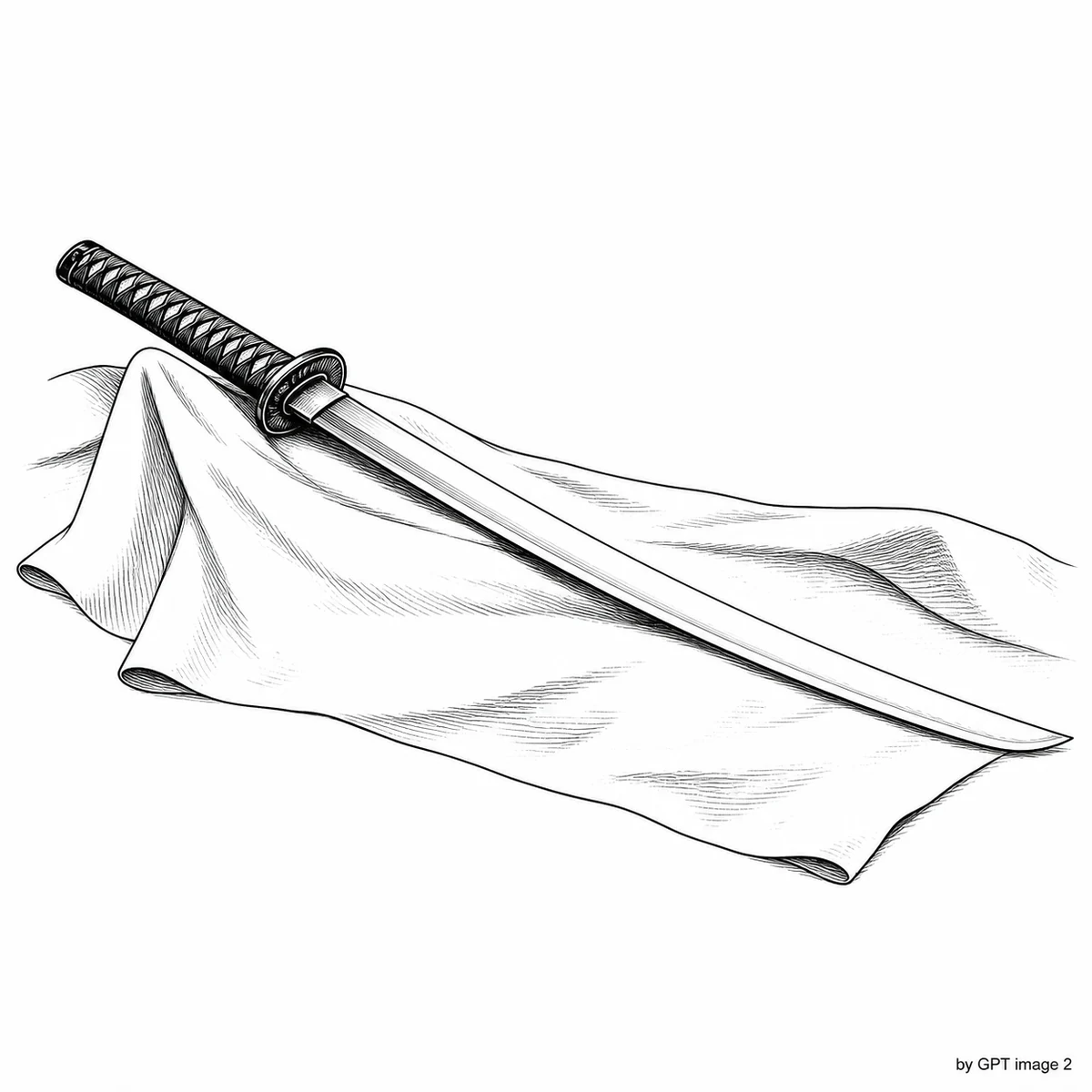
Canon — fc05 internal only. This entry is new data for this volume. Usumidori appears in some lore as a variant name for Hizamaru, but this volume treats it as a separate blade that split off under a new name at Yoshitsune's time. The data is separated because listing one blade under two entries at once would create contradictions in scenarios.
#Scent — The Blade That Goes to Dan-no-ura
When Yoshitsune met Musashibo Benkei at Horikawa, he took up Hizamaru. That blade was a token of recognition from his brother Yoritomo. But as Yoshitsune went all the way to Dan-no-ura in the pursuit of the Heike, that blade — changed. The blue of the edge is said to have faded. A pale green. People feared it — and began to call the blade Usumidori (薄綠).
While Yoshitsune fled the path after earning his brother's hatred, Usumidori once refused to come out of its scabbard. Only after Yoshitsune begged it to look upon its edge — could he drive one hand into the enemy's neck. The clearest example of a Heian blade refusing its master.
#Law — Tachi Base + Masterwork Technique
Base technique: Same as the tachi.
| Technique | Type | Energy | Check | Effect | Limit |
|---|---|---|---|---|---|
| [Masterwork] Breath of Dan-no-ura (壇ノ浦の息) | Kata | 3 | 2d10+Courage+Swordsmanship+2 >= Defense | 2 Wounds. If your own Wounds are 3 or less, +1 Wound. If the enemy's Wounds are 2 or less, Critical Hit range +1. "Only the one who followed to the end knows." | round 1 |
Blessing [aptitude]: +2 to escape and pursuit checks while equipped.
Curse [aptitude]: The blade tests its master — when your own Wounds are 2 or less, roll d100 when using a masterwork technique. On 01–10 the blade does not come out of the scabbard that breath (Energy is spent only, no effect). With recognition from Yoshitsune's direct line, eased to d100 01–03.
Ownership condition: Minamoto direct line, or the secret-transmission heir of the direct line. Vibrates near Heike remnants.
Acquisition scenario: A reward option of the Minamoto specter incident in co-09-09-minamoto-specter.md. Or the Yoshitsune heroic-spirit scenario reward in the co-04-08-22-heroic-spirit-catalog.md heroic spirit catalog.
#Dojigiri Yasutsuna — Yorimitsu's Blade
| Item | Value |
|---|---|
| Original data | co-07-02 |
| Heian tale | Yorimitsu severed the head of Shuten-doji with a single stroke. The decisive blow of the fc04-04-01-shutendoji.md subjugation tale. |
| Use in this volume | In Heian scenarios it appears together with the Yorimitsu sheet. In the later Muromachi and Sengoku, the Minamoto house keeps it as a treasure — it has almost no users. |
| Consistency note | Cross-reference with the Tenka Goken entry in this volume's fc05-02-02-tenka-goken.md. This blade is a masterwork, not a Divine Artifact — the tale of cutting down Shuten-doji is powerful, but its origin is not divine. |
#Raimei (雷鳴) — Yorimasa's Bow
| Item | Value |
|---|---|
| Original data | co-07-02 |
| Heian tale | Yorimasa shot down the nue. The nue is a bizarre yoma with the head of a monkey, the body of a tanuki, and the tail of a snake. It is said to have cried above the emperor's sleeping chamber. |
| Use in this volume | A late reward for a Heian yabusame samurai PC. Together with the yabusame variant rules of fc04-05-01-samurai.md. |
#Nasu no Yoichi's Bow
| Item | Value |
|---|---|
| Original data | co-07-02 |
| Heian tale | At Dan-no-ura, struck a fan atop a ship. A single arrow answering the Heike taunt — waving a small fan and saying "strike it if you can." |
| Use in this volume | The trump card of a precision-shooting scenario. The effect that destroys/seizes 1 piece of equipment is decisive when aiming at an enemy's masterwork. |
#§ Law — Blades of the Heike
#Kogarasumaru (小烏丸)
| Item | Value |
|---|---|
| Original data | co-07-02 |
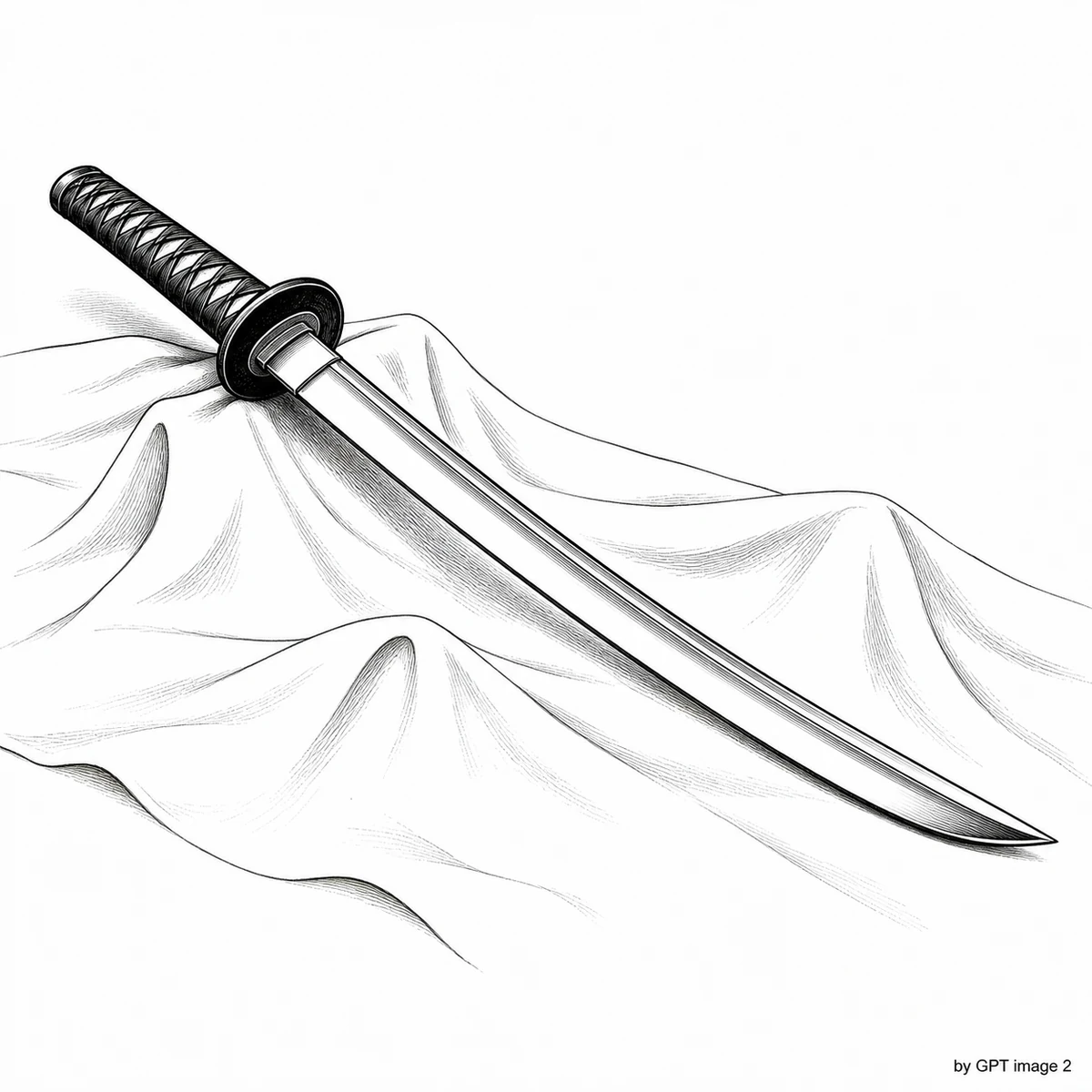
| Heian tale | A treasure blade enshrined at Ise Shrine and then bestowed upon the Heike house. Spine and edge are of one piece (double-edged 兩刃) — a strange form. Rumor that a crow's cry sounds from it. |
| Dan-no-ura | When the Heike child emperor sank together at Dan-no-ura, the account that Kogarasumaru vanished with him and the account that one Heike straggler fled carrying it both stand. |
| Use in this volume | The core prop of a Heike specter scenario. When a PC recovers it — whether to send it to enshrinement or to use it is put to the test. |
| Consistency note | A PC who grips Kogarasumaru comes to hear the crow's cry (aptitude). If they do not hear it, the edge does not respond. This is RP not stated in the source data — separated into an optional box. |
GM box — The crow's cry (optional): The bearer of Kogarasumaru makes a Presence check at the start of each scenario (Target Number 13, Hard). On failure, the Energy cost of the masterwork technique [double-edged] is +1 for that scenario. A single crow cries at a fixed hour — miss that hour and the blade does not respond.
#Kogarasumaru's Brethren — The Kogarasu-zukuri Blade School
Blades forged in the same double-edged (兩刃) form as Kogarasumaru were in vogue for a time in the late Heian period. These are called Kogarasu-zukuri (小烏造) and seen as one branch of a blade school. Connects to the smith school entry of fc05-05-03-smithing-schools.md.
The blades of the Kogarasu-zukuri school are all double-edged — they cut with the spine too. But unlike the Kogarasumaru itself, they have no crow's-cry effect. They can be forged as masterworks, yet a single masterwork blade (Kogarasumaru) and a blade school (Kogarasu-zukuri) are separate things.
#§ Law — The Relationship of Heian Warriors and Weapons
#The Tactics of the Heian Samurai
The Heian warrior stands on the premise of the yabusame samurai variant of fc04-05-01-samurai.md. They differ from later samurai in the following points.
| Axis | Heian (yabusame) | Later (Sengoku / Edo) |
|---|---|---|
| Main weapon | Bow and horse | katana |
| Auxiliary | katana / tachi | wakizashi / spear |
| Tactics | Mounted archer — shoots from range | Infantry swordsmanship — cuts in from range |
| Armor | O-yoroi (大鎧) — in use | Tosei-gusoku — for infantry |
| Meaning of masterwork blades | Both bow and blade — Raimei and Nasu no Yoichi are bow masterworks | Blade-centered |
Handling in this volume: In Heian scenarios, treat the weight of masterwork bows (Raimei, Nasu no Yoichi's bow) as equal to masterwork swords. Do not treat bow masterworks as "bonus weapons."
#Musashibo Benkei's Staff
co-07-02 § Benkei no Bo is the staff of an unnamed late-Heian warrior monk. The lore that Benkei himself wielded it is a later addition, but this volume accepts that addition too as part of the tale. In scenarios it suits as a reward for a warrior-monk / superhuman-strength PC.
#Does the Katana Suit Heian?
The main weapon of the Heian warrior is the bow, but the katana / tachi were used in ceremony, close combat, and court escort. Therefore the sword masterworks above appearing in Heian does not violate era consistency. However, the uchigatana (打刀) is a later style — a form that does not appear in Heian. When using a masterwork uchigatana (Muramasa, etc.) in a Heian scenario, convert it to tachi form for use (GM discretion).
#§ Law — How to Use Heian Scenarios
#The Rashomon Incident — Higekiri
When compressing the Rashomon / Ibaraki-doji incident of fc04-04-02-tsuchigumo-rashomon.md into a scenario for this volume.
- Tool: Higekiri. The blade vibrates and guides the way.
- Incident: The arm of Ibaraki-doji reappears at Rashomon (or its remnant preys on people).
- PC qualification: A descendant of Watanabe no Tsuna or the recognition of the Minamoto direct line.
- Climax: Cut the severed arm again and enshrine it. If it is not cut, the scenario passes to the next PC's hands.
#Shuten-doji Subjugation — Dojigiri Yasutsuna + Shinben-kidokushu
Compress fc04-04-01-shutendoji.md and fc04-03-02-yorimitsu.md into this volume.
- Tool: Dojigiri Yasutsuna + Shinben-kidokushu (consumable).
- Incident: The remnant of Shuten-doji (or his own shadow) revives.
- PC qualification: A 5-person squad (the Yorimitsu + Four Heavenly Kings motif).
- Climax: Offer the sake → call the true name → single stroke.
#Dan-no-ura — The Whereabouts of Kogarasumaru
- Tool: Kogarasumaru (unrecovered).
- Incident: A Heike specter rises from the seafloor of Dan-no-ura. The remnant of the child emperor.
- PC qualification: Anyone — but whoever recovers the blade must decide between enshrinement and use.
- Climax: Enshrinement → the scenario reward is fame and a blessing. Decision to use → the blade tests its master.
#Reference Links
- Masterwork Compendium
- The Minamoto Specter
- Heroic Spirit Catalog
- Yorimitsu and the Four Heavenly Kings
- Shuten-doji
- Rashomon / Tsuchigumo
- Yabusame Samurai
- Tenka Goken
- Smith Schools
An old blade harbors a song before it harbors rust.