#Curses, Blessings, and Devotions
Contents
Reference Only + Data Catalog. This document is a guide for safely designing the curse and blessing data of masterworks and the devotion data of Divine Artifacts. It prioritizes the values and structure of the main text's
co-07-02 § Masterworksandco-07-03 § Devotion Techniques— this volume adds writing principles and a catalog on top of them.
A curse is not a penalty but a mechanic of choice. The most important principle of this document. If a curse automatically strips the PC of their basic right to act, that is a rule defect, not a scenario.
#Fiction Intro — The Voice of the Price
The swordsman won every battle, and in every battle he lost something. First it was blood, then sleep, and last it was the voice of his dead son.
"Father." A small voice came from inside the scabbard. "Whom did you cut down today?"
The swordsman set down his sake cup. "You are dead. Your voice cannot be here."
The sword said nothing. But in the next battle that voice was heard again. Before the cut it dissuaded, after the cut it wept. The more he won, the clearer the voice became.
A companion asked. "That sword — can you not throw it away?"
The swordsman looked at the hilt. "If I throw it away, will this voice also vanish? Or is it that I forget my son at last?"
A curse is not only ruin. Some curses keep making one hear a promise the owner never repaid. So they cling longer than a blessing, and cut deeper than a devotion.
#§ Scent — What the Sword Takes Away
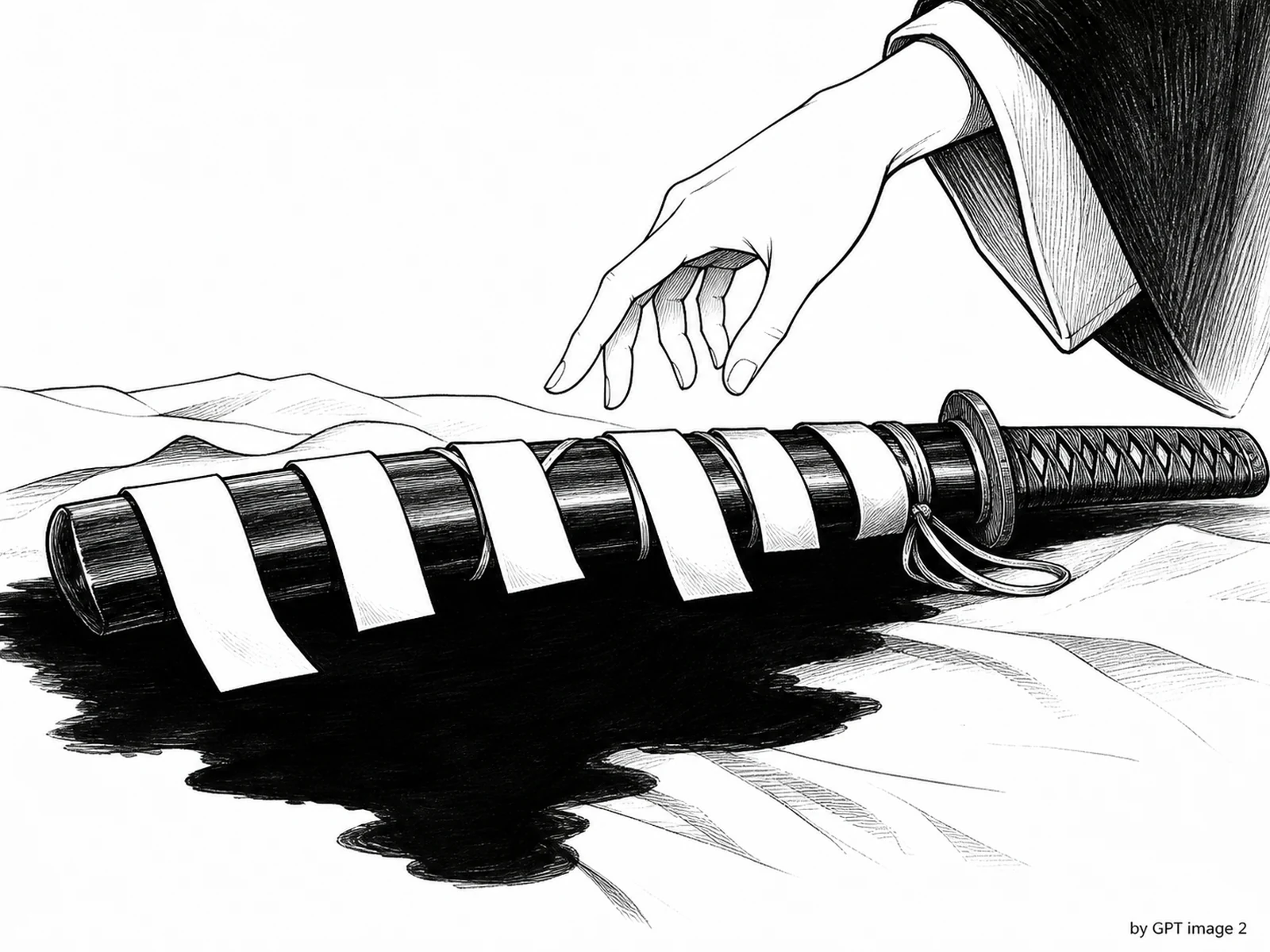
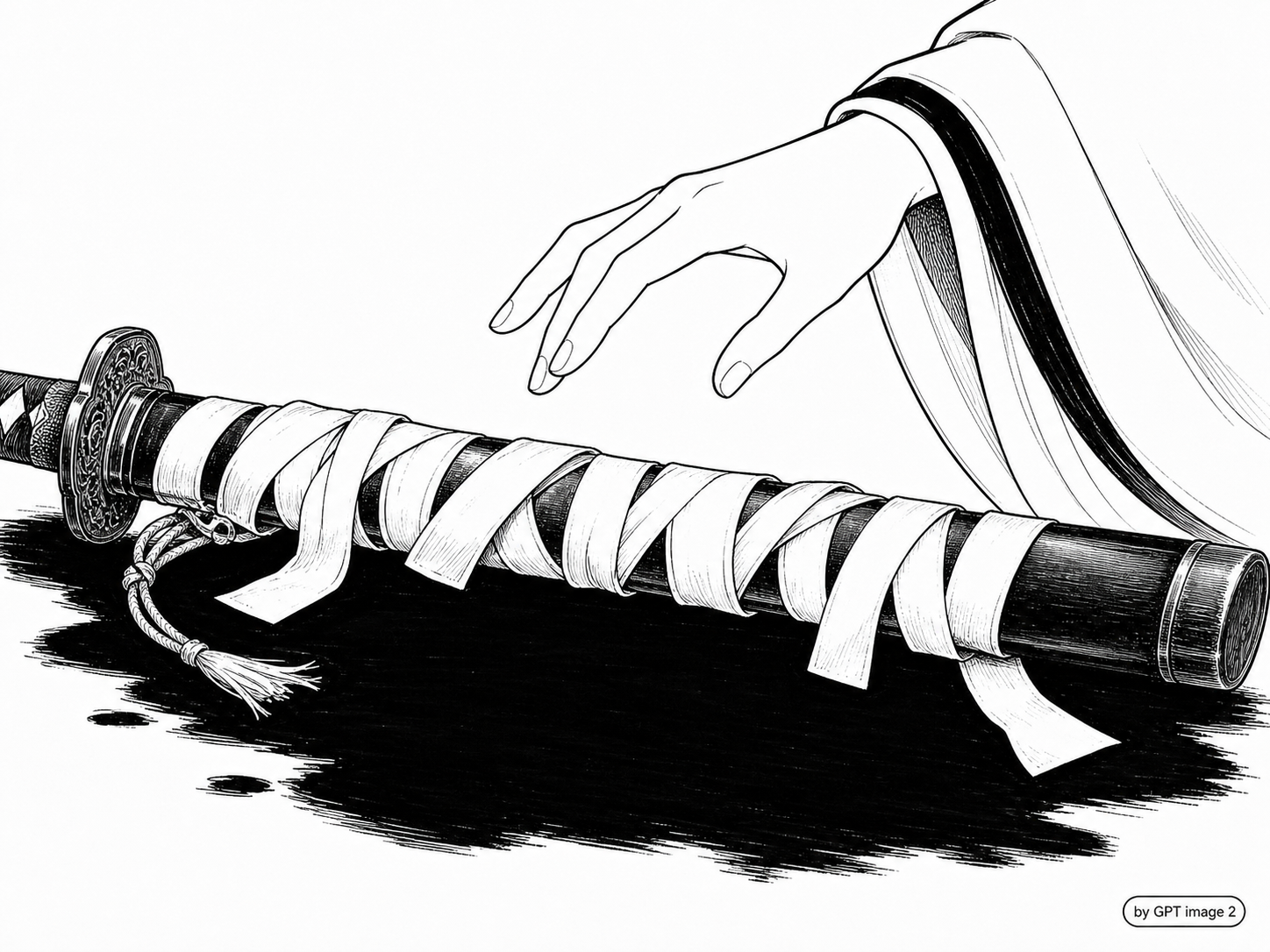
A sword is not swung for nothing. When a famous blade cuts a person down — the sword takes something of the one cut. A soul, a name, a span of time, or an anger. When the sword takes it, the one who swung the sword also loses something together. What is lost — is the curse.
A curse is not punishment. It is a transaction. As much as the sword takes, the sword lends its own power; and as much as it lends, that hand gives something to the sword. When the transaction is balanced, the sword is stable. When the balance breaks — the sword begins to take more. Until it takes everything the hand holds.
This volume's curse design is about the ratio of that transaction.
#§ Law — The Seven Types of Curse
#1. The Call of Blood (血の召し)
The sword desires human blood. Each time it is swung, the user too loses a little of their own blood.
Example: Shinigami-no-kama (-1 Wound after each battle). Shuten-no-Sakazuki (turns into a ko-oni when incapacitated).
Writing: Self Wounds -X at the end of each battle or roll d100 when self Wounds are N or less. When the writer uses this curse — place a seat where the PC can recover within the scenario (a lull, a shrine, a healing NPC, etc.).
#2. Casting Off the Owner (主の棄て)
The sword refuses its owner. The weapon does not come out of the hilt, or the masterwork technique does not activate.
Example: Usumidori (a d100 refusal when Wounds are 2 or less). Masterwork techniques cannot be used while placed atop the katana-kake.
Writing: On (condition), masterwork technique cost increases by N Energy or roll d100 on (condition). So that the refusal itself becomes the start of a scenario — specify the recovery procedure after the refusal.
#3. Killing Impulse (殺意の操り)
The sword decides one of the user's actions. A forced attack on the nearest enemy, or an outburst of murderous intent out of combat.
Example: Kanabo (a forced attack on the next round when d100 rolls 01-15 after use). Fudo-no-Ken (auto Critical Hit and forced target when Wounds are 2 or less).
Writing: The GM decides 1 action of one breath. The PC decides the PC's next action. Limit it to the unit of one breath so the killing impulse does not dominate the whole campaign.
#4. Responds Only to a Specific Enemy (敵限定發動)
The sword shows its true worth only against its own foe. It is ordinary against other opponents.
Example: Dojigiri Yasutsuna (full effect only against yoma). Raikiri (+effect against an enemy that made a lightning attack).
Writing: Make part of the masterwork technique's effect conditional. Not weakened against other opponents but — strengthened against this opponent. Present the same effect made to look different by two ways of phrasing.
#5. A House's Grudge (家の怨)
Ill fortune (凶) to one of a specific house, good fortune (吉) to that house's enemies. The most political curse.
Example: Muramasa (the Tokugawa house). The d100 system of §02-04 GM Box.
Writing: A house's grudge operates as a campaign's political mechanic. Activated only when one house appears within a scenario.
#6. A Sealed Name (封印名)
The sword's true name is sealed. If the user does not know the true name, a strong effect does not activate.
Example: §04-01 § The Release of the True Name (眞名). Usumidori (originally Hizamaru) — the true name of reversion.
Writing: When making an added effect not in the main-text data, locking it with a true name is safe. If the PC obtains the true name through a scenario, the effect opens.
#7. The Price After Victory (勝利の代價)
A price is paid right after winning a great victory with a masterwork technique.
Example: A rage rampage by d100 after using the Kanabo. Self Wounds -1 when using a masterwork technique.
Writing: An immediate price after using one masterwork technique. A degree where the price lasts until the next breath is appropriate. Avoid a price that ruins a whole scenario.
#§ Law — The Five Types of Blessing
#1. Opens Only in a Specific Scene (場面條件 開放)
A blessing that activates only in a specific environment or scene. In other scenes it is an ordinary weapon.
Example: Mugetsu (night/darkness only). Honno Naginata (shrine/Barrier only). The Rain Bow of Bizen (duel/rite only).
#2. Bearing the Owner's Weakness in Their Stead (代受弱)
The sword fills in the PC's weakness/deficiency in their stead. A case like the Kunitomo Prosthetic Eye of a PC who has lost one eye.
Example: Kunitomo Prosthetic Eye (one who has lost one eye). Sasa-no-yuki (physician PC). The Smith's Last Hammer (smith PC).
Writing: Convert the PC's identity/weakness into a point of reinforcement. Ordinary if a general PC holds it. A bonus such as Energy -1 on an identity match.
#3. Conversing with a Departed Spirit (亡靈會話)
The PC can converse with the spirit (靈) of the masterwork's previous owner. Obtaining information and advice.
Example: Kotetsu (an apparition of a future cut-down soul). Realm Wandering Relics in general.
Writing: A non-combat scenario reward. 1/scenario. The GM conveys information the PC could not know in the words of the departed spirit.
#4. The Smith's Last Teaching (刀工の教)
A teaching a smith engraved into the sword as he died. A once-only, miracle-like effect.
Example: The Smith's Last Hammer (the Last Strike). A Realm Wandering Relic with "this sword was not made in this era" engraved in one masterwork's technique slot.
Writing: A powerful, 1/scenario effect. Unusable in the next scenario (the next smith's rite is needed).
#5. A Once-Only Miracle (一度の奇跡)
A decisive effect 1/session or 1/campaign. Revival, turning back time, altering fate, and so on.
Example: Magatama (revival from incapacitation). Yasakani-no-Magatama (a devotion technique — full battlefield recovery). Tsuchimikado-no-Seiban (devotion — reroll all dice).
Writing: A campaign-climax reward. So that it is not used often, the sword rests for a while after one use (the next scenario's effect is weakened), and so on.
#§ Law — The Structure of Devotion (Divine Artifact Only)
#Devotion Is Not Used on a Masterwork
A devotion technique is a Divine Artifact's slot. If you add a devotion to a masterwork, that masterwork is elevated to a Divine Artifact. This volume does not elevate a masterwork to a Divine Artifact.
You want to use a devotion on a masterwork — then:
- Rewrite the data as a Divine Artifact. Divine Artifacts are the main text's
co-07-03domain. This volume has no authority to add Divine Artifacts. - Substitute with a weaker condition/quirk. It operates within the masterwork slot.
#Cautions When Writing a Divine Artifact Devotion
This volume does not create new Divine Artifacts, but cautions for when running a Divine Artifact devotion activation in a scenario:
| Item | Caution |
|---|---|
| Three Ways and Six Hearts match | Follow the table of co-07-03 § Devotion Techniques. Confirm the PC's current Three Ways and Six Hearts. |
| Heart Shift (心転) | If the Three Ways and Six Hearts change, the devotion cannot be used. A Heart Shift can become the decisive incident of a scenario. |
| 1/session | Devotion techniques are almost all 1/session. Their cost range differs from masterwork techniques (1 time per battle/round). |
| Energy 5-6 | Devotion is high-cost. Calculate in advance so it does not conflict with the one-breath Energy cap. |
#§ Law — The Paths of Easing a Curse
A scenario in which a PC who received a cursed weapon tries to ease or lift the curse. Five paths.
#1. Apology (謝罪)
Apologize to the one the sword hates. A Tokugawa PC holding a Muramasa apologizes at the Tokugawa house's grave.
| Cost | Effect |
|---|---|
| A Presence check 1 time per scenario (Target Number 13, Hard) | On success, the d100 range of curse activation is halved during the next scenario. |
#2. Dedication (奉納)
Dedicate it at a shrine or temple. The weapon cannot be used for a set period, but it is purified in that time.
| Cost | Effect |
|---|---|
| Dedicate the weapon for one season (3 scenarios) | After the season, the curse weakens by 1 stage (permanent). Possible 1 time per masterwork. |
#3. Re-Honing (再硏磨)
Commission a re-honing from a smith. As the blade's form changes minutely, part of the curse vanishes.
| Cost | Effect |
|---|---|
| A re-honing rite by a smith PC or NPC. 50 gold + 1 season | The curse eases. However, one aspect of the masterwork technique's effect may weaken (GM decision). |
#4. True-Name Restoration (眞名復元)
Find out the sealed name and engrave that name onto the sword again. After obtaining the true name through a scenario, a smith's rite.
| Cost | Effect |
|---|---|
| A true-name acquisition scenario + a smith's rite | The sealed name's effect opens. Part of the curse may also be lifted. |
#5. The Repair of a Smith's Heir (後繼者の修理)
An heir carrying on the original smith's school repairs the sword. If the smith is lost, a master of that school.
| Cost | Effect |
|---|---|
| A commission to a smith-heir NPC. One must know the original smith's true name and school. | The curse weakens by 1-2 stages. Cannot be applied to a Divine Artifact. |
#§ Law — Data-Writing Checklist
When writing a new masterwork's curse and blessing, the following checklist.
#Curse Check
- [ ] Is it a mechanic of choice rather than an automatic punishment? Can the PC choose each breath what to receive and what to give?
- [ ] Does it not continuously strip the PC's basic right to act (movement, basic attack, lull recovery)?
- [ ] Is there a path in the scenario to recover from the curse? (One or more of the five paths above)
- [ ] Have you not confused Energy and Wounds? The action-power cost is Energy; damage is Wounds.
- [ ] Does the curse not blockade the PC's class signature (a swordsman's swordsmanship, a shinobi's infiltration)?
#Blessing Check
- [ ] Does the always-applied bonus not exceed the average of the main text's masterworks? (Mostly +1-2)
- [ ] Does the blessing align with the PC's identity? Is it a tool of identity reinforcement?
- [ ] Does the blessing not imitate the effect of a Divine Artifact devotion slot?
- [ ] Does it automatically vanish if the weapon is thrown away or another weapon is held?
#Devotion Check (When Writing a Divine Artifact)
- [ ] Is the Three Ways and Six Hearts match table written out?
- [ ] Is the Energy cost 5-6? Can it be used within the one-breath Energy cap?
- [ ] Is it limited to 1/session?
- [ ] Is it clear to the PC that the devotion does not operate on a Heart Shift?
#§ Law — The Alignment of Target Number and Checks
When making an added check within a curse, blessing, or devotion, use the Target Number standard of the main text's co-03-03 § Target-Value Reference Table as is. This volume does not redefine that table — do not use even Target Numbers (12·14·16·18).
| Main-Text Difficulty | Target Number | This Volume's Suitable Use |
|---|---|---|
| Standard | 11 | An everyday rite — applying for dedication, the basics of weapon appraisal |
| Hard | 13 | Shrine dedication, apology, blade-sound appraisal, trail tracking |
| Very Hard | 15 | Owner-fitting, the first attempt at easing a curse |
| Extreme | 17 | True-name engraving, a Divine Artifact devotion qualification trial, a masterwork crafting rite |
| Impossible | 19 | The decision of a campaign-level incident — the dedication of the Tenka Goken alignment |
Below the standard 11 (5/7/9) is hardly used in this volume — smith rites and curse mechanics must all be challenging.
A curse's d100 roll is regarded as an added check. Separate from the masterwork technique's own attack check. So that d100 is not rolled twice within one breath — one d100 per one breath.
#Reference Links
- Checks and Saves
- Masterwork Compendium
- Divine Artifacts
- The Bond Between Weapon and Owner
- GM Masterwork Weapon Crafting Guide
- Smith Additional Traits
A curse is not only ruin but another name for a promise unrepaid.