#Sengoku / Edo Masterwork Blades
Contents
Canon (fc05 internal) + Fiction-Only. This document covers masterwork blades of the Sengoku period (1467–1603) and the Edo period (1603–1868). Listed entries are written as links, and unlisted entries as volume-only new data.
Foreign weapons are outside the scope of this document. It covers hybrid weapons as far as the late-shogunate Western sword (40-03-04), but pure foreign weapons such as the Joseon hwando, the Ming dao, and the Nanban breastplate are sent to the domain of
co-07-04-exotic-artifacts.mdandex2-45-foreign-relics.
#Opening Fragment — Blood and Dust
The Sengoku blade wiped away mud and blood. The Edo blade wiped away the dust of the tatami room. Wiped with the same cloth, but the scent left on the cloth differed.
A young swordsman asked. "Which blade is heavier? The blade that cut down many, or the blade that was never once drawn?"
The old man closed the scabbard. "The blade that killed makes a sound at night. The blade that could not kill makes a sound by day. Every time its master calls his own name."
"Does an undrawn blade hold a grudge too?"
"Memory more than grudge," the old man said. "The Sengoku blade remembers the one who survived, and the Edo blade remembers the one who endured. Which is heavier depends on what the master regrets."
That day the young swordsman learned that, more than how sharp the edge is, why it is still in the scabbard can become the more fearsome question.
#§ Scent — The Blades of Sengoku and Edo
The Sengoku period. The age in which the blade was swung the most. An age in which the number of people one warlord cut down in a lifetime crossed a thousand. The blade of that age — divides into two, the blade that does not break and the blade that cuts through. If the blade that does not break is Bizen Fine Work, the blade that cuts through is a masterwork like Masamune or Muramasa.
The Edo period. The age in which the blade was swung the least. The age of peace. Yet the masterworks did not vanish — they moved to the treasuries of daimyo houses, to the award ceremonies of swordsmanship dojos, to the waists of the Shinsengumi. When a blade is not swung — that blade's tales are organized, and a blade-analysis (刀解) is written. Half the masterwork data of this volume is the result of Edo-period blade-analysis.
#§ Law — The Blades of Sengoku Warlords
#Heshikiri Hasebe [New]
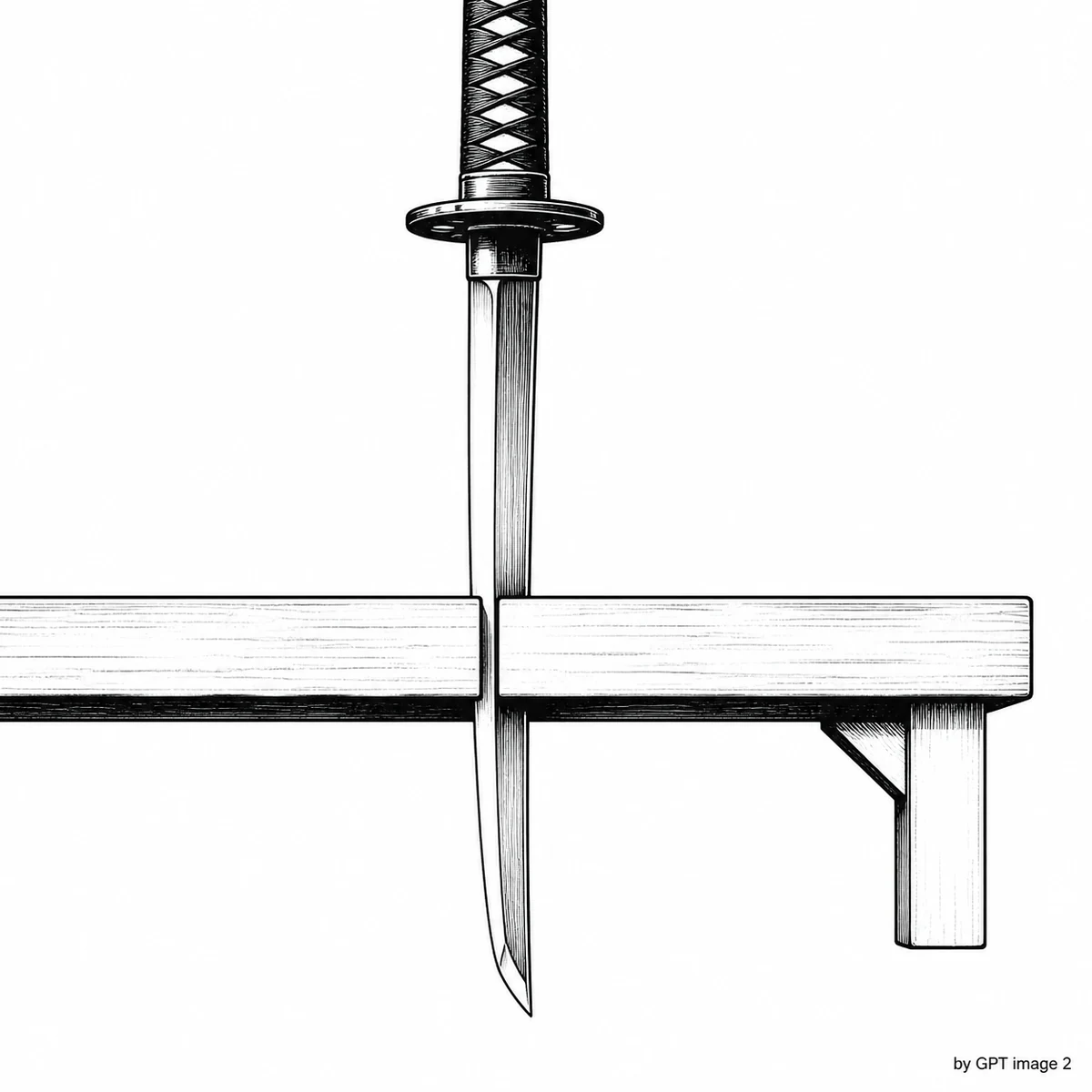
#Scent — Oda Nobunaga's Blade
It was in the hands of Oda Nobunaga. One day, a tea master (茶大将, a master of the tea ceremony) defied Nobunaga's command. Nobunaga — as the man fled beneath a table — cut him by pressing the blade down upon the table from above (oshikiri). As the blade cut through the table, it pierced the tea master's body in between. So the name is Heshikiri (押切, press-cut).
The smith is Hasebe (長谷部). The name divides into two parts — Heshikiri (the blade name) + Hasebe (the smith name). This volume notes both.
After Nobunaga's death this blade entered the Toyotomi house, and later entered the Kuroda house to be kept. One of the masterwork blades with the strongest cutting power.
#Law — Uchigatana Base + Masterwork Technique
Base technique: Same as the uchigatana.
| Technique | Type | Energy | Check | Effect | Limit |
|---|---|---|---|---|---|
| [Masterwork] Press-Cut (押切) | Kata | 4 | 2d10+Courage+Swordsmanship+2 >= Defense | 3 Wounds + [Pierce 2]. Cuts through cover or a light barricade as well — even if the target is behind cover, the masterwork technique reaches. | combat 1 |
Blessing [aptitude]: +2 to disarm checks while equipped.
Curse [aptitude]: Only the named answer. The masterwork technique triggers only when a PC who is class dan 5 or higher, or who has RP of daimyo / Nobunaga-house recognition, wields it. Otherwise only Energy is spent, no effect. "In the hand of the nameless, just a heavy blade."
Ownership condition: Class dan 5 or higher, or daimyo-grade recognition. RP of resolve. Toyotomi / Kuroda-house recognition, or the recovery of those houses' ruins.
Acquisition scenario: A daimyo-house treasury scenario. Or a reward of a Nobunaga campaign connected with fc02 (Sengoku Gazetteer).
#Raikiri / Chidori (雷切·千鳥) [New]
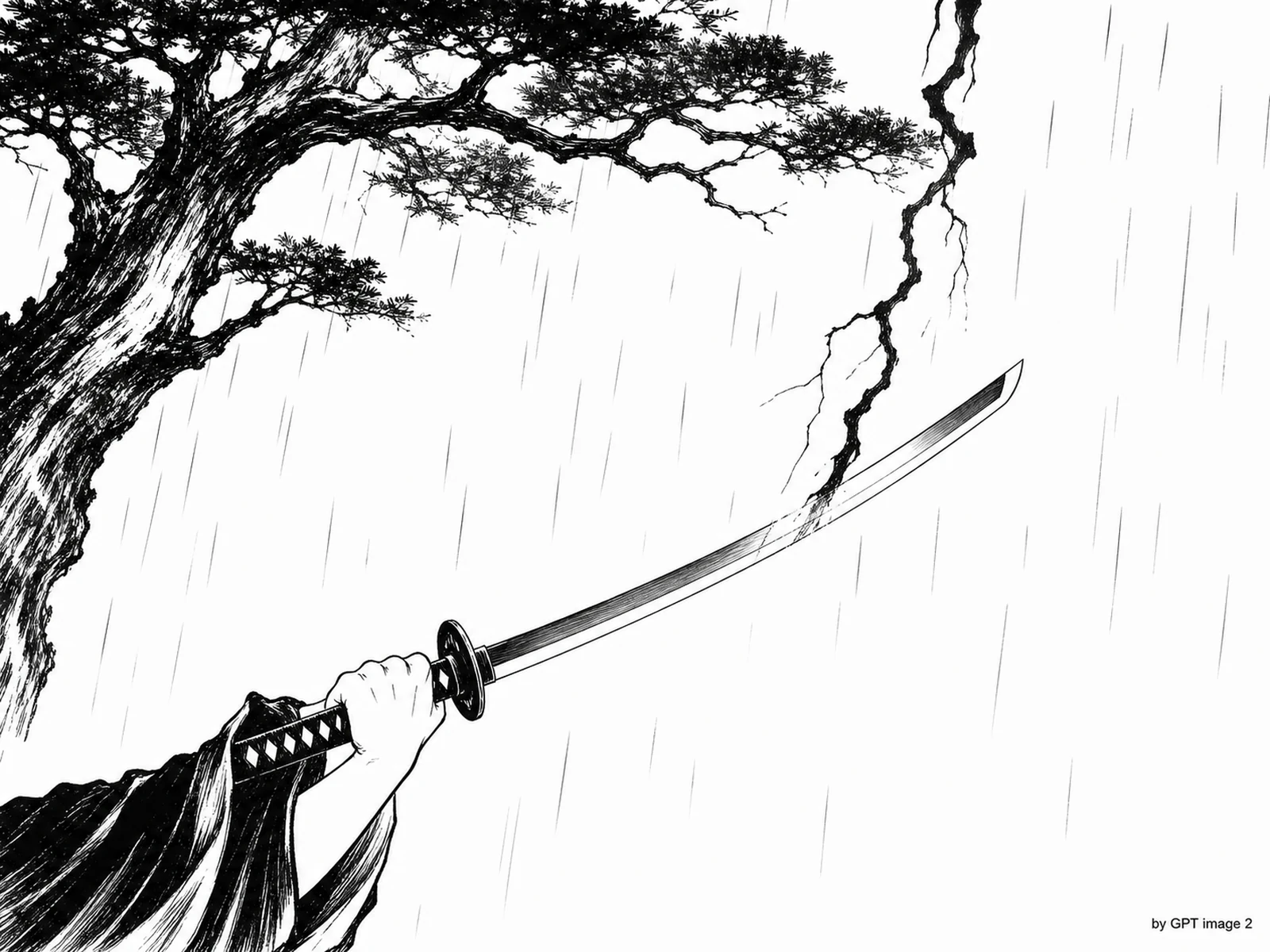
#Scent — Tachibana Dosetsu's Blade
Tachibana Dosetsu (立花道雪), a warlord of Chikuzen (筑前). Real name Bekki Akitsura (戸次鑑連). One day, he was sitting beneath a great tree in a heavy rain. Lightning struck that tree — Dosetsu instinctively drew his blade and cut the lightning. After that day, Dosetsu came to limp (the remnant of the lightning remained in his leg), but his blade earned the name Raikiri (雷切, lightning-cutter).
Its original name was Chidori (千鳥, a thousand birds). After it cut the lightning, Raikiri took that place. This volume notes both names together — "Raikiri / Chidori".
#Law — Uchigatana Base + Masterwork Technique
Base technique: Same as the uchigatana.
| Technique | Type | Energy | Check | Effect | Limit |
|---|---|---|---|---|---|
| [Masterwork] Thunder-Sever (雷斷) | Kata | 3 | 2d10+Courage+Swordsmanship+2 >= Defense | 2 Wounds. When it is the breath right after the target made a thunder (雷) / lightning-attribute attack, +2 Wounds + treat that attack as having been cut (for the next 1 round, that enemy cannot use a thunder attack). | round 1 |
Blessing [aptitude]: +2 to defense checks against thunder / lightning-attribute attacks while equipped.
Curse [aptitude]: Only one who has once been struck by lightning answers. The bearer needs RP of "an experience of having endured a single great shock (one blow of 4 Wounds or more)." Without that experience, the masterwork technique does not work.
Ownership condition: The Tachibana house or a descendant. RP of having endured a great shock.
Acquisition scenario: A Kyushu Tachibana-house scenario. Or appears as the reward of that experience after a PC endures a great shock.
#Muramasa — The Curse (凶) of the Tokugawa
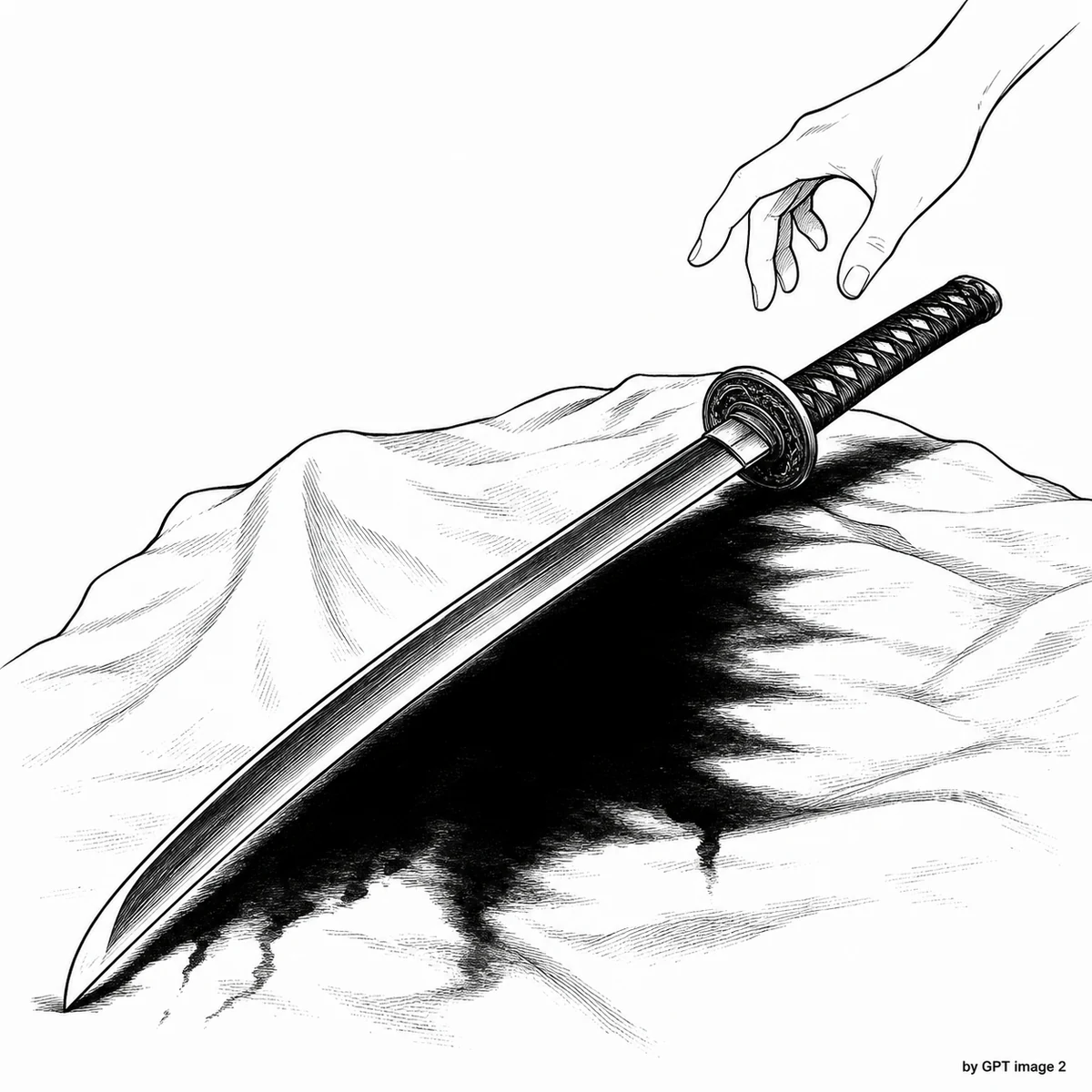
Follows the data of co-07-02 § Muramasa · ex2-40-03-01.
This volume's additional commentary:
| Tale | Point in time | Effect |
|---|---|---|
| Matsudaira Kiyoyasu, grandfather of Tokugawa Ieyasu, was cut by a Muramasa | 1535 | Misfortune (凶) for the house |
| Matsudaira Hirotada, father of Tokugawa Ieyasu, also self-harmed with a Muramasa | 1545 | Misfortune for the house |
| Ieyasu himself cut his own finger with a Muramasa | At some point | The rumor "Muramasa is misfortune for the Tokugawa" hardens |
These three gather and form the Tokugawa house's custom of shunning Muramasa. However, in the late shogunate part of the Shinsengumi deliberately took up Muramasa — the paradox that misfortune for the Tokugawa becomes fortune (吉) for the enemies of the Tokugawa.
GM box — A Tokugawa-house PC's Muramasa (optional): From the point a Tokugawa direct-line / descendant PC takes up a Muramasa, roll d100 at the start of each scenario. On 01–20, during that scenario an event occurs in which 1 of the PC's family / servant NPCs suffers a light injury (1 Wound of damage). Whom it targets is the GM's decision.
#The Takeda Red Spear
Follows the data of ex2-40-03-10. Its position in this volume is the Sengoku. A core prop of a Takeda-house Akazonae scenario.
The identity of the Akazonae (赤備え): the style of red armor and spears is inherited from the Takeda house → the Sanada house → the Ii house. When a PC takes up the red spear in this volume's scenario — membership in an Akazonae squad is automatically recognized, or it becomes the start of a squad-joining scenario.
#§ Law — The Blades of Edo Swordsmen
#A Jigen-ryu Master's Blade
Follows the data of ex2-40-03-05.
This volume's additional commentary: Jigen-ryu is the swordsmanship of the Satsuma domain — end it with the first strike. The Satsuma warriors of the late shogunate used this swordsmanship. In a late-shogunate scenario, a Jigen-ryu master's blade is a trump card. If a PC is of Satsuma origin and has a Jigen-ryu license, the matter is settled on the first breath.
#A Yagyu Shinkage-ryu Wooden Sword
Follows the data of ex2-40-03-06.
This volume's additional commentary: the philosophy of no killing. Able to cut, yet does not cut. After a swordsman like Yagyu Munenori became the swordsmanship master of the Tokugawa house, it is the philosophy that tested, in the age of peace, whether swordsmanship can become "a tool that does not cut people." A scenario in which a PC takes up this wooden sword and — chooses to spare the enemy.
#The Blades of the Shinsengumi
The masterwork blades used by the Shinsengumi (fc03-02-12-shinsengumi.md). This volume entrusts the main text on the Shinsengumi to fc03 and organizes only the weapons.
| Blade | User | Listed | Handling in this volume |
|---|---|---|---|
| Kotetsu (虎徹) | Kondo Isami | co-07-02 | A Realm Wandering Relic. Kondo himself does not know it is the work of a future smith. |
| Kanesada (兼定) | Hijikata Toshizo | co-07-02 § Kanesada Yari (same smith's school) | New: Kanesada katana — entry below. |
| Muramasa | Some Shinsengumi members | co-07-02 | Misfortune for the Tokugawa → used as fortune by the enemies of the Tokugawa. |
#Kanesada Katana (兼定 刀) [New]
#Scent — Hijikata's Katana
The beloved blade of Hijikata Toshizo, vice-commander of the Shinsengumi. Kanesada (兼定) is originally famed on both the sword and spear sides — this volume's co-07-02 § Kanesada Yari is the spear entry by the same smith. This entry is the katana. Two works by the same smith, yet different weapons.
Hijikata swung this katana all his life amid the storm of the late shogunate. It was in his hand in every duel of the Shinsengumi, and he wielded it in the last battle at Hakodate as well. After his death the whereabouts of the katana are lost — one candidate for a Realm Wandering Relic.
#Law — Uchigatana Base + Masterwork Technique
Base technique: Same as the uchigatana.
| Technique | Type | Energy | Check | Effect | Limit |
|---|---|---|---|---|---|
| [Masterwork] Sword-Spear Unity (劍槍一體) | Kata | 3 | 2d10+Courage+Swordsmanship+2 >= Defense | 2 Wounds. Within this breath, 1 Spearmanship technique can be used with the katana (the same PC must hold a Spearmanship license). | round 1 |
Compatibility with the Kanesada Yari: If the spear and the katana by the same smith are in one place, one PC freely switches between them (a PC with both sword and spear licenses). However, simultaneous equipping follows the Nito-ryu slot rules.
Blessing [aptitude]: -1 Energy for a PC with both sword and spear licenses (1 time per combat).
Curse [aptitude]: A boost limited to the late-shogunate era. When it appears in another era, masterwork-technique Energy is +1.
Ownership condition: Both sword and spear licenses. Or RP of Shinsengumi affinity.
#§ Law — The Late-Shogunate Western Sword and the Precision Matchlock
#The Late-Shogunate Western Sword
ex2-40-03-04 — late shogunate only. Within this volume's era range, the very last blade.
#The Precision Matchlock
ex2-40-03-14 — the precision matchlock of the Inatomi house. This volume connects it to the smith build — paired with fc05-05-03-smithing-schools.md § Inatomi school.
A masterwork by a firearms smith. An example of a masterwork that is not a blade.
#Shinnenju (信念銃)
co-07-02 — the teppo used by the peasant marksmen of the Ikko-ikki. This volume classifies it as a core prop of an Ikko-ikki scenario. A masterwork that is not a blade, shining together with a faith identity.
#§ Law — The Blade That Changes With Its Master
#Types of Transformation
One characteristic of the Sengoku / Edo masterwork blades: the blade changes with its master. Types of transformation:
| Type | Example | Effect |
|---|---|---|
| A blade that changes to fit its master | Usumidori (its color changes in Yoshitsune's hand) | The expression of the masterwork technique differs each time the master changes. The mechanic is the same. |
| A blade that chooses its master | Muramasa (misfortune for the Tokugawa, fortune for the enemies of the Tokugawa) | The effect divides into fortune or misfortune depending on the owner. |
| A blade that carries its curse along a house | The Tokugawa misfortune of the Muramasa lineage | A curse that applies to only one house. |
These three are made into rules as the relationship types of fc05-04-01-owner-bond.md.
#Handling in This Volume
This volume places a case in which a blade is transformed and earns a new name as a separate entry. Even a different name of the same blade has different data if the effect differs, so a different name means a different entry.
Example: Usumidori is a separate entry in §02-01. The lore that it is a transformation of Hizamaru is left as a tale only.
#Reference Links
- Masterwork Compendium
- ex2 Additional Masterworks
- Shinsengumi
- Swordsman Roster
- Exotic Artifacts
- The Relationship of Weapon and Master
- Smith Schools
The Sengoku blade remembers blood, and the Edo blade remembers silence.