#Kamakura / Muromachi Masterwork Blades
Contents
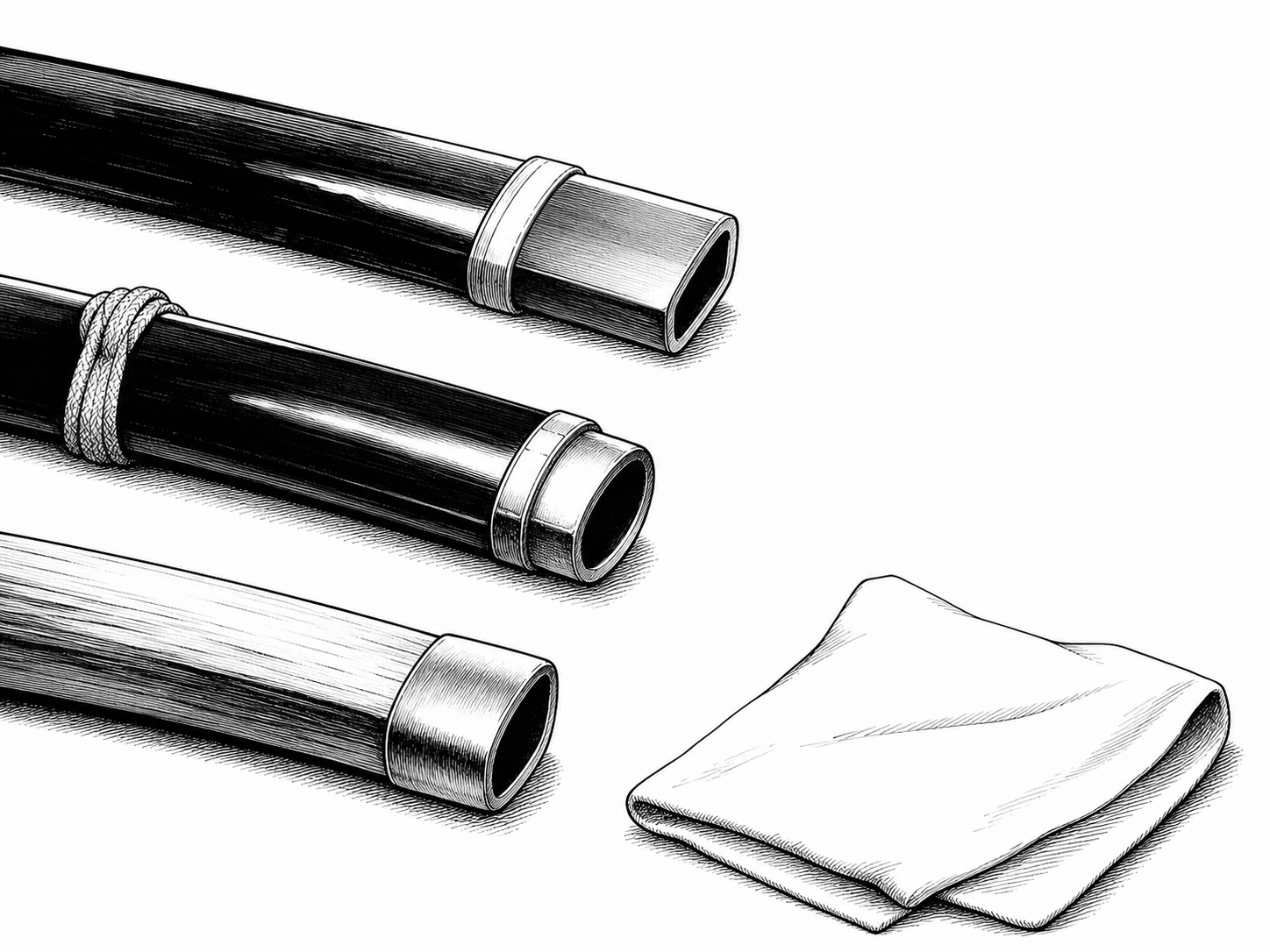
Canon (fc05 internal) + Fiction-Only. This document covers masterwork blades of the Kamakura (1185–1333) and Muromachi (1336–1573) periods. Listed entries are written as links, and unlisted entries as volume-only new data.
Masamune notation convention: "Masamune" is used for a smith name, a school name, and a blade name alike. This document separates them as follows — Goro Masamune (五郎正宗) = the smith name. Masamune school (正宗派) = that smith's school. Honjo Masamune / Fudo Masamune = the individual names of the blades he forged. In prose, always make clear which of the three a place written "Masamune" refers to.
#Opening Fragment — The Wave Pattern
The smith held the finished blade up to the sunlight. The apprentice saw the light of the edge, and the master saw the wave beneath it. Looking at the same blade, the two saw entirely different things.
"Will it cut well?" the apprentice asked.
The master did not laugh. "That is a question a warrior would ask. A smith asks something else first. Whose name can this wave endure?"
The apprentice looked at the pattern flowing along the spine. It was like water, like cloud, and like an old scar. "Is the pattern so important?"
"What cuts is the edge. But what remains long is the wave. War passes, the master dies, the records err. Even so, if someone sees this pattern and recalls the smith's age, the blade is still speaking."
That day the apprentice learned that a blade becomes a sentence before it becomes a weapon. The blades of Kamakura and Muromachi thus harbor the handwriting of their age.
#§ Scent — The Age of the Smith
When the Kamakura shogunate first established a warrior government, the Japanese blade made a single leap. Because warriors became the center of government — the warrior's blade was forged that much heavier. Goro Masamune, Awataguchi Yoshimitsu, Aoe Tsunetsugu. An age in which the name of one smith represents all the blades of an era.
Entering Muromachi, the schools harden. Soshu (相州), Yamashiro (山城), Yamato (大和), Bizen (備前), Mino (美濃). The five schools (Gokaden) become the basis for classifying smiths. The fact that one smith belongs to one school determines more than half the character of that smith's blade.
This volume's fc05-05-03-smithing-schools.md smith school entry is the rule form of these schools. The masterwork blades of this chapter all note which school they belong to.
#§ Law — The Masamune Lineage
#Goro Masamune (五郎正宗) — The Summit of the Smith
The summit of the Soshu school in the late Kamakura. His forging method became the standard of the Japanese blade. The blades he forged are praised in later ages as one axis of the Three Ancient Works (上古三作) (together with Mikazuki Munechika and Awataguchi Yoshimitsu).
This volume's Masamune-work masterwork blades:
| Blade | Listed | Handling in this volume |
|---|---|---|
| Masamune Severing Blade (絕刀) | ex2-40-03-02 | Link. A blessing for orthodox-faction action. |
| Honjo Masamune (本庄正宗) | New (this volume) | Entry below. |
| Fudo Masamune (不動正宗) | New (this volume) | Entry below. |
#Honjo Masamune (本庄正宗) [New]
#Scent — The Orthodoxy of the Smith
The most orthodox blade among Masamune's works. The lore that it was in the hands of Honjo Shigenaga (本庄繁長). Later presented to the Tokugawa house and kept as a Tokugawa house treasure. It was handed down to the late shogunate.
This blade is not showy. Its edge pattern is composed. Yet all the core of the Masamune school — the balance of the forging, the straight line of the edge, the lightness of the hilt — all of it is in this single blade. A smith who would master the Masamune school petitions the Tokugawa house once in their life to come see this blade.
#Law — Uchigatana Base + Masterwork Technique
Base technique: Same as the uchigatana.
| Technique | Type | Energy | Check | Effect | Limit |
|---|---|---|---|---|---|
| [Masterwork] True Work (正作) | Kata | 3 | 2d10+Courage+Swordsmanship+2 >= Defense | 2 Wounds. For this breath, the Critical Hit range of every check made with this weapon is +1 (other weapons do not apply). | round 1 |
Blessing [aptitude]: If a smith who studied under the Masamune school is in the same zone, the masterwork-technique Energy of allied swords in the same zone is -1.
Curse [aptitude]: None (a pure masterwork).
Ownership condition: Tokugawa-house recognition. Or access authority to the shogunate treasury. For a smith PC, a Masamune-school tutelage certificate.
Acquisition scenario: A Tokugawa-house treasury recovery scenario — since it is held in storage rather than enshrined, a political scenario of theft or dispatch.
#Fudo Masamune (不動正宗) [New]
#Scent — The Blade of Immovable Mind
The blade among Masamune's works in which a small standing statue of Fudo Myoo is carved into the hilt. It entered the Maeda house and became a family treasure. Together with the same house's Odenta Mitsuyo, it is one of the Maeda house's two treasure blades.
Having a standing statue of Fudo Myoo carved into it does not make it a Divine Artifact. It is a masterwork separate from the Divine Artifact Sword of Fudo (co-07-03 §14). Fudo Masamune is not the work of Myoo himself — it is a work that Masamune forged by carving the figure of Myoo. The blade is a tool of faith, not a tool of the divinity itself.
#Law — Uchigatana Base + Masterwork Technique
Base technique: Same as the uchigatana.
| Technique | Type | Energy | Check | Effect | Limit |
|---|---|---|---|---|---|
| [Masterwork] Immovable-Mind Strike (不動心一擊) | Kata | 3 | 2d10+Courage+Swordsmanship+2 >= Defense | 2 Wounds. If the bearer is in a fear or charm state, immediately dispel that state + an additional 1 Wound. | round 1 |
Blessing [aptitude]: While equipped, immune to fear. +3 to charm checks.
Curse [aptitude]: None. But if it is in the same place as the Divine Artifact Sword of Fudo — after using the masterwork technique, on the next breath there is the RP burden of courteously yielding to the bearer of the Sword of Fudo (GM discretion).
Ownership condition: Maeda-house direct line / recognition. RP of the will of immovable mind (one who is not swayed by fear or wrath).
#§ Law — The Awataguchi School
#Awataguchi Yoshimitsu (粟田口吉光) — The Summit of the Tanto
One axis of the Three Ancient Works. The smith judged the most perfect in the history of the Japanese blade for the making of the tanto. This volume's Yoshimitsu-work masterwork blades:
| Blade | Listed | Handling in this volume |
|---|---|---|
| Yoshimitsu (吉光) | co-07-02 | Link. A ninjato masterwork. |
| Yagen Toshiro (藥研藤四郎) | New (this volume) | Entry below. |
| Namazuo Toshiro (鯰尾藤四郎) | New (this volume) | Entry below. |
#Yagen Toshiro (藥研藤四郎) [New]
#Scent — The Dagger That Cut the Medicine Mortar
A dagger that was in the hands of Matsunaga Hisahide. At a certain scene of suicide, a warrior resolved to take his life and set the blade to his own belly. But the blade would not enter — the edge did not answer his will. In anger he threw the blade at the yagen (藥研, the vessel for grinding herbal medicine), and the blade cut the yagen in two. Seeing that, he is said to have given up his suicide.
The blade did not stop the suicide by its own will — the blade simply does not answer to deeds that do not suit it. Yagen Toshiro answers the resolve of the first strike. It does not enter a hesitating hand.
#Law — Tanto (Ninjato) Base + Masterwork Technique
Base technique: Same as the ninjato.
| Technique | Type | Energy | Check | Effect | Limit |
|---|---|---|---|---|---|
| [Masterwork] Resolve (決斷) | Kata | 2 | 2d10+Finesse+Ninjutsu+3 >= Defense | 2 Wounds. Usable only on the bearer's first breath or the first strike from an Infiltration state. On a Critical Hit, +1 Wound. | round 1 |
Blessing [aptitude]: -1 Energy on the first breath (the first action after combat begins).
Curse [aptitude]: Does not answer to hesitation. If another attack technique was used first in the same breath, Resolve cannot be used.
Ownership condition: One of resolve. A descendant of Matsunaga Hisahide or a dagger license.
Acquisition scenario: The wreckage of a Matsunaga-house extinction scenario. Or the first masterwork reward for a dagger-wielding PC.
#Namazuo Toshiro (鯰尾藤四郎) [New]
#Scent — The Wakizashi That Slips Like a Catfish
A wakizashi that became a treasure of the Toyotomi house. The form of the hilt was named for resembling the tail of a catfish (鯰). It suits a swordsmanship that receives the opponent's blade, slips out to the rear, and enters on the next breath.
Namazuo shines as the auxiliary of the katana. As a solo weapon it is an ordinary wakizashi. But when paired with a katana, after the katana's strike, Namazuo's follow-up enters precisely.
#Law — Kodachi Base + Masterwork Technique
Base technique: Same as the kodachi.
| Technique | Type | Energy | Check | Effect | Limit |
|---|---|---|---|---|---|
| [Masterwork] Catfish Tail (鯰尾) | Kata | 2 | 2d10+Finesse+Swordsmanship+2 >= Defense | 1 Wound. Limited to a target within the same breath that was hit by the same PC's other weapon. On a hit, nullify the enemy's defense technique on their next round. | round 1 |
Blessing [aptitude]: When holding Nito-ryu, +1 Energy on the next breath.
Curse [aptitude]: None. But as a solo weapon, the trigger condition of the masterwork technique is demanding.
Ownership condition: Toyotomi-house recognition or a Nito-ryu PC.
#§ Law — The Bizen School
#Bizen — The Pillar of the Japanese Blade
From Kamakura to Muromachi, the quantitative center of the Japanese blade was the Bizen (備前) school. Rather than the summit of a single blade, a multitude of steady quality. The Bizen blade was the blade that went to the battlefield most, and therefore the blade that broke most.
The masterwork blade of the Bizen school is a blade of trust rather than fame. This volume does not place the Bizen masterworks as separate new entries — Bizen is a school of Fine Work rather than a school of masterworks. In the place of a Bizen masterwork, place a single example such as the "Bizen Rain-Falling Bow" of fc05-06-02-sample-weapons.md.
GM box — Scenario use of Bizen Fine Work: When a PC carries a Bizen-school Fine Work katana (an ordinary Fine Work, not a masterwork), the GM may create an event in which the blade breaks within a scenario. A scenario to reforge a broken Bizen Fine Work is — the place for a smith PC build to appear. Connects with
fc05-05-01-swordsmith-artisan-guide.md.
#§ Law — The Rest of Kamakura / Muromachi
#Zanbato Keiun (斬馬刀 慶雲)
Follows the data of co-07-02. This volume's additional commentary: a weapon made amid the era of cavalry charges in the Kamakura period. The point that an unnamed warrior wielded it is important — being a masterwork blade does not mean it must be a family treasure. A case in which a single blade earned its name through the life of one warrior.
#The Takeda Red Spear
ex2-40-03-10 — late Muromachi / early Sengoku. The red spear carried by the Akazonae (赤備え) of the Takeda house. This volume classifies and handles it on the side of Sengoku masterwork blades in fc05-02-04-sengoku-edo-blades.md — because the core active period of the Takeda house is the Sengoku.
#§ Law — The Bridge to the Age of Swordmasters
#The Late Muromachi and the Coming of the Swordmasters
In the late Muromachi, swordsmanship schools are established. The Kage-ryu (陰流) first splits off, and its branches make the age of swordmasters. This volume's Kamakura / Muromachi masterwork blades are blades up to just before the coming of the swordmasters.
The weapons used by the swordmasters themselves are handled in the fc03-99-01-kenshi-roster.md swordmaster roster. This volume handles the weapons themselves, so it is a different place from the swordmaster sheets. A table connecting the two:
| Swordmaster | Well-suited Muromachi–Sengoku masterwork blade | This volume |
|---|---|---|
| Kamiizumi Nobutsuna | A Shinkage-ryu master's blade (fictional) | — |
| Tsukahara Bokuden | A Jigen-ryu / Shinkage-ryu master's blade | §02-04 |
| Yagyu Munenori | A Yagyu Shinkage-ryu wooden sword | §02-04 |
#Consistency Notes for the Late Muromachi
- The name "Masamune" begins in the late Muromachi to have its school name, smith name, and blade name all called by the single word Masamune. This volume separates the notation most strictly at this point.
- The late-Muromachi katana becomes mainly the uchigatana. There are many cases of the Kamakura-period tachi being reforged into a katana — the GM decides how this transformation affects the masterwork's tale (retention of name, retention of effect).
- There are also cases of a blade losing its name as it is transformed. Handled in the box of this volume's
fc05-04-01-owner-bond.md § Transformation and the name.
#Reference Links
- Masterwork Compendium
- ex2 Additional Masterworks
- Chronicle of Japanese Swordmasters
- Swordmaster Roster
- Tenka Goken
- Sengoku / Edo Masterwork Blades
- Smith Schools
- Certified Smith Build
Even when the smith's fire goes out, the wave pattern crosses the ages.