#Sample New Masterwork Weapons
Contents
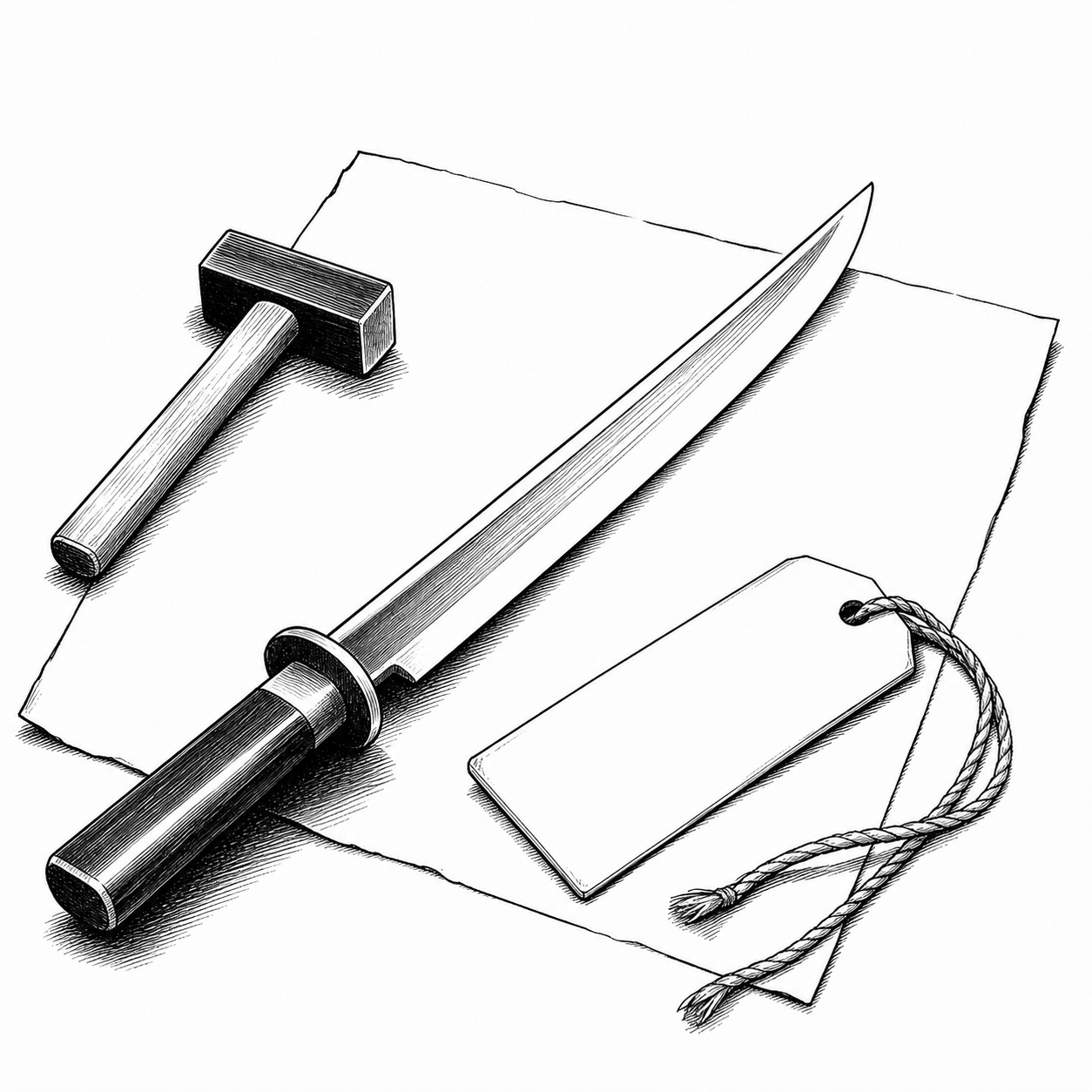
Data Catalog + Scene Tool. This document carries 4 sample masterworks made by the 7-stage procedure of
fc05-06-01-gm-creation-guide.md. Rather than filling it with blades alone, it mixes in a spear, a bow, and a swordsmith's tool.
The samples are usable as-is, but tuning them to the campaign is recommended. Since this document is also for verifying the authoring procedure, the result of the 7-stage checklist is placed at the end of each sample.
#Opening Fragment — The Four Gates
On the table lay four blades. One remembered the blood of an oni, one had been dedicated to a shrine, one held a swordsmith's last breath, and one rang its bowstring only on a rainy day.
"Wouldn't it be splendid to use them all?" the player said.
The GM set a finger between the four. "If you use them all, your stories will steal one another's breath. Today let us pick only one. Leave the rest as gates."
A Pure Land monk PC looked at the Dedication Naginata. "This suits a ritual scene more than a combat reward."
The swordsmith PC took up the Last Hammer. "I feel I must not repair this one. I think I should simply hold it."
Hearing that, the GM nodded. The sample weapons are not placed there to be used as-is. They are four gates that reveal what kind of scene the player wants to see. The gates need not all be opened. Even with only one open, the campaign gains direction.
#§ Scent — The First Line of Four Blades
New masterworks authored by this volume's 7-stage procedure. They took their places so as not to overlap in role with already-listed masterworks.
| Sample | Category | Era | Anecdote |
|---|---|---|---|
| Onibegi (鬼斬, new) | Tachi | mid-Kamakura | A counterpart to the Tenka Goken's Onimaru — a demon-cutting sword that guards the royal house |
| Dedication Naginata | Naginata | all eras | A polearm dedicated to a shrine. Female warriors, warrior-monks, shrine maidens |
| Swordsmith's Last Hammer | Swordsmith tool | all eras | A hammer a swordsmith left as he died. The key to masterwork forging |
| Bizen's Rain Bow | Daikyu | Kamakura – Sengoku | A longbow that shines in the seat of duels and the seat of ritual |
#§ Law — Sample 1: Onibegi (鬼斬)
#Scent — Onimaru's Counterpart
That in the Kamakura period the 5th Hojo lord Tokiyori kept the Onimaru Kunitsuna in his bedchamber was recorded in the Tenka Goken entry. But he did not ward off oni with that one blade for his whole life. Tokiyori did not often swing the Onimaru — the warrior's etiquette of not using the house treasure-sword in daily life.
Instead he used another blade for daily escort. Another blade forged by Awataguchi Kunitsuna, the same swordsmith as the Onimaru. Because it was the second blade forged at the same site while the swordsmith forged the Onimaru — it is called the Onimaru's sister.
This blade is Onibegi (鬼斬). It does not cut oni directly as the Onimaru does, but is a blade that follows the traces of oni. A place an oni passed, a place an oni dwelt, the place of a human an oni transformed into — the edge catches those traces.
As the Hojo house scattered after the shogunate fell, the Onibegi scattered too. A nameless samurai carried it about and then dedicated it to a temple. As of this volume, its whereabouts are unknown.
#Law — Tachi Foundation + Masterwork Technique
Base techniques: same as the tachi.
| Technique | Type | Energy | Check | Effect | Limit |
|---|---|---|---|---|---|
| [masterwork] Trace Tracking (痕跡追跡) | Kata | 3 | 2d10+Wisdom+Perception+2 >= 13 | non-combat. A place where an oni, yoko, bakeneko, etc., dwelt or transformed within the same scenario — the GM reveals the location once within the same scenario. | 1 per scenario |
Blessing [aptitude]: automatic see-through of the disguise of an oni/yoko/bakeneko in the same zone (same as Perception>=15).
Curse [aptitude]: at each scenario start a GM roll (hidden from the holder) — for that scenario, one oni/yoko follows the PC squad (undetected). This following is itself a scenario hook.
Ownership condition: the recognition of a Hojo-house descendant, or one who recovered the temple's dedicated copy. If a PC who has seen the Onimaru carries it, masterwork-technique Energy -1.
Acquisition scenario: the reward of a Kamakura-era scenario or a temple-protection scenario. A pair with fc05-02-02 § Onimaru.
#7-Stage Check
- Era: mid-Kamakura (based on Hojo Tokiyori's life and the Onimaru legend).
- Owner: the Hojo house, later a nameless samurai.
- Category: tachi (Kamakura style — era-fit).
- Anecdote: "a blade that follows the traces of oni" — one line.
- Ownership condition: Hojo-house recognition or temple recovery. PC-fulfillable.
- Curse/blessing: a non-combat information tool + a following hook. Not an automatic punishment.
- Masterwork technique: the 5th slot. +2 bonus (within the cap).
#§ Law — Sample 2: Dedication Naginata (奉納薙刀)
The body is in fc05-03-01 § Dedication Naginata. This document only reconfirms the 7-stage check.
#7-Stage Check
- Era: all eras (one blade, or several blades of one school).
- Owner: a shrine-dedicating shrine maiden, a borrowing female warrior or warrior-monk.
- Category: naginata — a case of a masterwork other than a blade.
- Anecdote: "a polearm dedicated to a shrine" — one line.
- Ownership condition: the shrine's recognition. PC-fulfillable via a shrine ritual.
- Curse/blessing: enhancement limited to shrine/barrier. Ordinary otherwise. Environmental restriction.
- Masterwork technique: the 5th slot. +2 bonus.
#§ Law — Sample 3: Swordsmith's Last Hammer (最後の槌)
The body is in fc05-03-02 § Swordsmith's Last Hammer. This document only reconfirms the 7-stage check.
#7-Stage Check
- Era: all eras (if a swordsmith's-death event is within the scenario).
- Owner: the dead swordsmith → the heir swordsmith.
- Category: swordsmith tool (not a weapon slot).
- Anecdote: "a hammer a swordsmith left as he died" — one line.
- Ownership condition: a swordsmith-school Licensed. The PC fulfills it through swordsmith-school study in
fc05-05-03. - Curse/blessing: an identity-enhancement tool. Nearly ordinary if the PC is not a swordsmith.
- Masterwork technique: a variant of the 5th slot — Sealing a masterwork's crack 1 per scenario.
#§ Law — Sample 4: Bizen's Rain Bow (備前の雨弓)
The body is in fc05-03-01 § Bizen's Rain Bow. This document only reconfirms the 7-stage check.
#7-Stage Check
- Era: Kamakura – Sengoku (the Bizen school's active period).
- Owner: a Bizen swordsmith, a warrior of duels.
- Category: daikyu. An atypical use — duel, ritual.
- Anecdote: "a bow of duels in the rain" — one line.
- Ownership condition: Archery Master + the RP of a duel. PC-fulfillable.
- Curse/blessing: environment-limited enhancement + a large-battlefield restriction. A scenario-dependent mechanic.
- Masterwork technique: the 5th slot. +3 bonus (within the cap).
#§ Law — Review After Authoring the Samples
#Distribution of the 4 Samples
| Item | Distribution |
|---|---|
| Category | blade 1 / spear-type 1 / bow-type 1 / tool 1 |
| Era | Kamakura 1 / all eras 2 / Kamakura–Sengoku 1 |
| Curse | strong curse 1 (the Onibegi's following) / environmental restriction 2 / nearly none 1 |
| PC identity | general swordsman 1 / female warrior or warrior-monk 1 / swordsmith 1 / archer 1 |
It is not blade-only. Era-fit is also distributed. Depending on PC identity, each is a reward candidate for a different PC.
#Role Alignment with Body Masterworks
| Sample | Similar body masterwork | Role separation |
|---|---|---|
| Onibegi | Dojigiri Yasutsuna | Dojigiri cuts directly, the Onibegi tracks — a non-combat information tool. |
| Dedication Naginata | Biten (毘天) | Biten is Uesugi Kenshin's faith, the Dedication Naginata is shrine faith — the faiths differ, and the roles differ (individual vs squad). |
| Swordsmith's Last Hammer | Kajinoishi (outside the samples) | Kajinoishi is a base asset, the hammer is portable. When the two meet, synergy. |
| Bizen's Rain Bow | Raimei / Nasu no Yoichi's bow | Raimei is yoma subjugation, Nasu no Yoichi is precision shooting, the Rain Bow is the seat of duels — all different scenarios. |
#§ Law — GM Usage Guide
#Introducing the Samples into a Scenario
Each sample suits the following scenario category:
| Sample | Scenario category |
|---|---|
| Onibegi | a transformation/lurking scenario of oni, yoko, bakeneko |
| Dedication Naginata | a shrine-protection / barrier scenario |
| Swordsmith's Last Hammer | a swordsmith PC's campaign — a master-smith's-death event |
| Bizen's Rain Bow | a duel scenario / the seat of ritual |
#Varying the Samples
A GM may vary a sample to fit their own campaign. When varying, reconfirm the 7-stage checklist.
Common variations:
- Era shift: the Onibegi into a Sengoku-era scenario. Another house in place of the Hojo.
- Owner swap: change the shrine location of the Dedication Naginata. Rewrite the one line of anecdote.
- Curse addition: add one more line of the swordsmith's lack to the Swordsmith's Last Hammer — the swordsmith PC bears that lack together.
#§ Law — Do Not Introduce All 4 Samples in One Campaign
Introducing all 4 of these blades in one campaign is too many masterwork rewards. Even for body-listed masterworks, the standard is for a PC squad to acquire 1~3 in one campaign.
Recommendation: use 1~2 of these 4 blades in a campaign. Leave the rest as candidates for the next campaign, or introduce them as NPC weapons.
#§ Law — The Authoring Intent of the Samples
What this volume intended in authoring these 4 blades:
- Model cases of categories other than blades — a spear, a bow, a tool, 1 each.
- Reward distribution by PC identity — swordsmith, female, archer, general swordsman.
- Verification of era-fit — Heian–Kamakura, Sengoku, all.
- Diversity of curses — strong curse, environmental restriction, nearly none.
- Role separation from the body — no overlap of place with body masterworks.
When a GM makes a new masterwork for their own campaign, refer to the distribution of these samples. It is good for one campaign's new masterworks too to have diversity of category, identity, era, and curse.
#Reference Links
- GM Masterwork Weapon Creation Guide
- Weapon Catalog
- Masterwork Compendium
- Divine Artifacts
- Swordsmith Additional Traits
- Swordsmith Schools
- Dedication Naginata
- Swordsmith's Last Hammer
- Bizen's Rain Bow
The samples are four blades, but on the table they become four branching gates.