#Masterwork Spears, Naginata, and Bows
Contents
Canon (fc05-internal) + Fiction-Only. This document covers masterwork arms that are not swords. Listed items appear as links; unlisted items are written as new data limited to this volume.
A chapter that softens the sword-centrism. The overwhelming majority of Japanese famous blades are swords — katana, tachi, wakizashi — but the real combat of the Japanese warrior houses was always half spear and bow. This volume places that half's masterworks in a separate chapter.
#Fiction Intro — What Reaches Before the Sword
The samurai in the Front Zone had not yet drawn his sword. But the bow on the ridge had already stopped breathing, and the long spear-tip had come before the horse's chest.
"Why do we only talk of swords?" the ashigaru captain asked. "By the time they see our swords, three clashes of the spear-shaft have already passed."
The archer laughed. "The bow is even more wronged. The enemy falls without even knowing who shot him."
Beside them, the naginata warrior-woman slowly wiped her blade. "The sword earns a name easily. Because it is there in the moment when person faces person. But the battlefield is often decided before they face each other."
Before those words were finished the first arrow flew. The enemy general was still touching the hilt of his own sword.
A masterwork that is not a sword is often not the protagonist. But what changes the battlefield's first breath is often the weapons before they become the protagonist.
#§ Scent — Masterworks That Are Not Swords
The sword is a tool of ritual, the spear a tool of the battlefield. The weapon a single warrior swings most in his life is — not the katana but the yari (suyari, 素槍). Among the warriors who beat a thousand foes, almost none cut down a thousand with a katana — those warriors' thousand were mostly the spear's thousand.
The bow is the same. The main weapon of the Heian warrior was the bow. The Heike pursuit that went all the way to Dan-no-ura was also a battle of bows. This volume's fc05-02-01-heian-genji-heike.md treated the bow as the equal of the sword — this chapter carries on that spirit.
When a sword gains a name, people remember it; but when a spear or bow gains a name — it gains the name because that weapon kept the most people alive. The masterworks of this chapter are weapons of that kind.
#§ Law — Masterwork Spears
#The Three Great Spears — Tonbogiri, Nihongo, Otegine
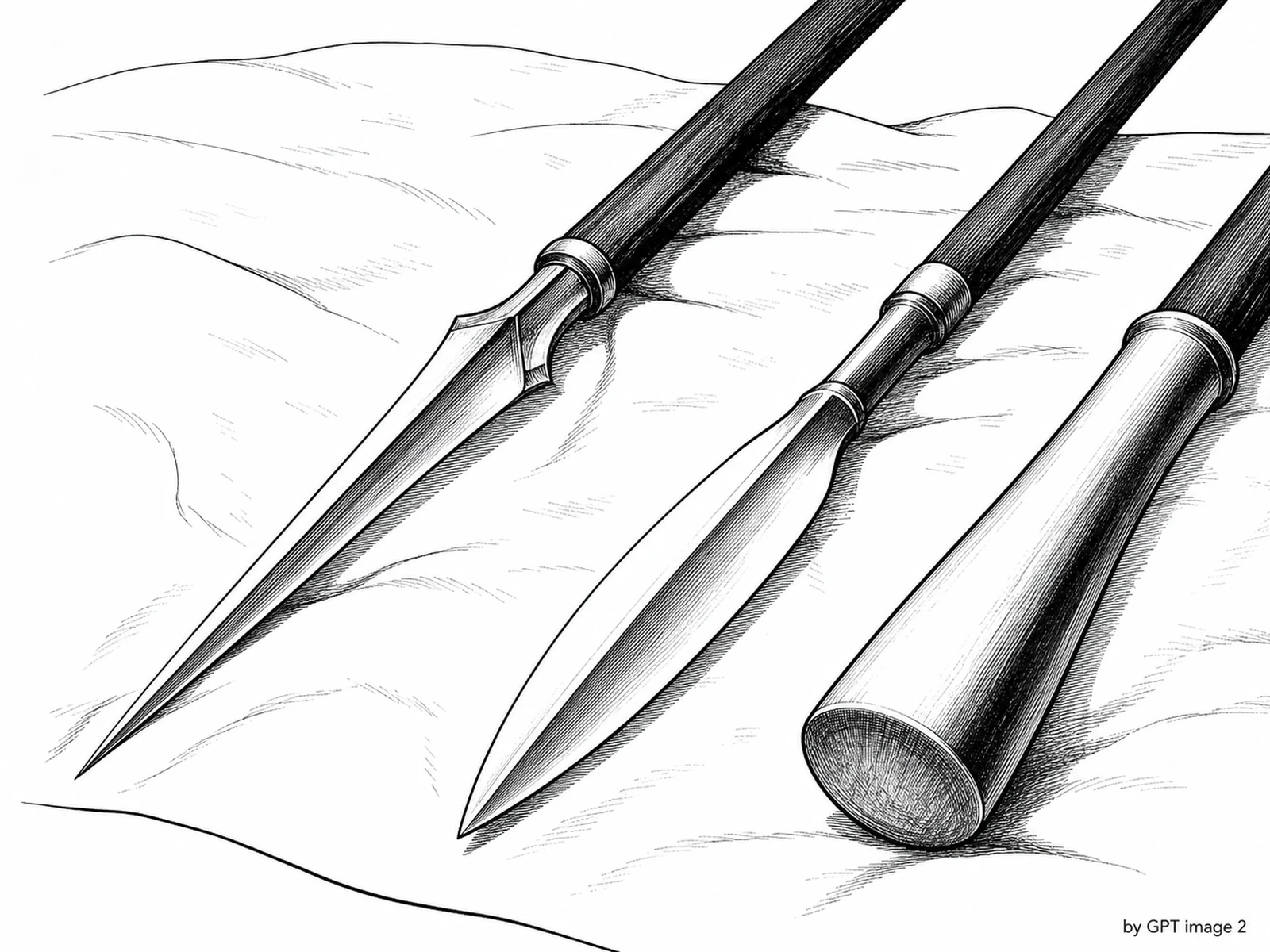
| Weapon | Listed | Holding House | This Volume's Note |
|---|---|---|---|
| Tonbogiri (蜻蛉切) | co-07-02 | Honda house | The trump card of formation and Front Zone scenarios. |
| Nihongo (日本號) | co-07-02 | Kuroda house | Bearing and diplomacy scenarios. A drinking-bout acquisition tale. |
| Otegine (御手杵) | co-07-02 | Yuki house | A reward for a large-build PC. The Energy penalty is a burden. |
The gathering of these three in one place is called the Seat of the Three Great Spears. It is a campaign event similar to this volume's alignment of the Tenka Goken, but the spear has none of the mysticism of the sword — the mere fact that three famous spears are on one battlefield presses upon everyone.
GM Box — Seat of the Three Great Spears (optional): When all three are on one battlefield, all Spearmanship techniques in the same zone cost Energy -1 (limited to the bearer or the same squad). 1 time per 1 combat.
#Kanesada Yari
co-07-02 § Kanesada Yari. The spear of a smith of both sword and spear. A pair with fc05-02-04 § Kanesada Katana.
#Hozoin Hozo · Hozoin Jumonji-yari
co-07-02 § Hozoin Hozo · ex2-40-03-09
The two treasured spears of the Hozoin-ryu spearmanship school. The Hozoin Hozo is a secret transmission — only one. The Hozoin Jumonji-yari is the standard-issue famous spear generally used by Hozoin-ryu Licensed holders. The difference between the two is license and grade.
#Takeda Aka-yari
ex2-40-03-10. Premised on a red-armor squad. This volume classifies it toward the fc05-02-04 Sengoku famous blades.
#Sengoku-yari (戰國槍)
co-07-02. The hundred-battle spear of a nameless ashigaru. A case of a masterwork of one person's whole life rather than a house treasure. In this volume's scenarios — anyone can wield it, but it shows its true worth only when one's own Wounds are 1 or less: a spear of the direst extremity.
#§ Law — Naginata and Long Weapons
#Biten (毘天)
co-07-02. Uesugi Kenshin's naginata. A pair with the Bishamon faith.
This volume's added note: Uesugi Kenshin called himself the "incarnation of Bishamonten." It has synergy (Blessing reinforcement) when in one place with the Divine Artifact co-07-03 § Bishamon-no-yoroi. However, since both are Kenshin's own, a scenario in which another PC acquires both pieces of equipment at the same time is difficult.
#Honno Naginata (奉納薙刀) [new]
#Scent — A Long Weapon Dedicated at a Shrine
The treasure of an unnamed shrine. A single miko used it for her whole life, then dedicated it. Afterward a woman warrior asked the shrine and borrowed it, and the next miko dedicated it again. In this way — a single naginata passing through the hands of woman warriors, warrior-monks, and miko. Dedication → loan → dedication.
A rumor that this blade does not answer to a man's hand. More precisely — it does not answer to one who has not received the shrine's recognition. It just so happened that all who received that recognition were women, but this volume leaves the rumor as it is and lets the GM decide by RP.
#Law — Naginata Base + Masterwork Technique
Basic technique: Same as the naginata.
| Technique | Type | Energy | Check | Effect | Limit |
|---|---|---|---|---|---|
| [Masterwork] Sweep of Dedication (奉納一掃) | Kata | 3 | 2d10+Courage+Spearmanship+2 >= Defense | Check against all enemies in the same zone. 1 Wound each. When used within a shrine or Barrier, nullify all enemies' next 1 round defensive techniques. | 1 time per 1 combat |
Blessing [aptitude]: Energy +1 in a shrine or Barrier zone (once per combat).
Curse [aptitude]: One without the shrine's recognition cannot use masterwork techniques. The trial of recognition is a shrine rite — the rite in which a miko hands over the blade.
Ownership condition: The shrine's recognition. Affinitive to woman warriors, warrior-monks, and miko in RP, but at the GM's discretion.
Acquisition scenario: A shrine-protection scenario. Or a one-shot of briefly borrowing the dedicated piece.
#§ Law — Kama-yari School
#Shinigami-no-kama · Enma-no-kama
co-07-02 § Shinigami-no-kama · § Enma-no-kama
Two cursed weapons. This volume frequently cites them as examples for writing the curse data of fc05-04-02-curses-devotions.md. The soul-absorption mechanic of the Shinigami-no-kama and the Three Ways and Six Hearts disclosure of the Enma-no-kama are both model cases showing that a curse is not a mere penalty but a mechanic of choice.
#§ Law — Masterwork Bows
#The Bows of Heian — Raimei, Nasu-no-Yoichi
co-07-02 § Raimei · § Nasu-no-Yoichi
Anecdotal commentary in this volume's fc05-02-01 § The Bows of Heian.
#Kazakiri · Yume-no-yumi · Zenmu-no-yumi · Issensha
From co-07-02 § Hankyu Masterworks to § Issensha
| Bow | Core Effect | Scenario |
|---|---|---|
| Kazakiri (風切) | Ignores cover | The trump card of a cover scenario — it reaches even if the enemy is behind a barricade. |
| Yume-no-yumi (夢の弓) | Sleep arrow | A non-lethal suppression scenario. Based on a Presence check. |
| Zenmu-no-yumi (善夢の弓) | Yoma-effective, unlimited range | The trump card of a Faith PC. |
| Issensha (一千射) | Auto-recheck even on a miss | An aid for a PC who struggles with precision shooting. |
#The Rain Bow of Bizen (備前の雨弓) [new]
#Scent — The Bow of the Duel
A single longbow forged by a smith of the Bizen sword school. A rumor that it is best loosed when rain falls. More precisely — at the seat of a duel, at a seat where each shot is a ritual, this bow shines. Carried into the midst of a great war it is merely a good bow, but at the 30 paces of a one-on-one duel — a hundred shots, a hundred hits.
The fact that a smith of the Bizen sword school also forged bows is one of this volume's notes. Bizen is a sword school, but a case where its forging method was applied to the bow's string rest. See the fc05-05-03 § Bizen entry.
#Law — Daikyu (or Hankyu) Base + Masterwork Technique
Basic technique: Same as the daikyu.
| Technique | Type | Energy | Check | Effect | Limit |
|---|---|---|---|---|---|
| [Masterwork] Rain of the Duel (決鬪の雨) | Kata | 2 | 2d10+Finesse+Archery+3 >= Defense | 1 Wound. Limited to the seat of a one-on-one duel or the seat of a rite (GM recognition). On a hit, Critical Hit range +1. | 1 time/round |
Blessing [aptitude]: Archery check +2 in rain or fog environments.
Curse [aptitude]: Cannot use masterwork techniques in a large battlefield (3 or more enemies in the same zone). "A bow that hates great commotion."
Ownership condition: An Archery Master. The RP of a rite or duel.
Acquisition scenario: A Bizen smith scenario, or a reward at the seat of a duel.
#§ Law — Masterwork Guns
#Kunitomo Reisen · Shinnenju · Inatomi Secret Fire · Matchlock Precision Type · Nanban Ozutsu
Follows the data of co-07-02 § Guns and ex2-40-03-14.
This volume's added note:
| Gun | Scenario Category |
|---|---|
| Kunitomo Reisen | Spiritual scenario — incorporeal yoma battle |
| Shinnenju | Religious scenario — Ikko-ikki |
| Inatomi Secret Fire | Firearm-smith PC — Inatomi-ryu license |
| Matchlock Precision Type | Precision-shooting scenario |
| Nanban Ozutsu | Siege and mass breakthrough |
Guns appear only in the latter part of this volume's era range (Heian to the end of the shogunate). They are forbidden in Heian and Kamakura scenarios.
#§ Law — Principles for Scenario Use of Non-Sword Masterworks
#Breaking Free of Sword-Centrism
A scenario in which all the PCs hold katana — half the scenario cannot make use of formation, zone, and distance mechanics. This volume places non-sword masterworks as a tool that makes the scene different.
| Sword Scenario | The Different Scene Non-Swords Create |
|---|---|
| A sword fight in one zone | A scene of blocking between two zones with a spear-wall |
| A one-on-one duel | A decision at 30 paces with a bow |
| Breaking through the enemy Front Zone | Sweeping a formation in one stroke with a naginata |
| A precision assassination | A single shot from a distance with a gun |
| Holding a formation | Squad cohesion with the Tonbogiri |
Slipping a single non-sword masterwork into a PC squad widens the range of possible scenarios.
#Separating Energy and Wounds
Non-sword masterworks often have a different cost structure from swords. This volume never confuses the two terms.
- Energy: Action power. Recovers each breath. The cost of using masterwork techniques.
- Wounds: Fatal-injury endurance. Lose it and you near combat incapacity.
In particular, the bow adds a distance mechanic (the bow school reloads automatically at no cost — the basic rules of co-07-01-weapon-catalog.md § Bow take priority).
#Connection to Zone Tactics
Non-swords connect directly to the co-03-08-zone-tactics.md zone tactics. When a masterwork technique creates a zone effect, the duration, transfer, and stacking of that effect follow the zone-tactics body text. The masterworks of this volume do not newly define zone rules.
#Reference Links
- Masterwork Compendium
- Weapon Catalog
- Zone Tactics
- Yabusame Samurai
- Famous Blades of Heian, Genji, and Heike
- Sengoku and Edo Famous Blades
- Masterwork Armor, Tools, and Accessories
- Smithing Schools
A weapon that is not a sword can also change the battlefield's first breath.