#Artisan Swordsmith Build Guide
Contents
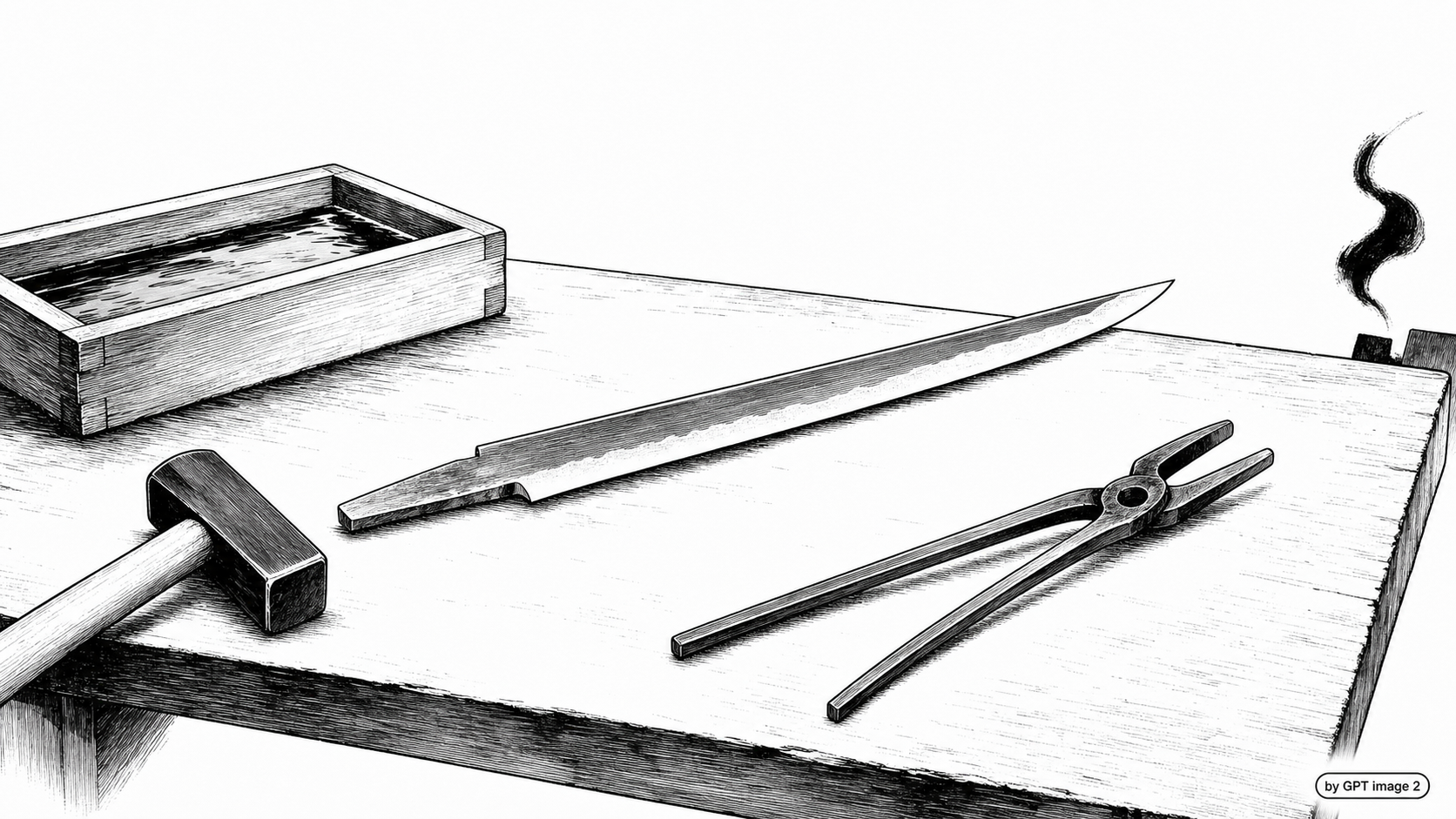
RP Guide — swordsmith build. This document is a build guide for setting the Artisan (工人) class of
co-04-07-11-artisan.mdas a swordsmith (刀工). It is not a new class — merely one branch of the Artisan's specialties.
The Artisan's core role stays intact. Barricades, traps, and karakuri are the Artisan's body role. The swordsmith build adds, on top of that, the crafting, appraisal, repair, and re-polishing of blades, armor, and tools.
#Opening Fragment — The First Hammer
The apprentice asked for the sword's name before heating the iron. The master set down the tongs and gazed at the fire for a long while.
"The name comes last," the master said. "First you must know what you cannot make."
"You mean the times you cannot make a good sword?"
"No. The times you must not make a good sword." The master did not draw out the heated iron. "Give an enraged master too light a sword, and killing becomes easy. Give a coward too strong a sword, and an excuse is born. A swordsmith is not one who looks only at iron. He looks at the hand."
The apprentice recalled the client waiting beyond the gate. A man who had spoken of revenge. "Then we do not forge today?"
Only then did the master take up the first hammer. "We forge. But not the sword he wants — the sword he can bear. The path of the Artisan swordsmith begins there."
#§ Scent — The Way of the Kakuji (刀工)
The Artisan body text carries this line — "Some Artisans forge but a single sword in their whole life. They believe that one sword is the most they can answer for. That is the way of the Kakuji (刀工) — the maker binds his own soul to his own work."
This volume's swordsmith build is that way of the Kakuji rendered into rules. If the way of the karakuri craftsman is the ethic of "what I made may save someone or kill someone," the way of the swordsmith is the ethic of "the one sword I made lives out a single person's life alongside them."
A swordsmith PC does not forge a sword within a single scenario. A single scenario is too short. Across a whole campaign — to forge a single famed blade for a lifetime is the summit of a swordsmith PC.
#§ Law — Build Guide
#Attributes
The 6 attributes of this rulebook (co-03-02-attributes.md) are followed as-is. Priorities for the swordsmith build:
| Attribute | Priority | Reason |
|---|---|---|
| Physique | 1 | Core of the Artisan body. Hammering, barricade construction. Wounds = 3+Physique. |
| Wisdom | 2 | Spiritual presence, true-name carving, barrier sealing. Mainstay of Sorcery and Barrier checks. |
| Finesse | 3 | Precision forging, Disable checks. Energy = 10+Finesse. |
| Presence | support | Negotiation and Bribery with swordsmith NPCs. Bearing RP. |
| Fate | support | Crisis in the forging ritual — 1 Fate Intervention recovers a season. |
| Courage | weak | When testing your own work directly. Weak in the swordsmith's main vocation. |
Do not change the core attributes. The Artisan's body is Physique and Wisdom. The swordsmith build is also Physique and Wisdom. A build prioritizing other attributes should go to another class.
#Skills
The Artisan's base Master-capable skills: Disable, Geography, Hardiness, Perception, Survival, Herbalism (co-04-07-11-artisan.md).
The swordsmith build leaves those 6 Master-capable skills intact and maps the swordsmith's use within them as follows.
| Master-capable skill | Category | Swordsmith use |
|---|---|---|
| Perception | Investigation | A weapon's spiritual presence. The core check of sword-tone Appraisal. |
| Disable | Investigation | Seal analysis, true-name Sealing release. Unlocking a masterwork's locked effects. |
| Geography | Investigation | Mines and spirit veins — finding the site of the Kajinoishi (spirit-vein anvil). |
| Herbalism | Investigation | Quenching liquid, blade treatment. The swordsmith PC's first aid. |
| Hardiness | dedicated (Physique) | Endurance of hammering, heat, and pain. Stamina of the forging ritual. |
| Survival | Investigation | Field forging, securing rations. Daily life of a swordsmith campaign. |
Recommended additional general skill points (outside Master-capable skills, recommended to the Novice–Licensed tier):
| Skill | Category | Swordsmith use |
|---|---|---|
| Sorcery | Mystic | Talismans and seals, language and calculation. The scholarly axis of true-name carving. |
| Barrier | Mystic | Seal reinforcement. Barrier handling for blood-quench Sealing and swordsmith rituals. |
| Exorcism | Mystic | Curse release and purification. Mitigation of a cursed masterwork. |
| Intimidation | Command | Pressuring the client. NPC master-smith RP. |
| Deceit | Command | Seeing through forged signatures. Identifying false famed blades. |
Note: Sorcery, Barrier, and Exorcism are not the Artisan's Master-capable skills. A swordsmith PC cannot raise them to Master. Licensed (3 points) is the limit — beyond that follows the Master-slot rule of
co-04-09-00 § Proficiency 5 Tiers"only 6 per class." The Artisan's 6 Master slots are decided within the 6 Master-capable skills above.
#Starting Automatic Skills
The starting automatic skills of co-04-07-11-artisan.md — Disable Trained, Geography/Perception/Herbalism Novice — stay as-is. The swordsmith build grants no additional automatic skills — because it is not a new class.
#Backgrounds
Backgrounds from co-04-01-backgrounds.md that suit the swordsmith build:
- Artisan Family — Born to a swordsmith family. Starts with a smithing-school Licensed.
- Kakuji Apprentice — Apprenticed at a swordsmith head house, then went independent.
- Miner — Handled spirit veins and ore at the mines.
- Warrior-Monk Swordsmith — One who carried battlefield experience over into forging.
#§ Law — Scene Roles
A swordsmith PC carries out the karakuri/barricade main work in combat as-is, and adds the following roles in non-combat / lull phases.
#Pre-Combat Preparation
- Weapon Appraisal: At scenario start, appraise the weapons the squad members carry. Identify masterworks, Divine Artifacts, Realm Wandering Relics. The GM reveals location and condition.
- Emergency Check: Confirm the durability and abnormalities of squad members' weapons.
- Material Check: Whether the swordsmith PC's own tools and materials are in place — whether a field forge can be set up.
#During Combat
A swordsmith PC's combat duty is the Artisan. Rather than swinging a blade directly, they raise barricades and deploy karakuri. But with the following added roles:
- Weapon First Aid: When a squad member's weapon breaks or a curse runs wild, lend a breath with a swordsmith additional trait such as
fc05-05-02 § Emergency Re-Polish. - No masterwork forging during combat — "Forge me a Tenka Goken blade right here, right now" is impossible.
#After Combat (Lull / Post-Scenario)
- Repair: Re-forge a broken weapon. Over one scenario.
- Re-Polish: Fine-tune a masterwork's form. One step on the path of curse mitigation (§04-02).
- True-Name Search: The master key of a scenario that works out a masterwork's sealed name.
- Owner Mediation: When a blade rejects its owner, the swordsmith steps between them and works out the reason for the rejection.
#Campaign Scale
- Masterwork Forging: In the latter half of a campaign, the swordsmith PC forges a single masterwork. The procedure is the 7 stages of
fc05-06-01-gm-creation-guide.md. - Smithing-School Succession: Recognizing the next heir of one's own smithing school.
#§ Law — Difference Between a PC Swordsmith and an NPC Master-Smith
#PC Swordsmith
- Active Dan: 1 to 9 dan (Artisan dan count as-is).
- Masterwork Forging: Once, in the campaign's latter half. One blade per campaign.
- Scene Weight: Combat 30%, non-combat / lull 70%.
- Ethic: Reads the maker's ethic of the Artisan body text through the swordsmith's way.
#NPC Master-Smith
- Active Dan: 9 dan or 10 dan Tatsujin (may hold the Artisan Renown Title
co-04-05-prestige.md § class capstone— the Artisan Renown Title fortifies 2 zones into impregnable strongholds). The scenario's client, master, or ancestor.
Note: The Artisan 9-dan class trait Master Artisan (名工) and the Artisan 10-dan Renown Title are separate slots. Master Artisan is chosen once at 9 dan; the Renown Title is the single title a 10-dan Tatsujin receives.
- Masterwork Forging: Proceeds within a scenario on a PC's commission.
- Scene Weight: Combat 0%, grants scenario motive and reward.
- Ethic: Binds his own soul to his final work. Close to death.
#When the Two Meet
A PC swordsmith studies under an NPC master-smith at his workshop. The rewards of the apprenticeship scenario are:
| Reward | Effect |
|---|---|
| Smithing-School Licensed | A Licensed in one smithing school from fc05-05-03. |
| Swordsmith Additional Trait 1 | One additional trait from fc05-05-02. |
| A Masterwork's True Name | The reading of one masterwork's true name and anecdote. |
| The Master-Smith's Tool | A base asset such as the Swordsmith's Last Hammer (§03-02). |
#§ Law — The Swordsmith PC's Breath Pattern (5 dan)
A typical breath pattern for a 5-dan swordsmith PC. A swordsmith-build variant atop the Artisan 5-dan co-04-07-11-artisan.md § Typical Breath Pattern (5단).
Swordsmith PC: Energy 10(10+Finesse 0), hammer (tetsubo) or suyari
Assume that at 3 dan, [Emergency Re-Polish] was chosen instead of one of the body's [Quick Repair / Set Trap / Reinforcement Work].

 Lull phase (before combat starts):
  [upkeep] Sword-Tone Appraisal(0 Energy, lull) — GM reveals the hidden condition of a squad member's masterwork
 Count 10 — first breath:
  Karakuri Fieldworks(3) + Emergency Re-Polish(2) = 5
  → install barricade + seal a curse on squad member's weapon 1 until the next breath
 Count 5 — second breath:
  Suyari harassment reservation(2) + relocation(2) = 4
  → Front Zone harassment + position adjustment
 Remainder: 10 - 5 - 4 = 1 (emergency evasion, etc.)
The swordsmith build's additional traits are referenced in fc05-05-02. Sword-Tone Appraisal is an [upkeep] slot, so it triggers in the lull phase at 0 Energy — no Energy spent during combat. Swinging a weapon at the third breath or beyond is not the main vocation (Artisan).
#§ Law — Recommended Weapons
The weapon a swordsmith PC carries is, by tradition, one they made themselves, but in the early campaign the following are recommended.
| Weapon | Reason |
|---|---|
| Tetsubo (鐵棒) | An extension of the hammer. The tradition for a Physique-focused swordsmith PC. An Artisan recommended weapon. |
| Rokushakubo | Suppression. Low lethality — the maker's ethic. An Artisan recommended weapon. |
| Suyari | Front Zone harassment. Recommended in the Artisan body text. |
| Hammer (improvised weapon) | The tradition of a tool turning into a weapon. Improvised-weapon rule. |
| Katana | When holding a Swordsmanship Licensed. Test your own work in Sengoku/Edo scenarios. |
A swordsmith PC's qualification to carry a masterwork: A swordsmith too can carry a masterwork. But if the masterwork-technique trigger condition is Swordsmanship Master, then 4 points in Swordsmanship are required. Since a swordsmith is not a swordsman by vocation, masterwork techniques generally center on non-combat masterworks (a tea-ceremony famed tea bowl, the Swordsmith's Last Hammer).
#§ Law — Recommended Schools
Follows the swordsmith schools of fc05-05-03-smithing-schools.md. Not a swordsmanship school but a crafting school. A swordsmith may hold a swordsmanship school at the same time, but mind slot conflicts and cost handling (see the next § Rule-Conflict Notes).
#§ Law — Rule-Conflict Notes
#Do Not Make a New Swordsmith Class
The swordsmith is an Artisan build. It is not split off into a new class. Dan count, skill slots, and Core Zone entry (forced Breakthrough) all follow the Artisan body text.
#The Difference Between a Field Forge and Masterwork Forging
The Artisan 5-dan Field Forge "temporarily enhances" a weapon — masterwork techniques +2 until the next combat. The swordsmith build's masterwork forging is permanent masterworking. The two differ — a Field Forge cannot make a masterwork, and the masterwork-forging procedure cannot finish a temporary enhancement.
#Masterwork Forging Is Not Instantly Possible
Even if a swordsmith PC can make a masterwork within a campaign — the forging does not finish within a single scenario. The 7-stage procedure of fc05-06-01 requires materials + time (in season units) + a commission + the swordsmith's lack + the owner's qualification, all of them. It does not nullify the normal economy of masterwork acquisition (scenario reward, inheritance, loot).
#Holding a Swordsmith Build and a Swordsmanship School at Once
Can one PC hold both an Artisan swordsmith build + a swordsmanship school — possible, but with cost burdens:
| Item | Burden |
|---|---|
| School slot | The swordsmanship school and the swordsmith school are placed in separate slots — see fc05-05-03 § Slot Alignment. |
| Skill points | Swordsmanship + Appraisal + Repair + lore interpretation — one PC can scarcely take every Master in a lifetime. |
| Narrative condition | A campaign for a PC who is both swordsman and swordsmith rises in dan slowly. A timing gap in dan-count bonuses. |
Recommendation: Focus on one path until mid-campaign. Add the other path's Licensed in the latter half.
#§ Law — Scenario Usage
#The Swordsmith PC's Debut
When a swordsmith PC joins the squad in the campaign's first scenario, he has no workshop of his own. That is the first scenario's motive — to find a site to set up his own forge.
#Workshop-Asset Scenario
In mid-campaign, the PC sets up his own forge. Finding the site of the Kajinoishi (spirit-vein anvil). Procuring the first tools. That workshop becomes the scenario's base.
#Masterwork Commission
Another PC in the squad commissions a masterwork from the swordsmith PC. Or an NPC's commission. Proceed through the 7 stages of fc05-06-01.
#The Swordsmith's Death Scenario
An NPC master-smith, dying, passes his smithing school to the swordsmith PC. The swordsmith PC's school change or head-house recognition.
#Reference Links
- Artisan
- Backgrounds
- Masterwork Compendium
- Equipment and Consumables
- Swordsmith Additional Traits
- Swordsmith Schools
- GM Masterwork Weapon Creation Guide
Before it strikes the iron, the swordsmith's hammer strikes a person's resolve.