#Hegemony — When Order Becomes Violence
Contents
Hegemony loves order. But it does not see those who do not enter that order as people.
#Opening Fragment — The Burning Gate
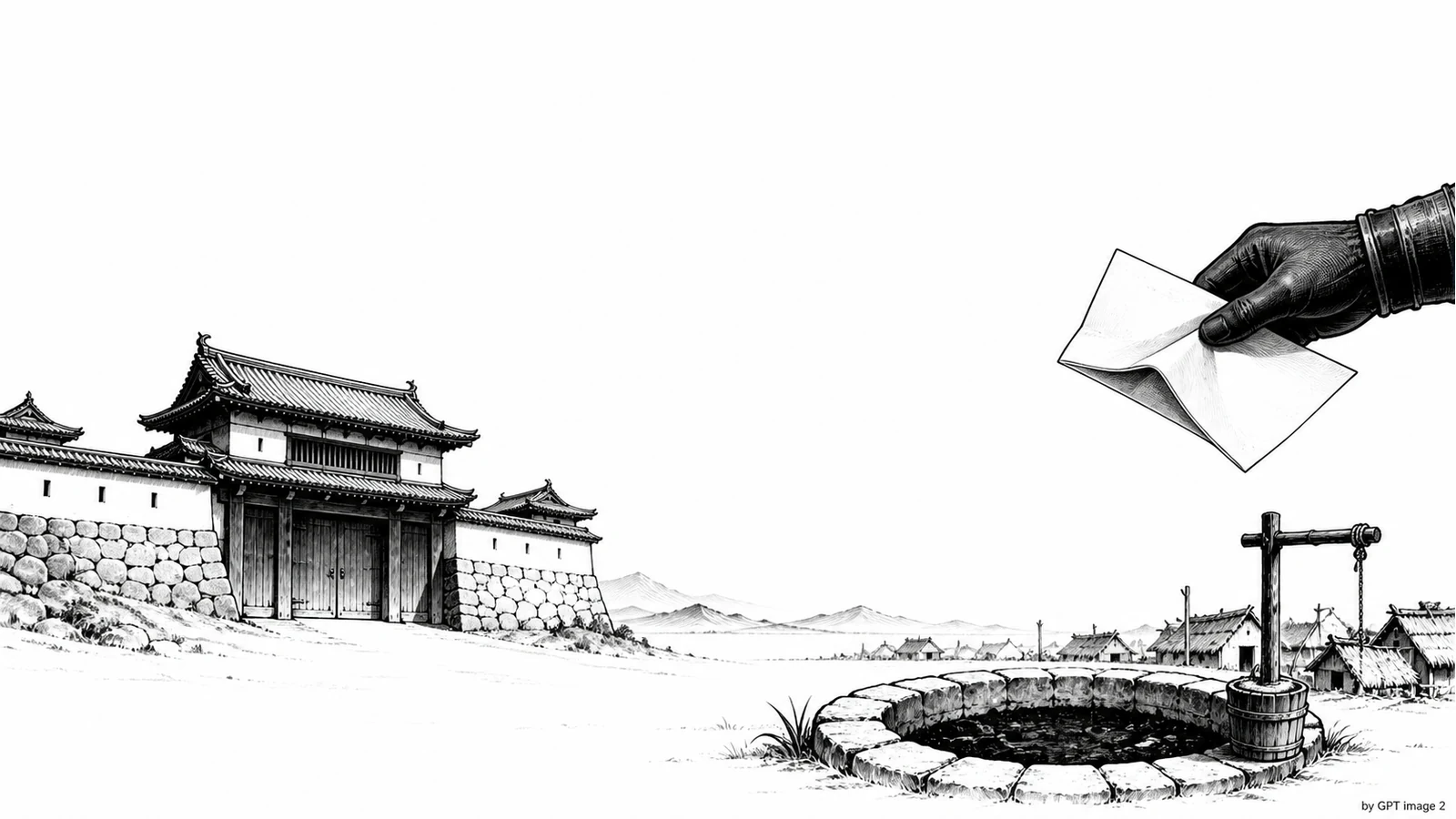
The order to close the gate was right. The enemy was approaching fast, and there were still troops and provisions inside the castle.
The problem was the people left outside the gate.
"If we open it, the castle falls," the samurai said.
"If we close it, the people die," the Pure Land Monk said.
The samurai closed his eyes for a moment. When he opened them again, the wavering was gone. "If the castle falls, more people will die."
The gate closed. The screaming did not last long. The next day he wrote this in his report.
Gate defense successful. Many civilian casualties. Unavoidable for the operation.
That sentence was so neat that everyone fell silent for even longer.
#The Core Question of Hegemony
Hegemony is the dark side of order.
Loyalty says, "I will keep my place." Hegemony says, "I will decide your place."
The core question of Hegemony is this.
"If I am right, do I also have the right to break others."
A figure of Hegemony often begins from a good goal. To end a war. To stabilize a domain. To prevent greater chaos. But over time, control becomes more important than the goal.
#What Is More Frightening Because It Is Less Blatant Than Demon
At the table, the dark side that becomes frightening first is usually Demon. Demon has a strong image of blood, predation, instinct, yoma nature, and frenzy. But Hegemony is frightening in a different way.
Demon devours people. Hegemony makes people line up of their own accord.
The villain of Demon breaks the gate and comes in, but the villain of Hegemony commands that the gate be closed. And to that written order they attach a seal, a cause, a signature, military law, and a great cause. So the victims of Hegemony often learn, along with it, "the reason I should be sacrificed."
There are three reasons Hegemony is truly frightening.
| Fear | Explanation |
|---|---|
| Fear of Legality | The evil deed takes the form of an order, a verdict, military law, or an ordinance. |
| Fear of Efficiency | It actually solves problems. The castle is held, the roads grow safe, the taxes are collected. |
| Fear of Internalization | The victims and subordinates begin to say "there is no other way." |
A Hegemony campaign is not only the story of toppling a tyrant. It is the story of seeing how much of the procedures and language that tyrant left behind remain inside the people.
#The Sentences Hegemony Speaks
| Sentence | Hidden Meaning |
|---|---|
| "It is necessary for the great cause." | Those outside the great cause may be erased. |
| "Building order comes with sacrifice." | I decide who is sacrificed. |
| "Fear is better than chaos." | I will make them submit through dread. |
| "If I do not do it, a more cruel one will." | So my cruelty is licensed. |
| "Later ages will understand." | I will not hear the words of those suffering now. |
These sentences are all plausible. That is why they are dangerous.
#The Scene Signals of Hegemony
- The written order looks cleaner than blood.
- There is relief when a subordinate says "I did as ordered."
- The number is recorded before the victim's name.
- They think of how to make an example of a surrendered enemy rather than how to govern them.
- A loyal figure begins to love their own order more than their lord.
Hegemony is not only a tyrant who shouts. The most frightening Hegemony is calm and courteous.
#Types of Hegemony Villains
#The Pacifier
They end the war and make the roads safe. They reduce bandits and stabilize taxes, and in fact save many people. But that peace is a peace after those who would not submit have been removed.
How to run:
- At first, bring them in as a figure the PCs can be helped by.
- Show, together, the problem they solved and the people they erased.
- Leave the dilemma that "if you topple this person, chaos returns."
#The Judge
They put the world in order through the language of crime and punishment. They are skilled at turning private anger into public procedure. The most dangerous point is that they often truly do punish criminals.
How to run:
- Place the first victim as an obvious wrongdoer.
- Place the second victim as an ambiguous figure.
- Place the third victim as someone guilty by procedure, yet whom everyone at the table finds uncomfortable.
#The Protector
To defend a village, a house, a temple, or a castle, they exclude outsiders. They can be warm toward those within. So those within see them not as a tyrant but as a father or a mother.
How to run:
- Make the protected people truly love that villain.
- Apply the cruel rules only to outsiders.
- When the PCs break that protection, show what those within lose.
#The Designer
They do not kill people directly. They design the gates, the supply lines, the hostage exchanges, the decrees, the marriages, the passes. Their hands are clean, but the lines on the map kill people.
How to run:
- Place more documents and maps than blood in the scenes.
- Let the victims say "that person did not do it directly."
- If the PCs break the design, the greater problem the design was holding back can be made to surface.
#The Pressures of a Hegemony Campaign
To use a Hegemony villain for a long time, make them not a simple target for subjugation but an order that is hard to replace.
| Pressure | Question |
|---|---|
| Public Order | If the rule of Hegemony disappears, who keeps the roads. |
| Records | Who wrote the records of who is a criminal and who is a victim. |
| The Submissive | Do the subordinates follow out of fear, or follow because they truly believe. |
| The Alternative | Can the PCs solve the same problem while being less cruel than Hegemony. |
A good Hegemony villain leaves a question even after defeat. "He was wrong, but what do we do about the problem he was holding back."
#Distinguishing Demon and Hegemony
| Demon | Hegemony |
|---|---|
| Speaks of instinct, predation, the flow. | Speaks of command, the great cause, order. |
| Sees the weak as devoured. | Sees those outside order as removed. |
| Takes naturalness as its excuse. | Takes legitimacy as its excuse. |
| Its traces are wounds and fear. | Its traces are documents, institutions, submission. |
Do not think Hegemony is less savage than Demon. Hegemony arranges savagery and turns it into an institution.
#Fitting Majin Connections
| Majin Class | Point of Contact with Hegemony |
|---|---|
| Shurado | War becomes the only language of order. |
| Kekka | They dominate the gaze of others through stage and fear. |
| Tatarigami | They sanctify their own order in the name of punishment. |
| Tesshin | They remove emotion and optimize control. |
This connection is a recommended interpretation. The actual class data follows each source text.
#The Hero Mirror
The mirror of Hegemony is Loyalty.
A figure of Loyalty also follows orders. But they keep asking whom the order protects. The figure of Hegemony sees that question as obstruction.
A good mirror NPC:
- A samurai who serves the same lord yet remembers the names of the commoners.
- A subordinate who followed the orders of Hegemony and comes to regret it too late.
- An old general who keeps courtesy even toward an enemy commander.
- An official who can die for order, yet will not trample a person outside that order.
#The Stopping Scene
The moment Hegemony can stop is when it sees the fact that its own order destroyed what it meant to protect.
Scene objects:
- The crest of one's own house left in a burned village.
- A child's name written on the back of a written order.
- The moment a submissive subordinate says "No" for the first time.
- A scene where a hero NPC won by the way of Hegemony, yet refuses that victory.
For Hegemony to return, the question must change from "my order is right" to "whom does my order keep alive."
#How to Use as GM
When handling Hegemony, do not make the harm only an abstract number. Leave names, places, objects. Only then can one see what the order of Hegemony trampled as it passed by.
At the same time, do not make the figure of Hegemony a fool. They can actually solve the problem. Close the gate and the castle lives. The problem is what world that success leaves behind.
Hegemony takes up the brush before the sword — because erasing the name first makes the cut easier.