#Depletion System (消盡)
Contents
Authority. This document is a variant rule (Variant). As with every variant rule of this volume, it is premised on GM permission, and fc cannot override the
cocanon (Canon). The data-card standard format this document fixes is followed by all 03-series cards of this volume.
#Scent — The Dwindling Future
#Opening Fragment — The Hand That Counts the Magazine
At the hour the campfire had burned low, the man drew out his magazine.
With his thumb he pushed out the rounds one by one, laying them in a row on a cloth spread over his knee. When the magazine was empty, he took out the last of the rounds left in his waist pouch and laid them beside the others. The brass cartridge cases caught the firelight and shone like little lanterns. One, two, three. The man's lips moved without sound.
Across from him, an ashigaru tending his spear asked, "Is that a thing that grows, if you count it every night?"
"It is a thing that dwindles." The man did not stop his counting hand.
"Then why count it?"
"Because it dwindles, I count it."
Thirty-two. Laying the last round at the edge of the cloth, the man looked down at them for a while. When he first fell into this era, it was about sixty rounds. Eight rounds to the pack of stray dogs on the mountain trail. Eleven rounds to the nobushi at the pass. Nine rounds to a something with three eyes, whose name he never could learn.
Thirty-two rounds. The future I hold is thirty-two rounds.
The man began to push the rounds back into the magazine, one by one. The ashigaru watched the movement of his hands for a long while, then, wiping the butt-end of his own spear with a rag, said,
"My spear, if it breaks, I shave a stalk of bamboo. That teppo of yours?"
The man did not answer. The magazine seated into the firearm with a short clang of metal. That sound resembled no sound of this era.
"...That is why we call you Kamikakushi." The ashigaru said, stirring the embers. "It was not only people the spirits hid away. The road home, they hid along with them."
#Scent — Strong, and Wearing Down
Modern goods are strong. The rifle shoots faster and farther than the teppo, and antibiotics save a person more surely than any decoction of this era. There would have been a road of shaving down that strength to balance it. This volume does not take that road. It leaves the strength as it is, and instead attaches an end.
[Depletion] is not a penalty. The hand that counts the remaining rounds, the night that decides on whom to spend the last single use, the hand that shaves a bamboo spear on the morning the firearm has fallen silent — all of that is the drama this volume means to give. The goods of one who has been taken by Kamikakushi are like an army with no supply line. Only what dwindles is worth counting.
#Law 1 — The [Depletion] Tag
The drifted-goods cards of this volume bear a new tag, [Depletion].
[Depletion N·unit]
Definition: N = the remaining count left in that gear. The unit is one of rounds, uses, or Clock.
Decrease: Reduced by 1 at each point the unit defines.
Silence: The instant N reaches 0, that gear enters the Silence (沈默) state — unusable.
Recovery: In principle impossible. The road of resupply, reloading, and recharging is opened
only by each card's special and the 03-series substitution rule (Law 3).#The Three Units of the Remaining Count
| Unit | Applies To | Point at Which 1 Is Lost | Notation Example |
|---|---|---|---|
| rounds (發數) | firearm ammunition | each time 1 round is fired | rifle live rounds [Depletion 60·rounds] |
| uses (回數) | medicine, consumables | per 1 use | antibiotics [Depletion 3·uses] |
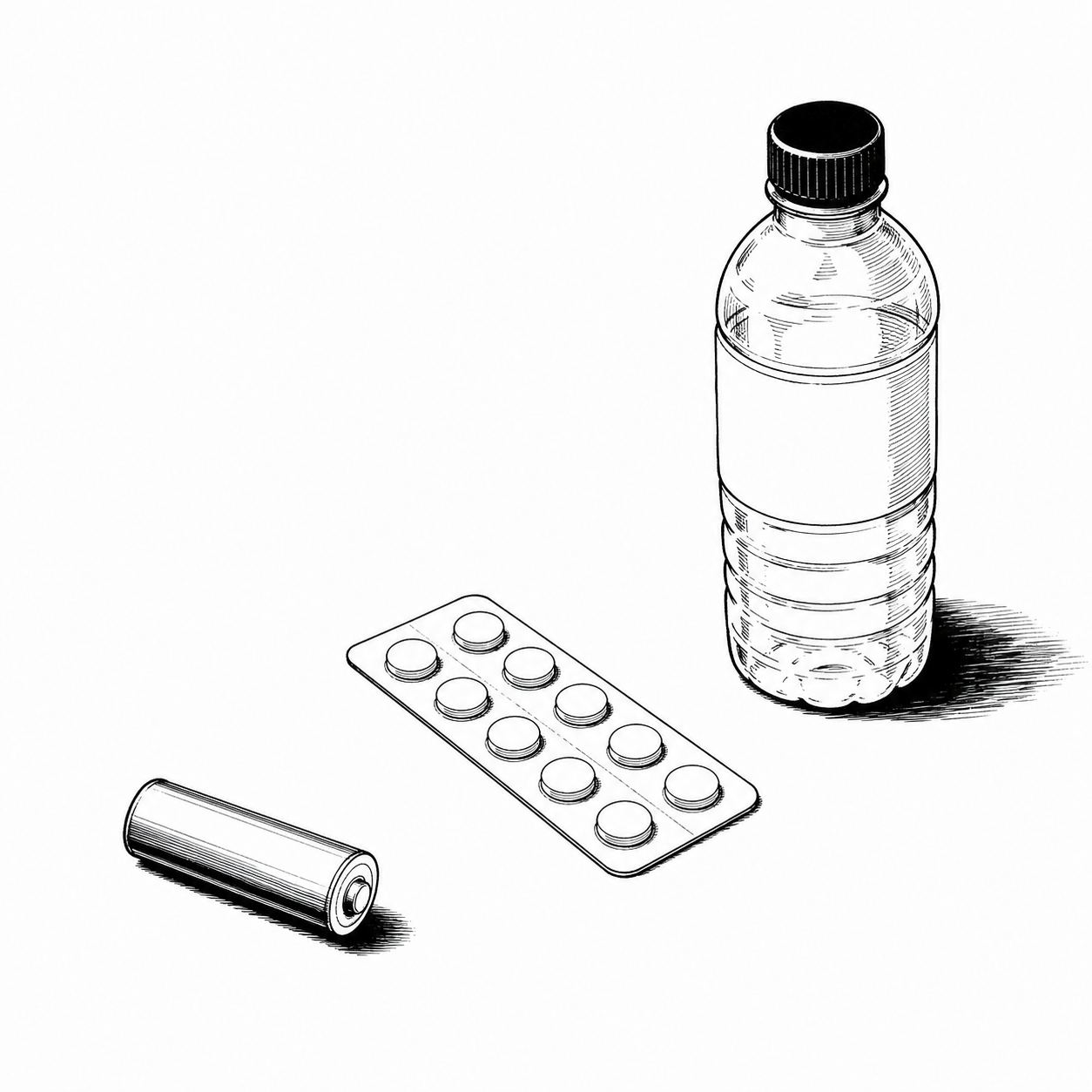
| Clock (時計) | batteries, fuel | each time a scene of meaningfully using that gear ends | flashlight [Depletion 4·Clock] |
- rounds: A different cartridge type means a different remaining count. You cannot feed a rifle with pistol rounds — remaining rounds are counted separately by cartridge type. The detail of firing modes and bursts is in Firearms.
- uses: Open it once, jab it once, swallow it once, and lose 1. Splitting a use or stretching a use is the GM's judgment, but the principle is, "modern consumables are packaged 1 portion at a time."
- Clock: Lose 1 each time a scene of having it on, of having it run, of having it spin ends. The degree of switching it on briefly and switching it right off, the GM can turn a blind eye to — the Clock is not a stopwatch but an hourglass.
#The Additional Rule of the Clock — Time Itself Is the Enemy
Clock-unit gear dies even if you do not use it. Fuel degrades, and batteries fall asleep on their own. For fuel, medicine, and batteries left to sit long enough for a season to turn, the GM may declare a Clock decrease of 1 at the interlude.
The standard is, at all times, a single [Depletion Clock]. The vehicle alone becomes an exception, with two Clocks — "fuel remaining" and "fuel degradation" — turning at once, and this double Clock is handled only as a card special in Vehicles, so as not to complicate the standard frame — here only the notice is given.
#The Responsibility of the Record
The remaining-count record is the PL's part. Write it on the remaining-count sheet, and erase it each time it drops. The GM does not count it for you — the hand that counts the magazine is not a rule but a staging, and the master of that staging is the PL. The starting remaining count follows each card's default, but the starting drifted goods of the Identity Set and the §Operation Dial adjust that value.
To add to this — not every drifted good bears [Depletion]. A book does not wear down, it only gets wet. A tool does not dwindle, it only gets lost. The drama of drifted goods without [Depletion] is handled by each set of the 02 series.
#Law 2 — The 4 Degradation Stages
If [Depletion] is the axis of "how much is left," then degradation (劣化) is the axis of "how much that object is dying." The two axes are separate — even with rounds left, a firearm can die.
| Stage | Name | State | Rule Effect |
|---|---|---|---|
| 1 | Intact (穩全) | exactly as on the day it crossed over | all of the card's effects |
| 2 | Worn | somewhere a strain has set in | the check using that gear -1, or the weakening effect the card's degradation special defines |
| 3 | On the Verge (故障直前) | the next single time is dreaded | the Worn effect is maintained. The Target Number of the breakdown check rises by one step |
| 4 | Silence (沈默) | dead | unusable. No return through maintenance — revival is a scenario-grade task |
#Degradation Triggers
Degradation does not advance of its own accord. A breakdown check occurs only when one of the following triggers arises.
- Overuse — rolled past the limit in a single scene (spraying bursts, overloaded driving, ceaseless operation).
- Drop and submersion — dropped, sunk, left to take the rain head-on.
- Disassembly by a non-specialist — a hand that does not know the structure opened the inside.
- Black-powder substitute — fed a modern firearm with this era's powder (detail in Firearms).
- GM declaration — when the GM judges that the scene is gnawing at the gear, as with firing in a sandstorm, or a battery on a midwinter open-air camp.
A breakdown check on the same gear is up to 1 time per scene. The trigger is a whip, not a flail.
#The Breakdown Check
Breakdown Check (故障判定)
Point: 1 time when a degradation trigger arises. — Not "each time you use it."
Check: 2d10 + ability-score + skill >= Target Number
   The base formula is 2d10+Finesse+Disable. If the card's degradation special specifies
   another formula, follow that one (e.g., a firearm is 2d10+Finesse+Archery).
Target number: Intact 11 / Worn 13 / On the Verge 15.
    A harsh trigger (submersion, black-powder substitute) is Target Number +2.
Failure: Degradation advances 1 stage. Fail at On the Verge, and — Silence.
Success: It held. This time.
The subject of the check is the PC who was handling the gear at that moment. A thing in hands that have grown used to it does not die easily — that is why ability-score and skill enter the check.
#Design Intent — Two Axes, One End
The remaining count, the PL counts; degradation, the story pushes. A rifle whose rounds have reached 0 and a rifle at degradation stage 4 both touch the same Silence, but it is not the same Silence. The Silence of the remaining count can be woken by resupply (Law 3); the Silence of degradation can be woken only by the story. Silence is not destruction — what a thing that has fallen silent remains as is answered by the "Value After Silence" field of Law 4.
#Law 3 — Maintenance and Substitution
#The Maintenance Check
Maintenance Check (整備判定)
Condition: half a day of non-combat time + suitable tools.
Check: 2d10+Wisdom+Disable >= Target Number (a card special may specify another formula)
Target number: Worn→Intact 11 / On the Verge→Worn 13
Limit: Maintenance turns back degradation by only one stage. 1 time per interlude on the same gear.
Failure: There is no worsening. Only the time and materials are lost. No retry in the same interlude.
Target: Implements only (firearms, electronics, vehicles, tools). Consumables (ammunition, medicine)
   cannot be maintained — there is only the road of substitution (below).
With this era's materials, this is as far as it goes. Perilla oil in place of lubricant, hammered-flat iron in place of replacement parts. So maintenance turns back only one stage — even a thing returned to Intact is already a different thing from the Intact of the day it crossed over.
The set technique of the Engineer Set raises this check itself. If an engineer is in the party, the Depletion Clock of everyone slows — the detail is in that document.
#Revival from Silence
The revival of an implement that has fallen silent is not the domain of the maintenance check but the domain of the scenario. A journey to entrust the barrel to a master of the Kunitomo Guild, a search to find parts in the baggage of another Kamikakushi who crossed over from the same era — revival is a reward, not a procedure.
#The Roads of Substitution Attempt
| Road | What | Result |
|---|---|---|
| Smithy collaboration | repair of the barrel, metal parts | a revival patched with this era's iron — traded against a permanent weakening of part of the card's effect. With a master of Kunitomo-Guild grade, the tale may differ. |
| Black-powder reloading | this era's powder into an empty case | rounds come back. In exchange, a performance drop + the breakdown risk of a "harsh trigger." And though the case and powder may be imitated, the primer (雷管) cannot be made in this era — the detail and the limit are handled by Firearms. |
| Leather and cord modification | sling, grip, cover, sheath | the effect stays the same, but it grows more familiar in the hand. The GM may grant a small advantage. |
#There Is No Complete Resupply
Look at what the three roads share. No road returns a thing to as it was. The barrel is filled with this era's iron, the case is loaded with this era's powder, the sling is replaced with this era's leather. There is no complete resupply — bit by bit, it becomes a thing of Japan.
This is the emotional parallel of the Adaptation mechanic. Just as a person observes and imitates this era's techniques and makes them their own, an object too is filled in with this era's materials. And at the end of Depletion the Kamikakushi returns to the canon — the Self-Defense Officer whose firearm has fallen silent shaves a bamboo spear and wears this era's equipment at the waist. The growth curve of this volume is not ascent but naturalization (歸化).
#Law 4 — The Data-Card Standard Format
Every data card of this volume's 03 series is equipped with the seven fields below. It is fixed here — from here on, all cards follow this format.
| Field | Content | Convention |
|---|---|---|
| Name | Korean (漢字) | parallel hanja required |
| Category | firearm / equipment and supplies / electronics / vehicle / drifted relic | matches the document the 03 series places it in |
| Effect | canonical numeric grammar — 2d10+ability-score+skill>=Target Number (Target Number odd), Wounds, Energy, zone, round | does not stray from the grammar of the canonical equipment card |
| [Depletion] | the unit and the starting value | the starting value can be adjusted by the §Operation Dial and set rules |
| Degradation Special | unique triggers, the check formula, the weakening effect of the Worn stage | when omitted, follows this document's default (Law 2) |
| A Handful of Story | 1 to 2 sentences — whose this object was | required of all cards. A numbers-only catalog is forbidden |
| Value After Silence | scrap iron? material? prestige piece? tsukumogami candidate? — what remains after it has fallen silent | required of all cards. A used-up thing remains as a story |
The "Value After Silence" field is the character of this volume. A rifle whose rounds have reached 0 is not scrap iron — in the hand of a daimyo it is a prestige piece, in the hand of an artisan it is a sample, and if it endures a hundred years it is a candidate for a tsukumogami. The one who writes the card writes that object's second life in this field.
#Sample Card — Flashlight (懷中電燈)
The following is a sample of the standard format and a proper card. The same card is carried in Electronics.
| Item | Value |
|---|---|
| Name | flashlight (懷中電燈) |
| Category | electronics |
| Effect | Secures sight in one's own zone and adjacent zones at night and in dark places (a superior version of a lamp). Ignores the check penalty due to darkness (one's own zone only). |
| [Depletion] | [Depletion 4·Clock] — lose 1 each time a scene spent with it switched on ends. |
| Degradation Special | Trigger: drop, submersion. The check is the base formula (2d10+Finesse+Disable). Worn: 1 time per scene, the GM can let the light go out for the span of 1 breath. |
| A Handful of Story | It was an object that lay in the emergency box beside the driver's seat of a night bus. Each time the switch is pressed, the terminus of that bus, which it never could reach, comes to mind. |
| Value After Silence | The lens and the mirror surface are precious material to an artisan — worth a handful of a prestige piece. If it endures a hundred years, a candidate for a tsukumogami that remembers light. |
#Operation Dial (Scene Tool)
Only this section is a Scene Tool — not a rule but a knob in the GM's hand. The speed of Depletion is at once the difficulty and the genre of the campaign.
| Dial | Nickname | Definition |
|---|---|---|
| Fast | Survival | Depletion is the master of the story. The starting remaining count is half the card default, and the Clock turns more often. |
| Standard | Drift Chronicle | The rule of this document as it is. |
| Slow | Heroic Tale | Depletion is background sound. The Clock turns only at the milestone scenes the GM sets. |
Stop and stand still just once before choosing Slow. Modern gear at which Depletion has stopped is no longer a variant rule but a replacement of the canonical weapon system. Before a rifle that does not wear down, the teppo too, the katana too, the spine of this volume too fall silent. The detail of operation by dial and the full text of the warning when choosing Slow are handled by the GM Guide — here only the definitions are placed.
Only what dwindles is worth counting. In the pocket of the Kamikakushi, the future thus becomes, one round at a time, a story.