#Electronics (電子機器)
Contents
Authority. The data-card numbers of this document are narrow Canon — they are the proper text only within this volume, and override no item of the
coproper text. The "Yoma and the Lens" section is Variant — as with every variation of this volume, it is premised on GM permission. And this is the most emotional data document in this volume. If the firearm's remaining rounds are the count of a life, the remaining count written here is the count of a heart — battery remaining is at once the remaining connection to home. That connection turns largest within the smallest screen in this document.
#Scent — The Home Within the Locked Screen
#Opening Fragment — Three Seconds (三秒)
Once every seven days, the man volunteered for the night watch.
At midnight when all had fallen asleep — waiting for the campfire to settle into embers, he drew from his breast a bundle of oiled cloth. The hands unwrapping one layer, two, moved as in a rite.
A black tablet came out. A black tablet with rounded corners, not even a hand-span across.
The porter boy, whom he had thought asleep beside him, raised his head. "...Are you looking at that again?"
"Go to sleep."
The boy did not sleep. The man sighed and pressed long on the side of the tablet. In the dark the tablet — switched on. With no spark and no flint, a cold white light.
Filling the screen, three people were laughing. One woman and two children. Behind them, a bridge slung long over the sea, which the man could in the end find no way to explain.
One. The man drew in his breath.
Two. He carved into his eye even the gap where the youngest's front tooth had fallen out.
Three. The light went out.
"...Too short." The boy lamented it as his own. "That lamp-light, does its oil run dry?"
"It runs dry." The man began to wind the cloth back. "And this oil is sold in no shop of this world."
"The people who were inside — are they shut in?"
"They are waiting." said the man, tying the knot. "When the oil runs out, it is only that one can no longer meet them."
The boy gazed into the embers for a long while, then asked. "Then, sparing it — how many times remain?"
The man did not answer. He only put the bundle, with both hands as one enshrines a mortuary tablet, inside his breast. That place was right above the heart — and so all night, the black tablet was lukewarm with a person's warmth.
#Scent — The Gravestone Called Out of Range
Among modern goods there is none so thoroughly rendered powerless as the smartphone, and at the same time none so deeply yearned for. On the first day of crossing over, the two characters that surface at the top left of the screen — out of range. The quietest death sentence in all of this volume. The phone call dies, the search dies, the map's update dies. A communication device ought to end when communication dies — yet it does not end. The photo album remains. The last received message remains. The contact list remains — no longer a register, but a list each of whose lines is a gravestone.
So this document's design proposition faces the firearm's as in a mirror. The firearm was dangerous because its use was great, and it paid that price with [Depletion]. Electronics lost use but gained meaning — and that meaning wears down upon the same [Depletion] Clock. One mark of the dial is one scene of lighting, one measurement — and the count of how many more times one can see a family's face. That is the reason the strictest Clock in this volume was assigned to this category. Only what dwindles is worth counting — and what dwindles here is home.
#Law 1 — The Age of Out of Range (Public Design)
#What Dies, What Remains
| What Died | What Remained |
|---|---|
| phone call, text, internet — there is no base station | photo, video, recording (record — the lens rule of Law 3) |
| map update, position display — the sky is empty | saved maps, documents, photo album (archive) |
| everything that gets updated | calculator, compass, level, clock, alarm (tool) |
| the wall a charger plugs into | the light of the screen, the light of the lamp (lighting) |
| — | music (double-edged — in Law 2) |
One line about satellites is set down clearly. There is no satellite in this sky. Not because it is four hundred years ago — but because it is a branched sky, where the future in which satellites rise has not yet come. The position-display screen gropes the sky forever, and no matter what interlude is spent on it, it does not end. Instead the compass lives — geomagnetism does not pick its era. The saved map lives too — only it is used not as coordinates but as a picture. The coastline and mountain ranges are by and large the same, and the roads, villages, and names are four hundred years off. Not the master key of wayfinding but an aid to direction and record — that is all that screen can do in this era.
#The Clock Strictly — The Moment You Switch It On, Home Dwindles
The Clock unit of the Depletion System is by origin an hourglass — "the degree of switching it on briefly and switching it right off, the GM can turn a blind eye to." Among the cards of this document, the smartphone and the digital camera do not receive that indulgence (card special). A scene in which the power has come on, even if its use was three seconds, turns the Clock by 1 when the scene ends. It is not a mark assigned to be harsh — it is a mark assigned to be heavy. The reason the man of the opening fragment switches off the screen in three seconds, the reason those three seconds carry the weight of one scene, lies entirely in this single line.
Time itself, too, is an enemy — just as this volume's standard has it, for a battery left to sit long enough for a season to turn the GM may declare an interlude Clock decrease of 1, and the battery of a midwinter open-air camp is a regular of the GM-declaration trigger. The cold shaves the battery's count — to hold it in the breast as one sleeps is not superstition but maintenance.
#The Two Roads of Charging — And There Is None Beyond Them
Recovery of the Clock unit is in principle impossible — that door which Law 1 of the Depletion System closed, only two cards of this document open. The auxiliary battery (a saved future) and the solar charger (slow permanence). There is no road beyond them. The dream of winding a magnet on a watermill, the dream of waiting for lightning — at the Engineer's table such a dream is not a maintenance check but a scenario-grade task. Even if it succeeds, it must be not a resupply made by the rule but a miracle made by the story.
#The Particular of the Category Called Electronics — An Inside That Cannot Be Hammered Out
The breakdown check of electronics is the base formula 2d10+Finesse+Disable as it is. But the road of substitution is narrower than other categories' — the smithy collaboration of Law 3 of the Depletion System does not reach the circuit board. A barrel can be patched with this era's iron, but a thing whose inside is woven of light no furnace of this era can mend. What the maintenance check does goes as far as wiping the contacts, drying the moisture, and binding up the cracked places. The revival of a silenced electronic device is the work of finding parts that crossed over from the same era — the engineer's spare-parts grammar (Engineer Set) is its only procedure. A dead thing feeds a living thing.
The remaining-count record is the PL's part — write it as marks on the remaining-count sheet, and erase it each time a scene ends. The adjustment of the starting remaining count is in the hands of the Depletion System §Operation Dial and the GM Guide.
#Law 2 — Data Cards
The cards follow the seven-field standard format of Law 4 of the Depletion System. The common matters of the seven are set down first.
- The category is all electronics. The breakdown check is the base formula
2d10+Finesse+Disable. - The common trigger is drop, submersion — submersion is always harsh (Target Number +2). The breast on a rainy day is this category's waterproof tarp.
- These cards are all "what was in the bag that day" — the things that rolled out from within the one-backpack principle (Drift Principles). The civilian-student set is this category's representative user, and the work lamp of the Engineer Set is also this category — the card is over there.
| Card | Base [Depletion] | When the Clock Turns | Notes |
|---|---|---|---|
| smartphone | 4·Clock | each scene the power is on — no indulgence | the strictest Clock in this volume |
| auxiliary battery | 3·Clock | 1 consumed = Clock 1 recovered on 1 device | a saved future |
| solar charger | none (generator) | — | slow permanence — it is not permanence |
| flashlight | 4·Clock | each scene spent with it switched on | re-record of the original of the 01-02 sample card |
| portable radio | 6·Clock | each scene kept on (standby included) | from two units it is a radio |
| digital camera | 8·Clock | each scene the power is on — no indulgence | the headquarters of the lens rule |
| wristwatch | none | — | the last pulse of uniform time |
#Smartphone (携帯電話)
| Item | Value |
|---|---|
| Name | smartphone (携帯電話) |
| Category | electronics |
| Effect | Out of range — communication, search, update are silent forever (Law 1). Remaining functions: ① record — photo, video, recording. Follows the lens rule of Law 3. Shooting during combat is Energy 1. ② lighting — ignores the darkness penalty of one's own zone (one step below the flashlight — it cannot light the adjacent zone). ③ tool — calculator, compass, level: +1 on a non-combat check hanging on counting, measuring, drafting, or bearing. ④ archive — saved maps, documents, photo album: spend half a day of interlude to reference, and +2 on 1 non-combat check to which its content directly connects (applying the major-subject-book grammar of the Scholar Set — but Clock 1 on the interlude referenced). ⑤ music — a separate item below the card. |
| [Depletion] | [Depletion 4·Clock] — 1 each time a scene in which the power is on ends. No blind eye is turned — even switched on for three seconds, a scene is a scene (Law 1). |
| Degradation Special | Trigger: drop, submersion (submersion is harsh). Worn: the battery has swollen — the Clock turns by 2 each scene it is switched on. On the Verge: half the screen sinks into darkness — loss of the bonus of the archive and tool functions. |
| A Handful of Story | The lock screen is a family photo, and the passcode is still someone's birthday. The finger lives in that world still, only when it presses those six digits. |
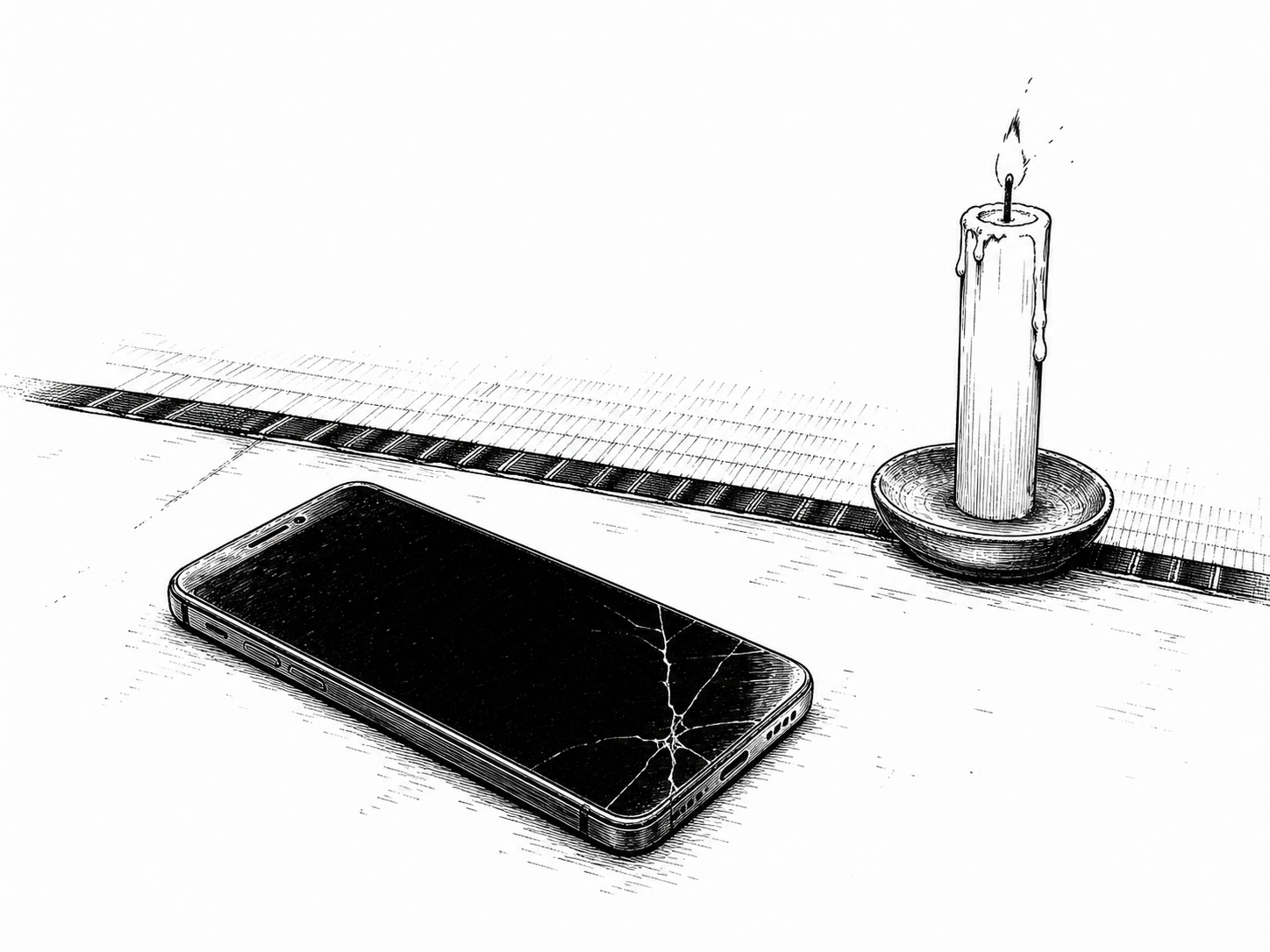
| Value After Silence | The dead screen is blacker and deeper than any mirror of this era — the onmyoji call it the "mirror that does not reflect" and shrink from looking into it. That the faces which could not return are sunk within that black glass, they know without knowing. If it endures a hundred years — the story of that mirror belongs to drifted relics. |
On music — double-edged. A saved song has no rule numbers — it returns neither Energy nor Wounds. But on the night of a rout, the night one buried someone, what a single track played low with the screen turned face-down does to the table is not the domain of numbers. Only remember — a sound from outside the era calls an ear from outside the era. If it sounded in an open place at midnight, the GM may roll the Firearms encounter-draw d10 when the scene ends — and at this time the yoma row (8 to 9) is read broadened to 6 to 9. Gunshot comes hearing the sound, but the song comes scenting the longing clinging to the sound.
#Auxiliary Battery (予備電池)
| Item | Value |
|---|---|
| Name | auxiliary battery (予備電池) |
| Category | electronics |
| Effect | Consume 1 at an interlude: recovers [Depletion] Clock 1 on 1 Clock-unit electronic device (up to the card's starting value). One of the two roads in this volume on which the Clock turns backward — the other is the solar charger. |
| [Depletion] | [Depletion 3·Clock] — three measures in a four-measure vessel. The regret of "I should have charged it to the end last night" is one measure. |
| Degradation Special | The 4 degradation stages are not applied — it only dwindles. Only, a single submersion silences it with no check. The count of water and electricity has no dice. |
| A Handful of Story | To whom shall the three measures of future be given — the party's radio, or my photo album? This little brick is the quietest ethical problem in this volume. |
| Value After Silence | A silver innard that an artisan cannot read even when opened — even after it has fallen silent it is listed in the Sakai Guild's appraisal catalog. With no one knowing what manner of thing it is for, only the price rises. |
#Solar Charger (太陽光充電器)
| Item | Value |
|---|---|
| Name | solar charger (太陽光充電器) |
| Category | electronics |
| Effect | Spread out a whole clear day under the sunlight (if moving, tie it to the backpack and the like, and a slow gait), and at that day's interlude it recovers [Depletion] Clock 1 on 1 Clock-unit device (up to the card's starting value). A cloudy day and a winter sun are 1 in two days (GM). A day is one mark of the dial — not complete freedom, but the recovery of a short right of use. |
| [Depletion] | none — this is not a remaining count but a spring. Only, a spring, in exchange for not drying up, wears down. |
| Degradation Special | Trigger: drop, scratch, submersion (submersion is harsh). Worn: charging becomes 1 in two days. On the Verge: 1 in three days, and that only on a clear day. Silence: a crack like a leaf-vein on the black plate — light goes in, but nothing comes out. |
| A Handful of Story | A thing that was in the disaster-preparedness bag, never once spread open. The thing one hoped most never to have to use — remains longest at one's side. |
| Value After Silence | The black plate that ate light when spread toward the sun — the villagers believed it to be a kind of sunflower, and that belief was accurate by as much as it was wrong. The artisan peers into the leaf-vein-patterned crack a lifetime. |
#Flashlight (懷中電燈)
The sample card of Law 4 of the Depletion System is this card — that is the original, and the reason it is carried again here is its proper place within the 03 series. The grammar of the count that darkness hangs on a check is seen in the Conditions List.
| Item | Value |
|---|---|
| Name | flashlight (懷中電燈) |
| Category | electronics |
| Effect | Secures sight in one's own zone and adjacent zones at night and in dark places (a superior version of a lamp). Ignores the check penalty due to darkness (one's own zone only). |
| [Depletion] | [Depletion 4·Clock] — lose 1 each time a scene spent with it switched on ends. |
| Degradation Special | Trigger: drop, submersion. The check is the base formula (2d10+Finesse+Disable). Worn: 1 time per scene, the GM can let the light go out for the span of 1 breath. |
| A Handful of Story | It was an object that lay in the emergency box beside the driver's seat of a night bus. Each time the switch is pressed, the terminus of that bus, which it never could reach, comes to mind. |
| Value After Silence | The lens and the mirror surface are precious material to an artisan — worth a handful of a prestige piece. If it endures a hundred years, a candidate for a tsukumogami that remembers light. |
#Portable Radio (携帶無電機)
| Item | Value |
|---|---|
| Name | portable radio (携帶無電機) |
| Category | electronics |
| Effect | Switched-on radios on the same channel converse instantly — information crosses over on the spot even between different zones, between different scenes. The audible distance is set by the terrain: about one ri (里) over open field and water, up to ten cho (町) within mountain, forest, valley, and village (Terms and Weights-and-Measures Dictionary) — the terrain of this country is the antenna's enemy, and the GM judges generously for the side standing on high ground. In combat it extends the audible distance of the squad command beyond the radio — the cost, count, and grammar of the command are the proper text as it is. Command issued from outside is a road that the proper-text Zone Gimmicks has already opened, and the radio only lends a voice to that road. |
| [Depletion] | [Depletion 6·Clock] — counted separately per unit. 1 each time a scene kept on (reception standby included) ends — it wears down even just listening, waiting too eats electricity. Operation that switches it on only at an appointed hour (刻) slows the Clock — in exchange a switched-off radio joins nothing. |
| Degradation Special | Trigger: drop, submersion (submersion is harsh). It dies separately per unit. Worn: a noise like seething sand — long speech is cut off. The transmission one can cross in a single scene is reduced to a handful (GM discretion), and the squad-command extension is lost. And the rule of the pair — if not a single radio remains to listen, the one unit that is left is as the silence from that day. Even with Clock remaining, it is not a card but a keepsake. |
| A Handful of Story | On its side a disaster-site call sign is taped on. Every sign that used to answer is four hundred years outside — and yet, as a habit, one comes to wait a beat before pressing the transmit button. |
| Value After Silence | "A voice-box that rides the wind" — it is appraised in a daimyo's treasury as a tool that commands a shikigami (式神). A wrong appraisal, but not wholly wrong. If it endures a hundred years — a candidate for a tsukumogami that remembers the voice beyond the noise. |
If only one. A radio is a radio from two units — what the one unit in the backpack of the disaster-dispatch Self-Defense Officer hears when switched on is only the noise that this era's empty sky gives off. But if on some night, among that noise, a human voice — in the tongue of this side — is caught, that is not a rule but a scenario. For the one hidden away from the same era is not one person alone.
#Digital Camera (寫眞機)
| Item | Value |
|---|---|
| Name | digital camera (寫眞機) |
| Category | electronics |
| Effect | Photo, video — the headquarters of the lens rule of Law 3. Optical zoom — draws in and views even beyond 2 zones: +1 on a perception or scouting check that examines a far zone, and what is seen remains as a record. Shooting during combat is Energy 1, the trembling hand is 2d10+Finesse+Perception >= 11 — fail, and it is a shaken photo. The flash in the dark is a gunshot of light — the infiltration and ambush of that scene are broken (applying article 1 of the Firearms gunshot rule — the encounter-draw is not rolled). |
| [Depletion] | [Depletion 8·Clock] — 1 each scene the power is on, no indulgence (Law 1). A battery that does only one thing lasts long. |
| Degradation Special | Trigger: drop, submersion (submersion is harsh). Worn: a fine crack on the lens — every photo turns blurry. The "sharp photo" of Law 3 can no longer be made — the machine is alive, but the evidence is dead. |
| A Handful of Story | It was the thing of someone who photographed birds. In the memory are four hundred shots of a kingfisher — and in the first shot taken after crossing over, something that is not a bird is in flight. |
| Value After Silence | The lens alone is worth ten Nanban mirrors. The photos sunk inside are shut closed beyond any ever drawing out — a black eye that does not return what it saw. There is a tale that an onmyoji pressed their palms together before it. |
#Wristwatch (腕時計)
| Item | Value |
|---|---|
| Name | wristwatch (腕時計) |
| Category | electronics |
| Effect | The one and only thing in this country that counts uniform time. This era counts time by the variable-hour system (不定時法), which lengthens and shortens with the season (Terms and Weights-and-Measures Dictionary) — this on the wrist alone keeps, by itself, a different count. In a scene where a coordinated action set to time (a simultaneous surprise attack, a rendezvous at a fork, a relieving watch) is the key, the GM may grant +1 to the relevant check — the rite of Kamikakushi setting their watches to one another is a small signature scene of this volume. |
| [Depletion] | none — the button battery is not counted by this volume's Clock. It lives in years. A day it stops does come someday, but that day is not a scenario but some quiet morning. |
| Degradation Special | Trigger: drop, submersion (submersion is harsh). Worn: it drifts off by a few minutes a day — loss of the coordination bonus. A watch worn without knowing it has drifted off is more dangerous than a watch that runs true. |
| A Handful of Story | It was a thing received as a gift for passing an exam. A wrist it was fastened on so as not to be late to an appointed time — yet now the appointments this watch knows are nowhere in the world. |
| Value After Silence | Even a stopped watch is right twice a day. The artisan who opened the back cover forgets his meals before the universe of gears, and the dream of the karakuri grows a hand-span. If it endures a hundred years — what counted time becomes what crosses time. |
#Law 3 — Yoma and the Lens (Variant)
This section is Variant — a variation rule premised on GM permission. It is this volume's signature rule, and it turns on one axis with the name theory of the Hyakki Denshoki.
#Can a Yoma Be Photographed — Its Rank (格) Decides
It can. Only, what is photographed is decided not by the shutter but by the subject's rank. It borrows, as they are, the proper-text grade grammar and fc08's classification axes.
| Subject | What Remains in the Photo |
|---|---|
| yoma of flesh and hide — those that have a body (most of the Mob, Minion, and Veteran grades — oni, kappa, tanuki…) | photographed. Just as it is seen — dark if in the dark, as much as the moonlight if under moonlight. An unmoving record that remains down to the number of fangs. |
those of the [Incorporeal] axis — vengeful spirits, dead spirits, living spirits, a body that is not a body | blurry. Only a sign instead of a form — a smear of light, a darkness emptied into a human shape, noise that swallowed half the screen. It becomes evidence that something was there, but cannot become evidence of what it was. |
| Elite and Lord grade — the upper ranks that have a name (whether they have a body or not) | blurry — even with a body. The rank presses the lens. The focus slips, the noise seethes, and in the worst case the power drops — the GM may declare the very attempt to photograph a breakdown trigger on the spot. |
Recording is the same grammar — the voice of the [Incorporeal] leaves only noise and breathing when played back. Do not treat a blurry photo meanly. As evidence it falls short, but as staging it overflows — a single darkness emptied into a human shape makes the table quieter than ten sharp fangs.
#To Photograph Is to Capture
A single sharp photo changes the investigation scene of this era. Eyewitness accounts waver and swell and contend with one another, but a photo does not contend.
- evidence — +2 on a non-combat check of information-gathering, testimony-collation, or persuading the commissioner directly connected to that yoma. 1 scenario per photo — the same grammar as the records of the Scholar Set, and the same limit. A photo is a thing — it is handed over, sold, taken away.
- first record — the weak-point grammar of the modern yoma writes "find the first poster, the first footage, the first victim, or the original place, and Domination -1 or defense -1." In this volume a sharp photo can stand in that seat of the first record — one who has fixed the true form of a ghost story into a single shot holds the first button to undoing that yoma. The GM opens the application.
#To Spread Is to Feed
But fc08's name theory is two-sided — lose the name and weaken, spread the name and strengthen. The moment a photo leaves the hands of the party and the commission's parties and spreads — the moment it is shown around the market with questions, a painter copies and draws it, and that picture is posted up as a placard (榜) — what spreads is not a warning but the name and form.
- The GM can attach to that yoma the reinforcement background named yoma (Domination +1 in a region where the name has spread) or ghost-story proliferation (re-appearance the more the rumor spreads).
- And the law of transmission follows — just as the common rule of the modern yoma has it, the one who saw can become the next eyewitness. Only the medium has changed from screen to mouth and picture; the law is the same. When eyewitness accounts begin to increase in a village where the photo has gone around — that is no coincidence.
Open wanted-posting, or secret investigation? To put this fork into the PL's hand is the purpose of this rule. To find it fast you must spread it, and spread it and the enemy grows — the shutter is free, but the printing is on credit.
#The Yoma Knows
A photographed yoma — the more it has the axis of name and taboo — knows that its own form has been fixed within the black tablet. To those that live by eating names, a photo is a stolen name. Some come to take it back. Some, wishing their own form to spread further, deliberately walk before the lens — which of the two applies is decided by what that yoma eats (What Is a Yoma). And remember — the pursuit follows not the hand that photographed but the breast that holds it. To sell off the device with the photo in it is to sell off the pursuit.
The Hyakki Denshoki wrote of the yoma that are born being saved and copied and searched — it is a book of the age in which the record gives birth to the yoma. This section is its mirror-image — the age in which the record captures the yoma. Only, that from the same lens come both the record that captures and the record that feeds — that alone is the same in the two ages.
#Operation — When the Lens Is Put on the Table (Scene Tool)
Only this item is a Scene Tool — not a rule but a knob in the GM's hand.
- A photo is a door, not a foot. Evidence +2 is not a ticket that skips the investigation scene but a card that opens the closed mouth. The eyewitness must still be sought out, and the mountain road must still be walked.
- Make the decisive single shot be traded against the remaining count. When a single shot in the dark is worth one mark of the Clock, the shutter carries weight. The moment "shall I shoot" becomes a torment, this rule has done its whole job.
- Do not forget the eye of this era. Half of those who see a photo for the first time fear the photo more than the yoma — the rumor of the "mirror that copies away the soul" walks faster than the party, and the appraiser of the Onmyoryo comes to buy that tablet, or to confiscate it. The lens does not call only the yoma.
Four marks of the dial. Home now dwells there — once for each switching-on, the face that draws near and the future that dwindles surface on the same screen.