#Shrine Priests and Miko — Those Who Prevent in Advance
Contents
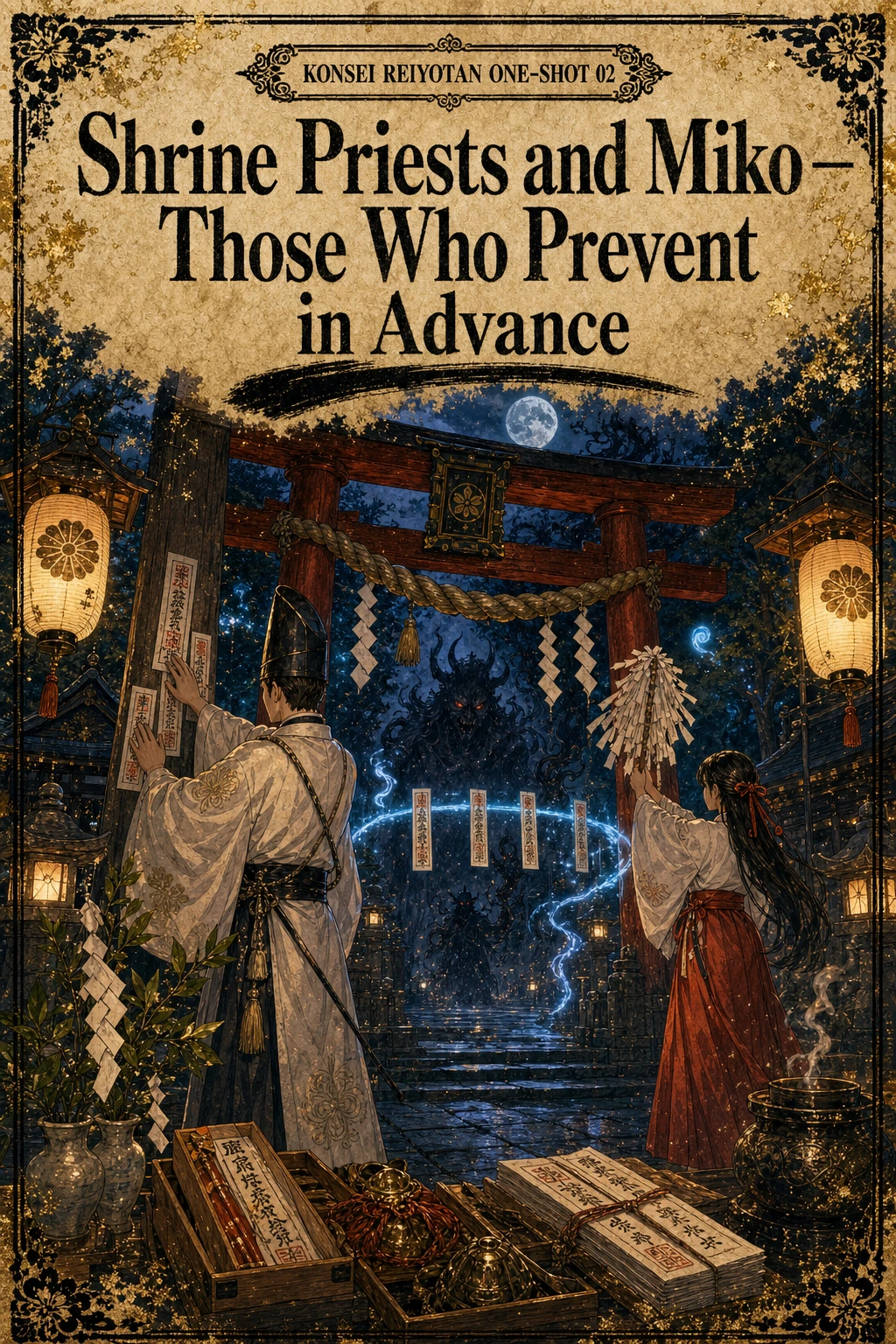
Scope declaration / opt-in. This issue is a meta article that carries both design commentary (Commentary) and opt-in data (Data / Rule). The new class "Shrine Keeper" this issue adds, along with its arts, is a Variant under
co-99-01— valid only when a table adopts it and the GM approves; before adoption it does not affect theco/ex/fcbaseline. Attributes, skills, the check formula, proficiency, and the Three Ways and Six Hearts all follow canonicalcoexactly as is. Character and atmosphere narration (Scent) is Fiction-Only.
#Brief — What This Issue Is
In Sengoku-period Japan, a shrine (神社) had shrine priests (神官) and miko (巫女). People who offered rites to the kami (神), washed away defilement (穢れ), danced the kagura (神楽) to serve the gods, and divined a village's fortunes. People who kept the spiritual order of the village.
Yet the Konsei Reiyotan class list has neither shrine priest nor miko. There are the onmyoji, esoteric monk, Pure Land Monk, shugenja, feng shui master, and arahitogami — so why, of all things, are the shrine's priests and miko not a separate class?
This issue answers that question, along three threads:
- What they are — what kind of beings the Shinto shrine priests and miko are. Their offices, the kagura, and the spiritual meaning that shrines and Barriers hold in this world. (
01) - Why they are not in the core — shrine priests and miko are a local standing attached to a shrine, not a battlefield role. So they are already realized through a combination build mixing the onmyoji, Pure Land Monk, arahitogami, feng shui master, scholar, and entertainer. Here are those recipes. (
02) - If you still want it — opt-in class data for tables that want a true single class, "Shrine Keeper." (
03)
#Commentary — The One-Line Thesis
"Shrine priests and miko are a standing defined not by 'what they do' but by 'where they belong.' That is why Konsei Reiyotan treats them not as a class but as a build — and the core of that build is always 'preventing in advance.'"
A blessing prevents a Curse in advance, a Barrier prevents harm in advance, and a Prophecy sees danger in advance. The mystery of shrine priests and miko lies not in cleanup after the fact but in preemptive warding (先制防護). The new class in 03 is precisely this one line translated into mechanics.
#Meta Card
| Item | Value |
|---|---|
| Series | zn (one-shot series) Issue 02 |
| Title | Shrine Priests and Miko — Those Who Prevent in Advance |
| Nature | meta/commentary one-shot — design column + build cookbook + opt-in new class |
| Volume | 4 documents (front + intro + builds + class data) · reading time about 16 minutes |
| Blocks | Brief · Scent · Commentary · Table · Data · Rule · Example · Note |
| Authority | opt-in (Variant) — GM approval recommended for the new class |
| Dependencies | co references (class list · mystic skills · Faith · Three Ways and Six Hearts) |
| Main-book version requirement | co >= 1.2 |
| Current version | v1.5 (zn02-VERSION) |
#Contents
| Document | Type | Content |
|---|---|---|
01 What They Are | Brief · Scent · Table | The offices of shrine priests and miko, the kagura, the spiritual meaning of shrines and Barriers |
02 Build Cookbook | Commentary · Table · Example | Why they are not in the core + 5 existing-class combination recipes + a worked example |
03 Class Data | Data · Rule · Note | The opt-in new class "Shrine Keeper" full stat block + GM notes |
99 Closing Fiction | Scent | "The Night Nothing Happened" — one evening when a young miko who reties the Barrier every day quietly warded off, in advance, a traveler who came bearing death |
Reading order: front → 01 → 02 → 03. If "a combination is enough" you may stop at 02, and if "you want a single class" you go to 03.
Closing fiction. At the end of this issue is "The Night Nothing Happened" (a pure Scent story) —
99.
#Production Notice
This issue is Issue 2 of the Konsei Reiyotan zn (one-shot) series. The Shinto offices and rites are based on actual history, but the game effects of Barriers and purification and the contact with the Spirit Realm (霊界) are fiction of this setting. The new class was designed atop canonical co's 6 attributes, 36 skills, check formula, and Three Ways and Six Hearts, and was limited to the preemptive-warding niche so that its role does not overlap with the existing Pure Land Monk, onmyoji, and arahitogami.
#AI Use Notice
A considerable part of this material was produced with the help of generative AI (LLM) in the planning, drafting, prose cleanup, and proofreading processes. The image generation process used the GPT Image 2 model. The Japanese and English translations used Claude Code and Codex. Final editing and the responsibility for publication rest with the creator.
If there are changes in domestic or foreign law regarding AI-assisted works, those laws are followed.
#Scent — One Sentence
"A good shrine priest does not cut down a yoma — before the yoma arrives, the gate is already closed."