#What They Are — Those Who Stand at the Shrine
Contents
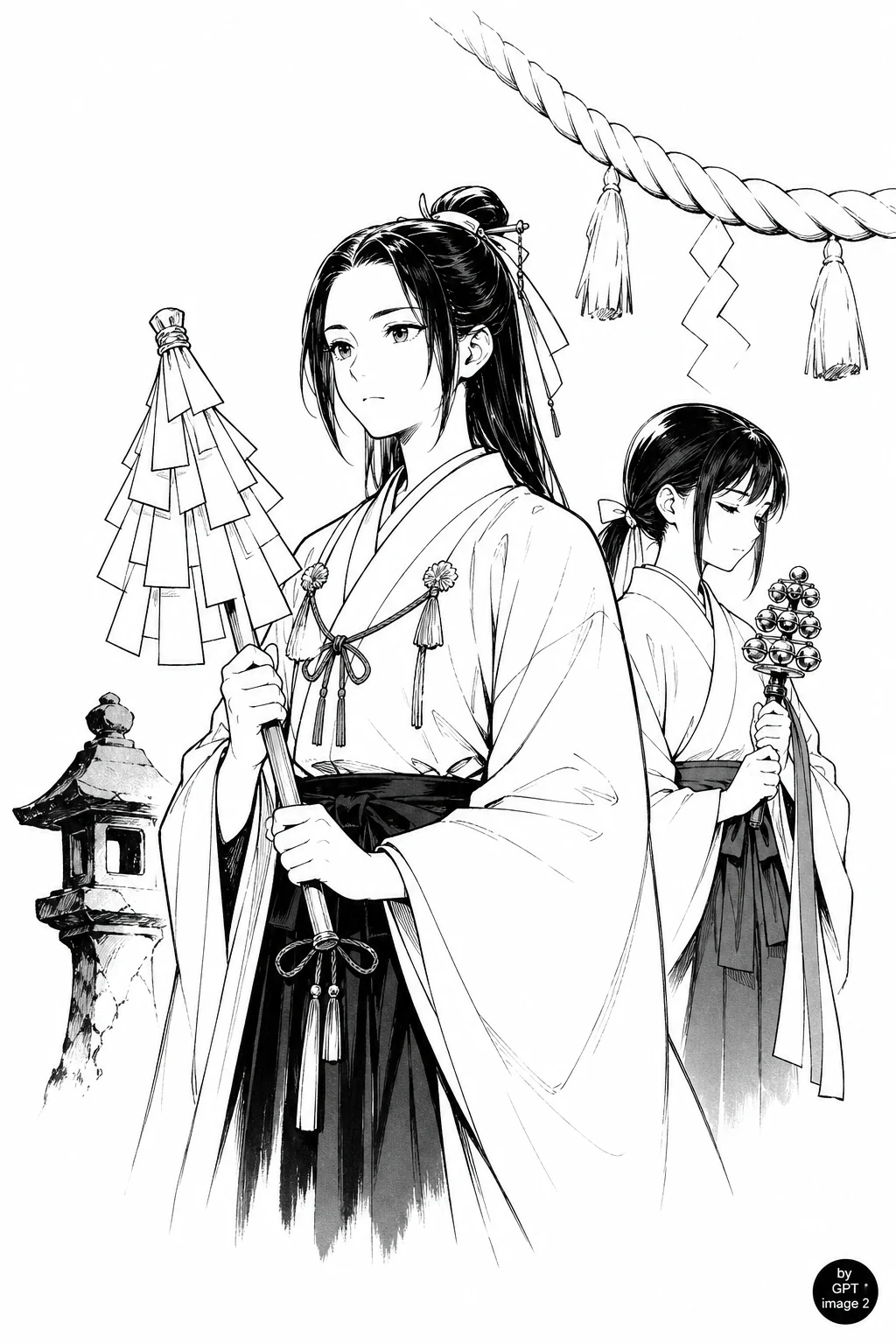
This document belongs to the front. The office descriptions follow real history; the spiritual effects of Barriers and defilement follow the main-volume view of faith. The Scent (香) is Fiction-Only.
#Brief — The People of the Shrine
Shinto (神道) has no founder, no scripture, no single doctrine. What it has is only the kami (神) and the seat that serves the kami. A mountain, a rock, a waterfall, an old tree is a kami. And between that kami and humans stand two kinds of people.
The shrine priest (神官) is a standing office. Attached to a shrine, the priest presides over rites, manages votive offerings, and conducts the harae (祓い) that washes away defilement. At a large shrine, titles and ranks attach according to scale and era — guji (宮司, head of the shrine), negi (禰宜, assistant), hafuri (祝, ritual duties) — and in the provinces households often hold the post for generations. Their authority comes from bloodline, office, and formality. In essence, they are people of Wisdom (智) — they know the rites, know the taboos, know the boundary.
The miko (巫女) has different roots. Originally the miko was a vessel into which the kami descends — a shaman who conveyed the god's words through kamigakari. As the ages passed, many miko settled into duties assisting priests and dancing kagura (神楽), yet in their blood the power to call the gods and soothe the spirits still remains. They are people of Presence (美) — they move the unseen with dance, bells, and voice. The "Miko's Dance" of the entertainer class reaches back to exactly this bloodline.
The shrine priest and the miko do not oppose each other. They are the two hands of one shrine. One hand sets order (Barrier, rite), the other soothes spirits (kagura, requiem). That is why this issue's new class binds the two as two faces of one profession.
#Table — Offices and Roles
| Office | Kanji | Track | Core Duties | Check Axis |
|---|---|---|---|---|
| guji / negi | 宮司・禰宜 | priest | shrine operation, conducting the grand festival (大祭), formality | Wisdom (智) + Negotiation, Culture |
| hafuri | 祝 | priest | harae (purification), votive offering, Barrier maintenance | Wisdom (智) + [Barrier], [Exorcism] |
| miko | 巫女 | miko | kagura offering, oracle, washing away defilement | Presence (美) + [Bearing], [Prophecy] |
| kamigakari miko | 神懸かり | miko | spirit descent, a medium close to kuchiyose | Presence (美) + Sorcery (in Konsei Reiyotan, the boundary touches that of the villain itako) |
| saigu / itsukime | 斎宮・斎女 | miko | high-ranking ritual women dedicated by the royal house or powerful households. The saigu in particular is an institution at the rank of princess or imperial princess | Presence (美) / Wisdom (智) |
The bracketed skills (e.g.
[Barrier]) are the Barrier, Exorcism, Prophecy, and Sorcery of the canonical 36 skills (co-04-09-01). Shrine priests and miko are people who use these skills, not a new skill system in themselves.
#Scent — Hearsay: The Shrine at Dusk
Editor's note: a tale heard from an old miko at a provincial shrine.
At the edge of the village, deep inside a cedar forest, there is a small shrine. Every day at dusk the miko walks once around its perimeter. With a broom she sweeps the fallen leaves, re-ties the slackened, disarrayed strands of the shimenawa (sacred rope), and scatters salt at the four corners. People call it cleaning — but the miko knows. It is the work of tying the Barrier anew.
"Defilement (穢れ) does not come with a loud noise," the old miko said. "When one who has seen death enters the village without purifying, it slips in clinging to that person's shadow. A wounded heart, an unresolved grudge (恨), a corpse buried wrong — when such things pile up, one night the shrine's sacred rope snaps of its own accord. And on that day, something walks out of the forest."
So the miko circles the perimeter before something comes out. On a night when she dances kagura, that dance is not a spectacle — it is a plea to call the kami and keep the gate shut for one more night. "What we do is not slaying yoma," she said. As she shook the bells, a clear sound spread through the gloaming. "If the time to slay them ever comes, we have already lost."
The official shrine clergy under the Kagura Domain (神樂藩) do this work on the scale of a nation. The Barriers of a domain that raises the cause of Exorcism, the defilement of the capital, the votive offerings of great shrines — they are the hands that bind those great sanctuaries. And when that work enters one person's body too deeply, sometimes that person becomes an arahitogami (現人神). The vessel that served the god becomes the god itself.
#Therefore — Two Branching Questions
Once you know the shrine priests and miko, two questions naturally remain.
- "Then how do I make a shrine priest or miko with the current rules?" →
02 Build Cookbook - "Why not just have a 'shrine priest / miko' profession slot?" →
03 Class Data